2011 AUDI A5 COUPE roof
[x] Cancel search: roofPage 199 of 362

_______________________________________________ A_ ir_ b_ a_,,,g '--- s.:.y _s _t_ e _ m ___ ffl'II
& WARNING (co ntinued )
• The inflating airbag will hit the child safety seat or infant
carrier with great force and will smash the child safety seat and
c hild against the backrest, center arm rest , door, or roof .
• Always install rearwa rd-facing child restraints in the back seat.
• If you must install a rearward facing child safety seat on the
front passenger seat because of except ional circumstances and
the PASSENGER AIR BAG OFF light does not come on and stay on ,
immediately install the rear-facing child safety seat in a rear
seating position and have the airbag system inspected by your
authorized Audi dealer.
& WARNING
If, in except ional circumstances, you must install a forward-facing
child re straint on the front pa ssenger's seat:
• Always make sure the forward-facing seat has been designed
and certified by its manufacturer for us e on a front seat with a
passenger front and s ide airbag.
• Never put the forward-facing child restraint up again st or very
near the instrument panel.
• Always move the passenger seat into its rearmost position
in
the seat's fore and aft adjustment range, as far away from the
airbag a s po ssible, before installing the forward-facing child
restraint. The backrest must be adjusted to an upr ight position.
• Make sure that the PASSENGER AIR BAG OFF light comes on
and stays on all the time whenever the ignition is switched on .•
Advanced Airbag System components
Th e front passenger seat i n your ve hicle has a lot of very im portant
parts o f th e Ad van ced A irbag System in it. These parts include t he
we ight-sens ing mat, sensors, wir ing, brackets, and mo re . The func-
Controls and equip
ment Safety first Vehicle operation
tion of the system
in the front passenger seat is checked by the elec
t ronic contro l unit whe n t he ignit io n is on. The con tro l u nit mon itors
t he Advanced A irbag System and tu rns th e airbag indicator light on
when a malfunction in the system components is detected. The func
tion of the a irbag indicator light is descr ibed in greater deta il below.
Beca use the front passen ger seat contains importa nt parts of the
Advance d Ai rbag System, you mus t take care to p revent i t fro m be ing
dama ged. Damage to the seat may prevent t he Advance d Airbag for
t he front p assenge r seat fro m d oin g its job in a cra sh.
The front Advanced Airbag System consists of the
following:
• Cras h sensors in the front of the vehicle t hat measure vehicle
acc ele ra tio n/d ecele ration to prov ide info rmat io n t o the Adva nced
Airbag System about t he severity of the crash.
• An elec tron ic con tro l unit, w it h i nteg rated crash senso rs fo r front
and side impacts . The contro l unit " dec ides" w het her to fire the front
a irbag s base d on th e informa tion re ceived from t he cr ash sensors.
The control unit also "decides" whether the safety be lt pretens ioners
s ho uld b e activa ted.
• An Advanced Airbag with gas generator and cont rol va lve for the
dr ive r inside t he st eer ing whee l hub .
• An Advanced Air ba g with gas gene rator and control valve inside
t he inst rume nt pan el for the front pass enger.
• A weig ht-sensing mat unde r the upholste ry paddin g of the front
passenger seat c ushi on that measures the tota l weigh t on the seat .
T he information registe red is se nt co ntin u ously to the electronic
cont rol uni t t o reg ulate deployment of t he front Advanc ed A irbag o n
the passenger side .
• An a irbag mon itoring system and ind icator light in the inst rume nt
cluster =>
page 201.
• A sensor in each fro nt seat reg isters the distance between t he
res pective seat and the s teer ing whee l o r i nst rume nt pane l. The
information reg iste red is sent co ntin uously to the e lectro nic cont rol
uni t to reg ulate dep loyment o f the front Advanced Airbags . .,_
Vehicle care Do-it-yourself service Technical data
Page 202 of 362

-L___:_A~ i r'....: b~ a ::::: gL:: s~y -=s ::..:t :.:e :..: m..:..:.. ______________________________________________ _
lower parts of the body. Front airbags only supplement the three
point s afety be lts i n some fro ntal c ollisions in which t he vehicle de ce l
eratio n is h igh enough to dep loy the a irbags.
Front airbags will not deploy:
• if the ignition is sw itched off when a cras h occu rs,
• in s ide collisions,
• in rea r-end collisions,
• in rollovers,
• when the cras h deceleration me asured by the ai rbag syste m is less
than t he m in imum threshold needed for airbag dep loyment as regis
t ere d by the e lectro nic cont rol unit.
The front passenger airbag will also not deploy:
• when the fron t pa sse nger sea t is not o ccupied,
• when the we ight on the front passenge r seat as sense d by the
Advanced Airbag Sys tem in dicates t hat the front airbag on the
passenger side has to be turned off by t he e lectron ic control un it (the
PASSENGER AIR BAG OFF light comes on and st ay s on).
& WARNING
Sitt ing in the wrong posit ion can increa se the risk of serious injury
in crashes .
• To reduce the risk of injury when the airbags inflate , the driver
and passengers must always sit in an upright position , must not
lean against or place any part of their body too close to the ar ea
where the airbags are located.
• Occupants who are unbelted, out of position or too close to the
airbag can be ser iously injured by an airbag as it unfolds with
great force in the blink of an eye=>
page 192.
& WARNING
A child in a rearward-facing ch ild safety seat installed on the front
pa ssenger seat will be seriou sly injured and can be killed if the
front airbag inflates -even with an Advanced Airbag System.
• The inflating airbag will hit the child safety seat or infant
carrier with great force and will smash the child safety seat and
child against the backrest, center armrest , door or roof.
• Always install rear-f acing child safety seats on the rear seat.
• If you must install a rearward facing child safety seat on the
front p assenger seat because of e xceptional circumstances and
the PASSENGER AIR BAG OFF light does not come on and stay on,
i mmediately install the rear-facing child safety seat in a rear
seating position and have the airbag system inspected by your
authorized Audi dealer.
& WARNING
Objects between you and the airb ag wilt increase the risk of injury
in a crash by interfering with the way the airbag unfolds or by
being pushed into you as the airbag inflates.
• N ever hold things in your hands or on your lap when the vehicle
is in use.
• Never tran sport items on or in the area of the front passenger
seat . Object s could move into the area of the front airbag s during
brak ing or other sudden maneuver and become dangerous projec
tiles that can cause serious personal injury if the airbags inflate.
• Never place or attach accessories or other objects (such as
cupholders , telephone bra ckets , large, heavy o r bulky objects) on
the doors, over or near the area marked "AIRBAG " on the steering
wheel, instrument panel , seat backrests or between those areas
and yourself . The se obj ect s could cause injury in a crash , especially
when the airbags inflate .
• Never recl ine the front passenger's seat to transport objects.
Items can also move into the area of the side airbag or the front ..,
Page 214 of 362

-Airbag system -
--=---=----------------
Side curtain airbags
Description of side curtain airbags
The side curtain airbag system can provide supplemental
protection to properly restrained occupants .
Fig . 18 5 Side c urta in
sys tem, drive r's side:
s ide cu rtain ai rba g
loc atio n
The side curtain airbags are located on both sides of the interio r
above the front and rear side windows=> fig. 185. They are identified
by t he word "AIRBAG" on the w indshield frame and t he center roof
pillar.
T he side curta in airbag system s upplements t he safety belts and can
help to reduce the risk of inju ry for occupa nts' heads a nd upper torso
on t he side of the vehicle th at is struck i n a sid e collision . The s ide
cu rtain airbag inflates i n side im pacts and o nly when the vehicle
acceleration reg istered by the contro l unit is high enoug h. If this rate
is below the reference va lue programmed into the cont rol unit, the
side airbags wi ll not be triggere d, even though t he car may be bad ly
damaged as a resul t of the co llis ion .
It is not possib le to define an
airbag triggering range that w ill cover every possible angle of impact,
s in ce the circumstance s will vary conside rably between one colli sion
and another. Important factors include, for example, the nature
(h ard o r soft) of t he impa cti ng obje ct, t he a ngle of impa ct, vehicle
speed, etc.=>
page 213, "H ow side curta in airbags work" . Aside from the
ir normal safety fu nction, safety belts work to he lp
keep the driver or fron t passen ger in posit io n in t he even t of a co lli
sion so that the s ide cu rta in a irbags can provide protection .
T he airbag system is not a substitute for your safety belt . Rathe r, it is
pa rt of the ove rall oc cupant rest ra int system in your veh icle. Alway s
remember that the airbag system can on ly help to protect you if yo u
a re wear ing you r safety be lt and we aring it p ro perly. Thi s is anothe r
reason why you s hou ld always wear your safety be lts, not just because
t he law requi res you to do so=>
page 181, "Gene ral no tes" .
It is important to remember that while the s ide curta in airbag system
is designed to he lp reduce the like lihood of ser io us injur ies, other
in ju ries, fo r example, swe lling, br uis ing, and minor abras ions can
also be assoc iate d with these airbags. Remember too, these a irbags
w ill deploy on ly on ce a nd on ly in ce rtain kinds of acci den ts -yo ur
safety belts are always there to offer p rotect ion .
The side curtain airbag system basically consists of:
• T he electron ic control mo dule and e xternal side impact sensors
• The sid e curtain airbags above the front and rea r side windows
• Th e air bag indic ator ligh t in the ins tru men t panel
T he a irbag system is mo nitored e lectro nica lly to make certain it is
functioning prope rly at a ll times . Each time you turn on t he ignitio n,
t he a irbag system indica to r light w ill come on for a few secon ds (self
diagnostics) .
The side curtain airbag is not activated:
• if the ignition is turned of f,
• in side co llisions when the accelerat io n measured by the sensor is
t oo low,
• in rear-end co llisions ,
• in rollovers. _,.
Page 221 of 362

___________________________________________ C_ h_il _d _ S_a _f _e _t ~y __ _
- If a stra p or tet her is be ing us ed to tie t he chil d safety seat
to t he fro nt passenger seat, make sure that it is no t so
tight that i t causes the weight-sens ing ma t to measure
more weight t han is act ually on the seat.
Alw ays reme mbe r: Even though yo ur vehicle is equip ped with an
Adva nced Airbag system, all ch ild ren, especially those 12 years a nd
younger, should a lways ride in the bac k seat proper ly rest ra ined for
their age and size .
& WARNING
Not using a child safety seat, us ing the wrong child safety seat or
improperly in stalling a child re straint in crea se s the ri sk of serious
personal injury and death .
• All vehicle oc cupants and e specially children mu st always be
restrained properly whenever riding in a vehicle.
- An unrestrained or improperly restrained child can be injured or killed by being thrown against the inside of the
vehicle or by being ejected from it during a sudden maneuver
or impact .
- An unre strained or improperly restrained child is at much
greater risk of injury or death by being struck by an inflating
airbag .
• Commercially a vailable child safety seats are requi red to
c omply with U .S. Federal Motor Vehicle Safety Standard (FMVSS )
213 (in Canada CMVSS 213 ).
- When buying a child restraint, select one that fits your child
and the vehicle.
- Only u se child restraint sy stem s that fully contact the flat
portion of the seat cushion . The child rest raint must not tip or
lean to either side . Audi does not recommend using child
s a fety seats that rest on legs or tube-like frames. They do not
provide adequate contact with the seat .
Controls and equip ment Safety first Vehicle operation
& WARNING
(co ntinued )
-Always heed all legal requirements pe rtaining to the in stal
lation and use of child safety seat s and carefully follow the
inst ructions provided by the manufacturer of the seat you are
using.
• Never allow children under 57 inche s (1.45 meter s) to wear a
normal safety belt . They must always be restrained by a prop er
child restraint system . Otherwise , they could sustain injuries to
the abdomen and neck areas during sudden braking maneuvers or accidents.
• Never let more than one child occupy a child safety seat.
• Never let babies or olde r children ride in a vehicle while sitting
on the lap of another passenger.
-Holding a child in your arms is never a sub stitute for a child
restraint system .
- The stronge st p ers on could not hold the child with the force s
that e xist in an accident . The child will strike the interio r of the
v ehicle and can also be struck by the pa ssenger.
- The child and the passenger can also injure each other in an
accident.
• Never install rearward-facing child safety seats or infant
c arrier s on the front pas senger seat. A child will be seriously
injured and can be killed when the passenger airbag inflates- even
with an Advanced Airbag Sy stem.
- The inflating airbag will hit the child safety seat or infant
c arrier with great force and will smash the child safety seat and
child against the backrest, door or roof .
- Alway s in stall rearward -facing child safety seats or infant
carriers on the rear seat.
• Forward-facing child safety seats installed on th e front
passenger 's seat can interfere w ith the airbag when it inflates and
c ause seriou s injury to the child . Always install forward-facing
c hild safet y seats on the rear seat . .,
Vehicle care Do-it-yourself service Technical data
Page 223 of 362

Child safety seats
Infant seats
Babies and inf ants up to abo ut one ye ar o ld and 2 0 lbs.
or
9 kg nee d s pec ial rea rwa rd -fac ing ch ild restraints tha t
s upport th e back, nec k and head in a crash.
F ig. 187 Schem atic
overview : re arwa rd
facing infa nt seat,
properly install ed on
the rea r seat
- Whe n u sin g the veh icle sa fety bel t to insta ll a child s afety
s e at, you mu st first acti vate the converti ble lo cking
ret ractor on th e saf ety belt to preven t th e chi ld safet y seat
fro m moving==>
page 2 25 or install t he seat usi ng t he
LAT CH attach ments .
- Pus h the child sa fety s eat d own with y our fu ll weight to
g et t he sa fety be lt really tig ht so t hat th e sea t c an not
mov e fo rwar d or sid eways mor e t han one in ch ( 2.5 cm) .
Infa nts up t o ab out one yea r (2 0 lb s. or 9 kg) are best protec ted in
special infant carr iers a nd ch ild safety seats desig ned fo r th eir age
g roup. Many e xperts believe t hat infa nts and sm all c hildr en sho uld
r ide on ly in spec ia l re stra in ts i n w hic h the child faces th e back of the
v ehicle . T hese i nfant seats support t he baby's back, neck and head in
a crash=>
page 221 , fig. 18 7.
Safety first Vehicle OP-eration
Child Safety
The airbag on the passenger side makes the fro nt seat a potentially
d ange rous place for a child to rid e. Th e front seat is not the safest
place for a ch ild in a forwa rd-faci ng child seat . It is a very da ngerous
place for an infant o r a larger child in a rearward-fac ing seat .
& WARNING
Not using a child safety seat, u sing the wrong child safety seat or
improperly installing a child restraint increases the risk of serious
personal injury and death in a cra sh .
• Never install rearward- facing child safety seats or infant
c arriers on the front passenger seat · even with an Advanced
Airbag System . A child will be seriously injured and can be killed
when the inflating airbag hits the child safety seat or infant carrier
with great force and smashes the child safety seat and child against the backrest, center armrest , door or roof=>
page 192,
"Child restraints on the front seat -some important things to
know".
• Always install rearward-facing child safety seats or infant
carriers on the rear seat .
• Never install a rearward-facing child restraint in the forward·
facing direction . Such restraints are designed for the special needs
of infants and very small children and cannot protect them prop·
erly if the seat is forward-facing .
• If you must install a rearward facing child safety seat on the
front passenger seat becau se of exceptional circumstances and
the PASSENGER AIR BAG
OFF light does not come on and stay on,
immediately install the rearward-facing child safety seat in a rear
seating position and have the airbag system inspected by your
authorized Audi dealer.
• Always read and heed all WARNINGS whenever using a child
restrained in a vehicle is being used=>
page 181, "Safety belts ",
=> page 190, "Airbag system " and => page 215, "Important
things to know". •
Vehicle care Do-it-yourselt service iTechnical data
Page 224 of 362
-Child Safety Pll:f __ .,.___ ____________ _
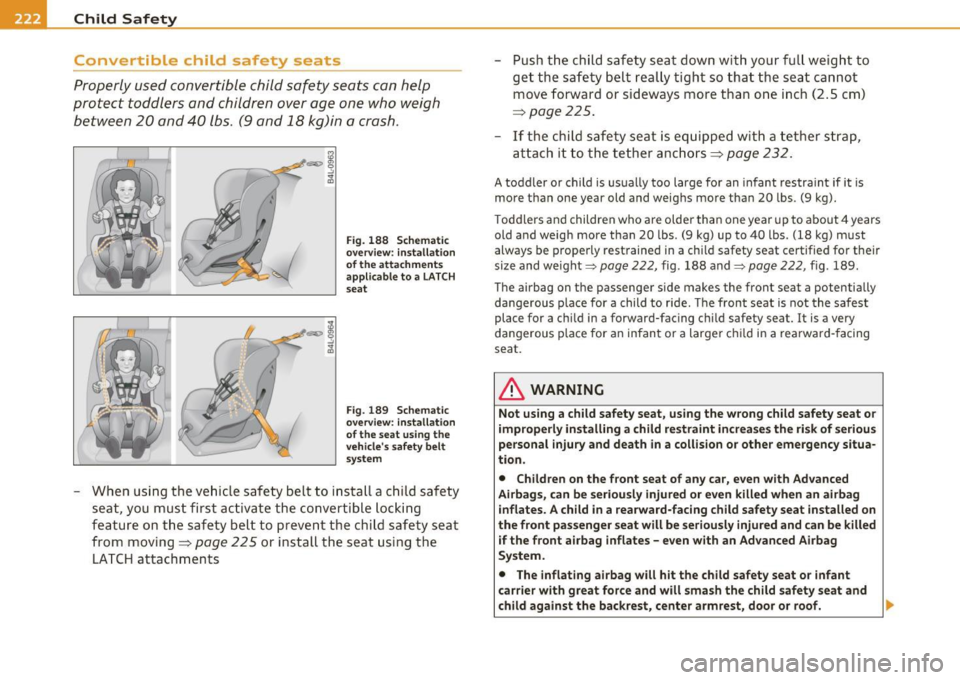
Convertible child safety seats
Properly used convertible child safety seats can help
protect toddlers and children over age one who weigh between 20 and 40 lbs. (9 and 18 kg)in a crash.
Fig. 188 Schematic
overview: installation
of the attachments
applicable to a LATCH
seat
Fig. 189 Schematic
overview: installation
of the seat using the
vehicle's safety belt
system
- When using the vehicle safety belt to install a child safety
seat, you must first activate the convertible locking
feature on the safety belt to prevent the child safety seat
from moving=>
page 225 or install the seat using the
LATCH attachments - Push the child safety seat down with your full weight to
get the safety belt really tight so that the seat cannot
move forward or sideways more than one inch (2.5 cm)
=>
page 225.
- If the child safety seat is equipped with a tether strap,
attach it to the tether anchors =>
page 232.
A toddler or child is usually too large for an infant restraint if it is
more than one year old and weighs more than 20 lbs . (9 kg).
Toddlers and children who are older than one year up to about 4 years
old and weigh more than 20 lbs. (9 kg) up to 40 lbs. (18 kg) must
always be properly restrained in a child safety seat certified for their
size and weight=>
page 222, fig. 188 and=> page 222, fig. 189.
The airbag on the passenger side makes the front seat a potentially dangerous place for a child to ride. The front seat is not the safest
place for a child in a forward-facing child safety seat. It is a very
dangerous place for an infant or a larger child in a rearward-facing
sea t.
& WARNING
Not using a child safety seat, using the wrong child safety seat or
improperly installing a child restraint increases the risk of serious
personal injury and death in a collision or other emergency situa
tion.
• Children on the front seat of any car, even with Advanced
Airbags, can be seriously injured or even killed when an airbag
inflates. A child in a rearward-facing child safety seat installed on
the front passenger seat will be seriously injured and can be killed
if the front airbag inflates -even with an Advanced Airbag
System.
• The inflating airbag will hit the child safety seat or infant
carrier with great force and will smash the child safety seat and
child against the backrest, center armrest, door or roof. ..,
Page 228 of 362

•L_---=C:..:h..:.. i:..: l .=d ~S=-= a..:..f .= e ~ty ~ --------------------------------------------
& WARNING (cont inued)
• Always buckle the child safety seat firmly in place even if a
child is not sitting in it. A loose child safety seat can fly around
during a sudden stop or in a collision.
• Always make sure that the rear seat backrest to which the
center rear safety belt is attached is securely latched whenever the
rear center safety belt is being used to secure a child restraint.
• If the backrest is not securely latched, the child and the child restraint will be thrown forward together with the backrest and
will strike parts of the vehicle interior. The child can be seriously
injured or killed.
• Never install rearward-facing child safety seats or infant
carriers on the front passenger seat. A child will be seriously injured and can be killed when the passenger airbag inflates .
• The inflating airbag will hit the child safety seat or infant
carrier with great force and will smash the child safety seat and
child against the backrest, center armrest , door or roof.
• Always install rearward-facing child safety seats or infant
carriers on the rear seat.
• Forward-facing child safety seats or infant carriers installed on
the front passenger's seat may interfere with the deployment of
the airbag and cause serious injury to the child.
• It is safer to install a forward-facing child safety seat on the
rear seat.
• Always read and heed all WARNINGS whenever using a child
restrained in a vehicle is being used=>
page 215. Special precau
tions apply when installing a child safety seat on the front
passenger seat=>
page 192, "Child restraints on the front seat -
some important things to know".
& WARNING
Always take special precautions if you must install a forward or
rearward-facing child restraint on the front passenger's seat in
exceptional situations :
• Whenever a forward or rearward-facing child restraint is
installed on the front passenger seat, the PASSENGER AIR BAG
OFF light must come on and stay on whenever the ignition is
switched on.
• If the PASSENGER AIR BAG OFF light does not come on and
stay on, perform the checks described =>
page 201, "Monitoring
the Advanced Airbag System".
• Take the child restraint off the front passenger seat and install
it properly at one of the rear seat positions if the PASSENGER AIR
BAG OFF light does not stay on whenever the ignition is switched
on .
• Improper installation of child restraints can reduce their effec
tiveness or even prevent them from providing any protection.
• An improperly installed child restraint can interfere with the
airbag as it deploys and seriously injure or even kill the child.
• Always carefully follow the manufacturer 's instructions
provided with the child safety seat or carrier.
• Never place additional items on the seat that can increase the
total weight registered by the weight-sensing mat and can cause
injury in a crash .
& WARNING
Forward-facing child restraints:
• Always make sure the forward-facing seat has been designed
and certified by its manufacturer for use on a front seat with a
passenger front and side airbag .
• Never put the forward-facing child restraint up, against or very
near the instrument panel. .,_
Page 229 of 362

Child Safety --------------------"'----
& WARNING (continued)
• Always move the passenger seat into its rearmost position in
the seat's fore and aft adjustment range, as far away from the airbag as possible before installing the forward-facing child
restraint. The backrest must be adjusted to an upright position.
• Make sure that the PASSENGER AIR BAG OFF light comes on
and stays on all the time whenever the ignition is switched on.
& WARNING
Rearward-facing child restraints:
• A child in a rearward-facing child safety seat installed on the
front passenger seat will be seriously injured and can be killed if
the front airbag inflates -even with an Advanced Airbag System.
• The inflating airbag will hit the child safety seat or infant
carrier with great force and will smash the child safety seat and
child against the backrest, center armrest, door or roof.
• Always be especially careful if you must install a rearward
facing child safety seat on the front passenger seat in exceptional
circumstances.
• A tight tether strap on a rearward-facing child restraint
attached to the front passenger seat can put too much pressure on
the weight-mat in the seat and register a heavier weight in the
Advanced Airbag System. The heavier weight registered can make
the system work as though an adult were on the seat and deploy the Advanced Airbag when it must be suppressed causing serious
or even fatal injury to the child.
• Make sure that the PASSENGER AIR BAG OFF light comes on
and stays on all the time whenever the ignition is switched on.
• If the PASSENGER AIR BAG OFF light does not come on and
stay on, immediately install the rearward-facing child safety seat
in a rear seating position and have the airbag system inspected by
your authorized Audi dealer. •
Controls and equip ment Safety first Vehicle operation
Activating the convertible Locking retractor
Use the convertible locking retractor to secure
a child
restraint.
Always heed the child safety seat manufacturer's instruc
tions when installing a child restraint in your vehicle. To acti
vate the convertible locking retractor:
- Place the child restraint on a seat, preferably on the rear
seat .
- Slowly pull the belt
all the way out.
- Route it around or through the child restraint belt path
::::>& .
- Push the child safety seat down with your full weight to
get the safety belt really tight.
- Insert the belt tongue into the buckle for that seating
position.
- Guide the safety belt back into the retractor until the belt
lies flat and snug on the child safety seat .
- You should hear a "clicking" noise as the belt winds back
into the inertia reel. Test the convertible locking retractor
by pulling on the belt. You should no longer be able to pull
the belt out of the retractor. The convertible locking
retractor is now activated.
- Make sure that the red release button is facing away from
the child restraint so that it can be unbuckled quickly.
- Pull on the belt to make sure the safety belt is properly
tight and fastened so that the seat cannot move forward
or sideways more than one inch (2.5 cm) . .,
Vehicle care Do-it-yourself service Technical data