2011 AUDI A5 COUPE headlights
[x] Cancel search: headlightsPage 71 of 362

headligh ts from rearward a pproachi ng veh icles). E ven in dimming
mod e, the mirr or s urf ac e tur ns b rig ht whe n:
• t he in ter ior light is swi tc he d o n
• reve rse gear i s eng ag ed.
& WARNING
Broken glass of automatic dimming mirror can cause electrolyte
fluid leakage. Electrolyte fluid can irritate skin, eyes, and respira
tory system.
• Repeated or prolonged exposure to electrolyte can cause irrita
tion to the respiratory system, especially among people with asthma or other respiratory conditions. Get fresh air immediately
by leaving the vehicle or, if that is not possible , open windows and
doors all the way.
• If electrolyte gets into the eyes, flush them thoroughly with
large amounts of clean water for at least 15 minutes; medical
attention is recommended.
• If electrolyte contacts skin, flush affected area with clean
water for at least 15 minute s and then wash affected area with
soap and water; medical attention is recommended. Tho roughly
wash affected clothing and shoes before reuse.
• If swallowed and person is conscious, rinse mouth with water
for at least 15 minutes. Do not induce vomiting unless instructed
to do so by medical professional. Get medical attention immedi ately .
0 Note
Liquid elec tro ly te le aked from a b roken mirr or glass will d am age a ny
plas tic surfaces it comes in contact wi th . Clean up spi lled electro lyte
immediately wit h clear wate r and a spon ge.
Con tro ls a nd e quip
m en t Vehicle
OP-eration
Clear vision
(I) Tips
• If you switch off the automatic dimming function on the inside
mirror , automatic dimming of the outside mirrors will likewise be
disabled.
• Check to make sure there are no o bjects prevent ing lig ht from
reach ing the inside mirror.
• Do not attach any st ic kers to the w indshield in fro nt of t he lig ht
senso r*, as this wo uld int erfere with both the a utomatic op eration of
the headlights a nd the automat ic di mm ing of the inside mirror .
• Be aware that a uto mat ic dimming o f the inside mirro r can on ly
operate pro pe rly if t he rear w indow s un bli nd* is ret racted .•
Outside mirrors
The outsid e mirr ors a re e le ctri call y ad juste d (powe r
mirr ors) .
Adjusting exterior mirrors
Fig . 65 Fo rward
section of driver 's
armrest : power mirror
c ontrols
- Rotate the kn ob t o the (D position ( driv er's exter ior
m irro r) o r t o th e® pos it ion (p asse nger 's exterior mi rror)
~ fig. 65 .
- Rotate t he k nob a nd th e mirror so t hat you hav e a c lear
v iew to the re ar. .,.
Vehicle care Do-it-yourselt service iTechnical data
Page 260 of 362

-~_C_ le_ a_n_ i_ n_ g=- a_ n_d__. p_ ro_ t_e _c_ t_ i_o _n ___________________________________________ _
0 Note
• Never try to remove dirt, mud or dust if the surface of the vehicle
is dry. Never use a dry cloth or sponge, since this could scratch your
vehicle's paint or windows.
• Never wash your car in bright sunlight. Drops of water act as
magnifying lenses and may damage your paint.
• When you wash your car in the winter: if you rinse your vehicle with
a hose, be careful not to aim the stream of water directly at locks, or
at door or hatch openings -they can freeze shut.
• Never use sponges designed to remove insects, or any kitchen
scouring sponges or similar products. They can damage your paint
finish.
• You should remove debris (such as insects) from the headlight
lenses on a regular basis, for example when refueling your vehicle .
Never use a dry cloth or sponge to clean the headlights. Only use wet
cloths or sponges to prevent scratches .
It is best to use soapy water.
<£> For the sake of the environment
In the interest of the environment, the vehicle should only be washed
in special wash bays. •
Washing your vehicle with a power washer
Cleaning the exterior of your car with a high-pressure
power washer is safe as long as you observe a few simple
rules.
- Before using the power washer, make sure you have read
and understood the WARNINGS=>
& in "General infor
mation" on
page 256 .
- Always follow the operating instructions for the power
washer. -
Make sure that the jet on the spray hose produces a "fan
shaped spray".
- Do
not hold the spray nozzle too close to soft materials.
When cleaning the vehicle with a power washer always follow the
operating instructions. This applies particularly to the
operating
pressure
and the spraying distance . Maintain a sufficient distance to
soft materials such as rubber hoses and sound/vibration deadening
materials (particularly on the underside of the engine hood). Do not
use a jet which sprays water in a
direct stream or one that has a
rotating jet.
Water temperature should not exceed 140
°F (60 °() .
& WARNING
Never wash tires with a jet that sprays water in a direct stream.
This could cause invisible damage to the tires and weaken them,
even if the spray is from a relatively long distance and for a short
time. Damaged and weakened tires can fail and cause accidents
and personal injury.
0 Note
To avoid damaging your vehicle, always make sure that there is sufficient distance between the spray head and soft materials like rubber
hoses , plastic parts and sound-deadening materials. Never aim the
spray head at the same point for a long time. This also applies to
cleaning headlights and painted bumpers. Remember: the closer the
nozzle is to the surface of the material, the greater the stress on the
material. •
Page 288 of 362

___ C_ h_ e_c _k _i _ n _g ~ a_n _d_ f_il _l_in _ g _________________________________________ _
Have the battery checked when you take your vehicle in for service.
You are well advised to replace a battery that is older than 5 years.
With certain types of a irbag deployment, the battery is disconnected
from the vehicle e lectrical system for safety reasons=>
& in "Repair,
care and disposal of the airbags" on
page 204.
Disconnecting the battery terminals
Some vehicle functions (power window regulators, for example) are
lost if the battery terminals are disconnected. These functions have
to be relearned after the battery terminals are connected aga in . To
prevent this, the battery should only be disconnected from the
vehicle electrical system when absolutely necessary for repairs.
Vehicles not driven for long periods
If you do not dr ive your vehicle over a period of several days or weeks,
electrical components are gradually cut back or switched off. This
reduces energy consumption and maintains starting capability over a
longer period=>
page 243.
Take into consideration that when you unlock you r vehicle, some
convenience functions, such as the master key remote function or
power seat adjustment, may not be available. The convenience func
tions will be available again when you turn on the ign ition and start
the engine.
W inter operation
During the w inte r months, battery capacity tends to decrease as
temperatures drop. This is because more power is also consumed
wh ile starting, and the headlights, rear window defogger, etc., are
used more often.
Avoid unnecessary power consumption, particularly in city traffic or
when traveling only short distances. Let your authorized Audi dealer
check the capacity of the vehicle battery before winter sets in
=> page 288. A well charged battery will not only prevent starting
problems when the weather is cold, but will also last longer.
W Tips
If your vehicle is left standing for several weeks at extremely low
temperatures, the vehicle battery should be removed and stored
where it will not freeze. This will prevent it from being damaged and
having to be replaced .•
Working on the battery
Be especially careful when working on or near the
battery.
The battery is located in the luggage compartment under the
floor. Before you check anyth ing in the lu~gage compart
ment,
read and heed all WARNINGS:=>& .
Always heed the safety warnings, when working on the vehicle
battery or the vehicle electrical system to prevent injury .
The following WARNINGS are very important when
working on the battery:
Always heed the following WARNING SYMBOLS and safety pre
cautions when working on the battery.
Always wear eye protection.
Battery acid contains sulfuric acid. Always wear
gloves and eye protection . .,,_
Page 354 of 362
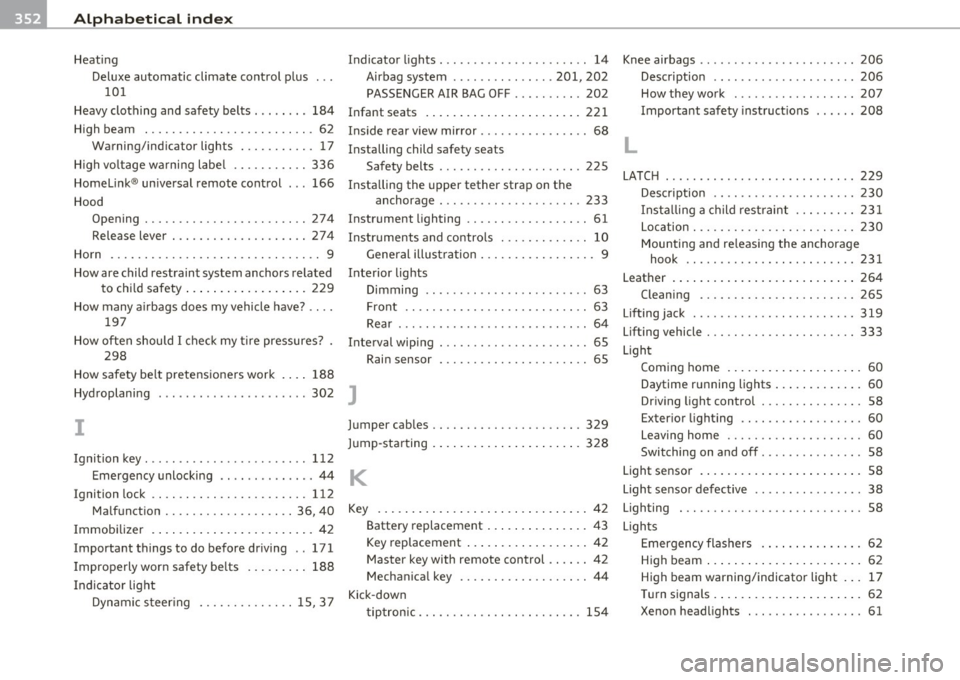
-Alphabetical inde x lffi'f ___,__ ______________ _
Heating
Deluxe automatic climate control plus
101
Heavy clothing and safety belts . ... ... . 184
High beam ................ ...... .. . 62
Warning/indicator lights . .......... 17
H igh vo ltage warning labe l ......... .. 336
HomeL ink® un iversal remote control . .. 166
Hood
Opening ................ ...... ..
274
Release lever ............ .. .... .. 2 7 4
Horn ................. .. .. .. .. .... .. 9
How are child restraint system anchors related to chi ld safety ..... .............
229
How many a irbags does my vehicle have? .. ..
197
How often should I check my tire pressures? .
298
How safety belt pretensioners work ... . 188
Indicator lights ... .......... ..... .. .. 14
Airbag system .......... .. ... 201, 202
PASSENGER AIR BAG OFF .......... 202
Infant seats ....... ... .. .... ....... 221
Ins ide rear view mirror ........ .. .. .. .. 68
Installing child safety seats
Safety belts ............... ... .. .
225
Installing the upper tether strap on the
anchorage ... .... ... ..... .... ..
233
Instrument lighting .......... .. .. .. .. 61
Instruments and controls ..... .. .... .. 10
General illustration .............. ... 9
Interior lights Dimming . .... ... .. .. .. .. .. .. .. ..
63
Front .. ................. .. .. .. .. 63
Rear ... ................. .. .. .. .. 64
Interval wiping . .. .. ............... .. 65
Rain sensor ......................
65
Hydroplaning . .. ............ ....... 302 J
I Jumper cables .. .. .................. 329
Jump-sta rting ................ .... .. 328
Ignition key ........ ............. ... 112
Emergency unlocking .. ....... ..... 44 K
Ignition lock .. .... .. .. .... ......... 112
Malfunction ............. ...... 36, 40 Key ........ ...... ... .. .... ........ 42
Immobilizer . ... ..... ............... 42 Battery replacement ............... 43
Important things to do before driving .. 171
Improperly worn safety belts ......... 188
Indicato r light
Dynamic steer ing .......... ....
15, 37
Key replacement ..... ............. 42
Master key with remote control .. .. .. 42
Mechanica l key ................. .. 44
Kick-down tiptronic ....... .............. ...
154
Knee airbags .. .... .... ...... ... .. .. 206
Description .. .. .. ............... 206
How they work .............. ... . 207
Important safety instructions ...... 208
L
LATCH 229
Description .. ...... ............. 230
Insta lling a child restraint ....... .. 231
Location . ........... .. .... .... .. 230
Mounting and releasing the anchorage
hook .. ...... .. .. ..... .. .. .. ..
231
Leather .................... ... .. .. 264
Cleaning ........... .. .... .... .. 265
Lifting jack .......... ... . .. .... .. .. 319
Lifting vehicle ...................... 333
Light
Coming home ............ ... ... ..
60
Daytime running lights ............. 60
Driving light control ............... 58
Exterior lighting .. .. .... ......... . 60
Leaving home ....... .. .. .. .... .. . 60
Switching on and off ....... ... .. .. . 58
Light sensor ................ ... .. .. . 58
Light sensor defective ...... .. .. ... ... 38
Lighting ..... .. .. .... .............. 58
Lights
Emergency flashers . . . . . . . . . . . . . . .
62
High beam ...... . .. .............. 62
High beam warning/indicator light ... 17
Turn signals .................... .. 62
Xenon headlights . .. .... .......... 61
Page 360 of 362

___ A_ l_. p_ h _ a_b_ e_ t_ic _a_ l_ in_ d_e _ x ____________________________________________ _
What should I do after changing a wheel? ...
298
What should I do after replacing wheels? 298
Wheel bolts Torque ............. .... .. .... .. 308
Wheels ........................... 291
Cast alloy .. ... ........... ..... .. 261
Checking tire pressure ............ 297
Cold tire inflation pressure ......... 295
General notes ................... 291
Glossary of tire and loading terminology . 292
New tires and wheels .. ..... ..... . 303
T ires and vehicle load limits ........ 299
When must a safety belt be replaced? . . 184
When must the a irbag system be inspected? .
201
When shou ld I adjust the tire pressures? 298
When should I check the tire pressures? 298
Where can I find the tire pressures for my car?
297
Why safety belts? ........... .... 181, 182
Window regulators Malfunct ions . ............. .... .. . 54
Power locks .. ................. .. . 54
Windows Clean ing . ...... ...... .... ..... .. 260
Windshield defogging/defrosting .. 100, 106
Windshield washer fluid Low level .. .. .. .. .... .. ... ....... 39 Windshield wipers
.. .......... ... .. .. 65
Faulty ...... .................. ... 41
Replacing w indshield wiper blades ... 67
Service position . . . . . . . . . . . . . . . . . . . 66
Was her reservoir ................. 290
Winter operation Battery .... .. .. .. .. .... ......... 285
Coolant system ... .. .. .. .. .. .. .. . 281
Defrosting windows .......... . 99, 106
Front seat heating ...... ......... 109
Tir es ......... ............. .... . 242
Windows ............ .. .. .. .... . 260
Winter tires ....................... 307
All-wheel drive .................. 307
Wiper blades Replacing windshield wiper blades ... 67
See also Windshield wipers ... .. .... 67
X
Xenon headlights ............ .. .. 61,327
y
Yellow symbols . .. .. ............... .. 36