2011 AUDI A5 COUPE child lock
[x] Cancel search: child lockPage 188 of 362

___ s_a_ f_ e_ t_ y _ b_e _l_t _s ___________________________________________ _
Automatic safety belt retractors
Every safe ty be lt is equipped with an automatic be lt retractor on the
shoulder belt . This feat ure locks t he be lt whe n the belt is pulled out
fast, d uring ha rd braking and in an accident. The belt may also lock
w hen you dr ive up or dow n a steep hill or throug h a sharp curve .
Dur ing norma l driv ing the belt lets you move freely.
Safety belt pretensioners
T he safety belts are eq uipped w ith a belt p retensioner that helps to
tighten the safety belt and remove slac k w hen the p retensioner is
activated . The f unction of the p retens ioner is monitored by a warn ing
light=>
page 16.
Switchable locking feature
E very safety be lt except the one on the driver seat is equipped with a
switchab le locking feature that
must be used when the safety belt is
used to attach a child safety seat. Be sur e to read t he importa nt info r
mation about this feature=>
page 225.
& WARNING
Improperly po sitioned safety belt s can cau se serious injury in an
accident =>
page 186, "Safety b elt position ".
• Safety belts offer optimum protection only when the seatback
is upright and belts are properly posit ioned on the body .
• Alway s make sure that the r ear seat backre st to which the
center rear safety belt is attached is se curely latched whene ver the
rear center safety belt is being u sed . If the ba ckre st is not securely
latched, the passenger will move forwa rd with the backrest during
sudden braking, in a sudden maneuve r and e specially in a crash.
• Never attach the safety belt to the buckle for another seat .
Attaching the belt to the wrong bu ckle will reduc e safety belt
effect iveness and can cause serious personal injury .
• A passenger who i s not properly restrained can be seriou sly
injured by the safety belt itself when it moves from the stronger
parts of the body into critical area s like the abdomen.
& WARNING (c on tinued )
• Alway s lock the convertible locking retractor when you are
securing a child safety seat in the vehicle=>
page 227. •
Safety belt position
Co rrect bel t posi tion is the key to get ting maximum
pro tec tion f rom safety belts .
Fig. 174 H ead
res traint a nd safety
belt po sit io n a s se en
from the side
Standard features on your vehicle help you adjust th e position of the
safety belt to match your body si ze.
• height-ad justable fron t sea ts.
& WARNING
Improperly po sitioned safety belts can cau se serious per sonal
i njury in an accident.
• The shoulder belt portion of the safety be lt must b e position ed
over the middle of the occupant's shoulder and never acro ss the
neck or throat.
• The safety belt must lie flat and snug on the occupant's upper
body => fig. 174. Pull on the belt to tighten if neces sary. .,,,.
Page 204 of 362

_,___A_ i_rb _ a_,g=-- s_, y:;.. s_ t_e _m ________________________________________________ _
PASSENGER AIRBAG OFF light
Fig. 180 Sec tion from
the in strume nt panel :
PASSENGER AIRBAG
OFF light
The PASSENGER AIRBAG OFF light is located in the center of the
ins trumen t panel => fig. 180 .
T he
PASSENGER AIRBAG OFF light w ill come o n and stay on to tell
you when the front Advanced Airbag on the passenger side has been
t u rn ed off by the ele ct ronic contro l unit. Each t ime you t urn on t he
ignition, the
PASSENGER AIRBAG OFF light w ill flash for a few
se conds and:
• will stay on if the front passenger seat is not occupied,
• will s tay on if t here is a small ch ild or child res trai nt on the fron t
passenger seat,
• will go out if t he front passenger seat is oc cupied by a n ad ult as
registered by the weight-sensing mat.
Th e
PASSENGER AIRBAG OFF light must come on and stay on if the
ignition is o n and
• a car bed has been installed o n the front seat, or
• a rearward-facing child restraint has been insta lled on the front
passenger seat, o r
• a forward-fac ing chi ld restraint has bee n installed on the front
passenge r seat, o r
• the weight registered on t he front passenger seat is equal to o r
less th a n the com bined we ight of a typic a l 1 year-o ld rest rained in one of the rear-faci
ng or forward-facing infant restraints listed in
F e d era l Mo tor Ve hicle Safe ty St and ar d 2 08 w ith which th e Adv anced
Airbag System in your vehicle was cert ified.
If the front passenger seat is not occupied, the front airbag will not
dep loy, and t he
PASSENGER AIRBAG OFF ligh t will s tay o n. N ever
install a rearward -facing child restraint on the f ront passenger seat,
t he s afest pla ce fo r a child in any k ind of child rest rain t is a t one o f th e
seating pos it ions on the rear seat::::;,
page 192, "Child restraints on
t he fro nt sea t- some im port an t things to kno w" and =>
page 215,
"Ch ild Safety".
If the PASSENGER AIRBAG OFF light comes on when one of the
c onditions lis ted above is met, be sure to check the lig ht reg ularly to
ma ke certain that the
PASSENGER AIRBAG OFF light stays on conti n
uously w henever the ignition is o n. If the
PASSENGER AIRBAG OFF
light does not appear and not stay on a ll the time, stop as soon as it
is safe to do so and
• reactivate the system by turn ing the ig nition off and then turn ing
it on again;
• remove and reinstall the child restraint. Make sure that the c hild
restrain t is properly insta lled and that the sa fety belt for the fron t
passenger seat has been correctly ro uted around the child restraint as
described in the child res trai nt ma nufactu rer's instr uctions;
• make sure that the convertible lock ing feature on t he safety belt
f or the front passenger sea t has been act ivate d an d that the safe ty
belt has bee n pulled tight. The belt m ust not be loose or have loops
of slac k so that t he senso r be low the safety belt latc h on the seat can
do its job::::;,
page 225.
• make s ure tha t things that may in crease the weight o f the chi ld
and child safety seat are not be ing transported on t he front
passenge r seat;
• make sure that the safety belt tension sensor is not blocked.
Shake the safety belt la tch on the front passenger seat back and
forth;
• If a st rap o r te ther i s be ing u sed t o tie the c hild safety sea t to the
front passenger seat, make sure that it is not so tig ht that it causes .,_
Page 220 of 362

_,___C_ h_ il_d _ S_a _ f_ e _ t-= y ;....._ ____________________________________________ _
Model
Graco Infant 8457
Graco Snug ride
Peg Perego Primo Viaggio SIP
IMUN00US
Manufactured on or
after
December 1, 1999
September 25, 2007
September 25, 2007
Subpart C -Fo rward-fa cing and con vertib le child
re straints
Model Manufactured on or
after
Britax Roundabout E9 L02xx September 25, 2007
Cosco Touriva 02519 December 1, 1999
Cosco Summit Deluxe High Back September 25, 2007
Booster 22 -262
Cosco H igh Back Booste r 22-209 September 25, 2007
Evenflo Tr ibute V 379xxxx September 25, 2007
Evenflo Medallion 25 4 December 1, 1999
Evenflo Generations 352xxxx September 25, 2007
Grace ComfortSport September 25, 2007
Grace Toddler Safety Seat Step 2 September 25, 2007
Graco P latinum Ca rgo September 25, 2007
& WARNING
To reduce the ri sk of serio us i njury , make sure th at the
PAS SENGER AIR BAG OFF l ight com es on and s tays on wh en ev e r a
c hild re straint is i nsta lle d on the front pas senge r seat and th e
ign itio n is s witch ed on .
& WAR NING (continu ed)
• Take the child re st raint off the front pa ssenger seat and in stall
i t properly at one of the rear s eat position s if the PASSENGER A IR
BAG OFF light doe s not stay on .
• Hav e the a irb ag sys tem in spect ed by your authori zed Audi
deal er immedi ate ly .
[I) Tips
The chi ld seats listed in categories A to C have been tested by Audi
only for the Advanced A irbag function .•
Important safety instructions for using
child safety seats
Correct use of child safety seats substantially reduces the
risk of injury in an accident!
As the driver, you are responsible for the safety of everybody
in th e veh icle, especially children :
- Always use the right child safety seat for each child and
always use it properly=>
page 221.
-Always carefully follow the child safety seat manufac
turer's instructions on how to route the safety belt prop
erly through the child safety seat .
- When using the vehicle safety belt to install a child safety
seat, you must first activate the convert ible locking
retractor on the safety belt to prevent the child safety seat
from movi ng =>
page 225.
- Push the child safety seat down wit h your full weig ht to
get the safety belt really tight so that the seat cannot move forward or sideways more than one inch (2.5 cm). ._
Page 222 of 362

____ C_ h_ il_d _ S_a_ f_ e_ t-= y;....._ ____________________________________________ _
& WARNING (continued)
• If exceptional circumstances require the use of a forward
facing child restraint on the front passenger's seat, the child's safety and well-being require that the following special precau
tions be taken:
-Make sure the forward-facing seat has been designed and
certified by its manufacturer for use on a front seat with a passenger front and side airbag.
- Always carefully follow the manufacturer's instructions
provided with the child safety seat or carrier.
- Always move the front passenger seat into the rearmost
position of the passenger seat's fore and aft adjustment range ,
and as far away from the airbag as possible before installing
the child restraint.
- Always make sure that nothing prevents the front
passenger's seat from being moved to the rearmost position in
its fore and aft adjustment range .
-Always make sure that the backrest is in the upright posi
tion .
• Always buckle the child safety seat firmly in place even if a
child is not sitting in it. A loose child safety seat can fly around
during a sudden stop or in a collision.
• Always read and heed all WARNINGS whenever using a child
restrained in a vehicle is being used~
page 181, "Safety belts ",
~ page 190 , "Airbag system " and ~ page 215, "Child Safety".
& WARNING
To reduce the risk of serious injury, make sure that the
PASSENGER AIR BAG OFF light comes on and stays on whenever a
child restraint is installed on the front passenger seat and the
ignition is switched on.
& WARNING (co ntinued )
• Take the child restraint off the front passenger seat and install
it properly at one of the rear seat positions if the PASSENGER AIR
BAG OFF light does not
stay on.
• Have the airbag system inspected by your authorized Audi
dealer immediately.
& WARNING
• A child in a child restraint installed with the LATCH lower
anchorages or with the standard safety belt on the rear seat may
play with unused rear seat safety belts and become entangled
resulting in serious personal injury and even death.
• Always buckle unused rear seat safety belts out of reach of chil
dren in child seats and properly activate the convertible locking
retractor so that the child cannot unreel the safety belt from the
retractor. •
Page 224 of 362
-Child Safety Pll:f __ .,.___ ____________ _
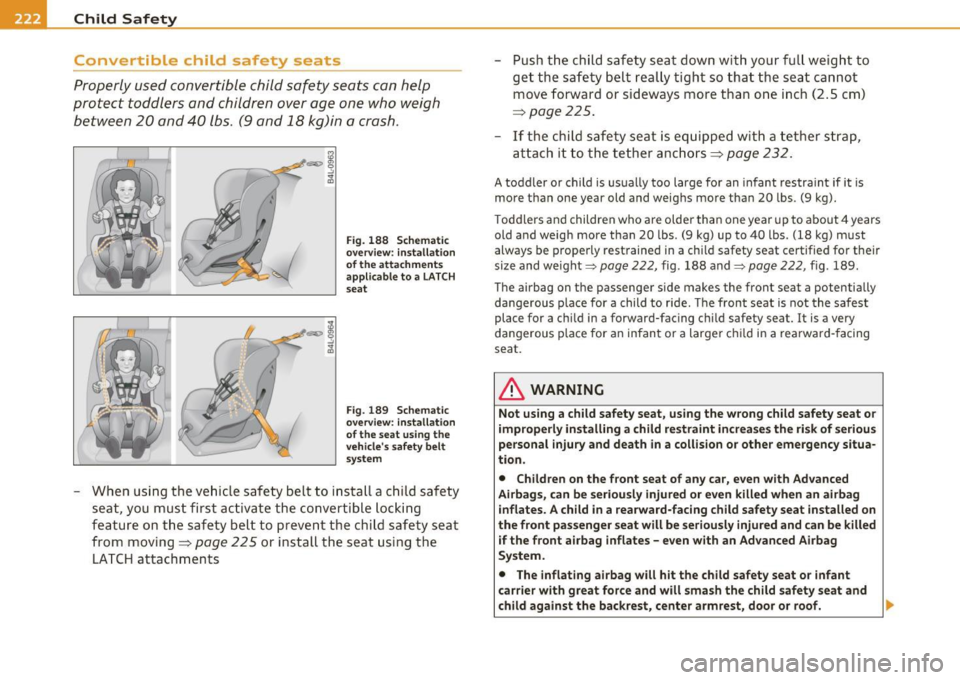
Convertible child safety seats
Properly used convertible child safety seats can help
protect toddlers and children over age one who weigh between 20 and 40 lbs. (9 and 18 kg)in a crash.
Fig. 188 Schematic
overview: installation
of the attachments
applicable to a LATCH
seat
Fig. 189 Schematic
overview: installation
of the seat using the
vehicle's safety belt
system
- When using the vehicle safety belt to install a child safety
seat, you must first activate the convertible locking
feature on the safety belt to prevent the child safety seat
from moving=>
page 225 or install the seat using the
LATCH attachments - Push the child safety seat down with your full weight to
get the safety belt really tight so that the seat cannot
move forward or sideways more than one inch (2.5 cm)
=>
page 225.
- If the child safety seat is equipped with a tether strap,
attach it to the tether anchors =>
page 232.
A toddler or child is usually too large for an infant restraint if it is
more than one year old and weighs more than 20 lbs . (9 kg).
Toddlers and children who are older than one year up to about 4 years
old and weigh more than 20 lbs. (9 kg) up to 40 lbs. (18 kg) must
always be properly restrained in a child safety seat certified for their
size and weight=>
page 222, fig. 188 and=> page 222, fig. 189.
The airbag on the passenger side makes the front seat a potentially dangerous place for a child to ride. The front seat is not the safest
place for a child in a forward-facing child safety seat. It is a very
dangerous place for an infant or a larger child in a rearward-facing
sea t.
& WARNING
Not using a child safety seat, using the wrong child safety seat or
improperly installing a child restraint increases the risk of serious
personal injury and death in a collision or other emergency situa
tion.
• Children on the front seat of any car, even with Advanced
Airbags, can be seriously injured or even killed when an airbag
inflates. A child in a rearward-facing child safety seat installed on
the front passenger seat will be seriously injured and can be killed
if the front airbag inflates -even with an Advanced Airbag
System.
• The inflating airbag will hit the child safety seat or infant
carrier with great force and will smash the child safety seat and
child against the backrest, center armrest, door or roof. ..,
Page 226 of 362

-L~C:_.!:h~ i~ld ~ S~ a:!: f~ e~ t~ y ~ ------------------------------------------
- Do not use the convertible locking retractor when using
the vehicle's safety belt to restrain a child on a booster
seat.
- Always position the shoulder portion of the safety belt midway over the child's shoulder . If you must transport an
older child in a booster seat on the front passenger seat,
you can use the safety belt height adjustment to help
adjust the shoulder port ion properly .
- Always make s ure that the shoulder por tion of the safety
belt never rests against or across the child's neck .
- Always make sure that the child can properly wear the lap portion of the belt low across the thighs or pelvis and
never over the stomach or abdomen .
Children up to about 40 lbs. (18 kg) are best protected in child safety
seats designed for their age and weight. Experts say that the skeletal
st ruct ure, particularly the pelv is, of these chi ldren is not fully deve l
oped, and they must not use the vehicle safety belts without a suit
able child rest raint .
Children who are at least 4 ft. 9 in . (57 inches/1.45 meters) tall can
generally use the vehicle's three point lap and shoulder belts . Never
use the lap belt port ion of the vehicle's safety belt alone to restra in
any child, regard less of how big the child is. Always remember that
childre n do not have the pronounced pelvic structure required for the
proper function of lap belt portion of the vehicle's three point lap and
shoulder belts. The ch ild's safety absolutely requires that a lap belt
portion of the safety belt be fastened snugly and as low as possible
around the pelvis. Neve r let the lap belt po rtion of the safety bel t
pass over the child's stomach or abdomen.
It is usua lly best to p ut these ch ildren in appropriate booster seats.
Be sure the booster seat meets all appl icable safety standards .
Booster seats raise the seating position of the child and reposition
both the lap and shoulder parts of the safety belt so that they pass across the child
's body in the right places . The rout ing of the belt over
t he c hild's body is very impo rtan t for the chi ld's p ro tect io n, whether
or not a booster seat is used. Children age 12 and under must always
ride in the rear seat .
In a crash, airbags m ust inflate with in a blink of an eye and with
considerable force. In order to do its job, the airbag needs room to
infl ate so that it w ill be t he re to protect t he oc cupan t as the occupant
moves forward into the a irbag.
A vehicle occupant who is out of position and too close to the airbag gets in the way of an inflating a irbag . When a n occupant is too close,
he or she will be struck violently and will receive serious or possibly
even fatal injury.
In order for the airbag to offer protection, it is important that all
veh icle occupants , espec ia lly any ch ild ren, who must be in the front
seat because of exceptional c ircumstances, be properly restra ined
and as far away from the airbag as possib le . By keeping room
between the child's body and the front of the passenger compart
ment, the airbag can inflate completely and provide supplemental
protection in certa in frontal collisions.
& WARNING
Not using a booste r sea t, using th e boo ste r seat improp erl y, inc or
rectl y installing a boo ste r seat or u sing the vehicle saf ety b elt
i mp roperly increa se s the risk of serio us per sonal injur y and death
i n a colli sion or oth er emergenc y situatio n. To he lp red uce the ri sk
of s eriou s pers onal injury and /or d eath:
• Alway s make su re to po sition the shoulder portion of the three
point b elt ove r the middl e of child' s sho ulder.
• Never l et the shoulder p orti on of the b elt re st again st or acro ss
th e neck, fa ce, chin , or thro at of the ch ild.
• Alwa ys make sure the lap belt portion of th e thr ee -point belt i s
worn snug and pa sses as low a s pos sible across the ch ild 's pel vis.
N ever le t th e be lt pa ss over the soft abdomen .
liJ>
Page 227 of 362

__________________________________________ ___:C~ h~il ~d ~ S~a ~f ~e ~t z._y __ _
& WARNING (c on tinued )
• Failure to properly route safety belt s ov e r a child' s body will
cause severe injurie s in an accident or oth er emergency situation
~ page 181 .
• The r ear side of the booster seat should be positioned as clo se
as possible to the backrest on the vehicle seat. Adjust o r remove
the rear seat head restraint if it is difficult to install the child seat
with the head restraint in place~
page 81. Install the head
restraint again immediatel y once the child seat is removed .
Driving without head restraints or with head restraints that are
not properly adju sted increases the risk of seriou s or fatal neck
injury dramat ically.
• Children on the front seat of any car, even with Advanced
Airbags , can be seriously injured or even killed when an airbag
inflates.
• Never let a child stand or kneel on any se at.
• Never let a child ride in the cargo area of your vehicle. • Alway s remember that a child leaning forward , sitting side
ways or out of position in any way during an accident can be struck by a deploying airbag. This will result in se rious personal injury or
death .
• If you must install a booster seat on the front passenger seat
because of e xceptional circumstances the PASSENGER AIR BAG
OFF light must come on and stay on, whenever the ignition is
switched on.
• If the PASSENGER AIR BAG OFF light does not come on and
stay on, perform the checks described
~ page 201, " Monitoring
the Advanced Airbag System ".
• Take the child restraint off the front passenger seat and install
it properly at one of the rear seat positions if the PASSENGER AIR BAG OFF light does not stay on whenever the ignition is sw itched
on.
• Always read and heed all WARNINGS whenever using a child
restrained in a vehicle is being used
~ page 181 , "Safety belts",
Controls and equip ment Safety first Vehicle operation
& WARNING
(co ntinued )
~ page 190, "Airbag system " and ~ page 215, "Important
things to know ".•
Installing a child safety seat
Securing a child safety seat using a safety
belt
Sa fety belts for the r ear seats and th e front passenger 's
seat c an be locked with the convertible locking retractor
t o pr operly secu re c hild safety se ats.
Th e safety bel ts emergency lock ing re trac to rs for the rear seats
safety belts and for the front passenger's seat safety belt have a
c onve rtible locking retractor for child res traints. The saf ety belt m ust
be locked so that belt webbing cannot un reel. The retractor can be
act ivate d to loc k the safety belt and prevent the safety belt webb ing
from loosening up during normal dr iv ing. A child safety seat can on ly
be pro pe rly in stall ed when the sa fety belt is locke d so th at th e child
and child safety seat will stay in place.
Always remembe r: E ven tho ugh yo ur vehicle is equippe d with an
Advanced Airbag system, all ch ild ren, espec ially those 12 yea rs and
younger, should a lways ride in t he back seat properly restrained for
their age and we ight.
& WARNING
Improperly installed child safety seats increase the risk of serious
personal injury and death in a collision.
• Always make sure that the safety belt retractor is locked when
installing a child safety seat . An unlocked safety belt retractor
cannot hold the child safety seat in place during normal driving or
in a cra sh. .,,
Vehicle care Do-it-yourself service Technical data
Page 229 of 362

Child Safety --------------------"'----
& WARNING (continued)
• Always move the passenger seat into its rearmost position in
the seat's fore and aft adjustment range, as far away from the airbag as possible before installing the forward-facing child
restraint. The backrest must be adjusted to an upright position.
• Make sure that the PASSENGER AIR BAG OFF light comes on
and stays on all the time whenever the ignition is switched on.
& WARNING
Rearward-facing child restraints:
• A child in a rearward-facing child safety seat installed on the
front passenger seat will be seriously injured and can be killed if
the front airbag inflates -even with an Advanced Airbag System.
• The inflating airbag will hit the child safety seat or infant
carrier with great force and will smash the child safety seat and
child against the backrest, center armrest, door or roof.
• Always be especially careful if you must install a rearward
facing child safety seat on the front passenger seat in exceptional
circumstances.
• A tight tether strap on a rearward-facing child restraint
attached to the front passenger seat can put too much pressure on
the weight-mat in the seat and register a heavier weight in the
Advanced Airbag System. The heavier weight registered can make
the system work as though an adult were on the seat and deploy the Advanced Airbag when it must be suppressed causing serious
or even fatal injury to the child.
• Make sure that the PASSENGER AIR BAG OFF light comes on
and stays on all the time whenever the ignition is switched on.
• If the PASSENGER AIR BAG OFF light does not come on and
stay on, immediately install the rearward-facing child safety seat
in a rear seating position and have the airbag system inspected by
your authorized Audi dealer. •
Controls and equip ment Safety first Vehicle operation
Activating the convertible Locking retractor
Use the convertible locking retractor to secure
a child
restraint.
Always heed the child safety seat manufacturer's instruc
tions when installing a child restraint in your vehicle. To acti
vate the convertible locking retractor:
- Place the child restraint on a seat, preferably on the rear
seat .
- Slowly pull the belt
all the way out.
- Route it around or through the child restraint belt path
::::>& .
- Push the child safety seat down with your full weight to
get the safety belt really tight.
- Insert the belt tongue into the buckle for that seating
position.
- Guide the safety belt back into the retractor until the belt
lies flat and snug on the child safety seat .
- You should hear a "clicking" noise as the belt winds back
into the inertia reel. Test the convertible locking retractor
by pulling on the belt. You should no longer be able to pull
the belt out of the retractor. The convertible locking
retractor is now activated.
- Make sure that the red release button is facing away from
the child restraint so that it can be unbuckled quickly.
- Pull on the belt to make sure the safety belt is properly
tight and fastened so that the seat cannot move forward
or sideways more than one inch (2.5 cm) . .,
Vehicle care Do-it-yourself service Technical data