2011 AUDI A5 COUPE service
[x] Cancel search: servicePage 321 of 362

_____________________________________________ W __ h....:a_ t ___ d_o ___ I_ d_o :.....:.. n.:..o::.. w.:....:.. ?------J-
& WARNING (continued)
• Do not loosen the wheel bolts more than one turn before you
raise the vehicle with the jack. -You risk an injury.
(I) Tips
• Never use the hexagonal socket in the handle of the screwdriver to
loosen o r tighten the wheel bolts .
• If a wheel bolt is very tight, you may find it easier to loosen by
carefully pushing down on the end of th e wheel bolt wrench with
one
foot only .
As you do so, hold on to the car to keep your balance and
take ca re not to slip .•
Raising the vehicle
The vehicle must be li~ed with the jack first before the
wheel can be removed.
•
Fig. 224 Changing a
wheel: mounting
points for the jack
Vehicle OP-eration
Fig. 225 Close-up:
proper positioning of
jack
The location of the jack point is indicated by an indentation
on the underside of the vehicle=> fig. 224.
- Activate the
parking brake to prevent the vehicle from
rolling unintentionally.
- Shift into
1st gear on vehicles with manual transmission
or move the selector lever to the
P position on vehicles
with automatic transmission*.
- Find the
lifting point in the sill that is closest to the faulty
wheel => fig. 224.
Turn the handwheel on the
vehicle jack until the jaw
=> fig . 225 @ covers the
notch on the vehicle.
- Align the vehicle jack so the jaw@ covers the notch and
the base plate @ is flat on the floor. The base plate @
must be
vertical under the lifting point@.
- Install the rod on the vehicle jack: Insert the rod into the
opening on the handwheel. Turn the rod left or right to
secure it.
- Continue raising the jack with the rod until the wheel lifts
off the ground slightly. ..,_
Vehicle care Do-it-yourself service iTechnical data
Page 323 of 362

What do I do now? Ill
----------------
- Screw the threaded end of the alignment pin from the
tool kit hand-tight into the empty bo lt hole~
page 320 ,
fig. 227.
- Then re m ove the o ther wheel bolts as described above.
- Take off t he w heel leaving the alignment pin i n the bolt
hole~ 0-
Putting on the inflatable spare tire
- Push t he spare tire over the a lignmen t pin.
- Screw on th e whe el bo lts and t ight en them
slightly using
the hexagonal soc ket .
- Remove the alignment pin and insert and tighten the
remaini ng whee l bol t slig htly like the rest .
- Turn the jack handle counter-clockwise to lower t he
vehicle unt il the jack is fully released.
- Use the wheel bolt wrench to t ighten a ll whee l bolts firmly
~ page 318 . Tighte n th em in a crisscross pattern, from
one bolt to the (approx imately) opposite one , to keep the
wheel centered.
- Perform the steps required after changing the wheel
~ page 317, "After c hanging a wheel".
T he hexagona l socket makes it easier to remove the whee l bolts from
the rim. Care should be take n when remov ing the reve rsib le blade .
0 Note
When removing or installing the wheel, the r im could hit the brake
rotor and damage the rotor . Work caref ully and have a second person
to he lp you.
Safety first
(I] Tips
• Whe n mounting tires with unidirection al tread de sign make sure
the tread pattern is pointed the rig ht way~
page 321.
• T he wheel bolts should be clea n and easy to turn. Check for dirt
and corrosion on the mating surfaces of both the whee l and the hub .
Remove all d irt from these surfaces before remounting the whee l.
• Do not use the hexagonal socket in the screwdriver hand le to
loose n or tig hten the wheel bolts .•
Tires with unidirectional tread design
Tires with unidirectional tread design mus t be mounte d
with their tread pattern pointed in the right direc tio n .
Using a spare tire with a tread pattern intended for
use in a specific direction
Whe n using a spare tire with a tread patte rn intended fo r use in a
specific direction, p lease note the fo llow ing:
• T he direction of ro ta t ion is ma rked by an
arrow on th e side of the
t ir e.
• If the spare tire has to be installed in the incorrect d irect ion, use
the spare t ire only temporar ily since the tire w ill not be ab le to
achieve its optimum pe rformance characterist ics with rega rd to
aquaplaning, noise and wear.
• We recommend tha t you pay particular attent ion to th is fact
dur ing wet weather and that you adjust your speed to match road
condi tions.
• Replace the flat ti re with a new one and have it installed on your
veh icle as soon as possible to restore the handling adva ntages of a
unidirect ional tire. •
Vehicle care Do-it-yourself service Technical data
Page 325 of 362

____________________________________________ ..:.F..:u::.:s:::.:e::.:::s_:a::.:n'...:.::d'.....!:::b~u~l~b~s !.__J-
Fuses and bulbs
Fuses
Replacing a fuse
Fuses that have blown will have metal strips that have
burned through .
Fig. 228 Left cockpit:
fuse panel cover
The fuses are located at the front left and right of the cockpit
and behind the trim on the right side of the luggage compart
ment .
- Turn off the ignition and the affected electrical
consumers.
- Check the following table to see which fuse belongs to the
consumer.
- Remove the appropriate cover => fig. 228 or =>
page 2 73,
fig. 201.
Vehicle OP-eration
- To remove the purple plastic clip if necessary 4
), hold onto
it at the small side and pull it out of the fuse panel
~ page 324, fig. 229 .
- Remove the clamp from the rear side of the fuse cover
~ fig. 228.
- Remove the fuse using the clamp and replace the blown
fuse with an identical new one.
& WARNING
Do not repair fuses and never replace a blown fuse with one that
has a higher amp rating. This can cause damage to the electrical
system and a fire.
0 Note
If a new fuse burns out again after shortly have you have installed it,
have the electrical system checked by your authori zed Audi dealer.
[I] Tips
• The following table does not list fuse locations that are not used .
• Some of the equipment items listed are optional or only available
on certain model configurations.
• The crank in the cover is used for emergency operation of the
sunroof* .•
4
> You ca n dis p ose of the plastic cl ip after removi ng it.
Vehicle care Do-it-yourself service iTechnical data
Page 327 of 362

Fuses and bulbs -----------------------=---==-=-=--=.:..:..:::...:....:.:..:....-EWII
No. Consumer Amps
8 Vehicle electrical system control module 1
30
--
9 sunroof 20
10 Vehicle electrical system control module 1 30
11 sunroof shade (Avant)
20
12 Convenience electronics 5
•
Fuse Location, Instrument Panel right
Fig. 230 Right cockpit:
f use panel with plastic
clip
Vehicle OP-eration
No. Consumer Amps
Fuse panel @ (black)
5 Steering column switch module
5
6 Electronic Stabilization Program
5
7 Terminal 15 diagnostic connector 5
8 Gateway (Databus diagnostic interface)
5
Fuse panel @ (brown)
1 CD-/DVD player
5
2 Audi drive select switch module 5
3 MMI/Radio 5/20
4 Instrument cluster 5
5 Gateway (instrument cluster control module)
5
6 Ignition lock 5
7 Rotary light switch 5
8 Climate control system blower 40
9 Steering column lock
5
10 Climate control 10
11 Terminal 30 d
iagnostic connector
10
12 Steering column switch module 5
•
Vehicle care Do-it-yourself service iTechnical data
Page 329 of 362

_______________________________________________ F_u _s_ e_ s_ a_ n_ d_ b_u _ l_ b _ s __ lR
No. I I Consumer
1 0 A udi side assis t
1 1 Rea r seat he ating
1 2 T ermin al 15 control mod ules
Fuse panel © (black)
3 D 5P amplifi er, rad io
4 MMI
5
Rea rvi ew c amer a
Rad io/nav igatio n/cell phon e prep
cell phone prep
Bulbs
Replacing bulbs
Amps
5
5
5
30/ 20
7,5
5
7,5
5 •
For your sa fety, we recommend tha t you have your autho
ri zed A udi de aler repl ace any bulbs for y ou.
It is becoming increas ingly more and more difficu lt to replace veh icle
ligh t bulbs since in many cases, other parts o f the car m ust first be
removed before you are able to get to the bu lb. This app lies espec ia lly
t o the ligh t bulbs in the fron t of your car which you can on ly reac h
t hroug h the engi ne compartment .
Sheet meta l and bu lb holders can have sharp edges that can ca use
serious cuts, parts must be co rrectly take n apart a nd the n properly
put back together to he lp prevent breakage of parts and long term
damage from w ate r that c an ente r housings tha t have no t been prop
er ly resea led.
F or your safety, we recommend that you have your authorized Audi
dealer replace any bu lbs for you, s ince your dealer has the p rope r
too ls, the cor rect bu lbs and the expertise.
Safety first Gas discharge lamps
(Xenon lights}*:
Due to the high electr ica l voltage, have the bulbs replaced by a qual
ified technicia n. Headl ights w it h Xe non lig ht are ident ified by t he
high voltage sticker.
& WARNING
Changing Xenon lamp s without the nece ssary equipment can
cause serious personal injury.
• Bulbs are pre ssurized and can explode when being changed.
Potential risk of injury!
• On vehicle s equipp ed with ga s discharge bulbs (Xenon light)*
life-threatening injuries can result from improper handling of the
high-voltage portions of such lamps!
• Only your authorized Audi dealer or a qualified workshop
s hould change the bulbs in gas discharge lamp s. There are parts
with sharp edges on the openings and on the bulb holders that can
c au se seriou s cuts. If you are uncertain about what to do , have the
work performed by an authoriz ed Audi dealer or other qualified
workshop. Seriou s person al injury may result from improperly
performed work.
(I] Tips
• If you st ill prefer to replace t he lig ht bulbs yourself, be aware that
the engine compartment is a hazardo us a rea to work in:::)
page 267 ,
" E ng ine compartme nt" :::) & .
• It is best to ask your a uthorized Au di dea ler w henever you wa nt to
change a b ulb. •
Vehicle care Do-it-yourself service Technical data
Page 331 of 362
_____________________________________________ E_ m___;, e_r-=g ~ e_ n_c,_:!y:.__: s_i:..:t ..:..u :..:a;;,. t.:.; i...: o :..: n...:..:. s _ __,J_
& WA RNING (co ntinued )
• Before you che ck anything in the engine compartment , always
read and heed all WARNINGS~
page 267, "Engine compart
ment ".
0 Note
• App lying a higher vo ltage booster battery will cause expensive
damage to sens itive e lec tron ic components, such as contro l units,
re lays, rad io, etc.
• Th ere must be no electrical contac t between the vehicles as othe r
wise current could a lready start to flow as soon as the posit ive(+)
t erm inals are con nected.
[I] Tips
• Th e discharged ba tte ry mus t be properly co nnecte d to the
vehicle's electrical system . When jump starting or charging the
bat tery, never connec t the negat ive ground cable to the batte ry nega
tive post because the battery manager system must be able to detect
t he battery's state of charge . Always connect the negative ground
cable to the negative ground post of the battery manage r contro l
unit. •
Vehicle OP-eration
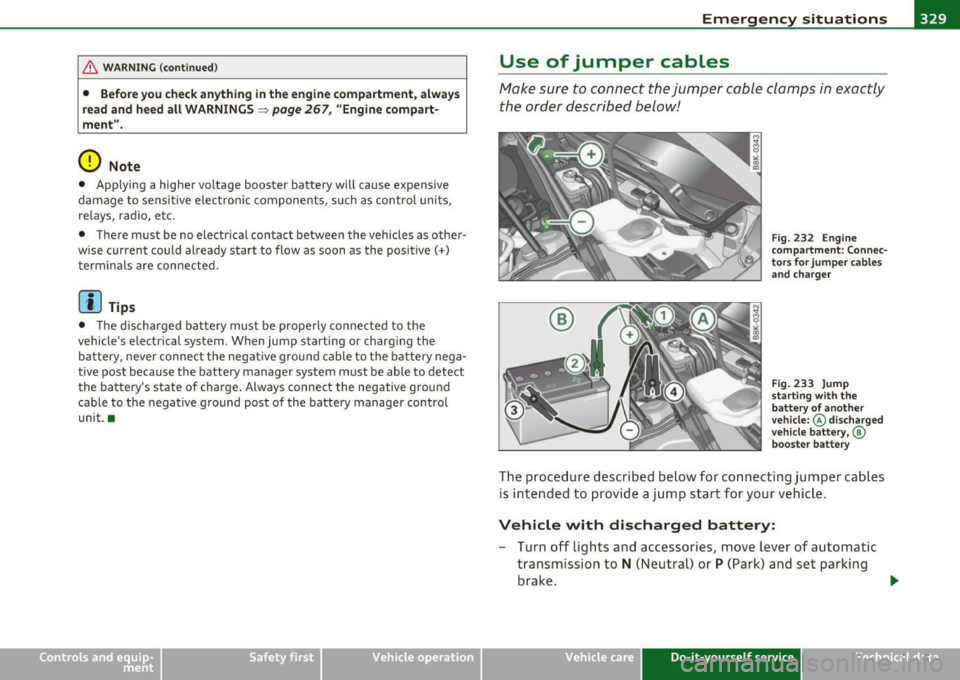
Use of jumper cables
Make sure to conne ct the jumper c able clamps in e xactly
the order described bel ow!
Fig. 232 Engine
c omp artment : C on nec
t o rs for jum per cable s
a nd ch arger
Fi g. 233 J ump
st arti ng with th e
battery of anot her
ve hicl e:@ disc harged
v ehi cle batt ery ,©
bo oste r batte ry
T he p roced ure descr ib ed below for co nnecting jumper cables
is intended to provide a j ump start for yo ur veh icle.
Vehicle with discharged battery:
- Turn o ff ligh ts an d accessories, move lever o f au tomatic
t ra nsmission to
N (Ne utral) o r P (P ark) and s et parking
brake .
~
Vehicle care Do-it-yourself service iTechnical data
Page 332 of 362

lffl!I.___E_ m_ e_r -=g =- e_ n_c -=y ;..._ s_i_t _u _a _ t_ i_ o _ n_ s ____________________________________________ _
Connect POSITIVE(+) to POSITIVE(+) (red)
- Remove the cover above the jump start connection .
- Open t he red cover on the positive pole~
page 329,
fig. 232.
1. Connect one end of the positive cable (red) on the
jump
start bolt~
page 329, fig. 233 (D (Bolts under red cover
= "positive") of the vehicle to be started @.
2. Connect the other end to the positive terminal @of the
booster battery ®·
Connect NEGATIVE(-) to NEGATIVE(-)
(black)
3. Connect one end to the negative terminal ® of the
booster battery @.
4. Connect the other end of the negative cable (black) to the
jump start bolt© (Bolts with hex head = "negative") of
the vehicle to be started @.
Starting the engine
- Start the engine of the vehicle with the booster battery.
Run the engine at a moderate speed.
- Start engine with discharged vehicle battery in the usual
manner.
- If the engine fails to start: do not keep the starter cranking for longer than 10 seconds. Wait for about
30 seconds and then try again.
- With engine running, remove jumper cables from both
vehicles in the exact
reverse order .
- Close the red cover on the positive pole.
The battery is vented to the outside to prevent gases from entering
the vehicle interior . Make sure that the jumper clamps are well
connected with their
metal parts in full contact with the battery
terminals.
& WARNING
To avoid serious personal injury and damage to the vehicle, heed
all warnings and instructions of the jumper cable manufacturer. If
in doubt, call for road service.
• Jumper cables must be long enough so that the vehicles do not
touch.
• When connecting jumper cables, make sure that they cannot
get caught in any moving parts in the engine compartment.
• Do not bend over the batteries· danger of chemical burns!
• The battery cell locking screws must be tightened securely.
• Before you check anything in the engine compartment, always
read and heed all WARNINGS~
page 267, ''Engine compart
ment".
0 Note
Improper hook-up of jumper cables can ruin the generator.
• Always connect POSITIVE(+) to POSITIVE(+), and NEGATIVE( -)
to NEGATIVE(-) ground post of the battery manager control unit.
• Check that all screw plugs on the battery cells are screwed in
firmly . If not, tighten plugs prior to connecting clamp on negative
battery terminal.
• Please note that the procedure for connecting a jumper cable as
described
above app lies specifically to the case of your vehicle be ing
jump started. When you are giving a jump start to another vehicle, do
not connect the negative (-) cab le to the negative(-) terminal on the
discharged battery©~
page 329, fig. 233. Instead, securely
connect the negative(-) cable to either a solid metal component that
is firmly bolted to the engine block or to the engine block itself.
If the _,,,
Page 333 of 362

Emergency situations Ill -------------=---:.-----J
battery that is being charged does not vent to the outside, escaping
battery gas could ignite and explode!•
Emergency towing with
commercial tow truck
General hints
Your Audi requires special handling for towing.
The following information is to be used by commercial tow truck
operators who know how to operate their equipment safely .
• Never tow your Audi, towing will cause damage to the engine
and transmission.
• Never wrap the safety chains or winch cables around the brake
lines.
• To prevent unnecessary damage, your Audi must be transported
with a flat bed truck.
• To load the vehicle on to the flat bed, use the towing loop found
in the vehicle tools and attach to the front or rear anchorage
~ page 331 and ~ page 332.
& WARNING
A vehicle being towed is not safe for passengers. Never allow
anyone to ride in a vehicle being towed, for any reason. •
Vehicle OP-eration
Front towing Loop
Do not install the front towing loop until it is needed.
Fig. 234 Front
bumper: removing the
cover cap
Fig. 235 Front
bumper: screwing in
the towing loop
The towing loop fits into the threaded hole located on the
right side of the front bumper and covered by a small cover
when not in use.
- Remove the towing loop from the vehicle toolkit
=> page 314.
- Press the cover in by applying short strong pressure to the
bottom part to release it from the bumper=> fig. 234.
- Screw the towing loop tightly into the threaded hole as far
asitwillgo=,,fig.235.
~
Vehicle care Do-it-yourself service iTechnical data