Page 29 of 166

4-2
4
EBU17814Indicator lights and warning light EBU17842Reverse indicator light“”
This indicator light comes on when the transmis-
sion is in the reverse position.Furthermore, this indicator light flashes when the
engine is being raced for 10 seconds or more.
TIPIf the indicator light flashes under any other circum-
stances or the speedometer does not show the
speed while riding, have a Yamaha dealer check
the speed sensor circuit.EBU17860Neutral indicator light“”
This indicator light comes on when the transmis-
sion is in the neutral position.EBU17920Coolant temperature warning light“”
This warning light comes on when the engine over-
heats. When this occurs during operation, stop the
engine as soon as it is safe to do so and allow it to
cool down for about 10 minutes.NOTICEECB00010�The engine may overheat if the ATV is over-
loaded. In this case, reduce the load to spec-
ification.
1. On-Command differential gear lock indicator light “DIFF.
LOCK”
2. Low-range indicator light “L”
3. High-range indicator light “H”
4. Neutral indicator light “N”
5. Reverse indicator light “R”
6. Park indicator light “P”
7. On-Command four-wheel-drive/differential gear lock
indicator“”/“”
8. Coolant temperature warning light“”U37S61E0.book Page 2 Tuesday, June 2, 2009 10:33 AM
Page 62 of 166
6-5
64. Check behind for people or obstacles, and
then release the brake pedal.
5. Open the throttle lever gradually and continue
to watch to the rear while backing.
EBU20682Engine break-in TIP�For ATVs equipped with an odometer or an hour
meter, follow the figures given in km (mi) or the
figures given in hours.�For ATVs not equipped with an odometer or
hour meter, follow the figures given in hours.There is never a more important period in the life of
your engine than the first 320 km (200 mi) or 20
hours of riding. For this reason, you should read
the following material carefully.
Since the engine is brand new, do not put an ex-
cessive load on it for the first 320 km (200 mi) or 20
hours. The various parts in the engine wear and
polish themselves to the correct operating clear-
ances. During this period, prolonged full-throttle
operation or any condition that might result in en-
gine overheating must be avoided.0–160 km (0–100 mi) or 0–10 hours
Avoid prolonged operation above 1/2 throttle. Vary
the speed of the ATV regularly. Do not operate it at
one set throttle position.
160–320 km (100–200 mi) or 10–20 hours
Avoid prolonged operation above 3/4 throttle. Rev
the engine freely, but do not use full throttle at any
time.
320 km (200 mi) or 20 hours and beyond
The ATV can now be operated normally.
NOTICEECB00220If any engine trouble should occur during the
engine break-in period, immediately have a
Yamaha dealer check the ATV.EBU20690Parking When parking the ATV, stop the engine, shift the
drive select lever into the park position, and then
turn the fuel cock to the “OFF” position.
U37S61E0.book Page 5 Tuesday, June 2, 2009 10:33 AM
Page 115 of 166

8-27
8 3. If the coolant is at or below the minimum level
mark, remove panel D. (See page 8-9.)
4. Remove the coolant reservoir cap, add cool-
ant or distilled water to the maximum level
mark, install the reservoir cap, and then install
the panel. NOTICE: If coolant is not avail-
able, use distilled water or soft tap water
instead. Do not use hard water or salt wa-
ter since they are harmful to the engine. If
water has been used instead of coolant, re-
place it with coolant as soon as possible,
otherwise the cooling system will not beprotected against frost and corrosion. If
water has been added to the coolant, have
a Yamaha dealer check the antifreeze con-
tent of the coolant as soon as possible,
otherwise the effectiveness of the coolant
will be reduced.
[ECB01011]
TIP�The radiator fan is automatically switched on or
off according to the coolant temperature in the
radiator.�If the engine overheats, see page 8-62 for fur-
ther instructions.EBU23603To change the coolant
WARNING
EWB01890Wait for the engine and radiator to cool before
removing the radiator cap. You could be
burned by hot fluid and steam blown out under
1. Coolant reservoir cap
2. Maximum level mark
3. Minimum level mark
Coolant reservoir capacity (up to the maximum
level mark):
0.25 L (0.26 US qt, 0.22 Imp.qt)
U37S61E0.book Page 27 Tuesday, June 2, 2009 10:33 AM
Page 121 of 166
8-33
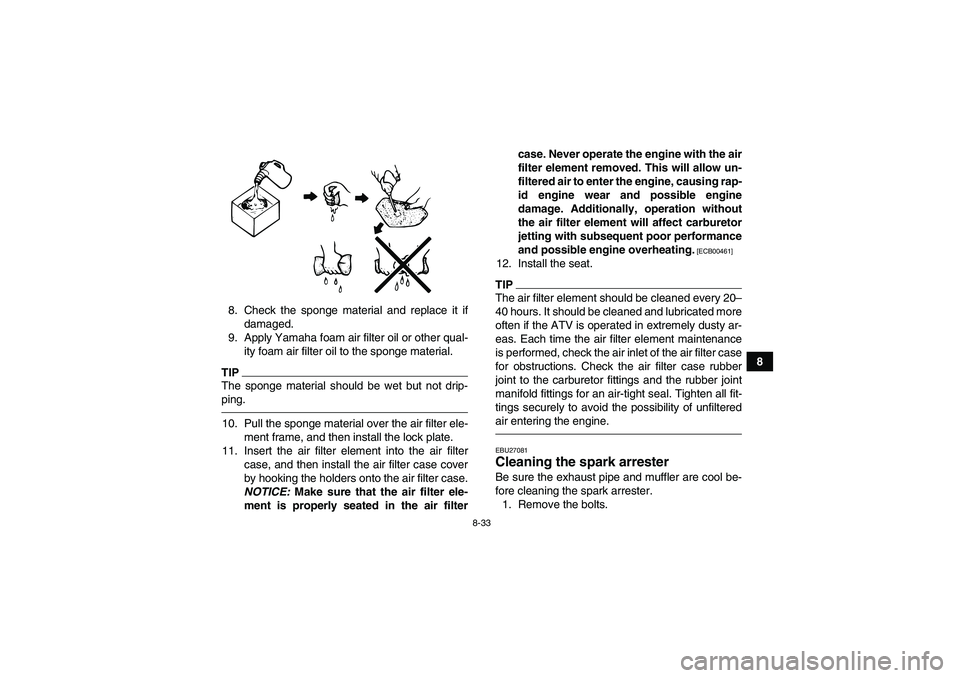
8 8. Check the sponge material and replace it if
damaged.
9. Apply Yamaha foam air filter oil or other qual-
ity foam air filter oil to the sponge material.
TIPThe sponge material should be wet but not drip-
ping.10. Pull the sponge material over the air filter ele-
ment frame, and then install the lock plate.
11. Insert the air filter element into the air filter
case, and then install the air filter case cover
by hooking the holders onto the air filter case.
NOTICE: Make sure that the air filter ele-
ment is properly seated in the air filtercase. Never operate the engine with the air
filter element removed. This will allow un-
filtered air to enter the engine, causing rap-
id engine wear and possible engine
damage. Additionally, operation without
the air filter element will affect carburetor
jetting with subsequent poor performance
and possible engine overheating.
[ECB00461]
12. Install the seat.TIPThe air filter element should be cleaned every 20–
40 hours. It should be cleaned and lubricated more
often if the ATV is operated in extremely dusty ar-
eas. Each time the air filter element maintenance
is performed, check the air inlet of the air filter case
for obstructions. Check the air filter case rubber
joint to the carburetor fittings and the rubber joint
manifold fittings for an air-tight seal. Tighten all fit-
tings securely to avoid the possibility of unfiltered
air entering the engine.EBU27081Cleaning the spark arrester Be sure the exhaust pipe and muffler are cool be-
fore cleaning the spark arrester.
1. Remove the bolts.
U37S61E0.book Page 33 Tuesday, June 2, 2009 10:33 AM
Page 151 of 166
8-63
8 Engine overheating
WARNING
EWB02290Wait for the engine and radiator to cool before removing the radiator cap. You could be burned by
hot fluid and steam blown out under pressure. Always put a thick rag over the cap when opening.
Allow any remaining pressure to escape before completely removing the cap.TIPIf coolant is not available, tap water can be temporarily used instead, provided that it is changed to the rec-
ommended coolant as soon as possible.Wait until the
engine has cooled.
Check the coolant level in the
reservoir and radiator.
The coolant level
is OK.The coolant level is low.
Check the cooling system
for leakage.
Have a Yamaha dealer check
and repair the cooling system.Add coolant. (See TIP.)
Start the engine. If the engine overheats again, have a
Yamaha dealer check and repair the cooling system.
There is
leakage.
There is
no leakage.
U37S61E0.book Page 63 Tuesday, June 2, 2009 10:33 AM
