Page 109 of 146

8-31
1
2
3
4
5
6
78
9
10
11
5. Move the throttle lever a few times and re-
check the position.
6. Install the fuel tank, side cover, radiator cover
and air filter case cover.
7. Connect the fuel hoses.
8. Install the seat.
EBU24020
Adjusting the engine idling speed
The engine idling speed must be checked and, if
necessary, adjusted as follows at the intervals
specified in the periodic maintenance and lubrica-tion chart.TIP
�
A diagnostic tachometer is needed to make this
adjustment.
�
The carburetor synchronization and the throttle
cable free play must be checked, and adjusted if
necessary, before adjusting the engine idling
speed.
1. Start the engine and warm it up.
TIP
The engine is warm when it quickly responds to the
throttle.
2. Attach the tachometer to the spark plug lead.
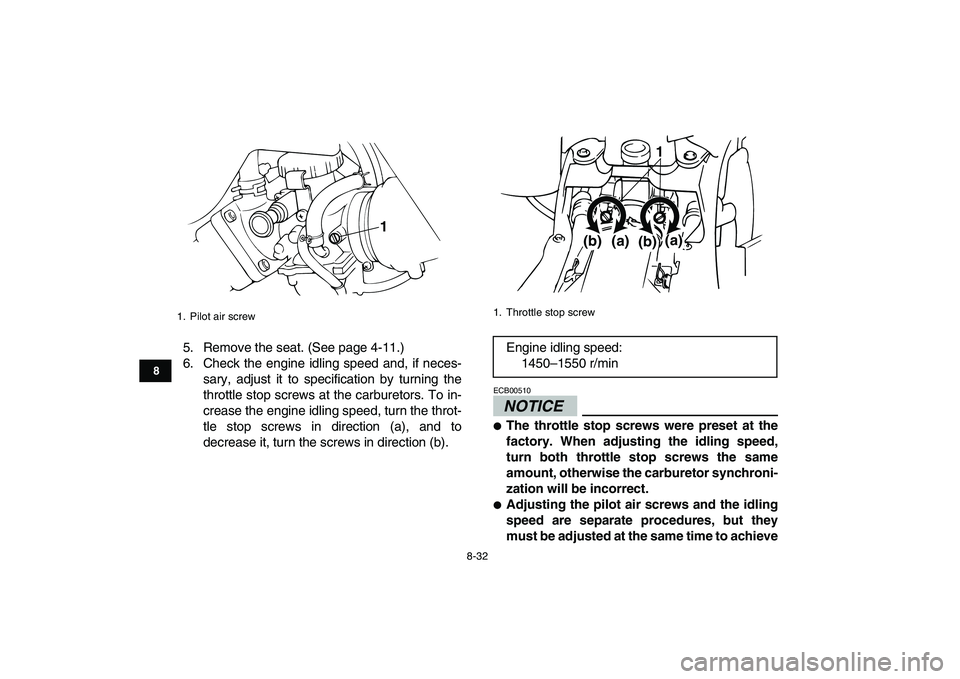
3. Turn in both pilot air screws until they lightly
seat.
4. Turn out both pilot air screws to specification.
(See the “Changing the carburetor settings”
section on the page 8-23.)
1. Adjusting nut
2. Locknut
1
2
✦✯��✬�✩✧�✤✲✣ ✦✤ ��
����������������������
Page 110 of 146
8-32
1
2
3
4
5
6
78
9
10
11
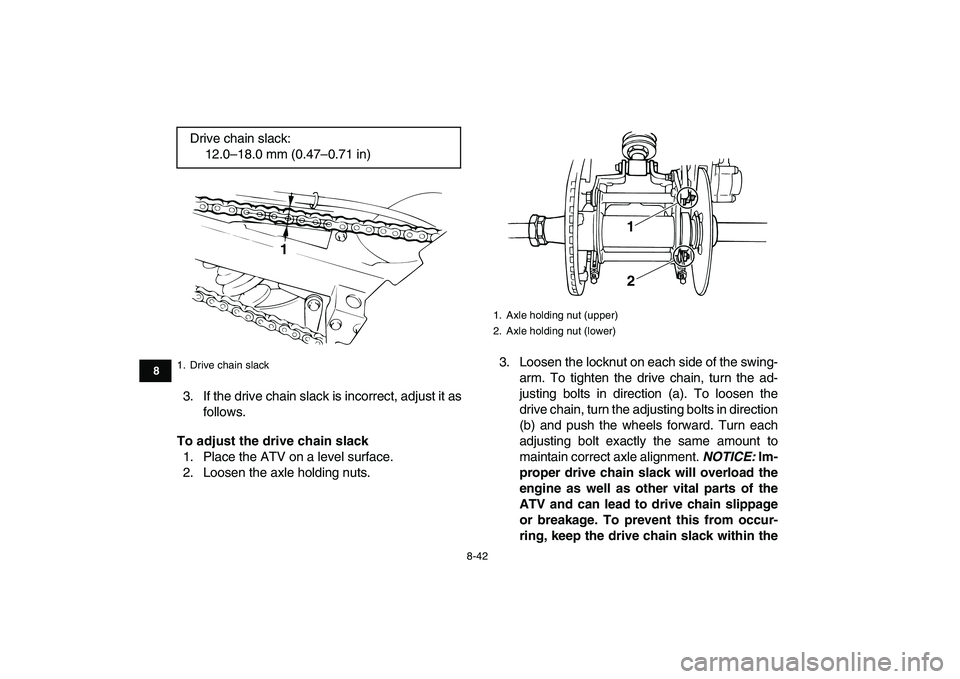
5. Remove the seat. (See page 4-11.)
6. Check the engine idling speed and, if neces-
sary, adjust it to specification by turning the
throttle stop screws at the carburetors. To in-
crease the engine idling speed, turn the throt-
tle stop screws in direction (a), and to
decrease it, turn the screws in direction (b).NOTICE
ECB00510
�
The throttle stop screws were preset at the
factory. When adjusting the idling speed,
turn both throttle stop screws the same
amount, otherwise the carburetor synchroni-
zation will be incorrect.
�
Adjusting the pilot air screws and the idling
speed are separate procedures, but they
must be adjusted at the same time to achieve
1. Pilot air screw
1
1. Throttle stop screw
Engine idling speed:
1450–1550 r/min
1
(b)
(a)
(a)
(b)
✦✯��✬�✩✧�✤✲✣ ✦✥ ��
����������������������
Page 111 of 146
8-33
1
2
3
4
5
6
78
9
10
11
optimum engine performance.
TIP
If the specified idling speed cannot be obtained as
described above, have a Yamaha dealer make the
adjustment.
7. Install the seat.
EBU24045
Adjusting the throttle cable free play
The throttle cable free play should be checked
and, if necessary, adjusted at the intervals speci-
fied in the periodic maintenance and lubrication
chart.
The throttle cable free play should measure
4.0–6.0 mm (0.16–0.24 in) at the throttle lever.
Periodically check the throttle cable free play
and, if necessary, adjust it as follows.
TIP
The engine idling speed must be checked, and ad-
justed if necessary, before adjusting the throttle ca-
ble free play.
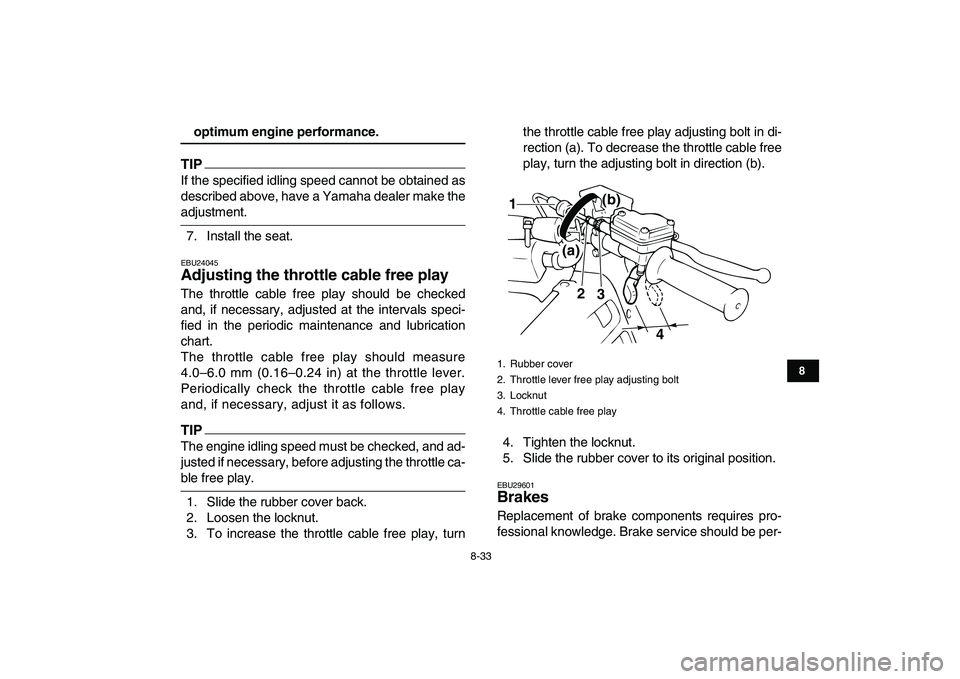
1. Slide the rubber cover back.
2. Loosen the locknut.
3. To increase the throttle cable free play, turnthe throttle cable free play adjusting bolt in di-
rection (a). To decrease the throttle cable free
play, turn the adjusting bolt in direction (b).
4. Tighten the locknut.
5. Slide the rubber cover to its original position.
EBU29601
Brakes
Replacement of brake components requires pro-
fessional knowledge. Brake service should be per-
1. Rubber cover
2. Throttle lever free play adjusting bolt
3. Locknut
4. Throttle cable free play
2
3
4
(a)(b)
1
✦✯��✬�✩✧�✤✲✣ ✦✦ ��
����������������������
Page 120 of 146
8-42
1
2
3
4
5
6
78
9
10
11
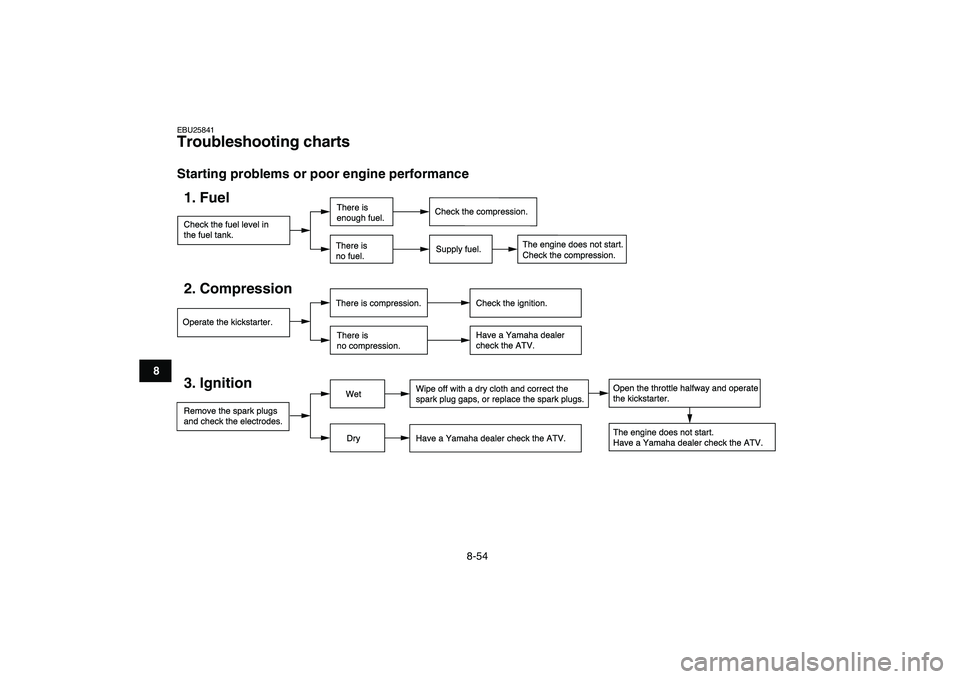
3. If the drive chain slack is incorrect, adjust it as
follows.
To adjust the drive chain slack
1. Place the ATV on a level surface.
2. Loosen the axle holding nuts.3. Loosen the locknut on each side of the swing-
arm. To tighten the drive chain, turn the ad-
justing bolts in direction (a). To loosen the
drive chain, turn the adjusting bolts in direction
(b) and push the wheels forward. Turn each
adjusting bolt exactly the same amount to
maintain correct axle alignment.
NOTICE:
Im-
proper drive chain slack will overload the
engine as well as other vital parts of the
ATV and can lead to drive chain slippage
or breakage. To prevent this from occur-
ring, keep the drive chain slack within the
Drive chain slack:
12.0–18.0 mm (0.47–0.71 in)
1. Drive chain slack
1
1. Axle holding nut (upper)
2. Axle holding nut (lower)
1
2
✦✯��✬�✩✧�✤✲✣ ✧✥ ��
����������������������
Page 122 of 146
8-44
1
2
3
4
5
6
78
9
10
11
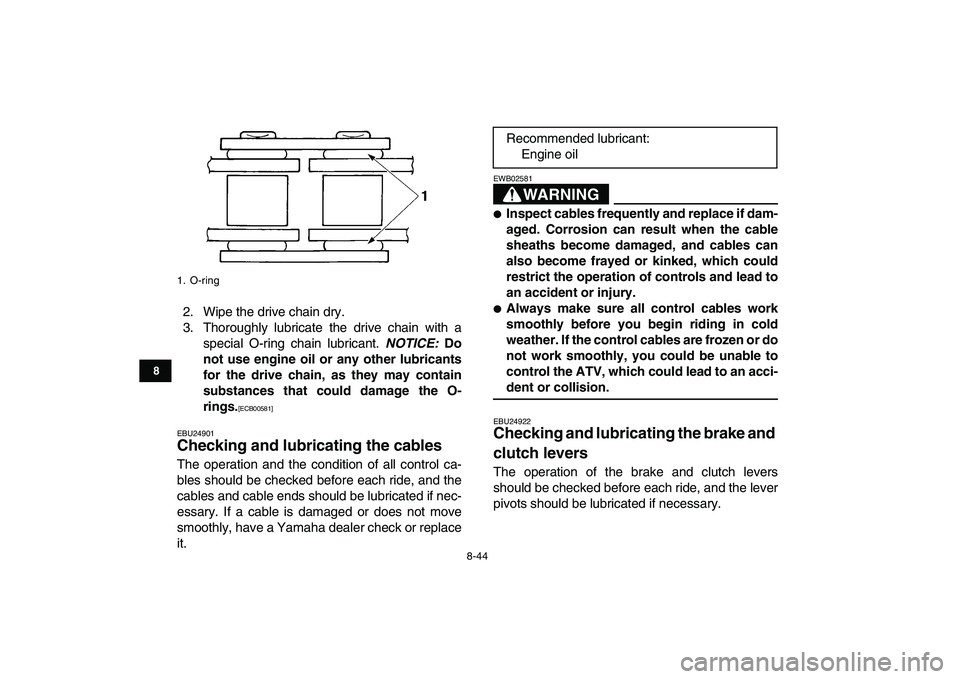
2. Wipe the drive chain dry.
3. Thoroughly lubricate the drive chain with a
special O-ring chain lubricant.
NOTICE:
Do
not use engine oil or any other lubricants
for the drive chain, as they may contain
substances that could damage the O-
rings.
[ECB00581]
EBU24901
Checking and lubricating the cables
The operation and the condition of all control ca-
bles should be checked before each ride, and the
cables and cable ends should be lubricated if nec-
essary. If a cable is damaged or does not move
smoothly, have a Yamaha dealer check or replace
it.WARNING
EWB02581
�
Inspect cables frequently and replace if dam-
aged. Corrosion can result when the cable
sheaths become damaged, and cables can
also become frayed or kinked, which could
restrict the operation of controls and lead to
an accident or injury.
�
Always make sure all control cables work
smoothly before you begin riding in cold
weather. If the control cables are frozen or do
not work smoothly, you could be unable to
control the ATV, which could lead to an acci-
dent or collision.
EBU24922
Checking and lubricating the brake and
clutch levers
The operation of the brake and clutch levers
should be checked before each ride, and the lever
pivots should be lubricated if necessary.
1. O-ring
Recommended lubricant:
Engine oil
✦✯��✬�✩✧�✤✲✣ ✧✧ ��
����������������������
Page 132 of 146
8-54
1
2
3
4
5
6
78
9
10
11
EBU25841
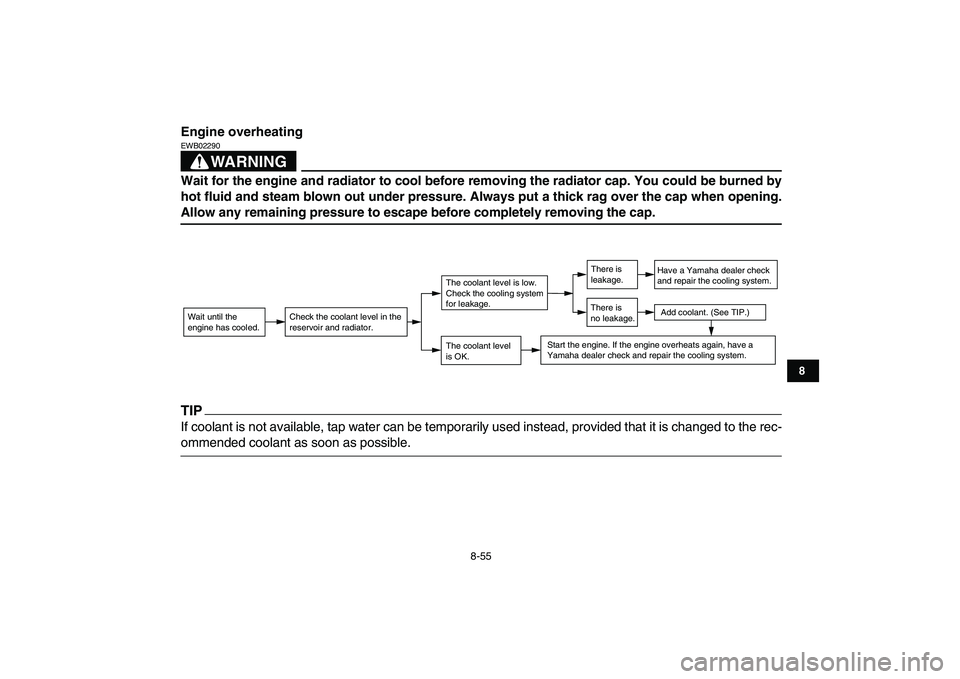
Troubleshooting charts
Starting problems or poor engine performance
Check the fuel level in
the fuel tank.1. Fuel
There is
enough fuel.
There is
no fuel.
Supply fuel.
Operate the kickstarter.2. Compression
There is compression.
There is
no compression.Check the ignition.
Have a Yamaha dealer
check the ATV.
Remove the spark plugs
and check the electrodes.3. Ignition
Wet
DryWipe off with a dry cloth and correct the
spark plug gaps, or replace the spark plugs.
Have a Yamaha dealer check the ATV.The engine does not start.
Have a Yamaha dealer check the ATV.
Open the throttle halfway and operate
the kickstarter.
Check the compression.
The engine does not start.
Check the compression.
✦✯��✬�✩✧�✤✲✣ �✧ ��
����������������������
Page 133 of 146
8-55
1
2
3
4
5
6
78
9
10
11
Engine overheating
WARNING
EWB02290
Wait for the engine and radiator to cool before removing the radiator cap. You could be burned by
hot fluid and steam blown out under pressure. Always put a thick rag over the cap when opening.
Allow any remaining pressure to escape before completely removing the cap.
TIP
If coolant is not available, tap water can be temporarily used instead, provided that it is changed to the rec-
ommended coolant as soon as possible.
Wait until the
engine has cooled.
Check the coolant level in the
reservoir and radiator.
The coolant level
is OK.The coolant level is low.
Check the cooling system
for leakage.
Have a Yamaha dealer check
and repair the cooling system.Add coolant. (See TIP.)
Start the engine. If the engine overheats again, have a
Yamaha dealer check and repair the cooling system.
There is
leakage.
There is
no leakage.
✦✯��✬�✩✧�✤✲✣ �� ��
����������������������
Page 134 of 146
9-1
1
2
3
4
5
6
7
89
10
11
EBU25860
CLEANING AND STORAGE
EBU25921
Cleaning
Frequent, thorough cleaning of your ATV will not
only enhance its appearance but will improve its
general performance and extend the useful life of
many components.
1. Before cleaning the ATV:
a. Block off the end of the exhaust pipe to
prevent water entry. A plastic bag and
strong rubber band may be used.
b. Make sure the spark plugs and all filler
caps are properly installed.
2. If the engine case is excessively greasy, apply
degreaser with a paint brush. Do not apply de-
greaser to the chain, sprockets or wheel ax-
les.
3. Rinse the dirt and degreaser off with a garden
hose. Use only enough pressure to do the job.
WARNING! Wet brakes may have reduced
stopping ability, increasing the chance of
an accident. Test the brakes after washing.
Apply the brakes several times at slow
speeds to let friction dry out the lin-
ings.
[EWB02311]
NOTICE:
Excessive water pres-sure may cause water seepage and
deterioration of wheel bearings, brakes,
transmission seals and electrical devices.
Many expensive repair bills have resulted
from improper high-pressure detergent
applications such as those available in
coin-operated car washers.
[ECB00711]
4. Once most of the dirt has been hosed off,
wash all surfaces with warm water and mild,
detergent-type soap. An old toothbrush or bot-
tle brush is handy for hard-to-reach places.
5. Rinse the ATV off immediately with clean wa-
ter and dry all surfaces with a chamois, clean
towel or soft absorbing cloth.
6. Dry the chain and lubricate it to prevent it from
rusting.
7. Clean the seat with a vinyl upholstery cleaner
to keep the cover pliable and glossy.
8. Automotive type wax may be applied to all
painted and chrome plated surfaces. Avoid
combination cleaner-waxes. Many contain
abrasives which may mar the paint or protec-
tive finish. When finished cleaning, start the
engine and let it idle for several minutes.
✦✯��✬�✩✧�✤✲✣ ✤ ��
����������������������