Page 3 of 724

1
2
3
4
5
6
7
3
2-3. Operating the lights and wipers
Headlight switch .................. 213
Fog light switch ................... 217
Windshield wipers and washer .............................. 218
2-4. Using other driving systems Cruise control ...................... 221
Intuitive parking assist......... 224
Rear view monitor system... 230
Four-wheel drive system ..... 236
AUTO LSD system.............. 240
Driving assist systems ........ 243
2-5. Driving information Off-road precautions ........... 250
Cargo and luggage ............. 255
Vehicle load limits ............... 258
Winter driving tips ............... 260
Trailer towing ...................... 264
Dinghy towing ..................... 285
3-1. Using the air conditioning system and defogger
Automatic air conditioning system .............................. 288
Manual air conditioning system .............................. 297
Outside rear view mirror defoggers and front
windshield wiper de-icer
(if equipped on Regular
Cab and Double Cab
models) ............................. 305 Back window, outside rear
view mirror defoggers
and front windshield
wiper de-icer (if equipped
on CrewMax models) ....... 307
3-2. Using the audio system Audio system types ............ 310
Using the radio ................... 314
Using the CD player ........... 322
Playing MP3 and WMA discs ................................. 331
Operating an iPod
®............ 339
Operating a USB memory ............................ 345
Optimal use of the audio system .............................. 352
Using the AUX adapter....... 356
Using the steering wheel audio switches.................. 358
3-3. Using the Bluetooth
® audio
system
Bluetooth
® audio system .... 361
Using the Bluetooth®
audio system .................... 364
Operating a Bluetooth
®
enabled portable player.... 369
Setting up a Bluetooth
®
enabled portable player.... 371
Bluetooth
® audio system
setup ................................ 376
3Interior and exterior
features
Page 94 of 724
94 1-3. Adjustable components (seats, mirrors, steering wheel)
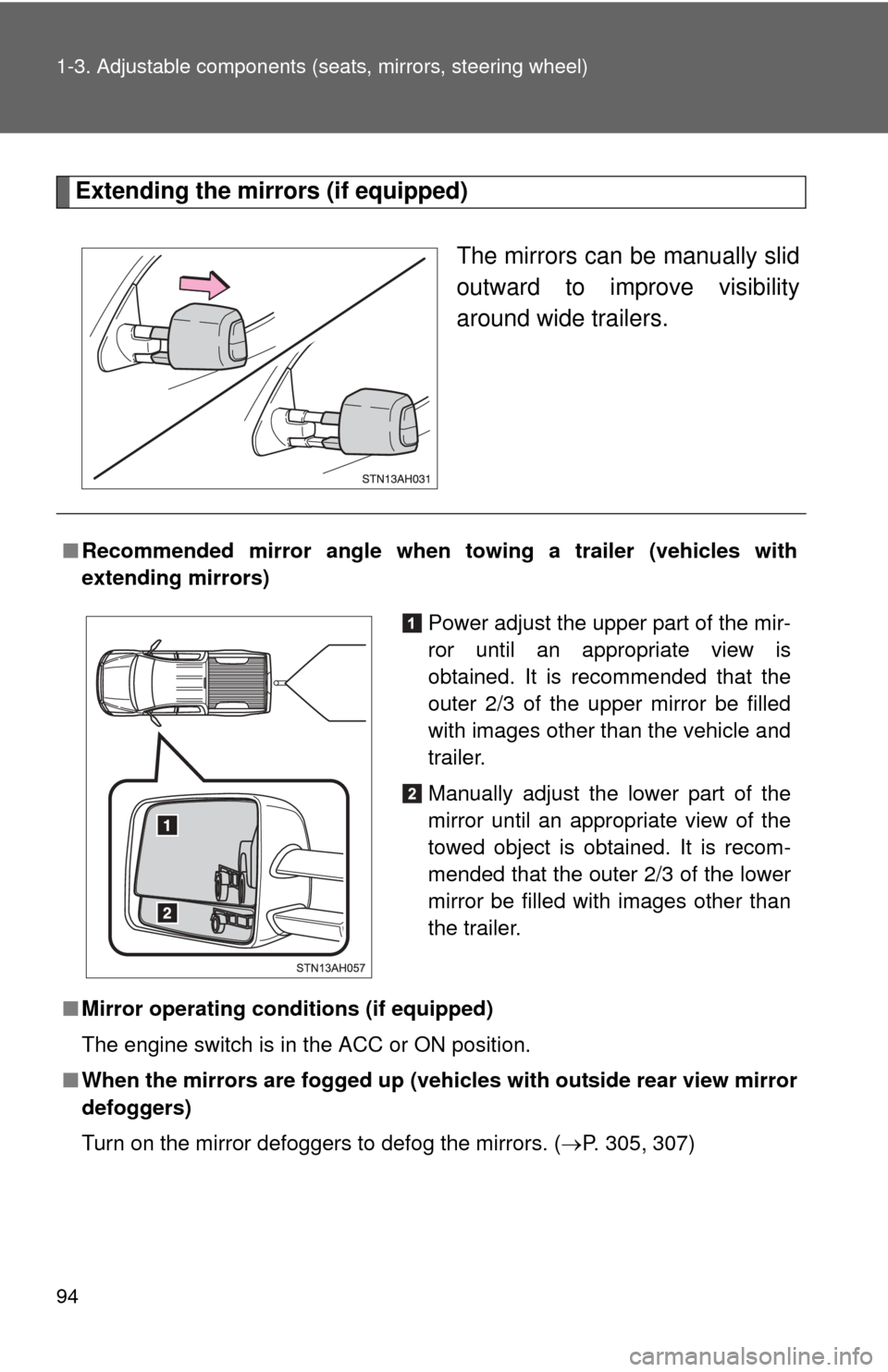
Extending the mirrors (if equipped)
The mirrors can be manually slid
outward to improve visibility
around wide trailers.
■Recommended mirror angle when towing a trailer (vehicles with
extending mirrors)
■ Mirror operating conditions (if equipped)
The engine switch is in the ACC or ON position.
■ When the mirrors are fogged up (veh icles with outside rear view mirror
defoggers)
Turn on the mirror defoggers to defog the mirrors. ( P. 305, 307)
Power adjust the upper part of the mir-
ror until an appropriate view is
obtained. It is recommended that the
outer 2/3 of the upper mirror be filled
with images other than the vehicle and
trailer.
Manually adjust the lower part of the
mirror until an appropriate view of the
towed object is obtained. It is recom-
mended that the outer 2/3 of the lower
mirror be filled with images other than
the trailer.
Page 173 of 724
When driving2
173
2-1. Driving proceduresDriving the vehicle............ 174
Engine (ignition) switch .... 183
Automatic transmission .... 186
Turn signal lever .............. 191
Parking brake ................... 192
Horn ................................. 193
2-2. Instrument cluster Gauges and meters ......... 194
Indicators and warning lights .............................. 200
Multi-information display............................ 204
Accessory meter .............. 210
2-3. Operating the lights and wipers
Headlight switch ............... 213
Fog light switch ................ 217
Windshield wipers and washer ........................... 218
2-4. Using other driving systems Cruise control ................... 221
Intuitive parking assist...... 224
Rear view monitor system ........................... 230
Four-wheel drive system ........................... 236
AUTO LSD system........... 240
Driving assist systems ..... 243 2-5. Driving information
Off-road precautions ........ 250
Cargo and luggage .......... 255
Vehicle load limits ............ 258
Winter driving tips ............ 260
Trailer towing ................... 264
Dinghy towing .................. 285
Page 189 of 724
189
2-1. Driving procedures
2
When driving
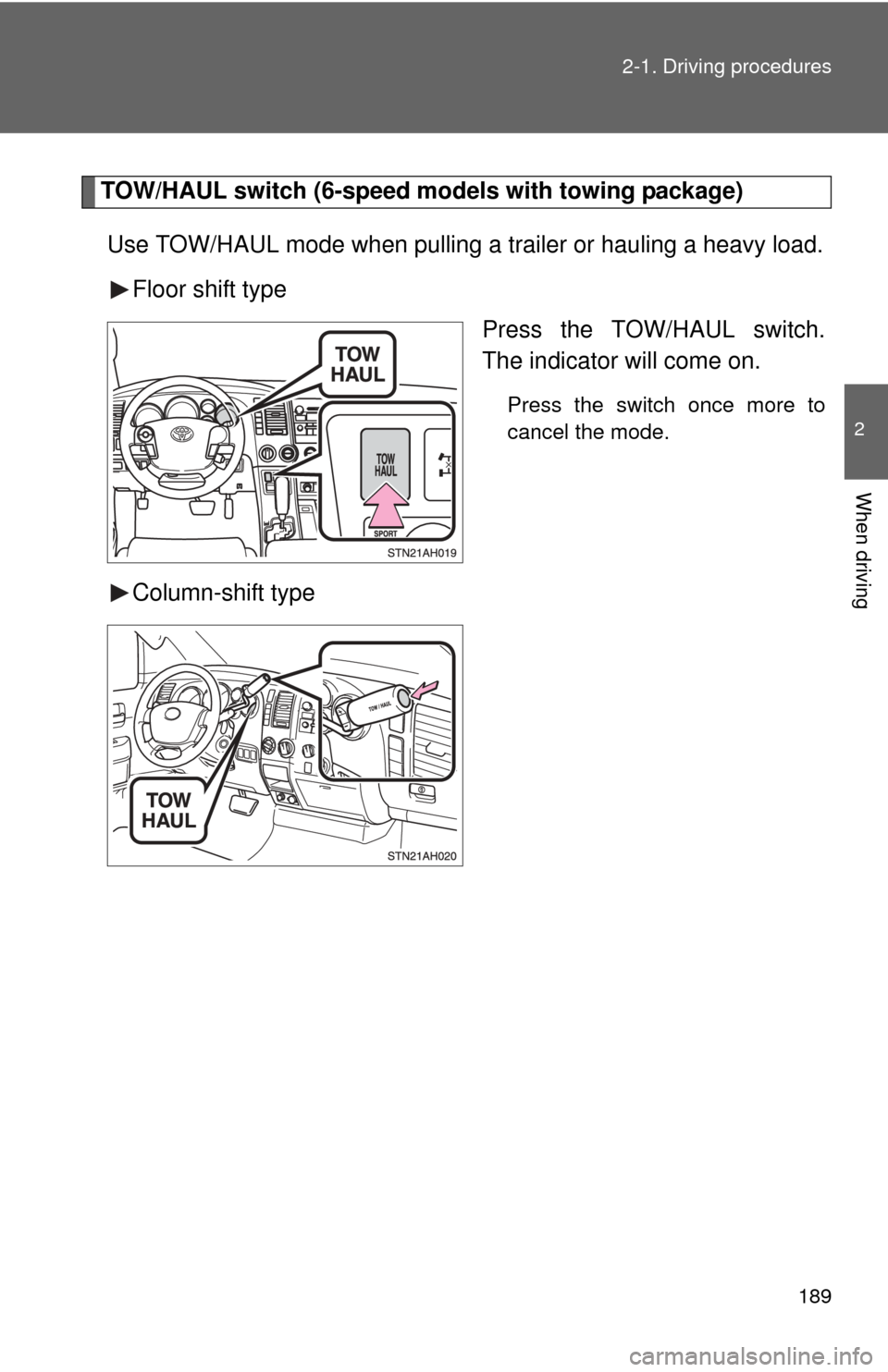
TOW/HAUL switch (6-speed
models with towing package)
Use TOW/HAUL mode when pulling a trailer or hauling a heavy load. Floor shift type Press the TOW/HAUL switch.
The indicator will come on.
Press the switch once more to
cancel the mode.
Column-shift type
Page 214 of 724
214 2-3. Operating the lights and wipers
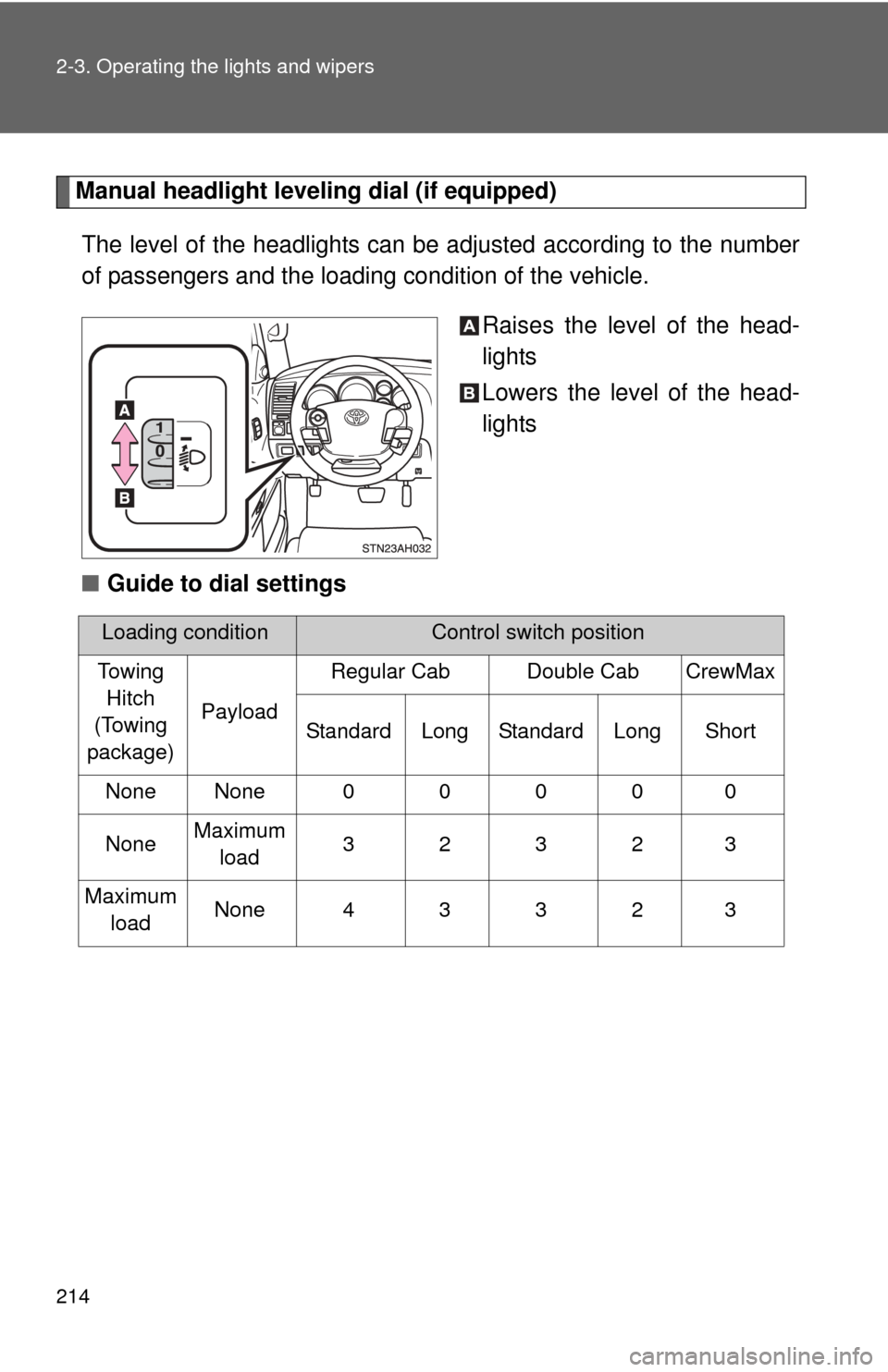
Manual headlight leveling dial (if equipped)
The level of the headlights can be adjusted according to the number
of passengers and the loading condition of the vehicle.
Raises the level of the head-
lights
Lowers the level of the head-
lights
■ Guide to dial settings
Loading conditionControl switch position
Towing Hitch
(Towing
package) Payload Regular Cab Double Cab CrewMax
Standard Long Standard Long Short
None None 0 0 0 0 0
None Maximum
load 32323
Maximum load None 4 3 3 2 3
Page 223 of 724

223
2-4. Using other
driving systems
2
When driving
■Automatic cruise control cancellation
The set speed is automatically cancelled in any of the following situations.
●Actual vehicle speed falls more than 10 mph (16 km/h) below the preset
vehicle speed.
At this time, the memorized set speed is not retained.
● Actual vehicle speed is below 25 mph (40 km/h).
● VSC is activated.
■ If the cruise control indicator flashes
Press the ON-OFF button to turn the cruise control off, and then reactivate
the system.
If the cruise control speed cannot be set or if the cruise control cancels
immediately after being activated, there may be a malfunction in the cruise
control system. Have the vehicle inspected by your Toyota dealer.
CAUTION
■To avoid operating the cruise control by mistake
Keep the ON-OFF button off when not in use.
■ Situations unsuitable for cruise control
Do not use cruise control in any of the following situations.
Doing so may result in control of the vehicle being lost and could cause an
accident resulting in death or serious injury.
●In heavy traffic
● On roads with sharp bends
● On winding roads
● On slippery roads, such as those covered with rain, ice or snow
● On steep hills
● When towing a trailer or emergency towing
Page 228 of 724

228 2-4. Using other driving systems
■The Intuitive parking assist system can be operated when
●Front corner sensors:
• The engine switch is in the ON position.
• The shift lever is in R.
• The shift lever is not in P or R and vehicle speed is approximate 6 mph
(10 km/h) or less.
● Back and rear corner sensors:
• The engine switch is in the ON position.
• The shift lever is in R
■ Sensor detection information
●Certain vehicle conditions and the surrounding environment may affect
the ability of a sensor to correctly detect an obstacle. Particular instances
where this may occur are listed below.
• There is dirt, snow or ice on a sensor.
• A sensor is frozen.
• A sensor is covered in any way.
• The vehicle is leaning considerably to one side.
• On an extremely bumpy road, on an incline, on gravel, or on grass.
• The vicinity of the vehicle is noisy due to vehicle horns, motorcycle
engines, air brakes of large vehicles, or other loud noises producing
ultrasonic waves.
• There is another vehicle equipped with intuitive parking assist sensors in the vicinity.
• A sensor is coated with a sheet of spray or heavy rain.
• The vehicle is equipped with a fender pole or radio antenna.
• A bumper or sensor receives a strong impact.
• The vehicle is approaching a tall or right-angled curb.
• In harsh sunlight or intense cold weather.
• The area directly under the bumpers is not detected. Objects lower than the sensors or thin stakes etc. may be detected ini-
tially, but as they draw closer, they may cease to be detected.
• A towing hitch is mounted to the vehicle.
• A non-genuine Toyota suspension (lowered suspension etc.) is installed.
• When attaching a two-way radio antenna.
• When the bumper is damaged.
Page 256 of 724
256 2-5. Driving information
(6) If your vehicle will be towing a trailer, load from your trailer will be
transferred to your vehicle. Consult this manual to determine how
this reduces the available cargo and luggage load capacity of your
vehicle.
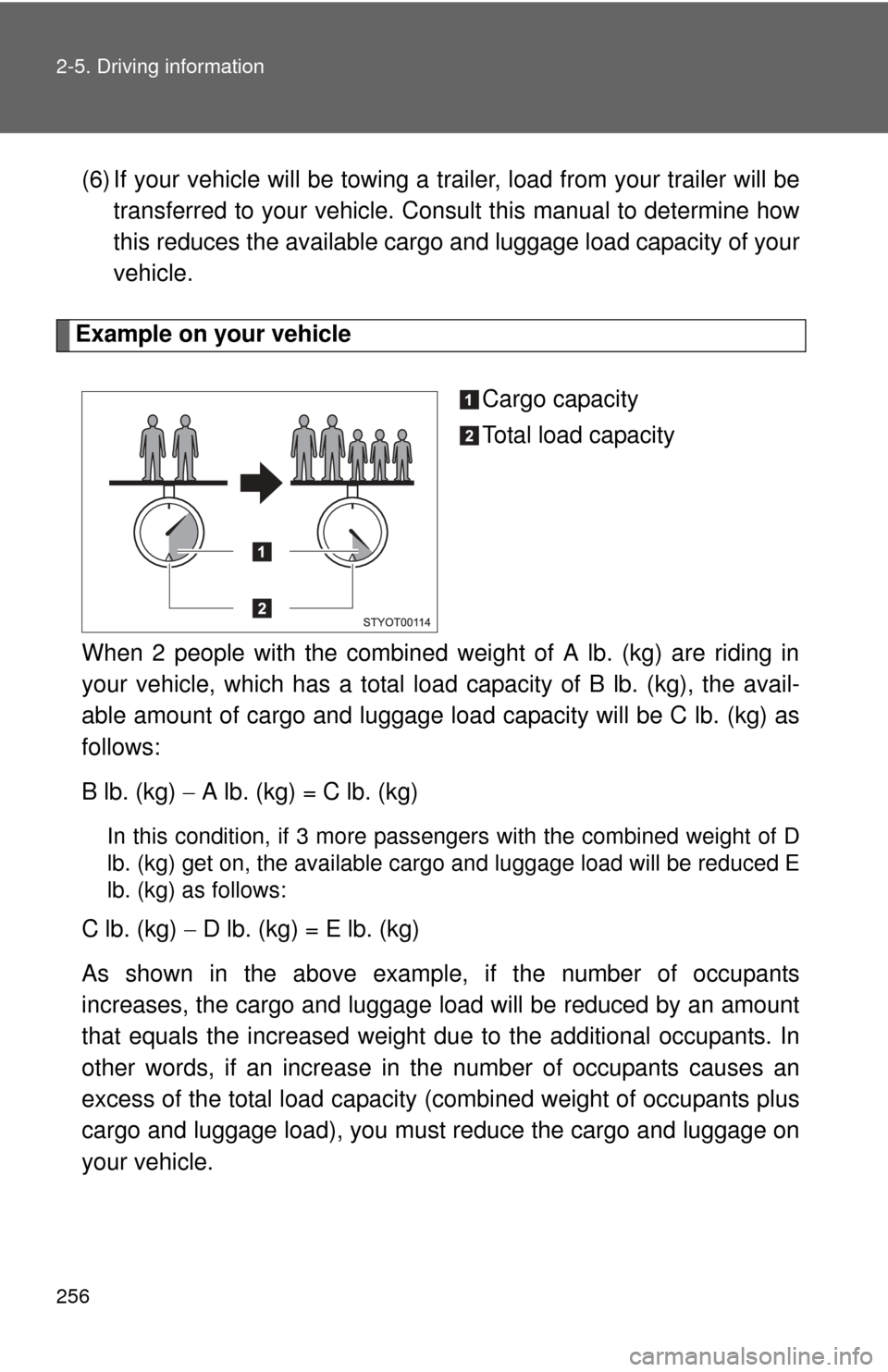
Example on your vehicle
Cargo capacity
Total load capacity
When 2 people with the combined weight of A lb. (kg) are riding in
your vehicle, which has a total load capacity of B lb. (kg), the avail-
able amount of cargo and luggage load capacity will be C lb. (kg) as
follows:
B lb. (kg) A lb. (kg) = C lb. (kg)
In this condition, if 3 more passengers with the combined weight of D
lb. (kg) get on, the available carg o and luggage load will be reduced E
lb. (kg) as follows:
C lb. (kg) D lb. (kg) = E lb. (kg)
As shown in the above example, if the number of occupants
increases, the cargo and luggage load will be reduced by an amount
that equals the increased weight du e to the additional occupants. In
other words, if an increase in the number of occupants causes an
excess of the total load capacity (combined weight of occupants plus
cargo and luggage load), you must reduce the cargo and luggage on
your vehicle.