Page 180 of 513

180
2-4. Using other driving systems
Driving assist systems
To help enhance driving safety and performance, the following sys-
tems operate automatically in res ponse to various driving situations.
Be aware, however, that these systems are supplementary and
should not be relied upon too h eavily when operating the vehicle.
■ABS (Anti-lock Brake System)
Helps to prevent wheel lock when the brakes are applied suddenly, or if
the brakes are applied while driving on a slippery road surface.
■Brake assist
Generates an increased level of braking force after the brake pedal is
depressed, when the system detects a panic stop situation.
■Enhanced VSC (Enhanced Vehicle Stability Control)
Helps the driver to control skidding when swerving suddenly or turning
on slippery road surfaces.
■TRAC (Traction Control)
Maintains drive power and prevents the drive wheels from spinning
when starting the vehicle or accelerating on slippery roads.
■AUTO LSD function (2WD models)
The AUTO LSD function is activated when the system is in TRAC off
mode. It operates when one of the drive wheels is spinning, such as
when the wheel is spinning freely on ice or mud. The system applies
the brakes to the spinning wheel and transfers some of the torque to
the other wheel to secure drive power.
■Active torque control 4WD system (4WD models)
Automatically switches from front-wheel drive to four-wheel drive
(4WD) according to the driving conditions, helping to ensure reliable
handling and stability. Examples of conditions where the system will
switch to 4WD are when cornering, going uphill, starting off or acceler-
ating, and when the road surface is slippery due to snow, rain, etc.
■EPS (Electric Power Steering)
Employs an electric motor to reduce the amount of effort needed to turn
the steering wheel.
Page 192 of 513

192
2-4. Using other driving systems
Four-wheel drive lock switch (4WD models)
■Four-wheel drive lock mode can be operated when
Vehicles without smart key system
The engine switch is in the “ON” position. Vehicles with smart key system
The “ENGINE START STOP” switch is in IGNITION ON mode.
■ Four-wheel drive lock mode
●Four-wheel drive lock mode is canceled when the brakes are applied to
ensure the ABS and Enhanced VSC systems operate effectively.
● Four-wheel drive lock mode is canceled when the vehicle speed exceeds
25 mph (40 km/h).
Four-wheel drive lock mode can be used when a large amount of
drive power needs to be applied to all the wheels, such as when the
vehicle gets stuck in mud and you need to free it.
Press the switch.
The torque of the engine is dis-
tributed to the rear wheels to
the maximum extent possible
in accordance with driving con-
ditions.
Pressing the switch again can-
cels four-wheel drive lock
mode and returns the active
torque control 4WD system to
normal mode. (P. 180)
Page 218 of 513
218
2-5. Driving information
Dinghy towing
NOTICE
■To avoid serious damage to your vehicle
■ To prevent causing serious damage to the transmission and active
torque control 4WD system (4WD models)
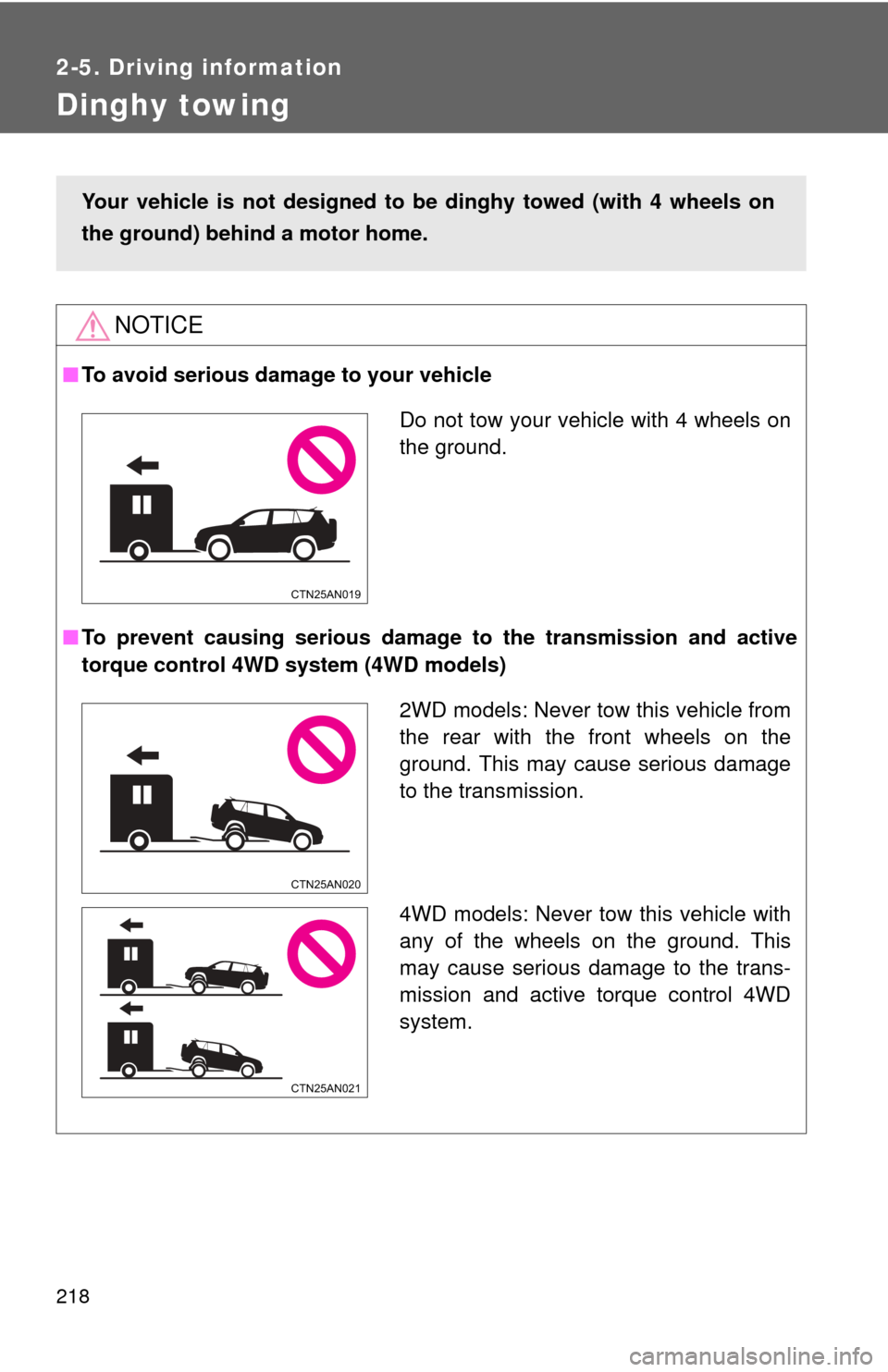
Your vehicle is not designed to be dinghy towed (with 4 wheels on
the ground) behind a motor home.
Do not tow your vehicle with 4 wheels on
the ground.
CTN25AN019
2WD models: Never tow this vehicle from
the rear with the front wheels on the
ground. This may cause serious damage
to the transmission.
4WD models: Never tow this vehicle with
any of the wheels on the ground. This
may cause serious damage to the trans-
mission and active torque control 4WD
system.
CTN25AN020
CTN25AN021
Page 414 of 513
5
When trouble arises
413
5-1. Essential information
NOTICE
■
To prevent body damage when towing with a sling-type truck
Do not tow with a sling-type truck, either from the front or rear.
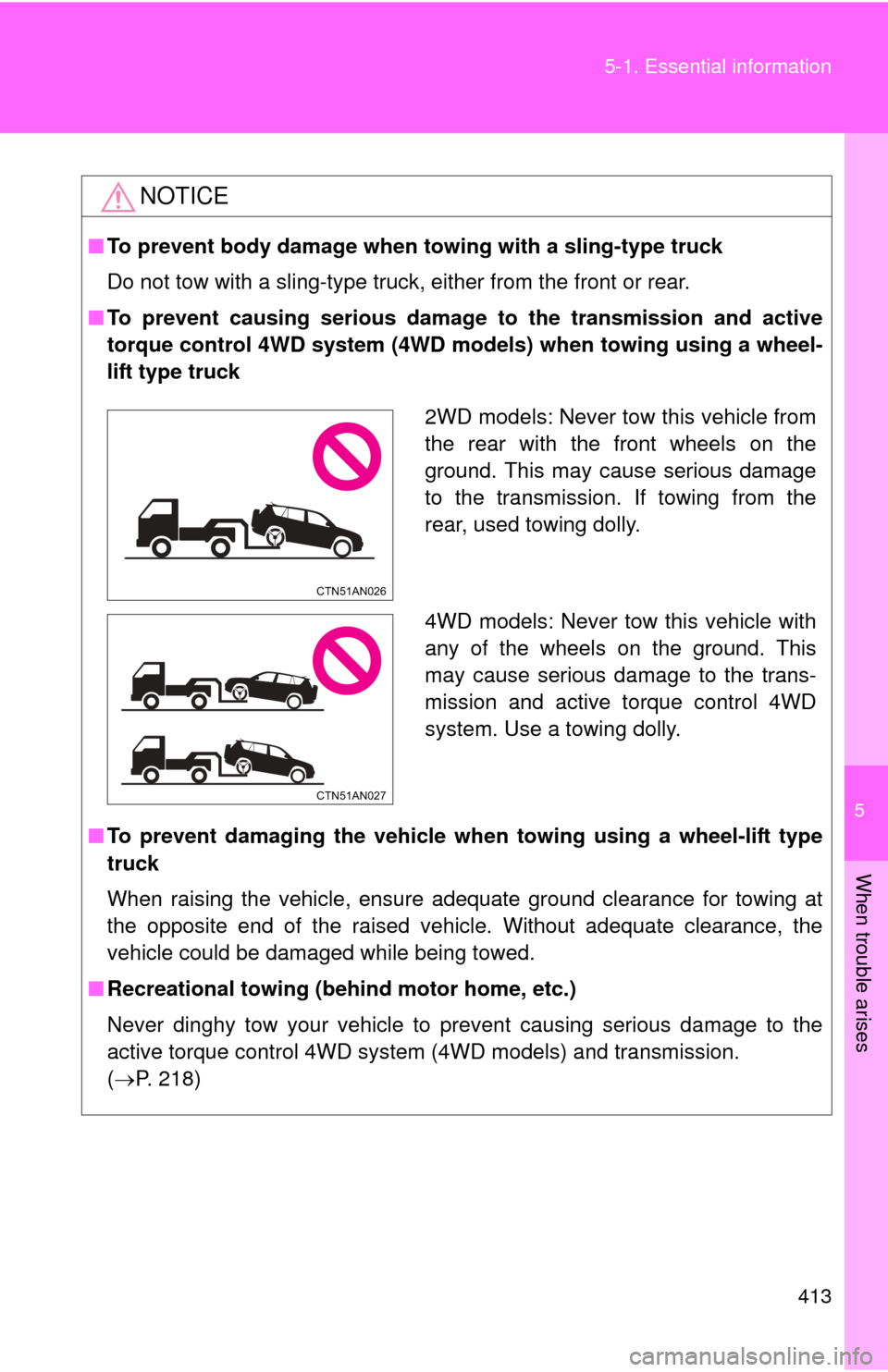
■ To prevent causing serious damage to the transmission and active
torque control 4WD system (4WD m odels) when towing using a wheel-
lift type truck
■ To prevent damaging the vehicle wh en towing using a wheel-lift type
truck
When raising the vehicle, ensure adequate ground clearance for towing at
the opposite end of the raised vehicle. Without adequate clearance, the
vehicle could be damaged while being towed.
■ Recreational towing (b ehind motor home, etc.)
Never dinghy tow your vehicle to prevent causing serious damage to the
active torque control 4WD system (4WD models) and transmission.
( P. 218)
2WD models: Never tow this vehicle from
the rear with the front wheels on the
ground. This may cause serious damage
to the transmission. If towing from the
rear, used towing dolly.
4WD models: Never tow this vehicle with
any of the wheels on the ground. This
may cause serious damage to the trans-
mission and active torque control 4WD
system. Use a towing dolly.
CTN51AN026
CTN51AN027
Page 441 of 513
440 5-2. Steps to take in an emergency
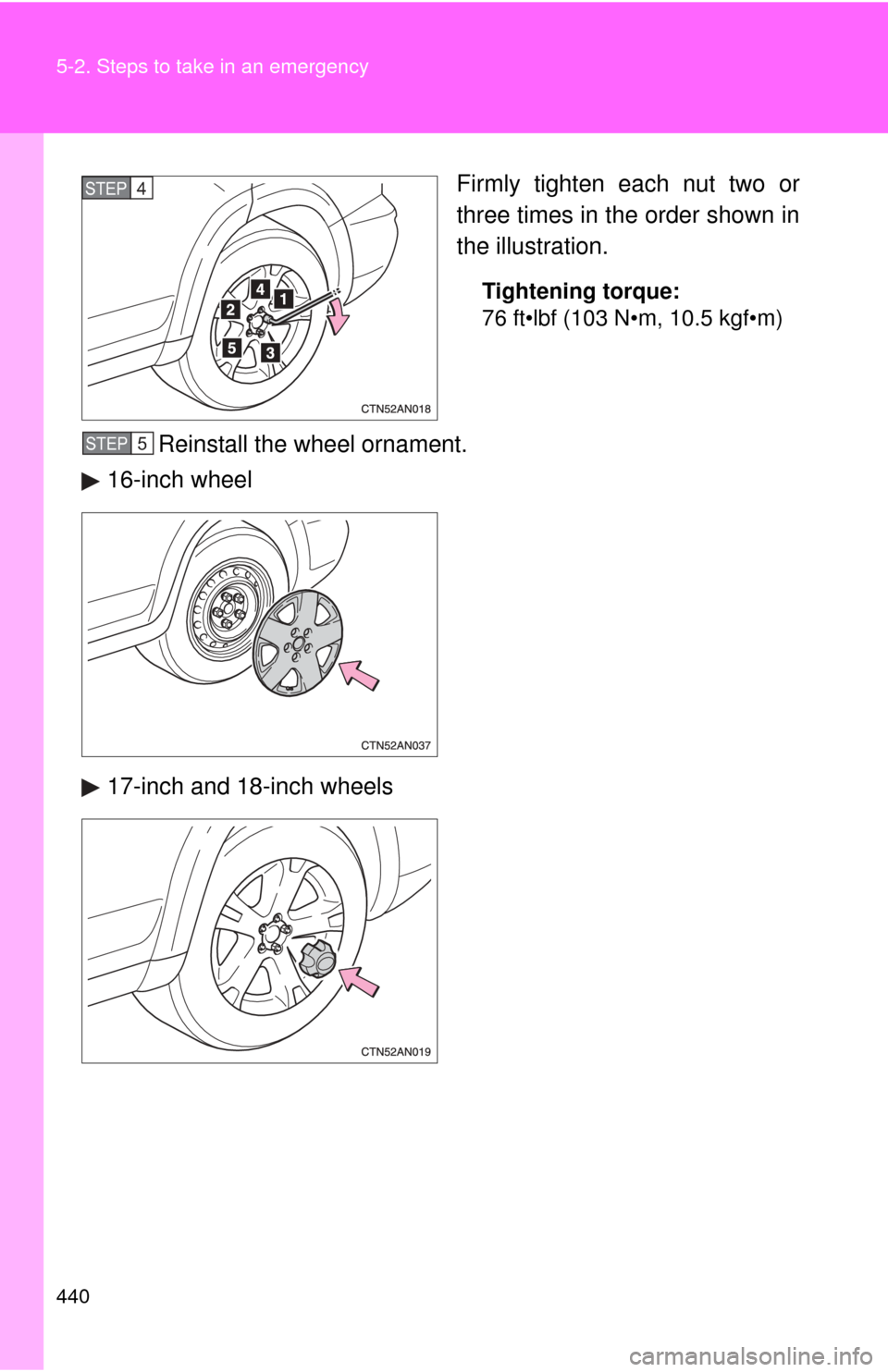
Firmly tighten each nut two or
three times in the order shown in
the illustration.
Tightening torque:
76 ft•lbf (103 N•m, 10.5 kgf•m)
Reinstall the wheel ornament.
16-inch wheel
17-inch and 18-inch wheels
STEP 4
STEP 5
Page 442 of 513
5
When trouble arises
441
5-2. Steps to take in an emergency
Stowing the flat tire
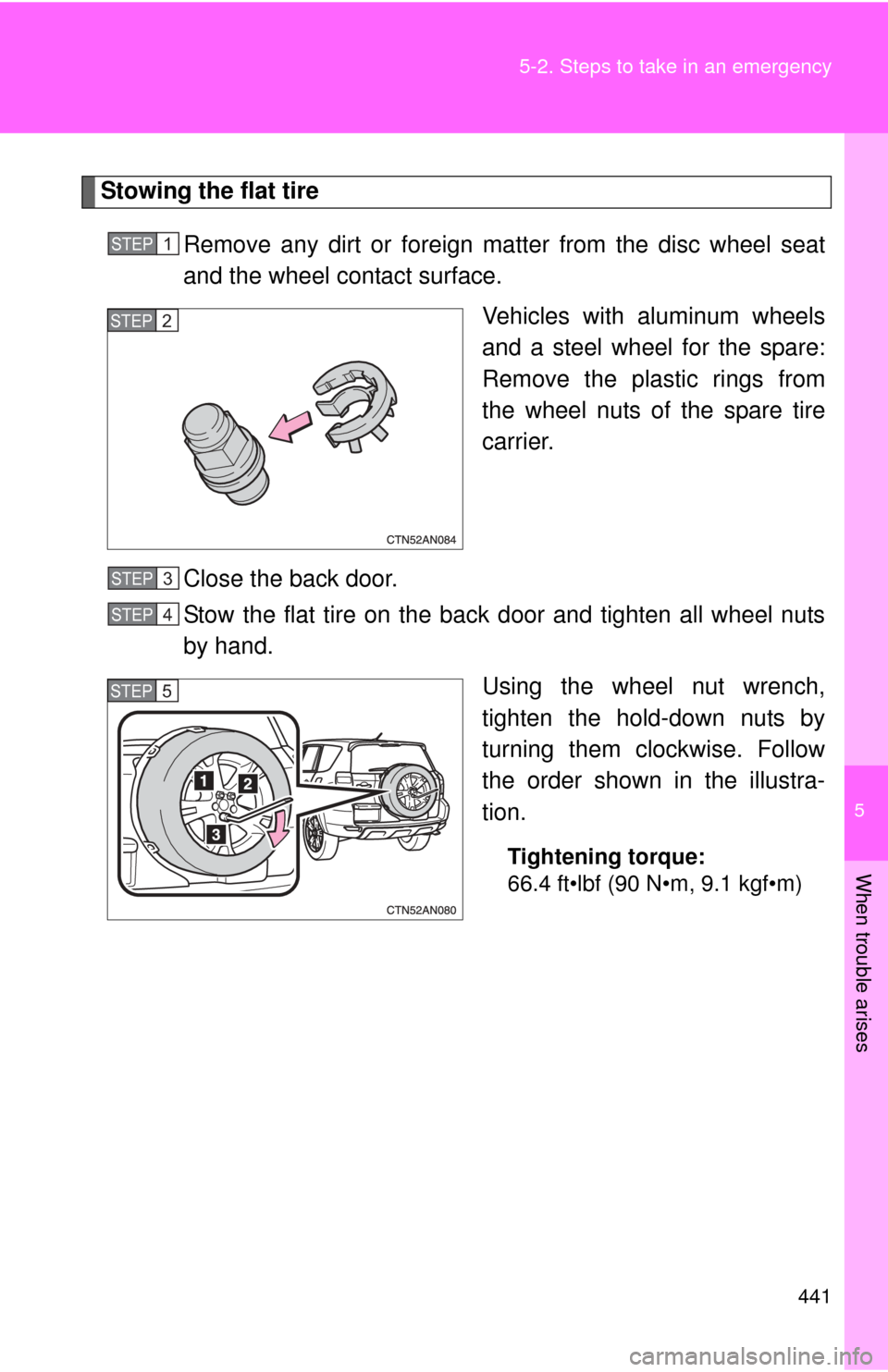
Remove any dirt or foreign matter from the disc wheel seat
and the wheel contact surface. Vehicles with aluminum wheels
and a steel wheel for the spare:
Remove the plastic rings from
the wheel nuts of the spare tire
carrier.
Close the back door.
Stow the flat tire on the back door and tighten all wheel nuts
by hand. Using the wheel nut wrench,
tighten the hold-down nuts by
turning them clockwise. Follow
the order shown in the illustra-
tion.
Tightening torque:
66.4 ft•lbf (90 N•m, 9.1 kgf•m)
STEP 1
STEP 2
STEP 3
STEP 4
STEP 5
Page 446 of 513

5
When trouble arises
445
5-2. Steps to take in an emergency
CAUTION
■Replacing a flat tire
Observe the following precautions to reduce the risk of death or serious
injury:
●Do not try to remove the ornament by hand. Take due care in handling
the ornament to avoid unexpected personal injury.
●Never use oil or grease on the wheel bolts or wheel nuts.
Oil and grease may cause the wheel nuts to be excessively tightened,
leading to bolt or disc wheel damage. In addition, the oil or grease can
cause the wheel nuts to loosen and the wheel may fall off, causing a
serious accident. Remove any oil or grease from the wheel bolts or
wheel nuts.
●Have the wheel nuts tightened with a torque wrench to 76 ft•lbf (103
N
•m, 10.5 kgf•m) as soon as possible after changing wheels.
Failure to follow these precautions could cause the nuts to loosen and
the wheel may fall off, which could lead to an accident causing death
or serious injury.
●Do not attach a heavily damaged wheel ornament, as it may fly off the
wheel while the ve hicle is moving.
●Make sure that the rubber rings are not installed to the wheel nuts for
aluminum wheel. Otherwise, the nuts may become loose and the
wheel may fall off, which may cause a serious accident.
Page 473 of 513
472 6-1. Specifications
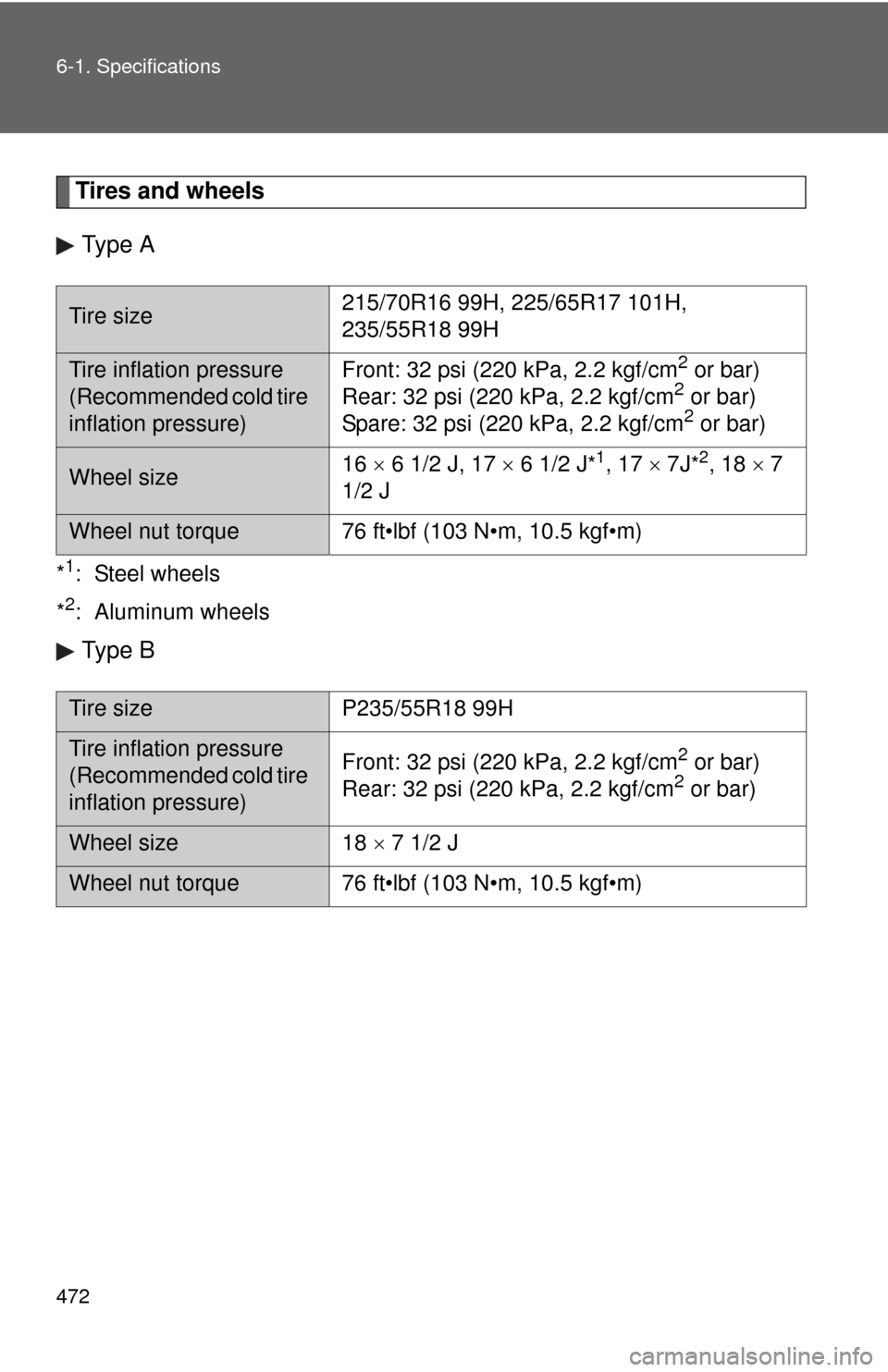
Tires and wheelsType A
*1: Steel wheels
*
2: Aluminum wheels
Type B
Tire size 215/70R16 99H, 225/65R17 101H,
235/55R18 99H
Tire inflation pressure
(Recommended cold tire
inflation pressure)Front: 32 psi (220 kPa, 2.2 kgf/cm2 or bar)
Rear: 32 psi (220 kPa, 2.2 kgf/cm2 or bar)
Spare: 32 psi (220 kPa, 2.2 kgf/cm2 or bar)
Wheel size 16
6 1/2 J, 17 6 1/2 J*1, 17 7J*2, 18 7
1/2 J
Wheel nut torque 76 ft•lbf (103 N•m, 10.5 kgf•m)
Tire size P235/55R18 99H
Tire inflation pressure
(Recommended cold tire
inflation pressure) Front: 32 psi (220 kPa, 2.2 kgf/cm2 or bar)
Rear: 32 psi (220 kPa, 2.2 kgf/cm2 or bar)
Wheel size 18 7 1/2 J
Wheel nut torque 76 ft•lbf (103 N•m, 10.5 kgf•m)