Page 397 of 513
396
4-3. Do-it-yourself maintenance
Light bulbs
You may replace the following bulbs yourself. The difficulty level of
replacement varies depending on the bulb. If necessary bulb
replacement seems difficult to perfor m, contact your Toyota dealer.
For more information about replacing other light bulbs, contact your
Toyota dealer.
■ Preparing a light bulb for replacement
Check the wattage of the light bulb being replaced. ( P. 473)
■ Removing the engine compartment cover
P. 352
■ Front bulb locations
Headlight
low beam
Front turn signal, parking and
front side marker lights
Headlight high beam
Front fog lights
(if equipped)
Page 406 of 513

When trouble arises5
405
5-1. Essential informationEmergency flashers ......... 406
If your vehicle needs to be towed ........................ 407
If you think something is wrong ......................... 414
Fuel pump shut off system ........................... 415
Event data recorder ......... 416 5-2. Steps to take in an
emergency
If a warning light turns on or a warning buzzer
sounds... ....................... 418
If you have a flat tire (vehicles with standard
tires) ............................... 430
If you have a flat tire (vehicles with run-flat
tires) ............................... 447
If the engine will not start ................................ 448
If the shift lever cannot be shifted from P............ 449
If you lose your keys ........ 450
If the electronic key does not operate properly....... 451
If the battery is discharged ..................... 453
If your vehicle overheats ....................... 456
If the vehicle becomes stuck .............................. 458
If your vehicle has to be stopped in an
emergency ..................... 459
Page 407 of 513
406
5-1. Essential information
Emergency flashers
NOTICE
■To prevent battery discharge
Do not leave the emergency flashers on longer than necessary when the
engine is not running.
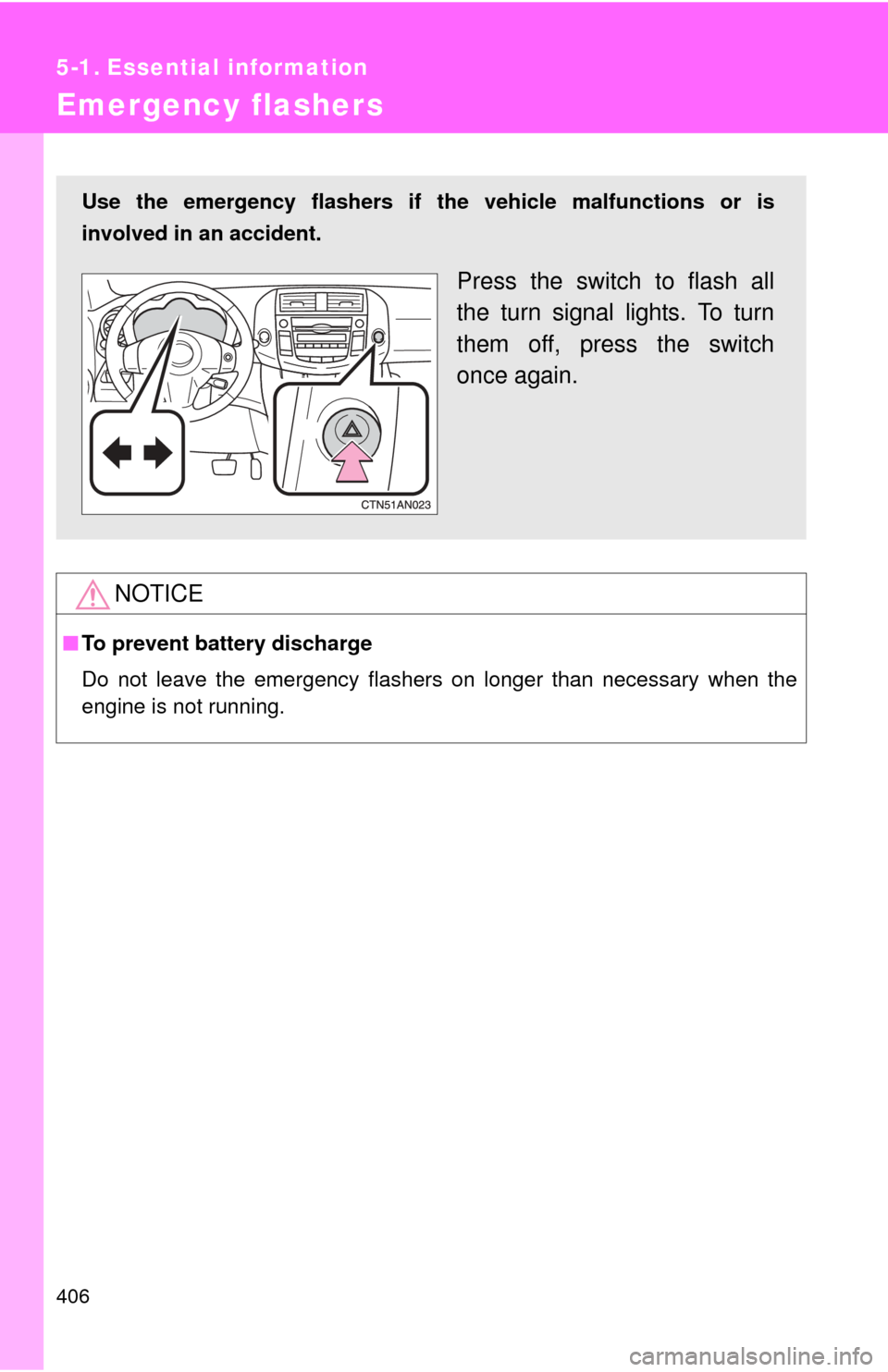
Use the emergency flashers if th e vehicle malfunctions or is
involved in an accident.
Press the switch to flash all
the turn signal lights. To turn
them off, press the switch
once again.
Page 408 of 513
5
When trouble arises
407
5-1. Essential information
If your vehicle needs to be towed
Before towingThe following may indicate a problem with your transmission. Contact
your Toyota dealer before towing.
● The engine is running, but the vehicle will not move.
● The vehicle makes an abnormal sound.
If towing is necessary, we recommend having your vehicle towed by
your Toyota dealer or a commercial towing service, using a wheel-lift
type truck or a flat bed truck.
Use a safety chain system for all to wing, and abide by all state/pro-
vincial and local laws.
2WD models: If towing your vehicle with a wheel-lift type truck from
the front, the vehicle's rear wheels and axles must be in good condi-
tions. ( P. 410, 413)
If they are damaged, use a towing dolly or flat bed truck.
4WD models: If towing your vehicle with a wheel-lift type truck, use a
towing dolly. ( P. 410, 413)
Page 412 of 513
5
When trouble arises
411
5-1. Essential information
From the rear
Use a towing dolly under the
front wheels.
Using a flat bed truck
If you use chains or cables to tie
down your vehicle, the angles
shaded in black must be 45.
Do not overly tighten the tie
downs or the vehicle may be
damaged.
■ Emergency towin g procedure
Release the parking brake.
Shift the shift lever to N.
Vehicles without smart key system: Turn the engine switch to “ACC”
(engine off) or “ON” (engine running) position.
Vehicles with smart key system: Turn the “ENGINE START STOP”
switch to ACCESSORY (engine off) or IGNITION ON (engine run-
ning) mode.
■ Location of the emer gency towing eyelet
The emergency towing eyelet is in the tool bag. ( P. 430)
STEP 1
STEP 2
STEP 3
Page 413 of 513
412 5-1. Essential information
CAUTION
■Caution while towing
●Use extreme caution when towing the vehicle.
Avoid sudden starts or erratic driving maneuvers which place excessive
stress on the emergency towing eyelet and the cables or chains. Always
use caution for the surroundings and other vehicles while towing.
● If the engine is not running, the power assist for the brakes and steering
will not function, making steering and braking more difficult.
■ Installing towing eyelet to the vehicle
Make sure that towing eyelet is installed securely.
If not securely installed, towing eyelet may come loose during towing. This
may lead to accidents that cause serious injury or even death.
Page 415 of 513
414
5-1. Essential information
If you think something is wrong
If you notice any of the following symptoms, your vehicle probably
needs adjustment or repair. Contact your Toyota dealer as soon as
possible.
■ Visible symptoms
●Fluid leaks under the vehicle
(Water dripping from the air cond itioning after use is normal.)
● Flat-looking tires or uneven tire wear
● Engine coolant temperature g auge needle continually points
higher than normal
■ Audible symptoms
●Changes in exhaust sound
● Excessive tire squeal when cornering
● Strange noises related to the suspension system
● Pinging or other noises related to the engine
■ Operational symptoms
●Engine missing, stumbling or running rough
● Appreciable loss of power
● Vehicle pulls heavily to one side when braking
● Vehicle pulls heavily to one side when driving on a level road
● Loss of brake effectiveness, s pongy feeling, pedal almost
touches the floor
Page 416 of 513
5
When trouble arises
415
5-1. Essential information
Fuel pump shut off system
Follow the procedure below to restart the engine after the system is
activated.
Vehicles without smart key system Turn the engine switch to the “ACC” or “LOCK” position.
Restart the engine.
Vehicles with smart key system Turn the “ENGINE START STOP” switch OFF.
Restart the engine.
NOTICE
■Before starting the engine
Inspect the ground under the vehicle.
If you find that fuel has leaked onto the ground, the fuel system has been
damaged and is in need of repair. Do not restart the engine.
To minimize the risk of fuel leakage when the engine stalls or an air-
bag inflates upon collision, the fu el pump shut off system stops sup-
plying fuel to the engine.
STEP 1
STEP 2
STEP 1
STEP 2