Page 241 of 616

241
2-4. Using other
driving systems
2
When driving
PRIUS_U (OM47668U) U.S.A.
CAUTION
■Situations unsuitable for the LKA system
Using the LKA system in any of the following situations may result in
improper operation of the system and could lead to an accident, causing
death or serious injury. Turn the LKA system off while driving in any of the
following situations.
● When it is difficult to see lane markings because they are dirty or not clear
● When it is difficult to see lane markings due to rain, snow, fog or glare
● When the headlights are not bright enough due to dirt on the lenses or if
the headlight aim is not adjusted appropriately
● When a lane marking is not present, such as before tollbooths on a free-
way
● When sudden changes in the light level occur repetitively
● When there are misleading lines such as shadows, lines of snow, wheel
ruts with rain collected in them, or lines that remain after road repairs
● When driving in lanes other than the driving lane or passing lane on free-
way or motor highways
● When there is a lane closure due to road repairs or when driving in a
makeshift lane
● When the lanes are narrow or wide
● When the distance from the vehicle ahead of you is short
● When the vehicle leans to one side an unusual amount due to a heavy
load or improper tire inflation pressure
● When driving on winding roads or on uneven roads
● When driving on slippery roads, such as those covered with rain, ice or \
snow
● The tires have been exchanged (including snow tires), or the suspension
has been modified
Page 248 of 616
248 2-4. Using other driving systems
PRIUS_U (OM47668U) U.S.A.
CAUTION
■When the Enhanced VSC is activated
The slip indicator light flashes and a warning buzzer sounds. Always drive
carefully.
Reckless driving may cause an accident. Exercise particular care when the
indicator light flashes and a buzzer sounds.
■ Replacing tires
Make sure that all tires are of the same size, brand, tread pattern and total
load capacity. In addition, make sure that the tires are inflated to the speci-
fied tire pressure level.
The ABS and Enhanced VSC will not function correctly if different tires are
fitted on the vehicle.
Contact your Toyota dealer for further information when replacing tires or
wheels.
■ Handling of tires and suspension
Using tires with any kind of problem or modifying the suspension will affect
the driving assist systems, and may cause the system to malfunction.
Page 255 of 616
255
2
When driving
PRIUS_U (OM47668U) U.S.A.
2-5. Driving information
Cargo and luggage
Take notice of the following information about storage precau-
tions, cargo capacity and load.
●Stow cargo and luggage in the luggage compartment when-
ever possible. Be sure all items are secured in place.
● Be careful to keep the vehicle le vel. Placing the weight as far
forward as possible helps maintain vehicle balance.
● For better fuel economy, do no t carry unnecessary weight.
Page 256 of 616

256 2-5. Driving information
PRIUS_U (OM47668U) U.S.A.
Capacity and distributionCargo capacity depends on the total weight of the occupants.
(Cargo capacity) = (Total load capa city) — (Total weight of occupants)
Steps for Determining Correct Load Limit—
(1) Locate the statement “The comb ined weight of occupants and
cargo should never exceed XXX kg or XXX lbs.” on your vehi-
cle’s placard.
(2) Determine the combined weight of the driver and passengers that will be riding in your vehicle.
(3) Subtract the combined weight of the driver and passengers from
XXX kg or XXX lbs.
(4) The resulting figure equals the available amount of cargo and luggage load capacity.
For example, if the “XXX” amount equals 1400 lbs. and there will
be five 150 lb passengers in your vehicle, the amount of avail-
able cargo and luggage load capacity is 650 lbs. (1400 - 750 (5
150) = 650 lbs.)
(5) Determine the combined weight of luggage and cargo being loaded on the vehicle.
That weight may not safely exceed the available cargo and lug-
gage load capacity calculated in Step 4.
(6) If your vehicle will be towing a tr ailer, load from your trailer will
be transferred to your vehicle. C onsult this manual to determine
how this reduces the available cargo and luggage load capacity
of your vehicle. ( P. 260)
Toyota does not recommend towing a trailer with your vehicle.
Your vehicle is not designed for trailer towing.
Page 257 of 616
257
2-5. Driving information
2
When driving
PRIUS_U (OM47668U) U.S.A.
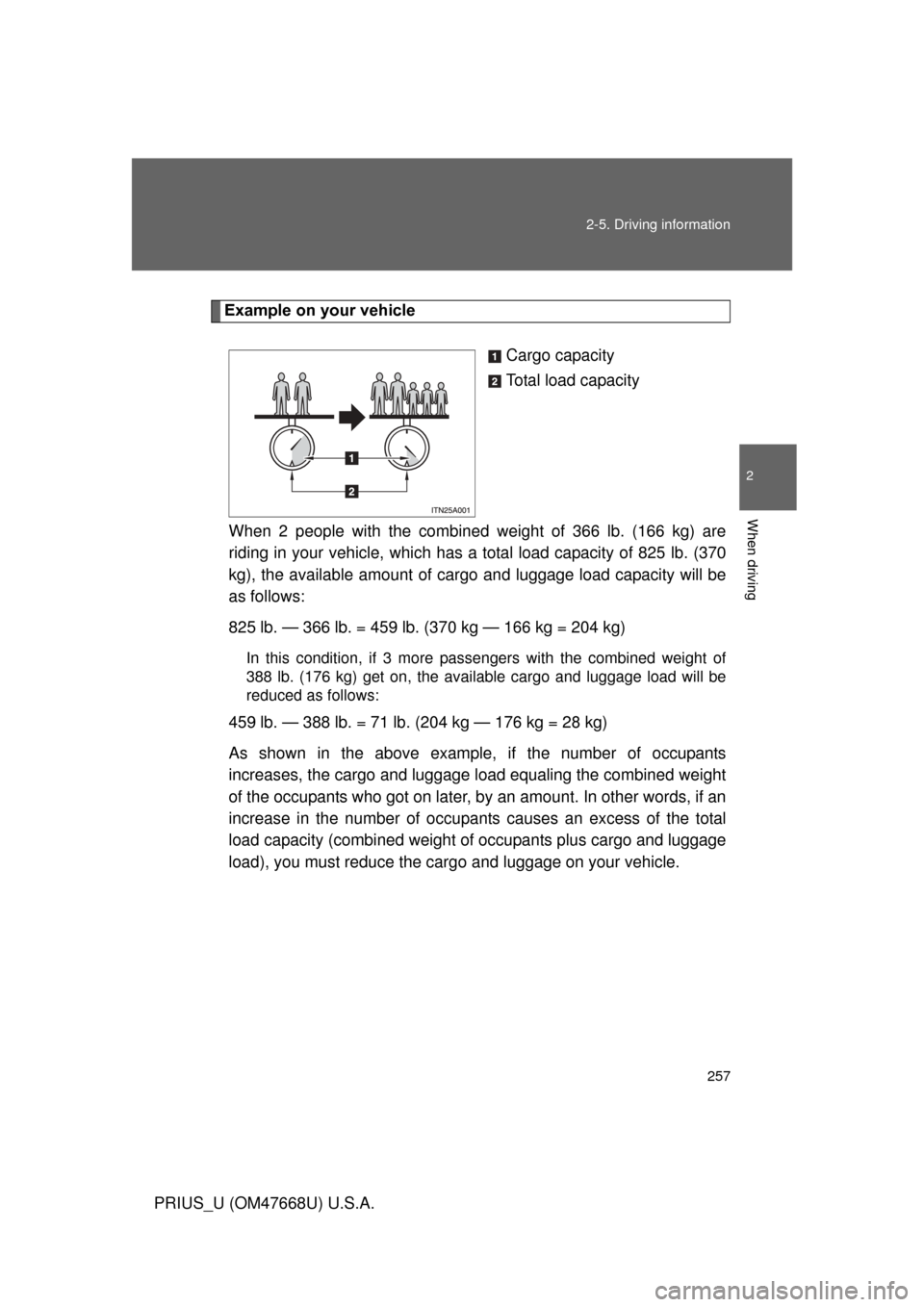
Example on your vehicle
Cargo capacity
Total load capacity
When 2 people with the combined weight of 366 lb. (166 kg) are
riding in your vehicle, which has a total load capacity of 825 lb. (370
kg), the available amount of cargo and luggage load capacity will be
as follows:
825 lb. — 366 lb. = 459 lb. (370 kg — 166 kg = 204 kg)
In this condition, if 3 more pass engers with the combined weight of
388 lb. (176 kg) get on , the available cargo and luggage load will be
reduced as follows:
459 lb. — 388 lb. = 71 lb. (204 kg — 176 kg = 28 kg)
As shown in the above example, if the number of occupants
increases, the cargo and luggage l oad equaling the combined weight
of the occupants who got on later, by an amount. In other words, if an
increase in the number of occupants causes an excess of the total
load capacity (combined weight of occupants plus cargo and luggage
load), you must reduce the carg o and luggage on your vehicle.
Page 258 of 616

258 2-5. Driving information
PRIUS_U (OM47668U) U.S.A.
CAUTION
■Things that must not be carried in the luggage compartment
The following things may cause a fire if loaded in the luggage compart-
ment.
●Receptacles containing gasoline
●Aerosol cans
■Storage precautions
Observe the following precautions.
Failing to do so may result in death or serious injury.
●Do not place cargo or luggage in or on the following locations as the
item may get under the brake or accelerator pedal and prevent the
pedals from being depressed properly , block the driver’s vision, or hit
the driver or passengers, causing an accident.
• Driver’s feet
• Front passenger or rear seats (when stacking items)
• Luggage cover (if equipped)
• Instrument panel
• Dashboard
• Auxiliary box or tray that has no lid
●Secure all items in the occupant compartment, as they may shift and
injure someone during sudden braking, sudden swerving or an acci-
dent.
●Never allow anyone to ride in the luggage compartment. It is not
designed for passengers. They should ride in their seats with their seat
belts properly fastened. Otherwise, th ey are much more likely to suffer
death or serious injury, in the event of sudden braking, sudden swerv-
ing or an accident.
Page 259 of 616
259
2-5. Driving information
2
When driving
PRIUS_U (OM47668U) U.S.A.
CAUTION
■Weight of the load
●Do not exceed the maximum axle weight rating or the total vehicle
weight rating.
●Even if the total load of occupant’s
weight and the cargo load is less
than the total load capacity, do no t apply the load unevenly. Improper
loading may cause deterioration of st eering or braking control which
may cause death or serious injury.
Page 260 of 616

260
2-5. Driving information
PRIUS_U (OM47668U) U.S.A.
Vehicle load limits
■Total load capacity and seating capacity
These details are also described on the tire and loading information
label. (P. 451)
CAUTION
■Overloading the vehicle
Do not overload the vehicle.
It may not only cause damage to the ti res, but also degrade steering and
braking ability, resulting in an accident.
Vehicle load limits include total load capacity, seating capacity,
towing capacity and cargo capacity.
■ Total load capacity: 825 lb. (370 kg)
Total load capacity means the combined weight of occupants,
cargo and luggage.
■ Seating capacity: 5 occupants (Front 2, Rear 3)
Seating capacity means the ma ximum number of occupants
whose estimated average weight is 150 lb. (68 kg) per person.
Even if the number of occupants are within the seating capacity,
do not exceed the total load capacity.
■ Towing capacity
Toyota does not recommend towing a trailer with your vehicle.
■ Cargo capacity
Cargo capacity may increase or decrease depending on the
weight and the number of occupants.