Page 315 of 616

315
3-2. Using the audio system
3
Interior features
PRIUS_U (OM47668U) U.S.A.
■
Lens cleaners
P. 308
■ MP3 and WMA files
MP3 (MPEG Audio LAYER3) is a standard audio compression format.
Files can be compressed to approximately 1/10 of their original size by using
MP3 compression.
WMA (Windows Media
TM Audio) is a Microsoft audio compression format.
This format compresses audio data to a size smaller than that of the MP3
format.
There is a limit to the MP3 and WMA file standards and to the media/formats
recorded by them that can be used.
● MP3 file compatibility
• Compatible standards
MP3 (MPEG1 LAYER3, MPEG2 LSF LAYER3)
• Compatible sampling frequencies
MPEG1 LAYER3: 32, 44.1, 48 (kHz)
MPEG2 LSF LAYER3: 16, 22.05, 24 (kHz)
• Compatible bit rates
MPEG1 LAYER3: 64, 80, 96, 112, 128, 160, 192, 224, 256, 320 (kbps)
• MPEG2 LSF LAYER3: 64, 80, 96, 112, 128, 144, 160 (kbps)
* Compatible with VBR
• Compatible channel modes: stereo, joint stereo, dual channel and monaural
Page 384 of 616
384
3-6. Other interior features
PRIUS_U (OM47668U) U.S.A.
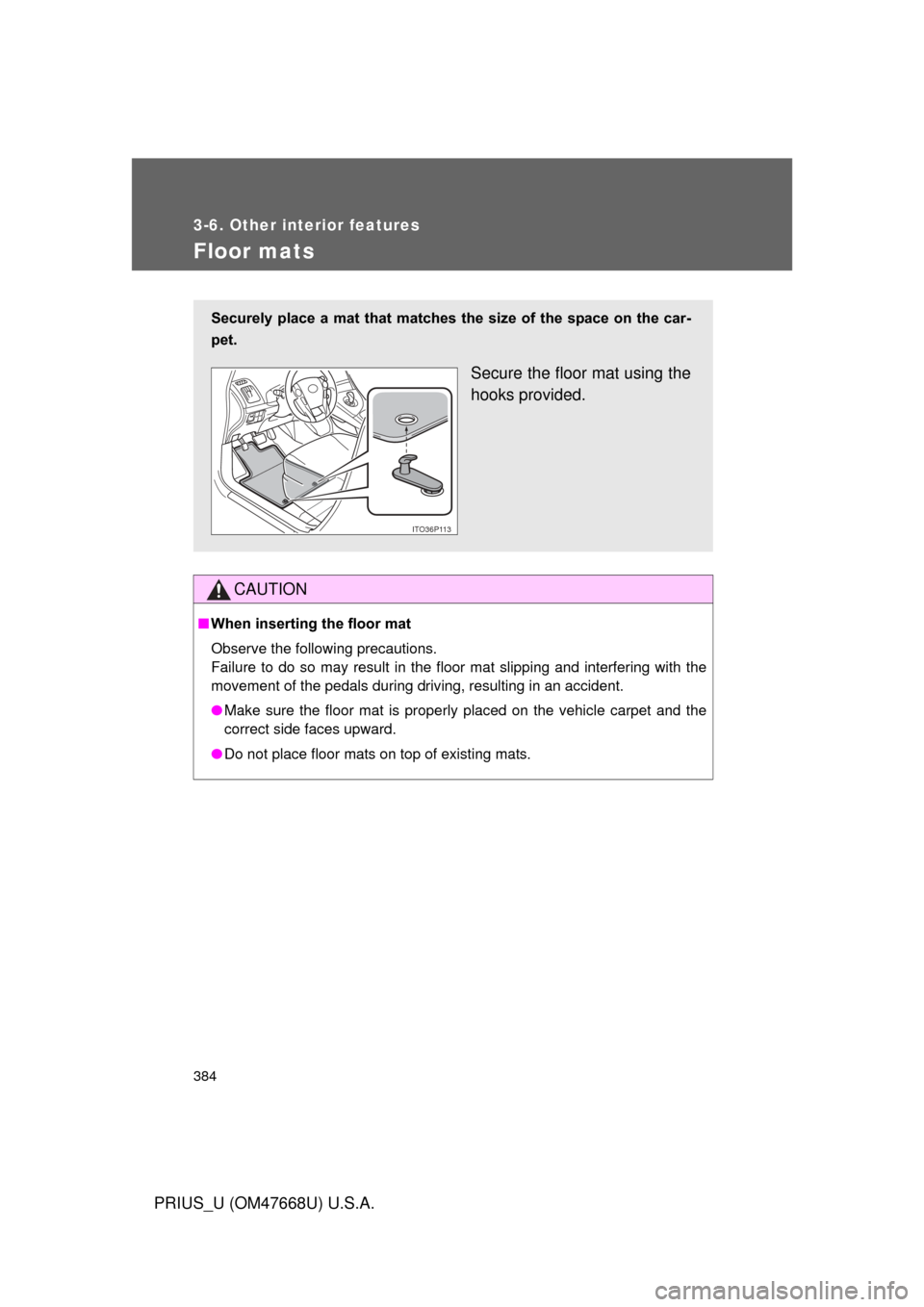
Floor mats
CAUTION
■When inserting the floor mat
Observe the following precautions.
Failure to do so may result in the floor mat slipping and interfering wi\
th the
movement of the pedals during driving, resulting in an accident.
● Make sure the floor mat is properly placed on the vehicle carpet and the
correct side faces upward.
● Do not place floor mats on top of existing mats.
Securely place a mat that matches the size of the space on the car-
pet.
Secure the floor mat using the
hooks provided.
ITO36P113
Page 442 of 616

442 4-3. Do-it-yourself maintenance
PRIUS_U (OM47668U) U.S.A.
Installing tire pressure warning valves and transmittersWhen replacing tires or wheels, ti re pressure warning valves and
transmitters must also be installed.
When new tire pressure warning valves and transmitters are
installed, new tire pressure warn ing valve and transmitter ID codes
must be registered in the tire pres sure warning computer and tire
pressure warning system must be initialized. Have tire pressure
warning valve and transmitter ID codes registered by Toyota dealer.
( P. 444)
Initializing the tire pressure warning system
■ The tire pressure warning system must be initialized in the fol-
lowing circumstances
●When rotating the tires on vehicles differing with front and rear
tire inflation pressures.
● When changing the tire inflation pressure by changing traveling
speed or load weight, etc.
● When changing the tire size.
When the tire pressure warning system is initialized, the current
tire inflation pressure is set as the pressure benchmark.
■ The tire pressure warning system
Your Toyota is equipped with a tire pressure warning system that
uses tire pressure warning valves and transmitters to detect low
tire inflation pressure before serious problems arise. (P. 499)
The compact spare tire is not equipped with a tire pressure
warning valve and transmitter.
Page 444 of 616

444 4-3. Do-it-yourself maintenance
PRIUS_U (OM47668U) U.S.A.
Registering ID codesThe tire pressure warning valve and transmitter is equipped with a
unique ID code. When replacing a ti re pressure warning valve and
transmitter, it is necessary to regist er the ID code of tire pressure
warning valve and transmitter. Have the ID code registered by your
Toyota dealer.
■ When to replace your vehicle’s tires
Tires should be replaced if:
● You have tire damage such as cuts, splits, cracks deep enough to
expose the fabric or bulges indicating internal damage
● A tire goes flat repeatedly or cannot be properly repaired due to the size
or location of a cut or other damage
If you are not sure, consult with your Toyota dealer.
■ Replacing tires and wheels
If the ID code of the tire pressure warning valve and transmitter is not regis-
tered, the tire pressure warning system will not work properly. After driving
for about 20 minutes, the tire pressure warning light comes on after blinking
for 1 minute to indicate a system malfunction.
Page 446 of 616

446 4-3. Do-it-yourself maintenance
PRIUS_U (OM47668U) U.S.A.
■Tire types
1 Summer tiresSummer tires are high-speed performance tires best suited to highway
driving under dry conditions. Since summer tires do not have the same
traction performance as snow tire s, summer tires are inadequate for
driving on snow-covered or icy ro ads. For driving on snow-covered
roads or icy roads, the use of snow tires is recommended. When
installing snow tires, be sure to replace all four tires.
2 All season tires All season tires are designed to provide better traction in snow and to
be adequate for driving in most winter conditions, as well as for use
year round. All season tires, however, do not have adequate traction
performance compared with snow tires in heavy or loose snow. Also,
all season tires fall short in acceleration and handling performance
compared with summer tires in highway driving.
3Snow tires
For driving on snow-covered roads or icy roads, we recommend using
snow tires. If you need snow tires, select tires of the same size, con-
struction and load capacity as the or iginally installed tires. Since your
vehicle has radial tires as original equipment, make sure your snow
tires also have radial construction. Do not install studded tires without
first checking local regulations for possible restriction. Snow tires
should be installed on all wheels. ( P. 261)
Page 449 of 616

449
4-3. Do-it-yourself maintenance
4
Maintenance and care
PRIUS_U (OM47668U) U.S.A.
CAUTION
■When inspecting or replacing tires
Observe the following precautions to
prevent accidents. Failure to do so
may cause damage to parts of the drive train, as well as dangerous han-
dling characteristics, which may lead to an accident resulting in death or
serious injury.
●Do not mix tires of different ma kes, models or tread patterns.
Also, do not mix tires of remarkably different treadwear.
●Do not use tire sizes other than those recommended by Toyota.
●Do not mix differently constructed tire s (radial, bias-belted or bias-ply
tires).
●Do not mix summer, all season and winter tires.
●Do not use tires that have been used on another vehicle.
Do not use tires if you do not know how they were used previously.
■When initializing the tire pressure warning system
Do not push the tire pressure warnin g reset switch without first adjusting
the tire inflation pressure to the spec ified level. Otherwise, the tire pres-
sure warning light may not come on even if the tire inflation pressure is
low, or it may come on when the tire inflation pressure is actually normal.
Page 451 of 616
451
4-3. Do-it-yourself maintenance
4
Maintenance and care
PRIUS_U (OM47668U) U.S.A.
Tire inflation pressure
■Tire inflation pressure
The recommended cold tire inflation pressure and tire size is dis-
played on the tire and loadi ng information label. (P. 565)
Page 455 of 616

455
4-3. Do-it-yourself maintenance
4
Maintenance and care
PRIUS_U (OM47668U) U.S.A.
Wheels
If a wheel is bent, cracked or heavily corroded, it should be
replaced.
Otherwise, the tire may separate from the wheel or cause loss of
handling control.
■ Wheel selection
When replacing wheels, care shou ld be taken to ensure that
they are equivalent to those removed in load capacity, diameter,
rim width, and inset
*.
Replacement wheels are available at your Toyota dealer.
*: Conventionally referred to as “offset”.
Toyota does not recommend using:
● Wheels of different sizes or types
● Used wheels
● Bent wheels that have been straightened
■ Aluminum wheel precautions
●Use only Toyota wheel nuts and wrenches designed for use
with your aluminum wheels.
● When rotating, repairing or changing your tires, check that the
wheel nuts are still tight after driving 1000 miles (1600 km).
● Be careful not to damage the aluminum wheels when using
tire chains.
● Use only Toyota genuine balance weights or equivalent and a
plastic or rubber hammer when balancing your wheels.