Page 5 of 592

1
2
3
4
5
6
7
5
L/C200_U
5-1. Essential informationEmergency flashers ............ 490
If your vehicle needs to be towed ................................ 491
If you think something is wrong ................................ 496
Fuel pump shut off system .............................. 497
Event data recorder ............ 498
5-2. Steps to take in an emergency If a warning light turns on or a warning sounds... ..... 500
If a warning message is displayed........................... 511
If you have a flat tire............ 514
If the engine will not start .... 526
If the shift lever cannot be shifted from P.................... 528
If you lose your keys ........... 529
If you cannot operate back door opener .............. 530
If the electronic key does not operate properly.......... 531
If the battery is discharged ........................ 534
If your vehicle overheats ..... 537
If the vehicle becomes stuck ................................. 540 6-1. Specifications
Maintenance data (fuel, oil level, etc.) ........... 542
Fuel information.................. 552
Tire information .................. 555
6-2. Customization Customizable features........ 567
6-3. Initialization Items to initialize ................. 576
Reporting safety defects for U.S. owners ................ 578
Abbreviation list ............... 580
Alphabetical index............ 582
What to do if... .................. 590
5When trouble arises6Vehicle specifications
7For U.S. owners
Index
Page 151 of 592

151
2-1. Driving procedures
2
When driving
L/C200_U
NOTICE
■
If you get a flat tire while driving
A flat or damaged tire may cause the following situations. Hold the steering
wheel firmly and gradually press the brake pedal to slow down the vehicle.
● It may be difficult to control your vehicle.
● The vehicle will make abnormal sounds.
● The vehicle will behave abnormally.
Replace a flat tire with a new one. ( P. 514)
■ When encountering flooded roads
Do not drive on a road that has flooded after heavy rain etc. Doing so may
cause the following serious damage to the vehicle.
● Engine stalling
● Short in electrical components
● Engine damage caused by water immersion
In the event that you drive on a flooded road and the vehicle is flooded, be
sure to have your Toyota dealer check the following.
● Brake function
● Changes in quantity and quality of oil and fluid used for the engine, trans-
mission, transfer, differentials, etc.
● Lubricant condition for the propeller shaft, bearings and suspension joints
(where possible) and the function of all joints, bearings, etc.
Page 165 of 592
165
2-2. Instrument cluster
2
When driving
L/C200_U
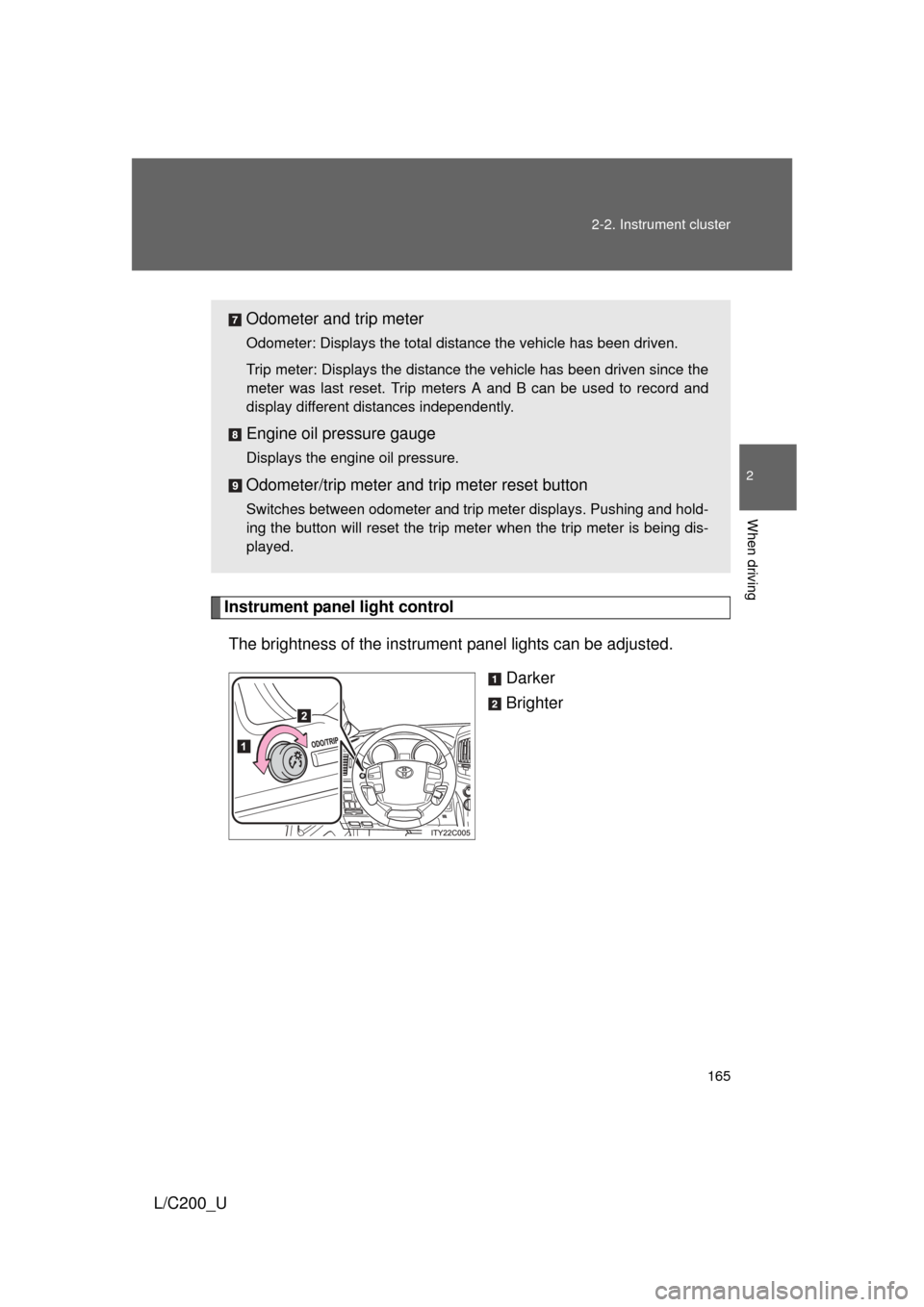
Instrument panel light control
The brightness of the instrument panel lights can be adjusted.
Darker
Brighter
Odometer and trip meter
Odometer: Displays the total distance the vehicle has been driven.
Trip meter: Displays the distance the vehicle has been driven since the
meter was last reset. Trip meters A and B can be used to record and
display different distances independently.
Engine oil pressure gauge
Displays the engine oil pressure.
Odometer/trip meter and trip meter reset button
Switches between odometer and trip meter displays. Pushing and hold-
ing the button will reset the trip meter when the trip meter is being dis-
played.
Page 166 of 592
166 2-2. Instrument cluster
L/C200_U
NOTICE
■To prevent damage to the engine and its components
● Do not let the indicator needle of the tachometer enter the red zone, which
indicates the maximum engine speed.
● The engine may be overheating if the engine coolant temperature gauge is
in the red zone (“H”). In this case, immediately stop the vehicle in a safe
place, and check the engine after it has cooled completely. ( P. 537)
■ While driving
● When the voltmeter indicates more than 19 V or less than 9 V, the battery
may be malfunctioning. Have your vehicle checked at your Toyota dealer.
● When the engine oil pressure gauge does not work properly, immediately
stop the engine and contact your Toyota dealer.
Page 217 of 592

217
2-5. Driving information
2
When driving
L/C200_U
NOTICE
■
To prevent the water damage
Take all necessary safety measures to ensure that water damage to the
engine or other components does not occur.
● Water entering the engine air intake will cause severe engine damage.
● Water entering the automatic transmission will cause deterioration in shift
quality, locking up of your transmission accompanied by vibration, and ulti-
mately damage.
● Water can wash the grease from wheel bearings, causing rusting and pre-
mature failure, and may also enter the differentials, transmission and
transfer case, reducing the gear oil’s lubricating qualities.
■ When you drive through water
If driving through water, such as when crossing shallow streams, first check
the depth of the water and the bottom of the river bed for firmness. Drive
slowly and avoid deep water.
■ Inspection after off-road driving
● Sand and mud that has accumulat ed in brake drums and around brake
discs may affect braking efficiency and may damage brake system compo-
nents.
● Always perform a maintenance inspection after each day of off-road driv-
ing that has taken you through rough terrain, sand, mud, or water. For
scheduled maintenance information, refer to the “Scheduled Maintenance
Guide” or “Owner’s Manual Supplement”.
Page 226 of 592
226
2-5. Driving information
L/C200_U
Winter driving tips
Carry out the necessary preparations and inspections before driving
the vehicle in winter. Always drive the vehicle in a manner appropri-
ate to the prevailing weather conditions.
■ Pre-winter preparations
●Use fluids that are appropriate to the prevailing outside tem-
peratures.
• Engine oil
• Engine coolant
• Washer fluid
● Have a service technician inspect the level and specific grav-
ity of battery electrolyte.
● Have the vehicle fitted with four snow tires or purchase a set
of tire chains for the rear tires.
Ensure that all tires are the same size and brand, and that chains
match the size of the tires.
Page 281 of 592
281
3-2. Using the audio system
3
Interior features
L/C200_U
NOTICE
■
Player precautions
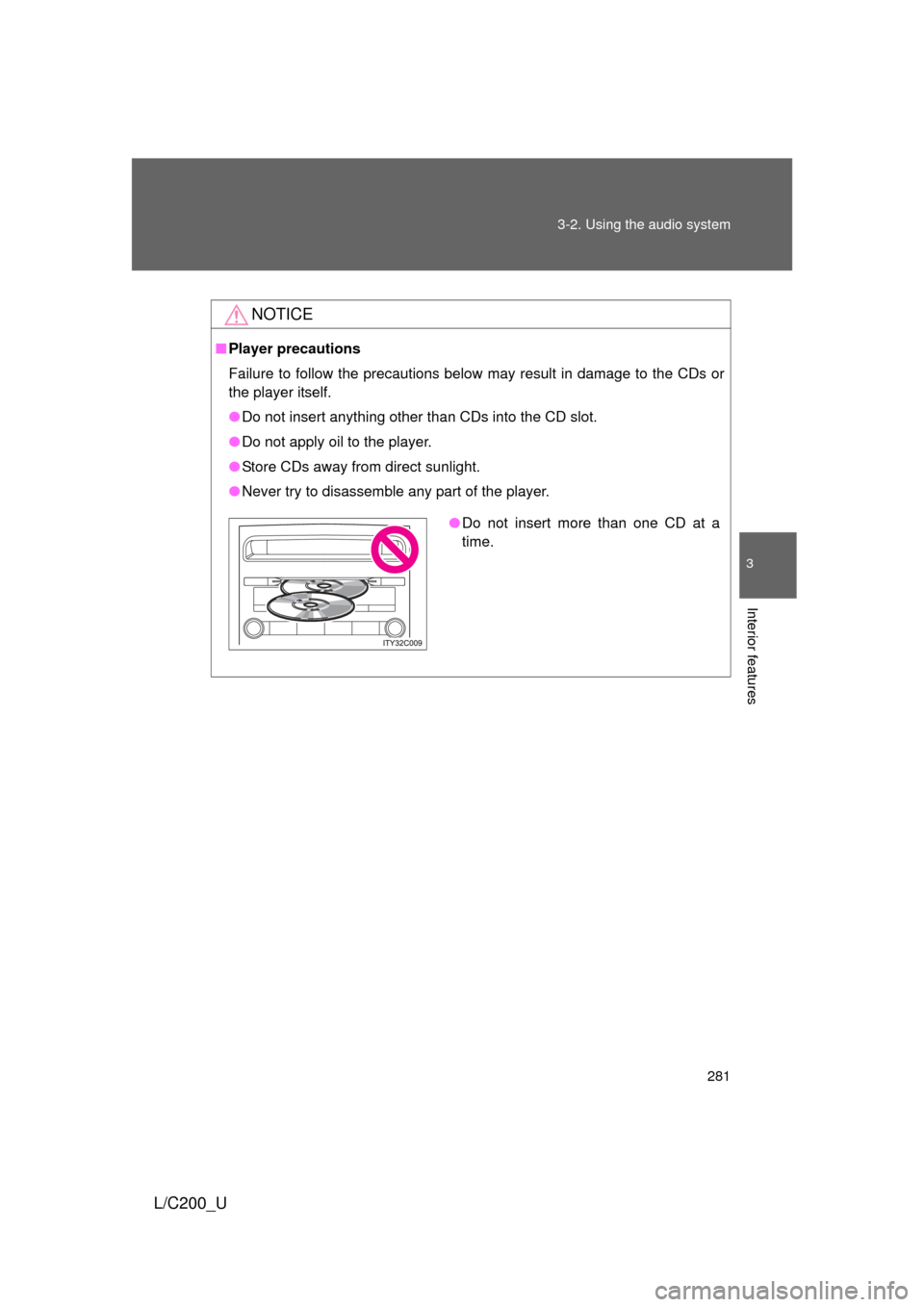
Failure to follow the precautions below may result in damage to the CDs or
the player itself.
● Do not insert anything other than CDs into the CD slot.
● Do not apply oil to the player.
● Store CDs away from direct sunlight.
● Never try to disassemble any part of the player.
●Do not insert more than one CD at a
time.
Page 413 of 592
413
4-1. Maintenance and care
4
Maintenance and care
L/C200_U
■
To prevent paint deterioratio n and corrosion on the body
● Wash the vehicle immediately in the following cases:
• After driving near the sea coast
• After driving on salted roads
• If you see coal tar or tree sap on the paint surface
• If you see dead insects or insect droppings on the paint
• After driving in an area contaminated with soot, oily smoke, mine dust,
iron powder or chemical substances
• If the vehicle becomes heavily soiled in dust or mud
• If liquids such as benzene and gasoline are spilled on the paint surface
● If the paint is chipped or scratched, have it repaired immediately.
CAUTION
■Caution about the exhaust pipe
Exhaust gasses cause the exhaust pipe to become quite hot.
When washing the vehicle, be careful not to touch the pipe until it has cooled
sufficiently, as touching a hot exhaust pipe can cause burns.