Page 159 of 476
159
2-3. Operating the lights and wipers
2
When driving
■
The windshield wipers and w ashers can be operated when
Vehicles with smart key system
The “ENGINE START STOP” switch is in IGNITION ON mode.
Vehicles without smart key system
The engine switch is in the “ON” position.
■ If no windshield washer fluid sprays
Check that the washer nozzles are not blocked and if there is washer fluid in
the windshield washer fluid reservoir.
NOTICE
■When the windshield is dry
Do not use the wipers, as they may damage the windshield.
■ When there is no washer fluid spray from the nozzle
Damage to the washer fluid pump may be caused if the lever is pulled
toward you and held continually.
■ When a nozzle becomes blocked
Do not try to clear it with a pin or other object. The nozzle will be damaged.
Page 177 of 476
177
2-5. Driving information
2
When driving
■
Before towing
●Ensure that your vehicle’s tires are properly inflated. ( P. 338)
● Trailer tires should be inflated according to the trailer manufacturer's rec-
ommendation.
● All trailer lights must work in order to be legal.
● Confirm all lights work each time you connect them.
● Check that your vehicle remains level when a loaded or unloaded trailer
is hitched. Do not drive if the vehicle is not level, and check for improper
tongue load, overloading, worn suspension, or other possible causes.
● Make sure the trailer cargo is securely loaded.
● Check that your rear view mirrors c onform to any federal, state/provincial
or local regulations. If they do not, inst all rear view mirrors appropriate for
towing purposes.
■ Break-in schedule
Toyota recommends that you do not use a new vehicle or a vehicle with any
new power train components (engine, transmission, differential, wheel bear-
ings, etc.) to tow a trailer for the first 500 miles (800 km) of driving.
■ Maintenance
●If you tow a trailer, your vehicle will require more frequent maintenance
due to the additional load. (See “Scheduled Maintenance Guide” or
“Owner's Manual Supplement”.)
● Retighten the fixing bolts of the towing ball and bracket after approxi-
mately 600 miles (1000 km) of trailer towing.
Page 293 of 476
Maintenance and care4
293
4-1. Maintenance and careCleaning and protecting the vehicle exterior......... 294
Cleaning and protecting the vehicle interior.......... 296
4-2. Maintenance Maintenance requirements .................. 299
General maintenance....... 301
Emission inspection and maintenance (I/M)
programs........................ 304 4-3. Do-it-yourself maintenance
Do-it-yourself service precautions .................... 305
Hood ................................ 309
Positioning a floor jack ..... 311
Engine compartment ........ 314
Tires ................................. 330
Tire inflation pressure ...... 338
Wheels ............................. 342
Air conditioning filter......... 344
Key battery ....................... 346
Checking and replacing fuses .............................. 350
Light bulbs........................ 360
Page 326 of 476
326 4-3. Do-it-yourself maintenance
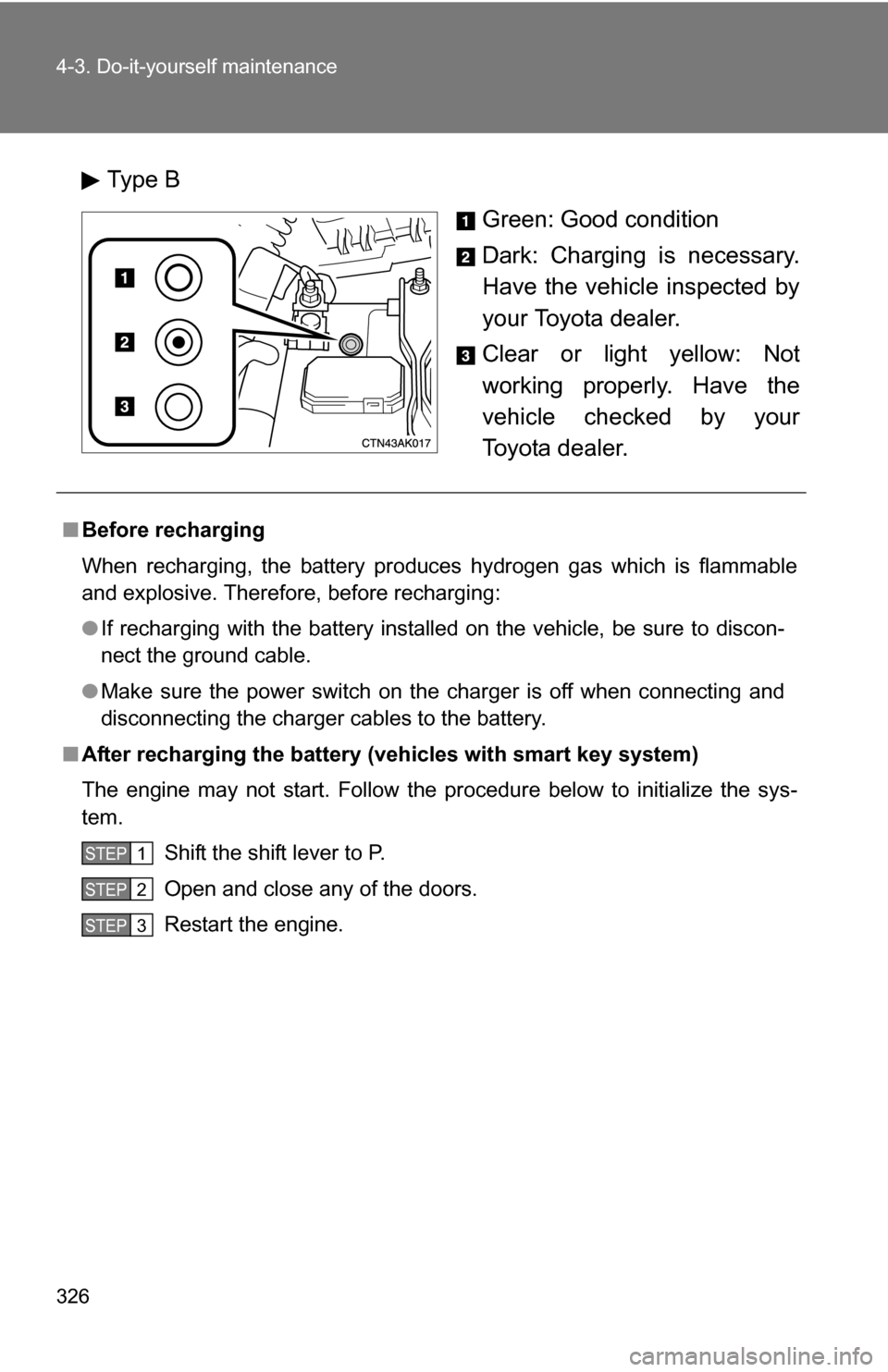
Type BGreen: Good condition
Dark: Charging is necessary.
Have the vehicle inspected by
your Toyota dealer.
Clear or light yellow: Not
working properly. Have the
vehicle checked by your
Toyota dealer.
■Before recharging
When recharging, the battery produces hydrogen gas which is flammable
and explosive. Therefore, before recharging:
●If recharging with the battery installed on the vehicle, be sure to discon-
nect the ground cable.
● Make sure the power switch on the charger is off when connecting and
disconnecting the charger cables to the battery.
■ After recharging the battery (vehicles with smart key system)
The engine may not start. Follow the procedure below to initialize the sys-
tem.
Shift the shift lever to P.
Open and close any of the doors.
Restart the engine.
STEP 1
STEP 2
STEP 3
Page 328 of 476
328 4-3. Do-it-yourself maintenance
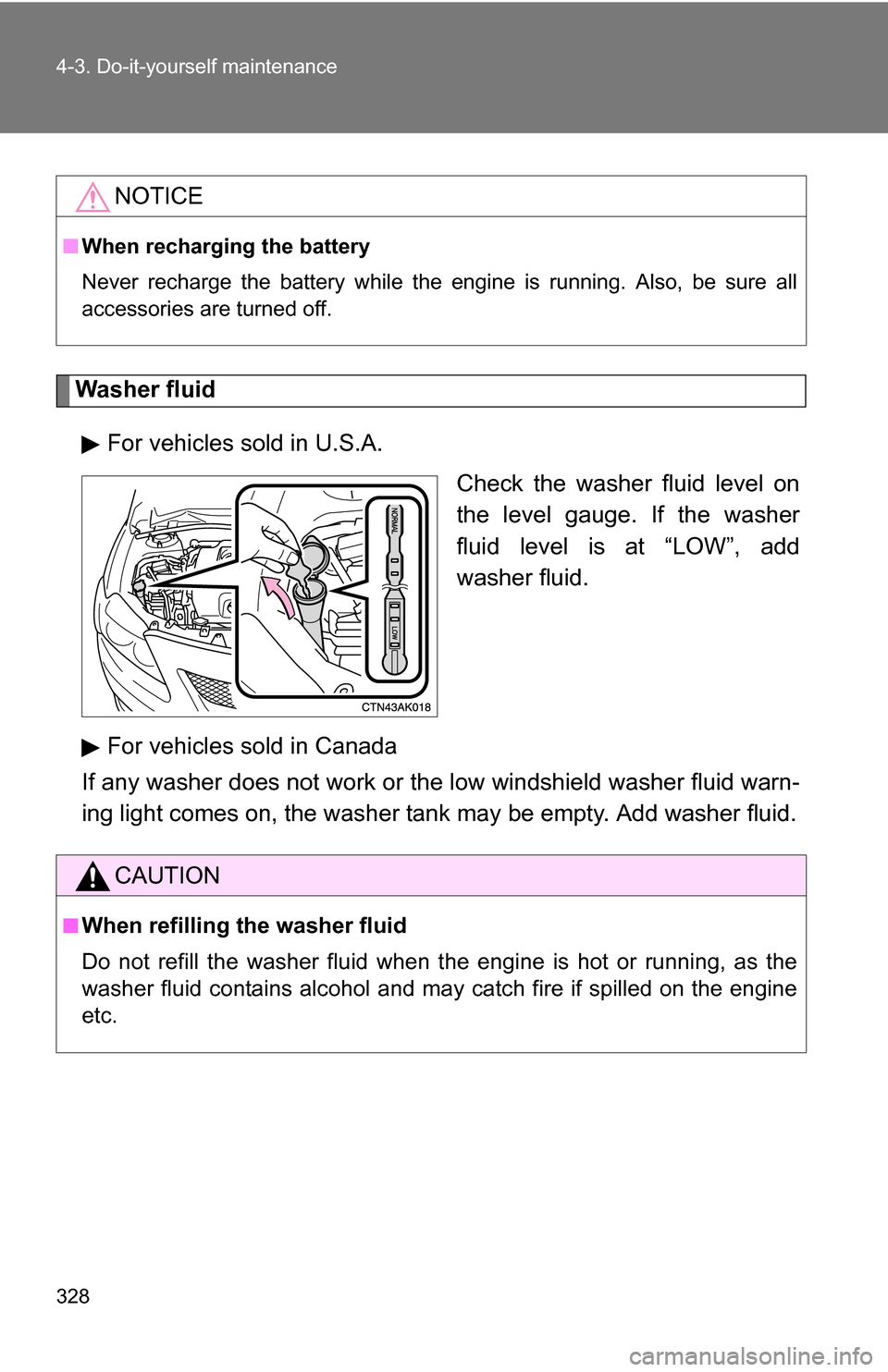
Washer fluidFor vehicles sold in U.S.A. Check the washer fluid level on
the level gauge. If the washer
fluid level is at “LOW”, add
washer fluid.
For vehicles sold in Canada
If any washer does not work or the low windshield washer fluid warn-
ing light comes on, the washer tank may be empty. Add washer fluid.
NOTICE
■ When recharging the battery
Never recharge the battery while the engine is running. Also, be sure all
accessories are turned off.
CAUTION
■When refilling the washer fluid
Do not refill the washer fluid when t he engine is hot or running, as the
washer fluid contains alcohol and may catch fire if spilled on the engine
etc.
Page 385 of 476
5
When trouble arises
385
5-2. Steps to take in an emergency
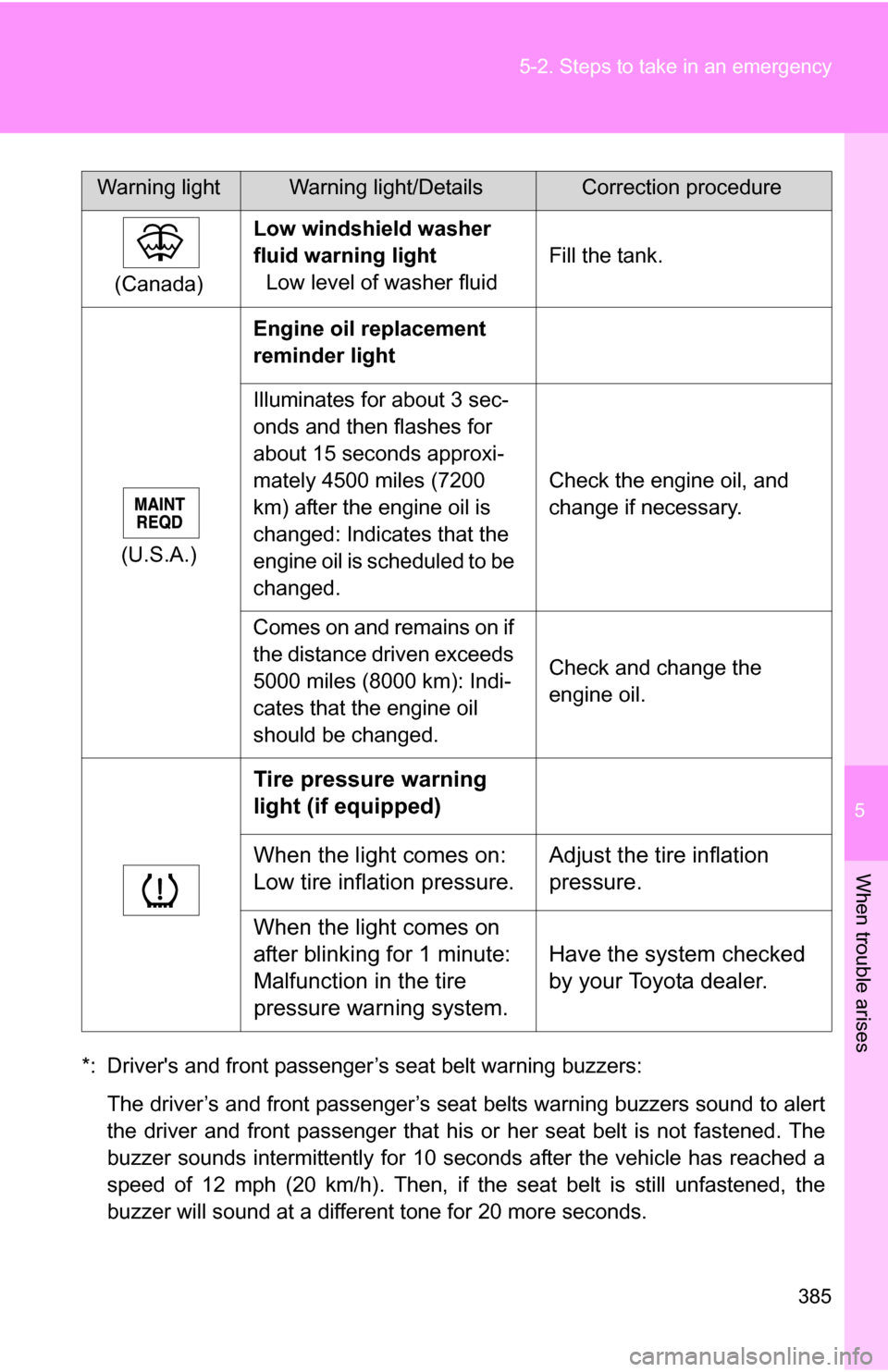
*: Driver's and front passenger’s seat belt warning buzzers:
The driver’s and front passenger’s seat belts warning buzzers sound to alert
the driver and front passenger that his or her seat belt is not fastened. The
buzzer sounds intermittently for 10 seconds after the vehicle has reached a
speed of 12 mph (20 km/h). Then, if the seat belt is still unfastened, the
buzzer will sound at a different tone for 20 more seconds.(Canada)
Low windshield washer
fluid warning light
Low level of washer fluid Fill the tank.
(U.S.A.) Engine oil replacement
reminder light
Illuminates for about 3 sec-
onds and then flashes for
about 15 seconds approxi-
mately 4500 miles (7200
km) after the engine oil is
changed: Indicates that the
engine oil is scheduled to be
changed.
Check the engine oil, and
change if necessary.
Comes on and remains on if
the distance driven exceeds
5000 miles (8000 km): Indi-
cates that the engine oil
should be changed. Check and change the
engine oil.
Tire pressure warning
light (if equipped)
When the light comes on:
Low tire inflation pressure.
Adjust the tire inflation
pressure.
When the light comes on
after blinking for 1 minute:
Malfunction in the tire
pressure warning system. Have the system checked
by your Toyota dealer.
Warning lightWarning light/DetailsCorrection procedure
Page 386 of 476

386 5-2. Steps to take in an emergency
■Front passenger detect ion sensor and passenger seat belt reminder
● If luggage is placed on the front passenger seat, the front passenger
detection sensor may cause the warning light to flash, even if a passen-
ger is not sitting in the seat.
● If a cushion is placed on the seat, the sensor may not detect a passen-
ger, and the warning light may not operate properly.
■ Changing the engine oil (U.S.A. only)
Make sure to reset the oil change system. ( P. 319)
■
When the tire pressure warning light comes on
Check the tire inflation pressure and adjust to the appropriate level.
Pushing the tire pressure warning reset switch does not turn off the tire
pressure warning light.
■The tire pressure warning light ma y turn on due to natural causes
The tire pressure warning light may turn on due to natural causes such
as natural air leaks or tire inflation pressure changes caused by temper-
ature. In this case, adjusting the ti re inflation pressure will turn off the
warning light (after a few minutes).
Page 388 of 476
388 5-2. Steps to take in an emergency
■If the tire pressure warning light comes on after blinking for 1
minute frequently
If the tire pressure warning light comes on after blinking for 1 minute fre-
quently when the “ENGINE START STOP” switch or engine switch is
turned ON, have it checked by your Toyota dealer.
■Customization that can be co nfigured at Toyota dealer
The vehicle speed linked seat belt reminder buzzer can be disabled.
(Customizable features P. 449) However, Toyota recommends that the
seat belt reminder buzzer be operational to alert the driver and front passen-
ger that the seat belts are not fastened.
CAUTION
■If the tire pressure warning light comes on
Be sure to observe the following precautions. Failure to do so could
cause loss of vehicle control and re sult in death or serious injury.
●Stop your vehicle in a safe place as soon as possible. Adjust the tire
inflation pressure immediately.
●If the tire pressure warning light comes on even after tire inflation pres-
sure adjustment, it is pr obable that you have a flat tire. Check the tires.
If the tire is flat, change to the spare tire and have the flat tire repaired
by the nearest Toyota dealer.
●Avoid abrupt maneuvering and braking. If the vehicle tires deteriorate,
you could lose control of the steering wheel or the brakes.
■If a blowout or sudden air leakage should occur
The tire pressure warning syste m may not activate immediately.