Page 458 of 538
456 5-2. Steps to take in an emergency
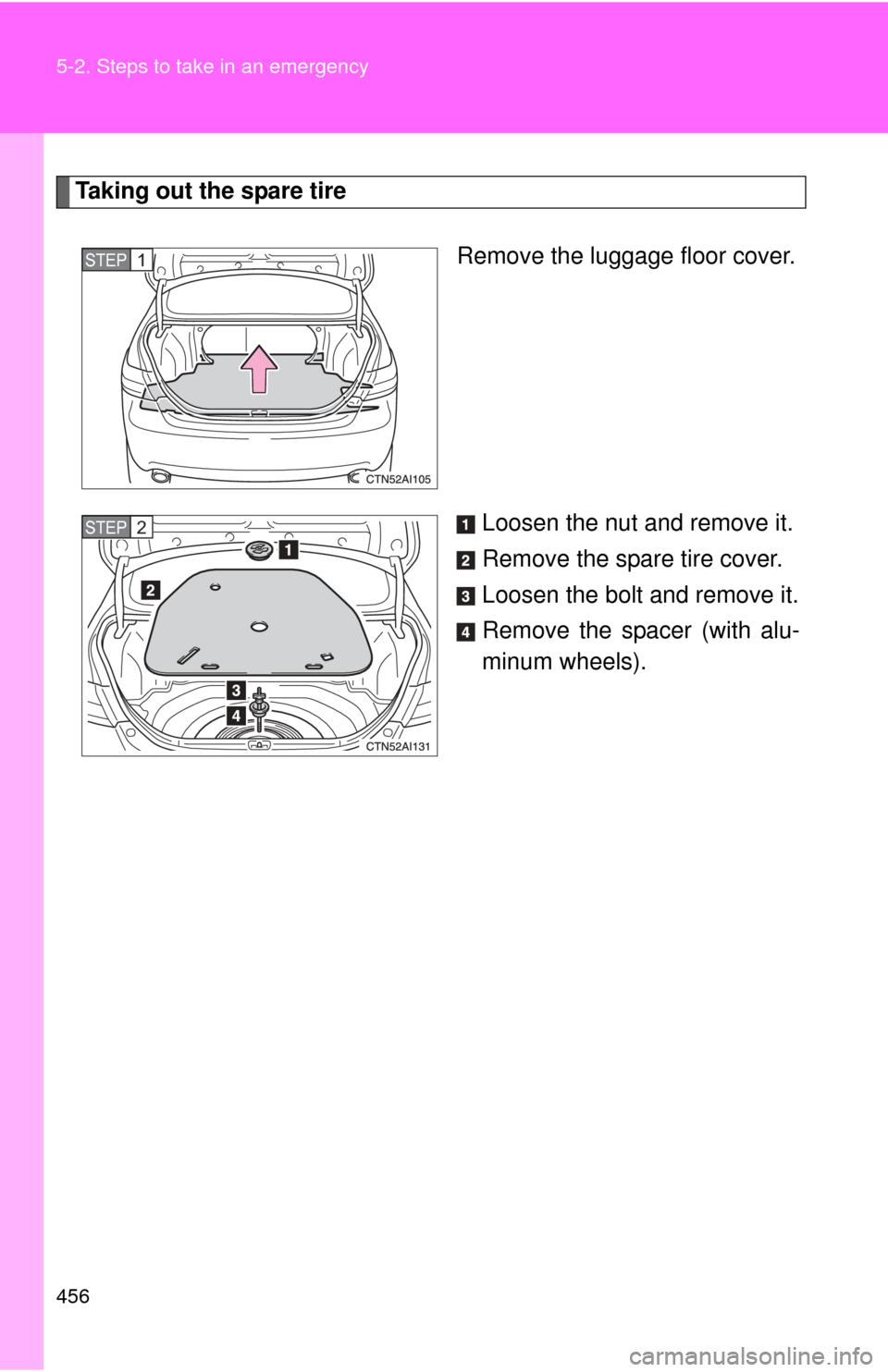
Taking out the spare tireRemove the luggage floor cover.
Loosen the nut and remove it.
Remove the spare tire cover.
Loosen the bolt and remove it.
Remove the spacer (with alu-
minum wheels).
STEP1
STEP2
Page 463 of 538
5
When trouble arises
461
5-2. Steps to take in an emergency
Stow the flat tire, tire jack and all tools.
■The compact spare tire
●The compact spare tire is identifi
ed by the label “TEMPORARY USE
ONLY” on the tire sidewall.
Use the compact spare tire temporarily only in an emergency.
●Make sure to check the tire pre ssure of the compact spare tire.
( P. 491)
■If you have a flat front tire on a road covered with snow or ice
Install the compact spare tire on the rear of the vehicle. Perform the fol-
lowing steps and fit tire chains to the front tires.
Replace a rear tire with the compact spare tire.
Replace the flat front tire with the tire removed from the rear of
the vehicle.
Fit tire chains to the front tires.
■After completing the tire change (U.S.A. only)
The tire pressure warning system must be reset. (P. 384)
■When using the compact spare tire
As the compact spare tire is not equipped with the tire pressure warning
valve and transmitter, low inflation pressure of the spare tire will not be
warned. Also, if you replace the compac t spare tire after the tire pressure
warning light comes on, the light remains on.
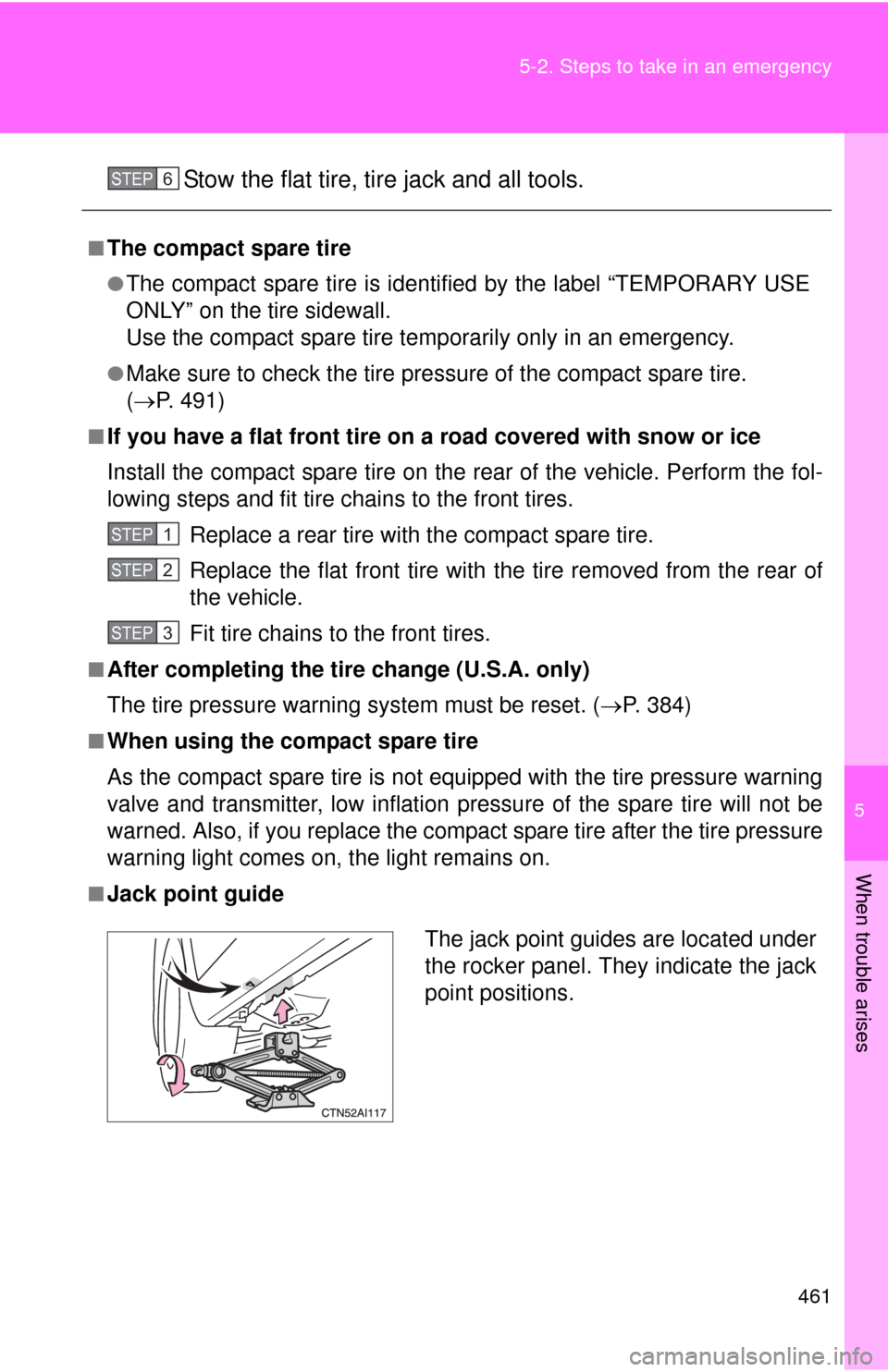
■Jack point guide
STEP6
STEP1
STEP2
STEP3
The jack point guides are located under
the rocker panel. They indicate the jack
point positions.
Page 465 of 538
5
When trouble arises
463
5-2. Steps to take in an emergency
CAUTION
■Replacing a flat tire
Observe the following precautions to reduce the risk of death or serious
injury.
●Never use oil or grease on the wheel bolts or wheel nuts.
Oil and grease may cause the wheel nuts to be excessively tightened,
leading to bolt or disc wheel damage. In addition, the oil or grease can
cause the wheel nuts to loosen and the wheel may fall off, causing a
serious accident. Remove any oil or grease from the wheel bolts or
wheel nuts.
●Have the wheel nuts tightened with a torque wrench to 76 ft•lbf (103
N
•m, 10.5 kgf•m) as soon as possible after changing wheels.
Failure to follow these precautions could cause the nuts to loosen and
the wheel may fall off, which could lead to an accident causing death
or serious injury.
■When using the compact spare tire
●Remember that your compact spare tire is specifically designed for
use with your vehicle. Do not use your compact spare tire on another
vehicle.
●Do not use two compact spare tires simultaneously.
●Replace the compact spare tire with a standard tire as soon as possi-
ble.
●Avoid sudden acceleration, deceleration and braking, as well as sharp
cornering.
■Speed limit when using the compact spare tire
Do not drive at speeds in excess of 50 mph (80 km/h) when a compact
spare tire is installed on the vehicle.
The compact spare tire is not designed for driving at high speeds. Failing
to observe this precaution may lead to an accident causing death or seri-
ous injury.
Page 466 of 538
464 5-2. Steps to take in an emergency
CAUTION
■When the spare tire is attached
The vehicle speed may not be correctly detected, and the following sys-
tems may not operate correctly:
●ABS & Brake assist
●VSC
●TRAC
●Navigation system (if equipped)
NOTICE
■Do not drive the vehicle with a flat tire.
Do not continue driving with a flat tire.
Driving even a short distance with a flat tire can damage the tire and the
wheel beyond repair.
■Be careful when driving over bumps with the compact spare tire
installed on the vehicle.
The vehicle becomes lower when driving with the compact spare tire
compared to when driving with standard tires. Be careful when driving
over uneven road surfaces.
■Driving with tire chains and the compact spare tire
Do not fit tire chains to the compact spare tire.
Tire chains may damage the vehicle body and adversely affect driving
performance.
■When replacing the tires
When removing or fitting the wheels, tires or the tire pressure warning
valve and transmitter, contact your Toyota dealer as the tire pressure
warning valve and transmitter may be damaged if not handled correctly.
■To avoid damaging the tire pressure warning valves and transmit-
ters
Do not use liquid sealants on flat tires.
Page 493 of 538
491
6-1. Specifications
6
Vehicle specifications
Steering
Tires and wheels
3.5 L V6 (2GR-FE) engine with 16-inch tires
Free play Less than 1.2 in. (30 mm)
Power steering fluid type Automatic transmission fluid DEXRON® II
or III
Tire size P215/60R16 94V,
T155/70D17 110M
Tire inflation pressure
(Recommended cold tire
inflation pressure)Driving under normal conditions
Front: 30 psi (210 kPa, 2.1 kgf/cm
2 or
bar)*
Rear: 30 psi (210 kPa, 2.1 kgf/cm
2 or
bar)*
Spare: Full-size spare tire
30 psi (210 kPa, 2.1 kgf/cm or bar)
Compact spare tire
60 psi (420 kPa, 4.2 kgf/cm or bar)
*: When driving at high speeds above 100 mph (160 km/h), in countries
where such speeds are permitted by
law, add 5 psi (30 kPa, 0.3 kgf/cm
2 or
bar) to the front tires and rear tires.
Never exceed the maximum cold tire
inflation pressure indicated on the tire
sidewall.
Wheel size 16
6 1/2 J or 16 6 1/2 JJ,
17 4 T (compact spare)
Wheel nut torque 76 ft•lbf (103 N•m, 10.5 kgf•m)
Page 494 of 538
492 6-1. Specifications
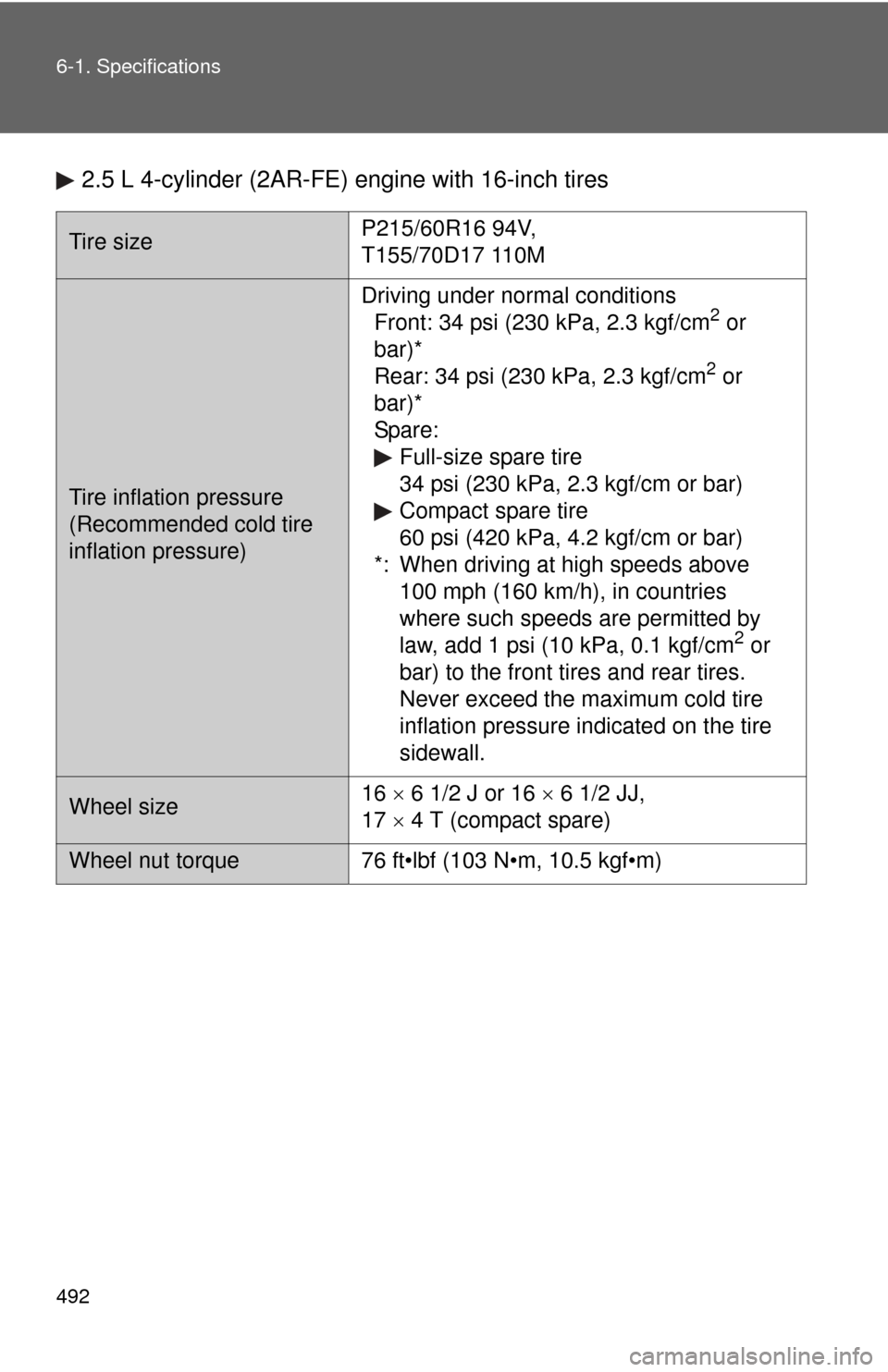
2.5 L 4-cylinder (2AR-FE) engine with 16-inch tires
Tire sizeP215/60R16 94V,
T155/70D17 110M
Tire inflation pressure
(Recommended cold tire
inflation pressure)Driving under normal conditions
Front: 34 psi (230 kPa, 2.3 kgf/cm
2 or
bar)*
Rear: 34 psi (230 kPa, 2.3 kgf/cm
2 or
bar)*
Spare: Full-size spare tire
34 psi (230 kPa, 2.3 kgf/cm or bar)
Compact spare tire
60 psi (420 kPa, 4.2 kgf/cm or bar)
*: When driving at high speeds above 100 mph (160 km/h), in countries
where such speeds are permitted by
law, add 1 psi (10 kPa, 0.1 kgf/cm
2 or
bar) to the front tires and rear tires.
Never exceed the maximum cold tire
inflation pressure indicated on the tire
sidewall.
Wheel size 16
6 1/2 J or 16 6 1/2 JJ,
17 4 T (compact spare)
Wheel nut torque 76 ft•lbf (103 N•m, 10.5 kgf•m)
Page 495 of 538
493
6-1. Specifications
6
Vehicle specifications
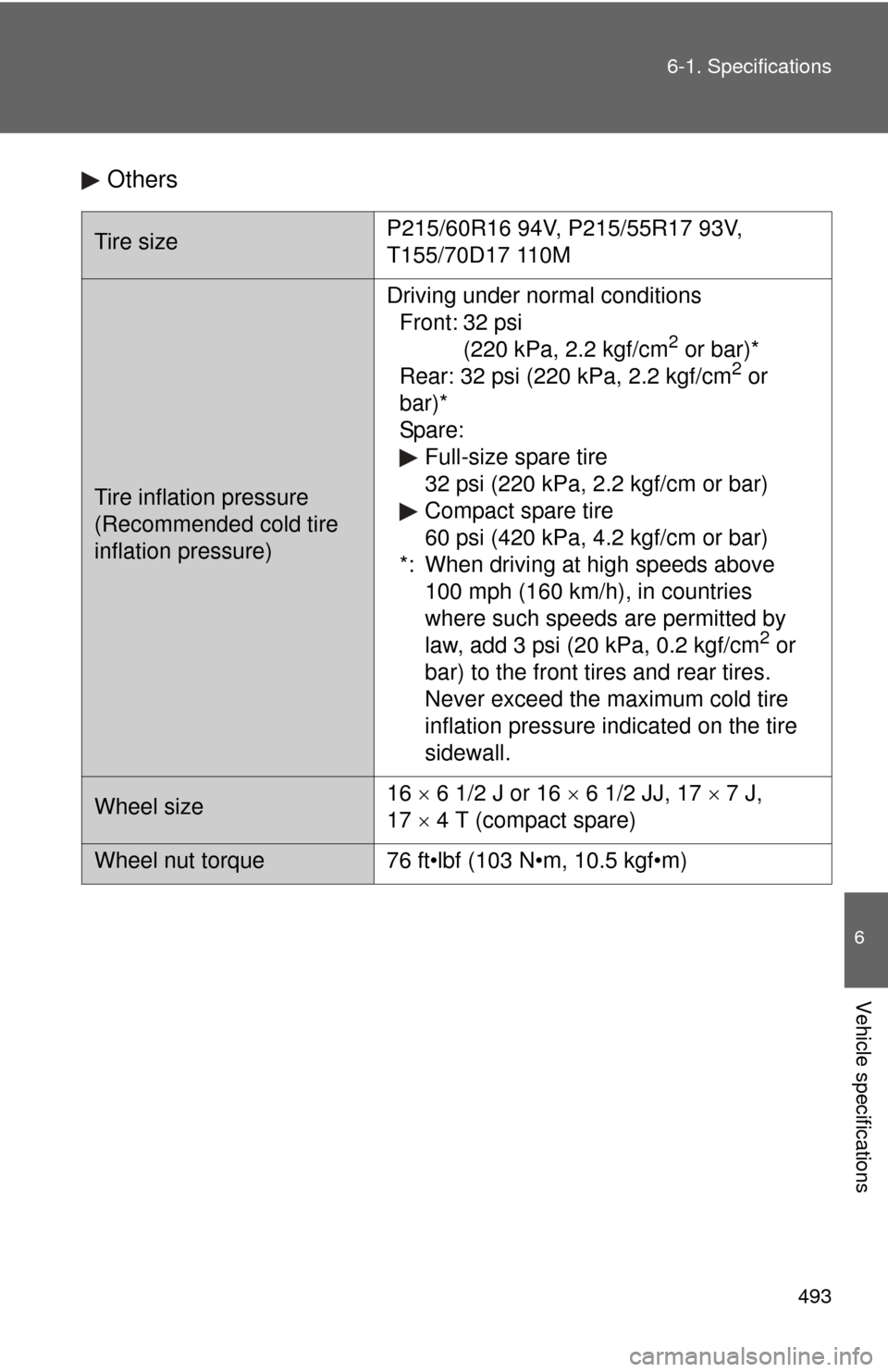
Others
Tire size
P215/60R16 94V, P215/55R17 93V,
T155/70D17 110M
Tire inflation pressure
(Recommended cold tire
inflation pressure)Driving under normal conditions
Front: 32 psi (220 kPa, 2.2 kgf/cm
2 or bar)*
Rear: 32 psi (220 kPa, 2.2 kgf/cm2 or
bar)*
Spare: Full-size spare tire
32 psi (220 kPa, 2.2 kgf/cm or bar)
Compact spare tire
60 psi (420 kPa, 4.2 kgf/cm or bar)
*: When driving at high speeds above 100 mph (160 km/h), in countries
where such speeds are permitted by
law, add 3 psi (20 kPa, 0.2 kgf/cm
2 or
bar) to the front tires and rear tires.
Never exceed the maximum cold tire
inflation pressure indicated on the tire
sidewall.
Wheel size 16
6 1/2 J or 16 6 1/2 JJ, 17 7 J,
17 4 T (compact spare)
Wheel nut torque 76 ft•lbf (103 N•m, 10.5 kgf•m)
Page 500 of 538
498
6-1. Specifications
Tire infor mation
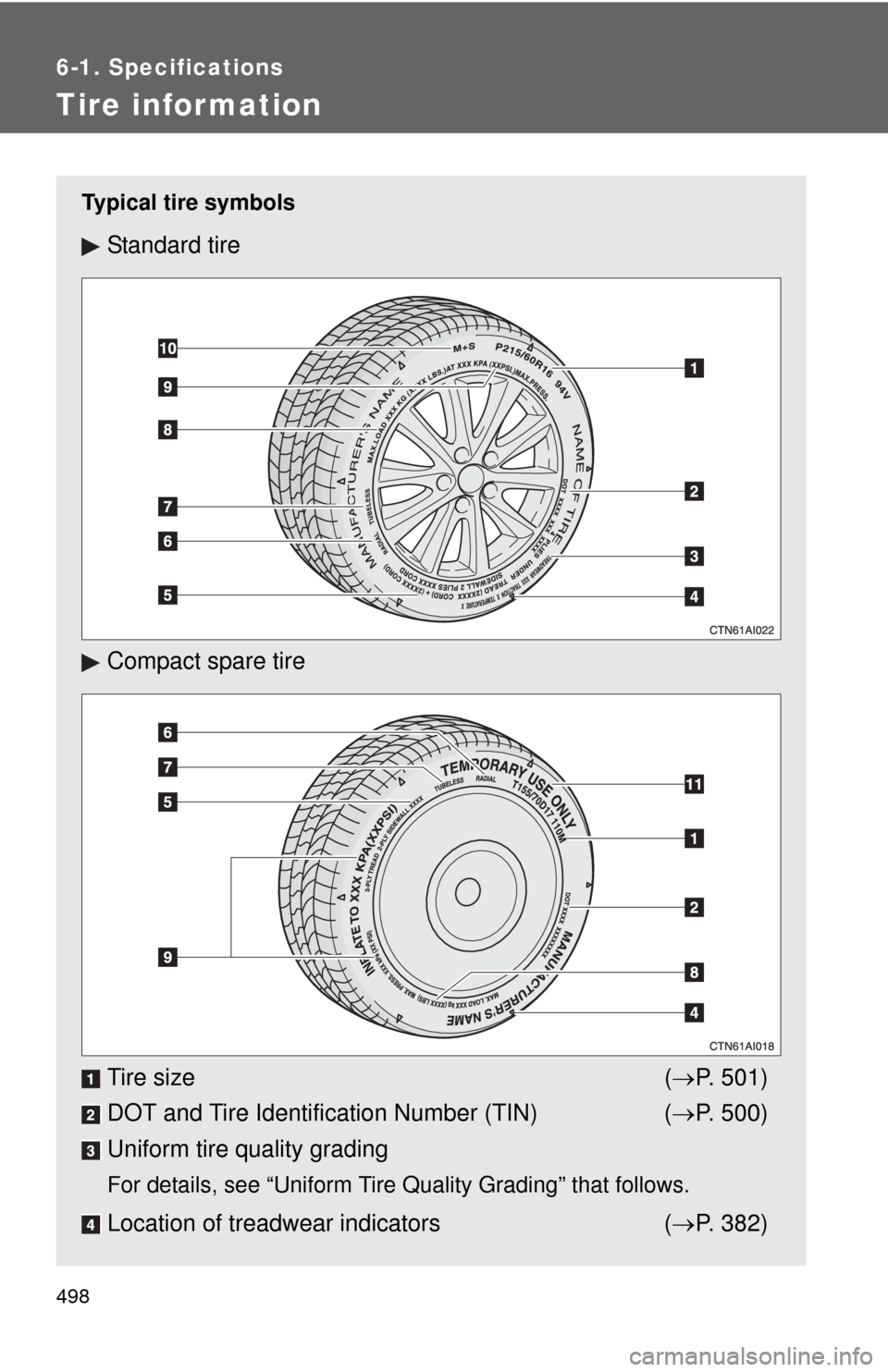
Typical tire symbols
Standard tire
Compact spare tire
Tire size (P. 501)
DOT and Tire Identification Number (TIN) ( P. 500)
Uniform tire quality grading
For details, see “Uniform Tire Quality Grading” that follows.
Location of treadwear indicators ( P. 382)