Page 369 of 476
4
Maintenance and care
369
4-3. Do-it-yourself maintenance
AVALON_U (OM41437U)
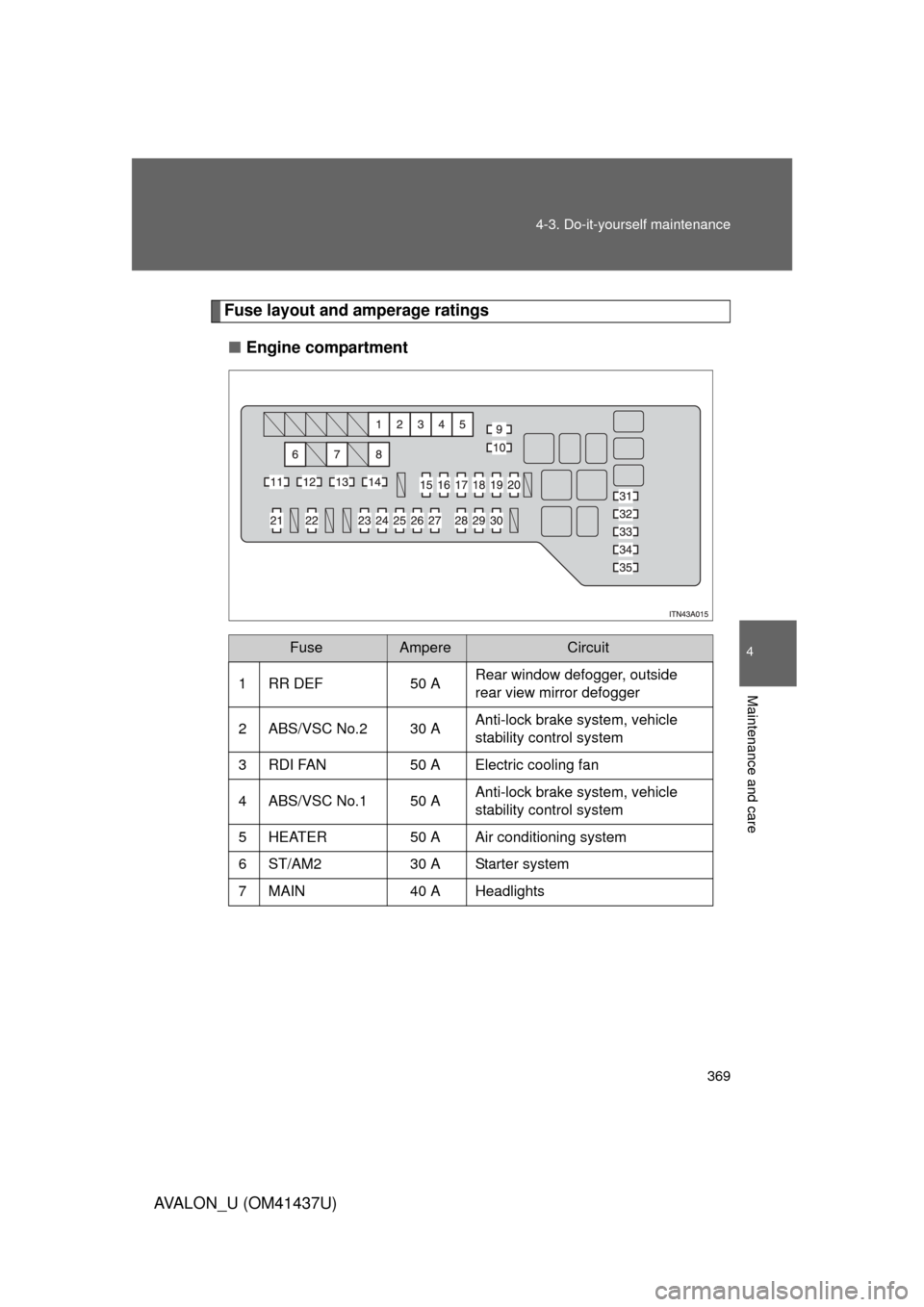
Fuse layout and amperage ratings
■ Engine compartment
FuseAmpereCircuit
1 RR DEF 50 A Rear window defogger, outside
rear view mirror defogger
2 ABS/VSC No.2 30 A Anti-lock brake system, vehicle
stability control system
3 RDI FAN 50 A Electric cooling fan
4 ABS/VSC No.1 50 A Anti-lock brake system, vehicle
stability control system
5 HEATER 50 A Air conditioning system
6 ST/AM2 30 A Starter system
7 MAIN 40 A Headlights
Page 376 of 476
376
4-3. Do-it-yourself maintenance
AVALON_U (OM41437U)
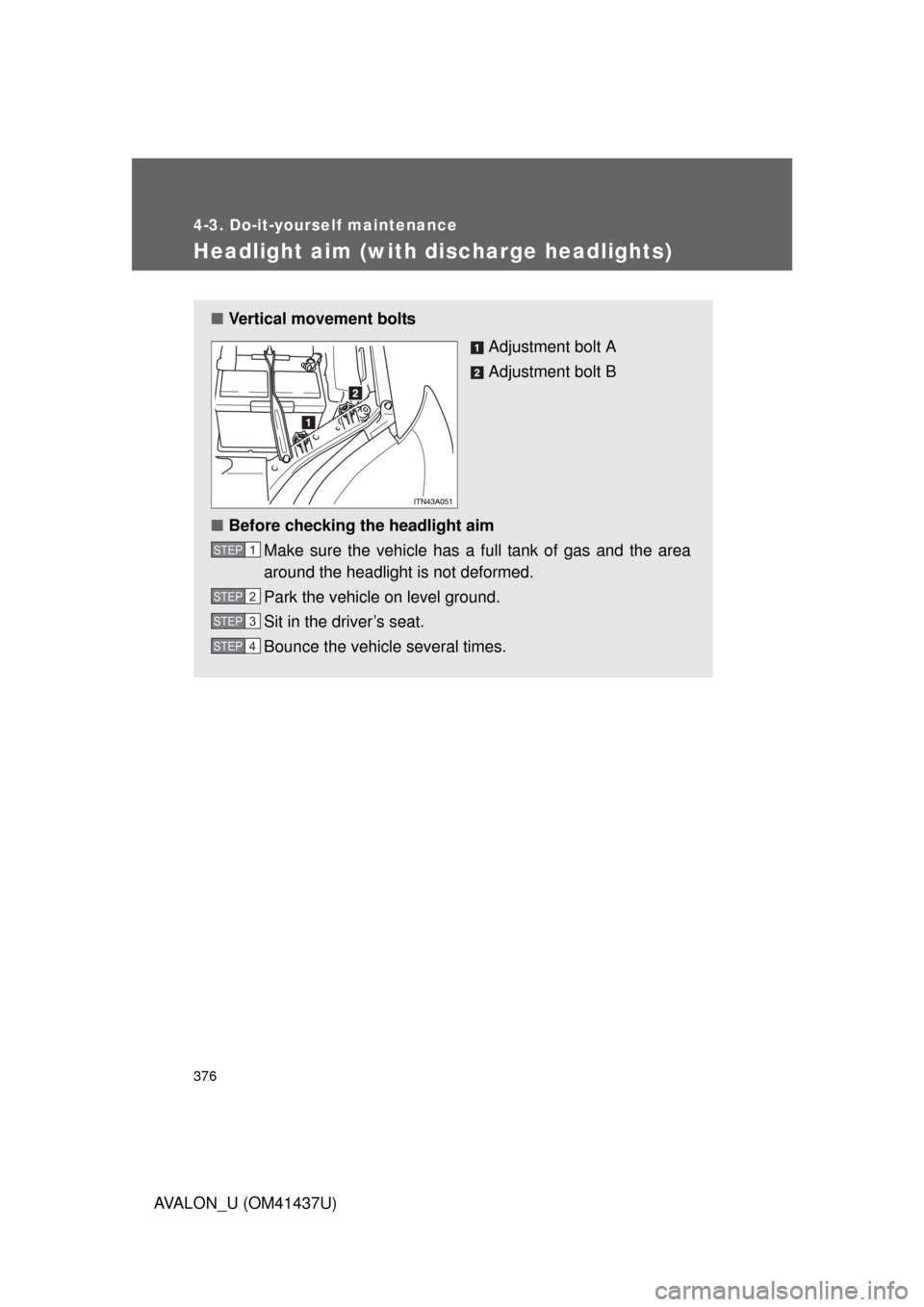
Headlight aim (with discharge headlights)
■Vertical movement bolts
Adjustment bolt A
Adjustment bolt B
■ Before checking the headlight aim
Make sure the vehicle has a full tank of gas and the area
around the headlight is not deformed.
Park the vehicle on level ground.
Sit in the driver’s seat.
Bounce the vehicle several times.
STEP1
STEP2
STEP3
STEP4
Page 381 of 476
4
Maintenance and care
381
4-3. Do-it-yourself maintenance
AVALON_U (OM41437U)
■
Bulbs other than the above
If any of the bulbs listed below has burnt out, have your Toyota
dealer replace it.
● Headlights
● Fog lights
● Front turn signal/parking lights
● Front side marker lights
● Tail lights
● Back-up lights
● High mounted stoplight
■Condensation build-up on th e inside of the lens
Contact your Toyota dealer for more information in the following situations.
Temporary condensation build-up on the inside of the headlight lens does
not indicate a malfunction.
● Large drops of water are built up on the inside of the lens.
● Water has built up inside the headlight.
■ LED light bulbs
The high mounted stoplights consist of a number of LEDs. If any of the LEDs
burn out, take your vehicle to your Toyota dealer to have the light replaced.
If two or more LEDs in a stoplight burn out, your vehicle may not conform to
local laws (SAE).
■ High-intensity discharge (H ID) headlights (if equipped)
If voltage to the high-intensity discharge bulbs is insufficient, the light may
not come on, or may go out temporarily. The high-intensity discharge bulbs
will come on when normal power is restored.
Page 382 of 476
382 4-3. Do-it-yourself maintenance
AVALON_U (OM41437U)
CAUTION
■Replacing light bulbs
● Turn off the headlights. Do not attempt to replace the bulb immediately
after turning off the headlights.
The bulbs become very hot and may cause burns.
● Do not touch the glass portion of the light bulb with bare hands. Hold the
bulb by the plastic or metal portion.
If the bulb is scratched or dropped it may blow out or crack.
● Fully install light bulbs and any parts used to secure them. Failing to do so
may result in heat damage, fire, or water entering the headlight unit. This
may damage the headlights or cause condensation to build up on the lens.
● Do not take apart or repair the low beam discharge headlight bulbs, con-
nectors, power supply circuits, or related components.
Doing so could result in electric shock and death or serious injury.
■ High-intensity discharge (HID) headlights (if equipped)
● Contact your Toyota dealer before replacing high-intensity discharge
headlights (including light bulbs).
● Do not touch the high-intensity discharge headlight’s high voltage socket
when the headlights are turned on. An extremely high voltage of 20000V
will be discharged and could result in serious injury or death by electric
shock.
■ To prevent damage or fire
Make sure bulbs are fully seated and locked.
Page 414 of 476
414
5-2. Steps to take in an emergency
AVALON_U (OM41437U)
If the engine will not star t
If the engine will not start even though correct starting procedures
are being followed (
P. 133, P. 137), consider each of the following
points.
■ The engine will not start even when the starter motor oper-
ates normally
One of the following may be the cause of the problem.
●There may not be sufficient fuel in the vehicle’s tank.
Add fuel to the vehicle.
● The engine may be flooded.
Try to restart the engine once more following correct starting
procedures. ( P. 133)
● There may be a malfunction in the engine immobilizer system.
( P. 8 3 )
■ The starter motor turns over slowly, the interior lights and
headlights are dim, or the horn does not sound or sounds at
a low volume
One of the following may be the cause of the problem.
●The battery may be discharged. ( P. 420)
● The battery terminal connec tions may be loose or corroded.
■ The starter motor does not turn over (vehicles with smart
key system).
The engine starting system may be malfunctioning due to an
electrical problem such as an open circuit or a blown fuse. How-
ever, an interim measure is available to start the engine.
( P. 133)
Page 415 of 476

5
When trouble arises
415
5-2. Steps to take in an emergency
AVALON_U (OM41437U)
Emergency start function (vehicles with smart key system)
When the engine does not start, the following steps can be used as
an interim measure to start the engine if the “ENGINE START STOP”
switch is functioning normally. Set the parking brake.
Shift the shift lever to “P”.
Set the “ENGINE START STOP” switch to the ACC mode.
Push and hold the “ENGINE START STOP” switch about 15
seconds while depressing the brake pedal firmly.
Even if the engine can be start ed using the above steps, the system
may be malfunctioning. Have the vehicle checked by your Toyota
dealer.
■ The starter motor does not turn over, the interior lights and
headlights do not turn on, or the horn does not sound
One of the following may be the cause of the problem.
● One or both of the battery terminals may be disconnected.
● The battery may be discharged. ( P. 420)
● There may be a malfunction in the steering lock system (vehi-
cles with smart key system).
Contact your Toyota dealer if the problem cannot be repaired, or if
repair procedures are unknown.
STEP1
STEP2
STEP3
STEP4
Page 421 of 476

5
When trouble arises
421
5-2. Steps to take in an emergency
AVALON_U (OM41437U)
■
Starting the engine when the battery is discharged
The engine cannot be started by push-starting.
■ To prevent battery discharge
● Turn off the headlights and the audio system while the “ENGINE START
STOP” switch or the engine is turned off.
● Turn off any unnecessary electrical components when the vehicle is run-
ning at a low speed for an extended period, such as in heavy traffic, etc.
Start the engine of the second vehicle. Increase the engine
speed slightly and maintain at that level for approximately
five minutes to recharge the battery of your vehicle.
Vehicles with smart key system Open and close any of
the doors with the “ENGINE START STOP” switch OFF.
Vehicles with smart key system: Maintain the engine speed
on the second vehicle and turn the “ENGINE START
STOP” switch to IGNITON ON mode, then start the vehi-
cle’s engine.
Vehicles without smart key system: Maintain the engine
speed on the second vehicle and turn the engine switch to
the “ON” position, then start the vehicle’s engine.
Once the vehicle’s engine has started, remove the jumper
cables in the exact reverse order in which they were con-
nected.
Once the engine starts, have the vehicle checked at your Toyota
dealer as soon as possible.STEP2
STEP3
STEP4
STEP5
Page 438 of 476
438 6-1. Specifications
AVALON_U (OM41437U)
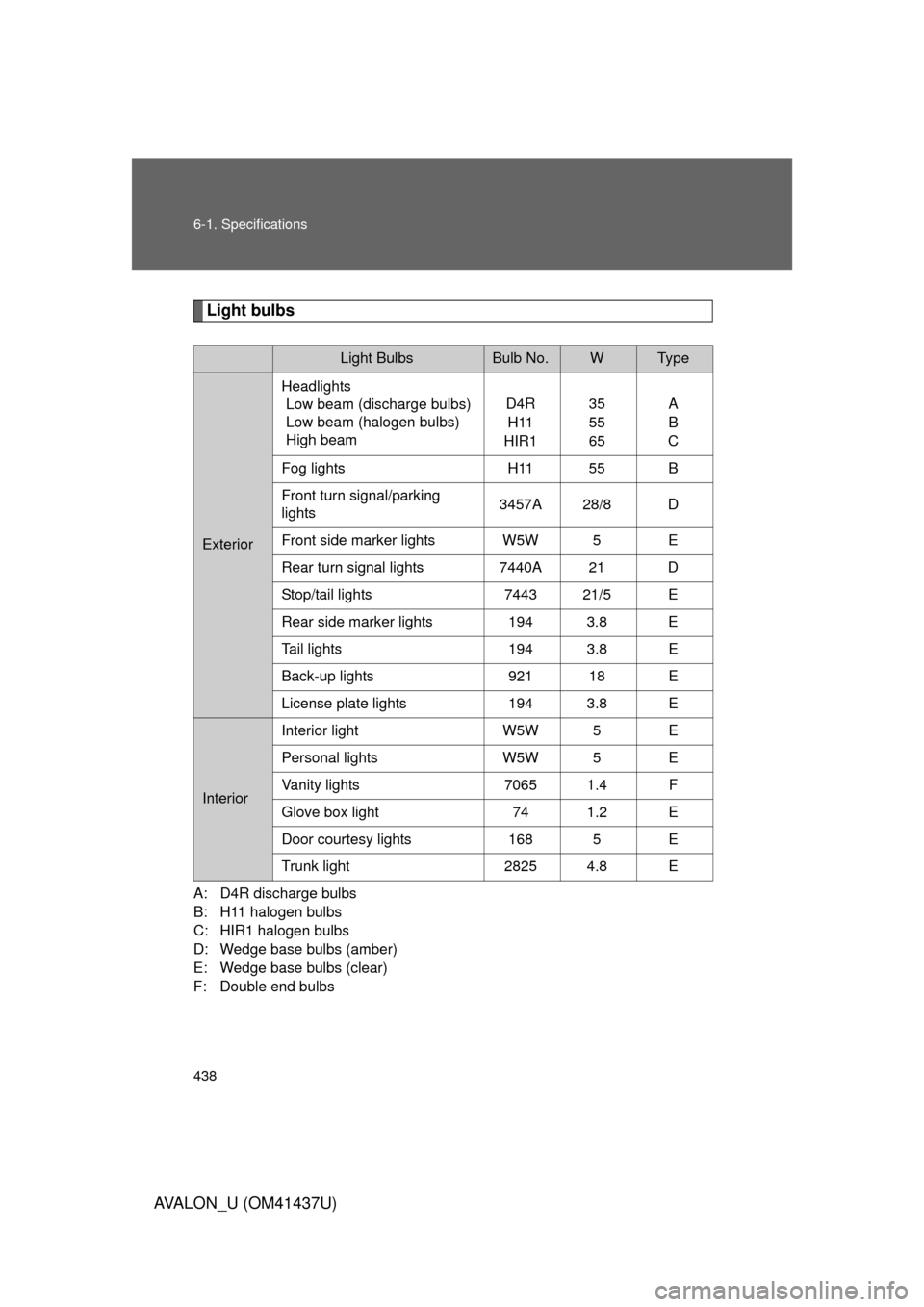
Light bulbs
A: D4R discharge bulbs
B: H11 halogen bulbs
C: HIR1 halogen bulbs
D: Wedge base bulbs (amber)
E: Wedge base bulbs (clear)
F: Double end bulbs
Light BulbsBulb No.WTy p e
ExteriorHeadlights
Low beam (discharge bulbs)
Low beam (halogen bulbs)
High beam D4R
H11
HIR1 35
55
65A
B
C
Fog lights H11 55 B
Front turn signal/parking
lights 3457A 28/8 D
Front side marker lights W5W 5 E
Rear turn signal lights 7440A 21 D
Stop/tail lights 7443 21/5 E
Rear side marker lights 194 3.8 E
Tail lights 194 3.8 E
Back-up lights 921 18 E
License plate lights 194 3.8 E
Interior Interior light W5W 5 E
Personal lights W5W 5 E
Vanity lights 7065 1.4 F
Glove box light 74 1.2 E
Door courtesy lights 168 5 E
Trunk light 2825 4.8 E