Page 97 of 476
97
1-7. Safety information
1
Before driving
AVALON_U (OM41437U)
CAUTION
■
SRS airbag precautions
Observe the following precautions regarding the airbags. Failure to do so
may cause death or serious injury.
● The driver and all passengers in the vehicle must wear their seat belts
properly.
The SRS airbags are supplemental devices to be used with the seat belts.
● The SRS driver airbag deploys with considerable force, and can cause
death or serious injury especially if the driver is very close to the airbag.
The National Highway Traffic Safety Administration (“NHTSA”) advises:
Since the risk zone for driver airbag is the first 2 - 3 in. (50 - 75 mm) of
inflation, placing yourself 10 in. (250 mm) from your driver airbag provides
you with a clear margin of safety. This distance is measured from the cen-
ter of the steering wheel to your breastbone. If you sit less than 10 in. (250
mm) away now, you can change your driving position in several ways:
• Move your seat to the rear as far as you can while still reaching the
pedals comfortably.
• Slightly recline the back of the seat. Although vehicle designs vary, many drivers can achieve the 10 in. (250 mm) distance, even with the
driver seat all the way forward, simply by reclining the back of the seat
somewhat. If reclining the back of your seat makes it hard to see the
road, raise yourself by using a firm, non-slippery cushion, or raise the
seat if your vehicle has that feature.
• If your steering wheel is adjustable, tilt it downward. This points the air- bag toward your chest instead of your head and neck.
The seat should be adjusted as recommended by NHTSA above, while still
maintaining control of the foot pedals, steering wheel, and your view of the
instrument panel controls.
Page 98 of 476
98 1-7. Safety information
AVALON_U (OM41437U)
CAUTION
■SRS airbag precautions
● The SRS front passenger airbag also deploys with considerable force, and
can cause death or serious injury especially if the front passenger is very
close to the airbag. The front passenger seat should be as far from the air-
bag as possible with the seatback adjusted, so the front passenger sits
upright.
● Improperly seated and/or restrained in fants and children can be killed or
seriously injured by a deploying airbag. An infant or child who is too small
to use a seat belt should be properly secured using a child restraint sys-
tem. Toyota strongly recommends that all infants and children be placed in
the rear seats of the vehicle and properly restrained. The rear seats are
the safest for infants and children. (P. 109)
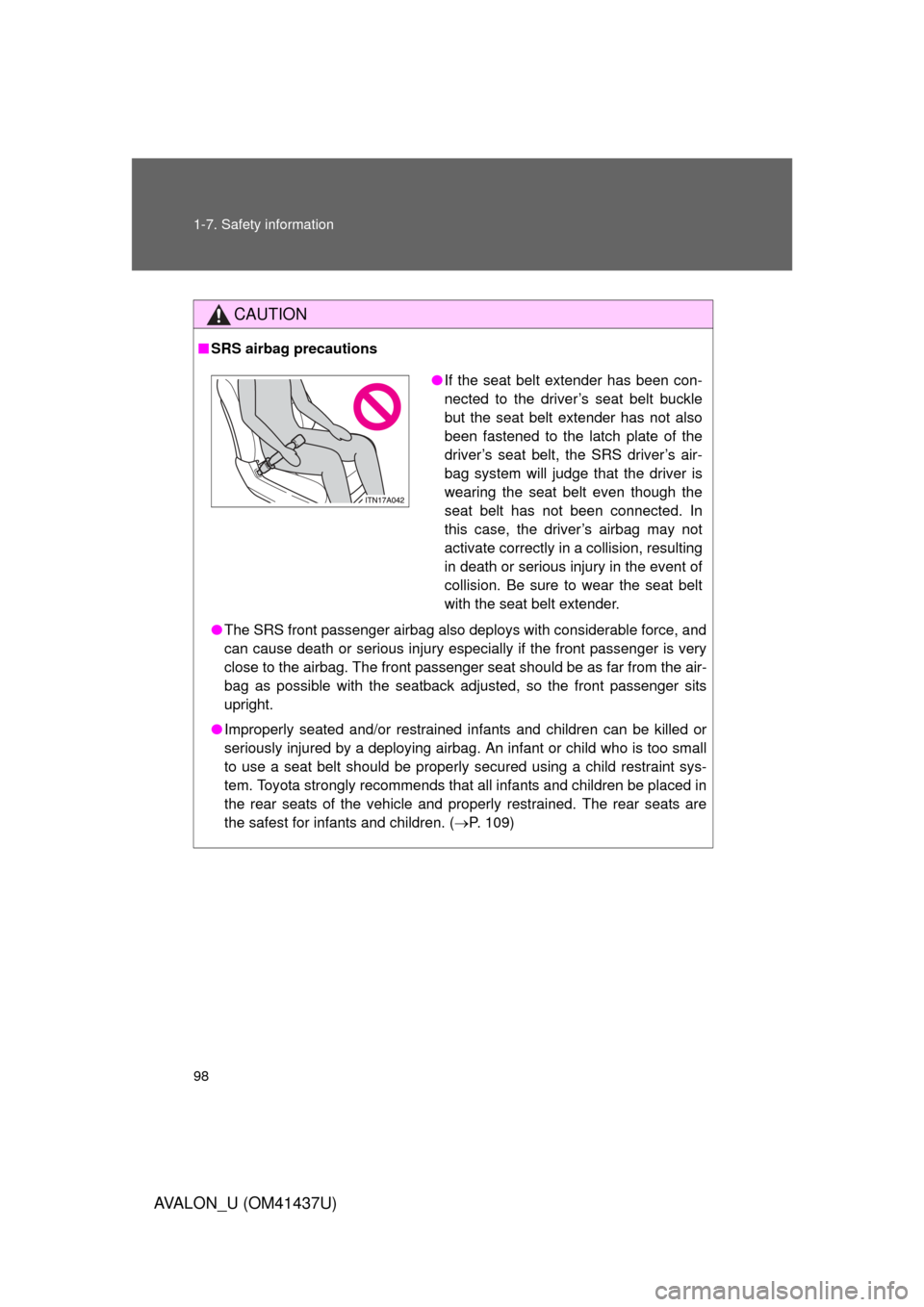
● If the seat belt extender has been con-
nected to the driver’s seat belt buckle
but the seat belt extender has not also
been fastened to the latch plate of the
driver’s seat belt, the SRS driver’s air-
bag system will judge that the driver is
wearing the seat belt even though the
seat belt has not been connected. In
this case, the driver’s airbag may not
activate correctly in a collision, resulting
in death or serious injury in the event of
collision. Be sure to wear the seat belt
with the seat belt extender.
Page 125 of 476
125
2-1. Driving procedures
2
When driving
AVALON_U (OM41437U)
Starting on a steep incline
Firmly set the parking brake and shift the shift lever to “D”.
Gently depress the accelerator pedal.
Release the parking brake.
■Driving in the rain
● Drive carefully when it is raining, because visibility will be reduced, the
windows may become fogged-up, and the road will be slippery.
● Drive carefully when it starts to rain, because the road surface will be
especially slippery.
● Refrain from high speeds when driving on an expressway in the rain,
because there may be a layer of water between the tires and the road
surface, preventing the steering and brakes from operating properly.
■ Breaking in your new Toyota
To extend the life of the vehicle, the following precautions are recommended
to observe:
● For the first 200 miles (300 km):
Avoid sudden stops.
● For the first 1000 miles (1600 km):
• Do not drive at extremely high speeds.
• Avoid sudden acceleration.
• Do not drive continuously in the low gears.
• Do not drive at a constant speed for extended periods.
■ Operating your vehicle in a foreign country
Comply with the relevant vehicle registration laws and confirm the availability
of the correct fuel. ( P. 432)
STEP1
STEP2
STEP3
Page 126 of 476

126 2-1. Driving procedures
AVALON_U (OM41437U)
CAUTION
■When starting the vehicle
Always keep your foot on the brake pedal while stopped with the engine run-
ning. This prevents the vehicle from creeping.
■ When driving the vehicle
● Do not drive if you are unfamiliar with the location of the brake and accel-
erator pedals to avoid depressing the wrong pedal.
• Accidentally depressing the accelerator pedal instead of the brake
pedal will result in sudden acceleration that may lead to an accident
that could result in death or serious injury.
• When backing up, you may twist your body around, leading to a diffi- culty in operating the pedals. Make sure to operate the pedals properly.
• Make sure to keep a correct driving posture even when moving the vehicle only slightly, allowing you to depress the brake and accelerator
pedals properly.
• Depress the brake pedal using your right foot. Depressing the brake pedal using your left foot may delay response in an emergency, result-
ing in an accident.
● Do not drive the vehicle over or st op the vehicle near flammable materials.
The exhaust system and exhaust gases can be extremely hot. This may
cause a fire if there is any flammable material nearby.
● Do not let the vehicle roll backwards while the shift lever is in a driving
position, or roll forward while the shift lever is in “R”.
Doing so may cause the engine not to operate or lead to poor brake and
steering performance, resulting in an accident or damage to the vehicle.\
● If the smell of exhaust is noticed inside the vehicle, open the windows and
check that the trunk is closed.
Large amounts of exhaust in the vehicle can cause driver drowsiness and
an accident, resulting in death or a serious health hazard. Have the cause
of the problem inspected immediately.
Page 155 of 476
155
2-2. Instrument cluster
2
When driving
AVALON_U (OM41437U)
Trip information
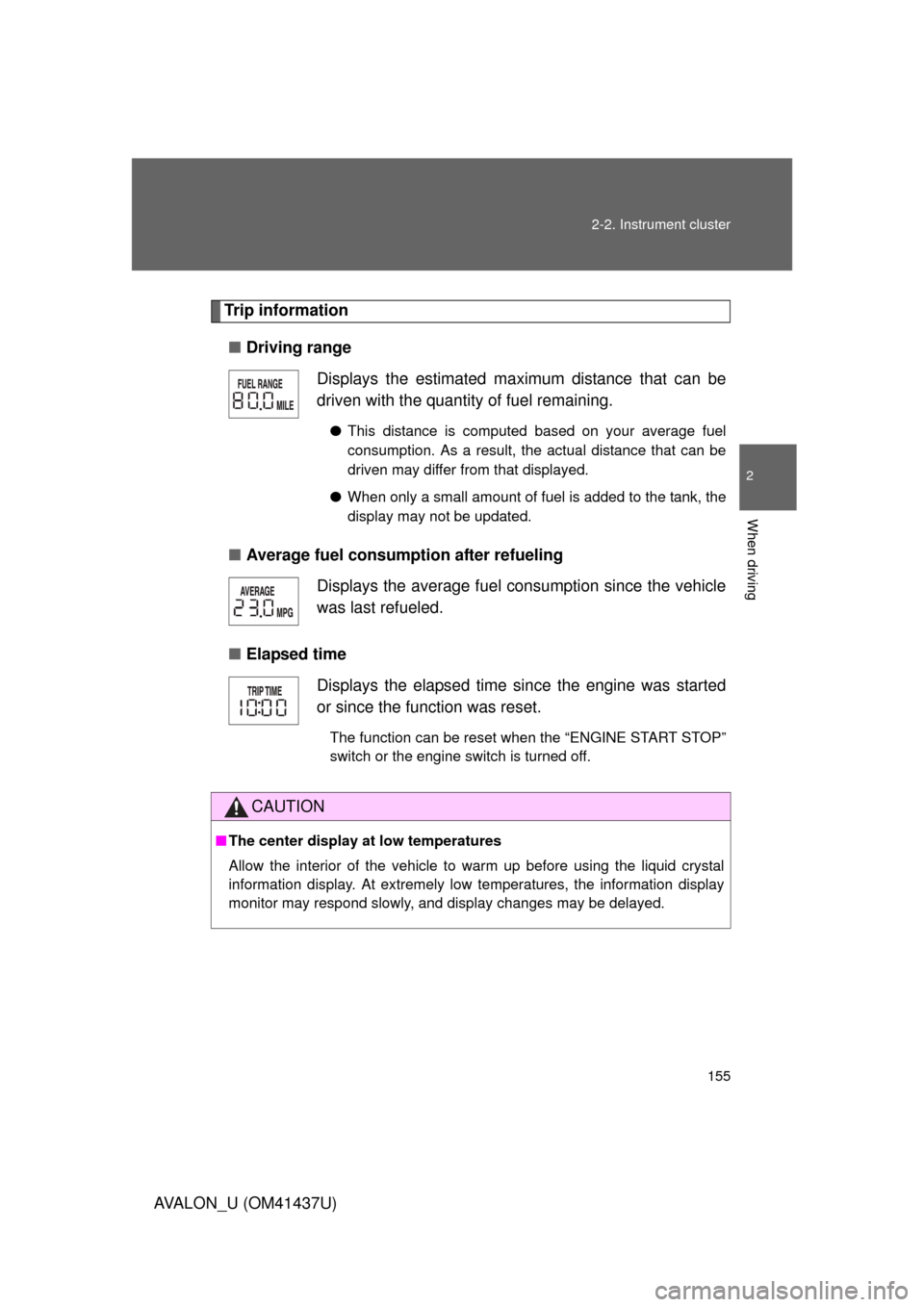
■ Driving range
■ Average fuel consumption after refueling
■ Elapsed time Displays the estimated ma
ximum distance that can be
driven with the quantity of fuel remaining.
● This distance is computed based on your average fuel
consumption. As a result, the actual distance that can be
driven may differ from that displayed.
● When only a small amount of fuel is added to the tank, the
display may not be updated.
Displays the average fuel consumption since the vehicle
was last refueled.
Displays the elapsed time since the engine was started
or since the function was reset.
The function can be reset when the “ENGINE START STOP”
switch or the engine switch is turned off.
CAUTION
■The center display at low temperatures
Allow the interior of the vehicle to warm up before using the liquid crystal
information display. At extremely low temperatures, the information display
monitor may respond slowly, and display changes may be delayed.
Page 210 of 476
210
AVALON_U (OM41437U)
3-2. Using the audio system
Audio system type
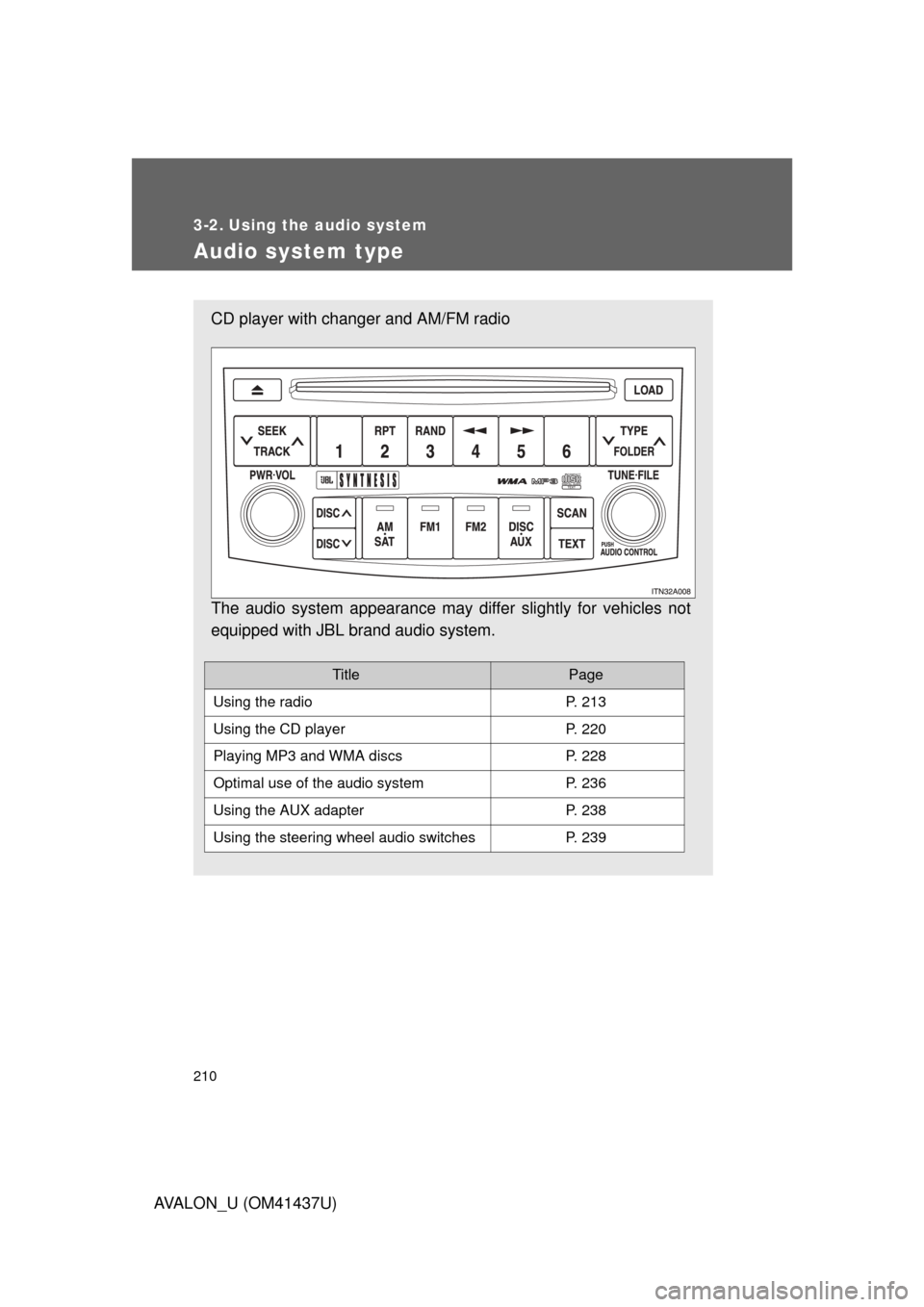
CD player with changer and AM/FM radio
The audio system appearance may differ slightly for vehicles not
equipped with JBL brand audio system.
TitlePage
Using the radioP. 213
Using the CD playerP. 220
Playing MP3 and WMA discsP. 228
Optimal use of the audio systemP. 236
Using the AUX adapterP. 238
Using the steering wheel audio switchesP. 239
Page 244 of 476

244 3-3. Using the hands-free system (for cellular phone)
AVALON_U (OM41437U)
NOTICE:
This equipment has been tested and found to comply with the limits for a
Class B digital device, pursuant to Part 15 of the FCC Rules. These limits
are designed to provide reasonable protection against harmful interference
in a residential installation. This equipment generates, uses and can radiate
radio frequency energy and, if not installed and used in accordance with the
instructions, may cause harmful interference to radio communications. How-
ever, there is no guarantee that interference will not occur in a particular
installation. If this equipment does cause harmful interference to radio or
television reception, which can be determined by turning the equipment off
and on, the user is encouraged to try to correct the interference by one or
more of the following measures:
● Reorient or relocate the receiving antenna.
● Increase the separation between the equipment and receiver.
● Connect the equipment into an outlet on a circuit different from that to
which the receiver is connected.
● Consult the dealer or an experienc ed radio/TV technician for help.
FCC WARNING:
Changes or modifications not expressly approved by the party responsible
for compliance could void the user’s authority to operate the equipment.
Page 305 of 476
305
3-6. Other interior features
3
Interior features
AVALON_U (OM41437U)
■
Before programming
● Install a new battery in the transmitter.
● The battery side of the transmitter must be pointed away from the
HomeLink
.
■ Certification for the garage door opener
This device complies with Part 15 of the FCC Rules and with RSS-210 of the
IC Rules.
Operation is subject to the following two conditions: (1) this device may not
cause harmful interference, and (2) this device must accept any interference
received, including interference that may cause undesired operation.
WARNING: This transmitter has been tested and complies with FCC and IC
rules. Changes or modifications not expressly approved by the party respon-
sible for compliance could void the user’s authority to operate the device.
CAUTION
■When programming a garage door or other remote control device
The garage door may operate, so ensure people and objects are out of dan-
ger to prevent potential harm.
■ Conforming to federal safety standards
Do not use the HomeLink
Compatible Transceiver with any garage door
opener or device that lacks safety stop and reverse features as required by
federal safety standards.
This includes any garage door that cannot detect an obstruction object. A
door or device without these features increases the risk of death or serious
injury.