Page 505 of 665
504 4-3. Do-it-yourself maintenance
4RUNNER_U
Radiator and condenserCheck the radiator and condenser and clear away any foreign
objects.
If either of the above parts is extr emely dirty or you are not sure of
their condition, have your vehicle inspected by your Toyota dealer.
CAUTION
■When the engine is hot
Do not remove the engine coolant reservoir cap.
The cooling system may be under pressure and may spray hot coolant if the
cap is removed, causing burns or other injuries.
NOTICE
■When adding coolant
Coolant is neither plain water nor stra ight antifreeze. The correct mixture of
water and antifreeze must be used to provide proper lubrication, corrosion
protection and cooling. Be sure to read the antifreeze or coolant label.
■ If you spill coolant
Be sure to wash it off with water to prevent it from damaging parts or paint.
CAUTION
■When the engine is hot
Do not touch the radiator or condenser as they may be hot and cause burn\
s.
Page 506 of 665
505
4-3. Do-it-yourself maintenance
4
Maintenance and care
4RUNNER_U
Brake fluid
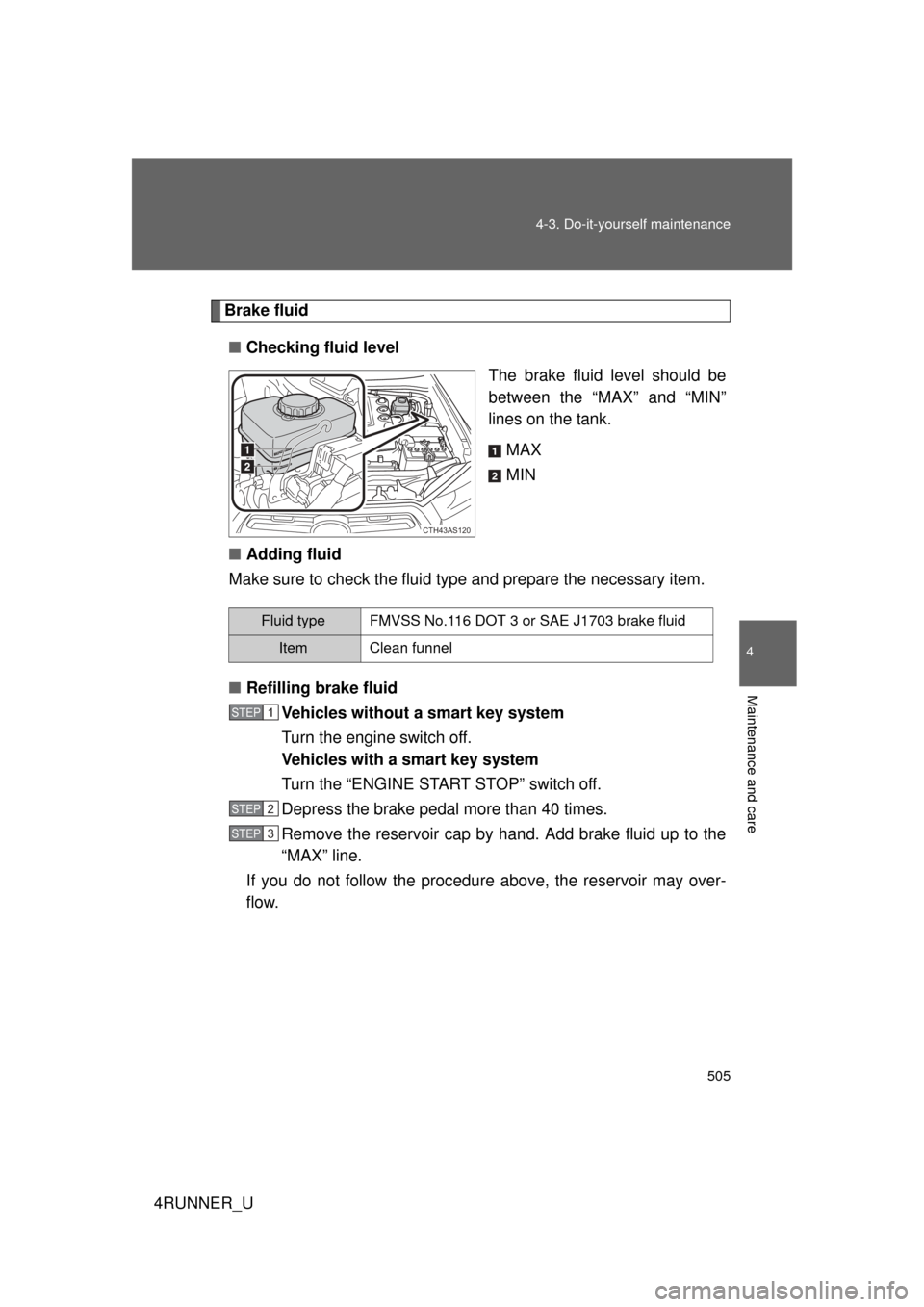
■ Checking fluid level
The brake fluid level should be
between the “MAX” and “MIN”
lines on the tank.
MAX
MIN
■ Adding fluid
Make sure to check the fluid type and prepare the necessary item.
■ Refilling brake fluid
Vehicles without a smart key system
Turn the engine switch off.
Vehicles with a smart key system
Turn the “ENGINE START STOP” switch off.
Depress the brake pedal more than 40 times.
Remove the reservoir cap by hand. Add brake fluid up to the
“MAX” line.
If you do not follow the procedure above, the reservoir may over-
flow.
CTH43AS120
Fluid typeFMVSS No.116 DOT 3 or SAE J1703 brake fluid
ItemClean funnel
STEP 1
STEP 2
STEP 3
Page 532 of 665
531
4-3. Do-it-yourself maintenance
4
Maintenance and care
4RUNNER_U
Checking and replacing fuses
If any of the electrical components do not operate, a fuse may have
blown. If this happens, check and replace the fuses as necessary.
Vehicles without a smart key system
Turn the engine switch off.
Vehicles with a smart key system
Turn the “ENGINE START STOP” switch off.
Open the fuse box cover.
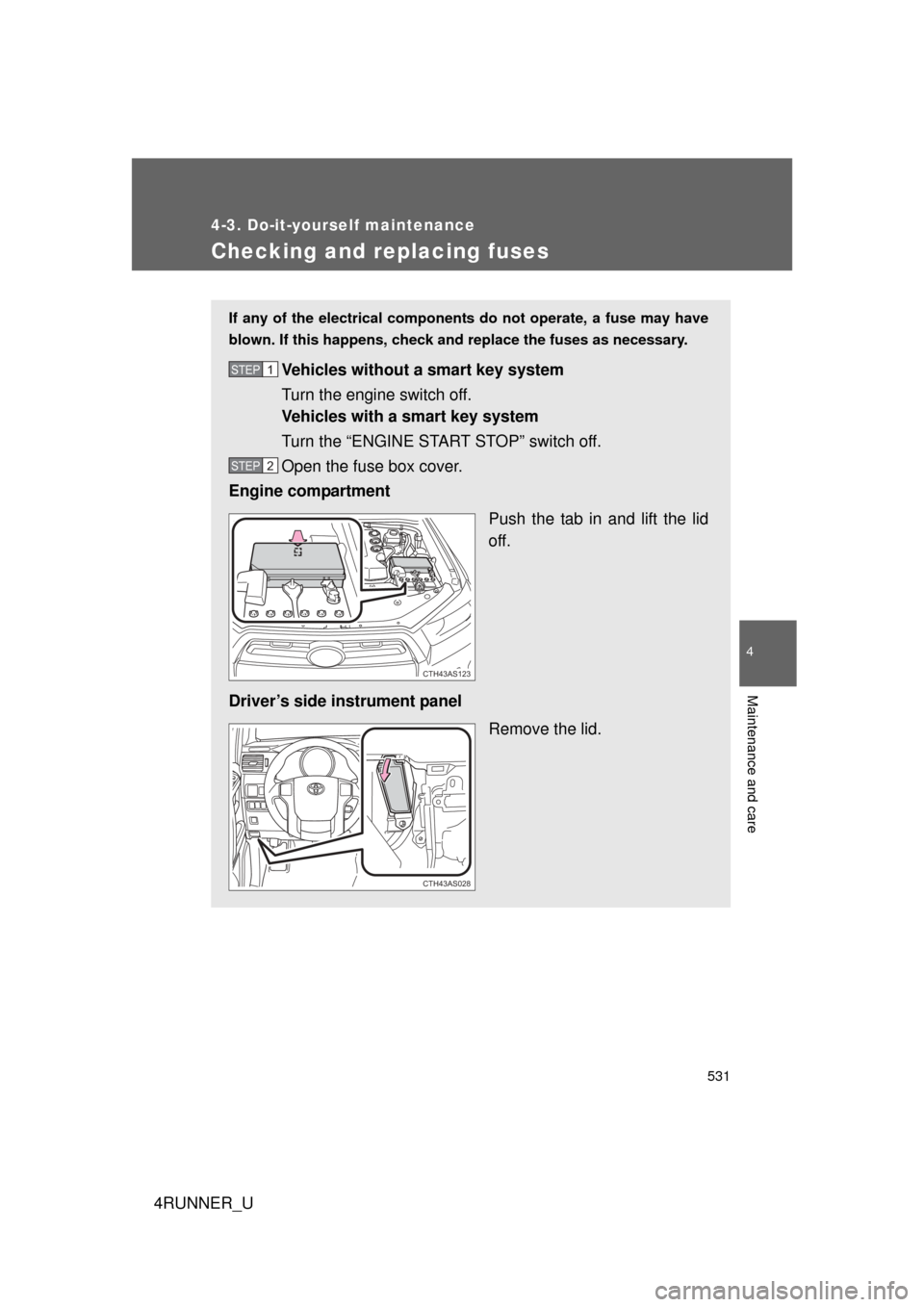
Engine compartment
Push the tab in and lift the lid
off.
Driver’s side instrument panel Remove the lid.STEP 1
STEP 2
CTH43AS123
CTH43AS028
Page 542 of 665
541
4-3. Do-it-yourself maintenance
4
Maintenance and care
4RUNNER_U
Light bulbs
You may replace the following bulbs yourself. The difficulty level of
replacement varies depending on the bulb. If necessary bulb
replacement seems difficult to perfor m, contact your Toyota dealer.
For more information about replacing other light bulbs, contact your
Toyota dealer.
■ Preparing for light bulb replacement
Check the wattage of the light bulb to be replaced. ( P. 622)
■ Removing the engine compartment cover
P. 497
■ Front bulb locations
CTH43AS100
Parking light
and front side
marker light
Fog light
(if equipped) Headlight high beam Headlight low beam
Front turn signal light and
daytime running light
Page 571 of 665

570 5-2. Steps to take in an emergency
4RUNNER_U
Follow the correction procedures. (vehicles with a smart key system)
After taking the specified steps to correct the suspected problem,
check that the warning light goes off.
Interior
buzzerExterior
buzzerWarning lightWarning light/DetailsCorrection procedure
Once Smart key system warning
light
Indicates that the electronic
key is not present when the
“ENGINE START STOP”
switch is pressed Confirm the
location of the
electronic
key*.
Once3 times
Smart key system warning
light
Indicates that a door other
than the driver’s door has
been opened and closed with
the “ENGINE START STOP”
switch in any mode other
than off and the electronic
key has been taken out of
the detection area Confirm the
location of the
electronic
key.
Once3 times
Smart key system warning
light
Indicates that the driver’s
door has been opened and
closed with the shift lever in
P, the “ENGINE START
STOP” switch in any mode
other than off and the elec-
tronic key has been taken out
of the detection area Turn the
“ENGINE
START
STOP” switch
off or confirm
the location of
the electronic
key.
Page 573 of 665

572 5-2. Steps to take in an emergency
4RUNNER_U
■SRS warning light
This warning light system monitors the airbag sensor assembly, front airbag
sensors, side and curtain shield airbag sensors, curtain shield airbag sen-
sors, floor sensor, driver's seat belt buckle switch, front passenger occupant
classification system, SRS airbag on-off indicator, roll sensing of curtain
shield airbags off indicator, front passenger's seat belt buckle switch, seat
belt pretensioner assemblies, inflators, interconnecting wiring and power
sources. ( P. 114)
■ Key reminder buzzer (vehicl es without a smart key system)
The buzzer indicates that the key has not been removed with the engine off
and the driver’s door opened.
■ Open moon roof reminder buzzer (if equipped)
The buzzer indicates that the moon roof is not fully closed with the engine off
and the driver’s door opened.
■ Front passenger detection sensor, passenger seat belt reminder and
warning buzzer
● If luggage is placed on the front passenger seat, the front passenger
detection sensor may cause the warning light to flash and the warning
buzzer to sound even if a passenger is not sitting in the seat.
● If a cushion is placed on the seat, the sensor may not detect a passen-
ger, and the warning light may not operate properly.
■ If the malfunction indicator lamp comes on while driving
First check the following:
● Is the fuel tank empty?
If it is, fill the fuel tank immediately.
● Is the fuel tank cap loose?
If it is, tighten it securely.
The light will go off after several driving trips.
If the light does not go off even after several trips, contact your Toyota dealer
as soon as possible.
Page 588 of 665

5
When trouble arises
587
5-2. Steps to take in an emergency
4RUNNER_U
■After completing the tire change
The tire pressure warning
system must be reset. (P. 515)
■When using the spare tire
As the spare tire is not equipped with a tire pressure warning valve and
transmitter, low inflation pressure of the spare tire will not be indicated by
the tire pressure warnin g system. Also, if you replace the compact spare
tire after the tire pressure warning light comes on, the light remains on.
CAUTION
■Using the tire jack
Improper use of the tire jack may cause the vehicle to suddenly fall off
the jack, leading to death or serious injury.
●Do not use the tire jack for any pu rpose other than replacing tires or
installing and removing tire chains.
●Only use the tire jack that comes wi th this vehicle for replacing a flat
tire.
Do not use it on other vehicles, and do not use other tire jacks for
replacing tires on this vehicle.
●Always check that the tire jack is securely set to the jack point.
●Do not put any part of your body under the vehicle while it is supported
by the jack.
●Do not start or run the engine while your vehicle is supported by the
jack.
●Do not raise the vehicle while someone is inside.
●When raising the vehicle, do not put an object on or under the jack.
●Do not raise the vehicle to a hei ght greater than that required to
replace the tire.
●Use a jack stand if it is necessary to get under the vehicle.
Take particular care when lowering the vehicle to ensure that no one
working on or near the vehicle may be injured.
Page 604 of 665
5
When trouble arises
603
5-2. Steps to take in an emergency
4RUNNER_U
If your vehicle overheats
If your engine overheats:Stop the vehicle in a safe place and turn off the air condi-
tioning system.
Check to see if steam is coming out from under the hood.
If you see steam:
Stop the engine. Carefully lift the hood after the steam sub-
sides and then restart the engine.
If you do not see steam:
Leave the engine running and carefully lift the hood.
Remove the engine compartment cover. (
P. 497)
Check to see if the cooling fan is operating.
If the fan is operating:
Wait until the temperature of the engine (shown on the
instrument panel) begins to fall and then stop the engine.
If the fan is not operating:
Stop the engine immediately and call your Toyota dealer.
After the engine has cooled
down sufficiently, check the
engine coolant level and
inspect the radiator core (radi-
ator) for any leaks.
STEP 1
STEP 2
STEP 3
STEP 4
CTH52AS043
STEP 5