2010 SUZUKI KIZASHI Warning light
[x] Cancel search: Warning lightPage 319 of 388

7-34
INSPECTION AND MAINTENANCE
57L20-03E
Tire Rotation
54G114
To avoid uneven wear of your tires and
to prolong their life, rotate the tires as
illustrated. Tires should be rotated as
recommended in the periodic mainte-
nance schedule. After rotation, adjust
front and rear tire pressures to the
specification listed on your vehicle’s
Tire and Loading Information Label.Compact Spare Tire (if equipped)
54G115
(1) Wear indicator
(2) Indicator location mark
Your vehicle comes equipped with the
compact spare tire. The compact
spare is designed to save space in
your storage area, and its lighter
weight makes it easier to install if a flat
tire occurs. It is only intended for tem-
porary emergency use, until the con-
ventional tire can be repaired or
replaced. The inflation pressure of the
compact spare tire should be checked
at least monthly. Use a quality pocket-
type inflation pressure gauge and set
at 420 kPa (60 psi). At the same time,
check that the tire is stored securely. If
it is not, tighten it.
WARNING
Rust or dirt on a wheel, or on the
parts to which it is fastened, can
make wheel nuts become loose
after a time. The wheel could
come off and cause an accident.
When you change a wheel,
remove any rust or dirt from
places where the wheel attaches
to the vehicle. In an emergency,
you can use a cloth or a paper
towel to do this; but be sure to
use a scraper or wire brush later,
if you need to, to get all the rust
or dirt off.
Page 326 of 388

7-41INSPECTION AND MAINTENANCE
57L20-03E
The main fuse, primary fuses and some of
the individual fuses are located in the
engine compartment. If the main fuse
blows, no electrical component will func-
tion. If a primary fuse blows, no electrical
component in the corresponding load
group will function. When replacing the
main fuse, a primary fuse or an individual
fuse, use a genuine SUZUKI replacement.
To remove a fuse, use the fuse puller pro-
vided in the fuse box. The amperage of
each fuse is shown in the back of the fuse
box cover.
60A243
NOTE:
Make sure that the fuse box always carries
spare fuses. (20) 15A Head light low (Right)
(21) 15A Head light high (Left)
(22) 15A Head light high (Right)
(23) 15A CVT
(24) 20A Front fog light
(25) 15A O2 sensor heater
(26) 15A Horn
(27) –Head light low relay
(Left)
(28) –Head light low relay
(Right)
(29) – Blank
(30) – Blank
(31) – Blank
(32) –Air conditioning com-
pressor relay
(33) – Rear defogger relay
(34) – Blank
(35) –Windshield wiper relay
2
(36) – Blank
(37) –Windshield wiper relay
1
(38) – Starting motor relay
(39) – Fuel pump relay
(40) – Radiator fan relay 3
(41) – Radiator fan relay 1
(42) –Door mirror heater
relay
(43) – Radiator fan relay 2
(44) – Main relay
(45) – Throttle motor relay
WARNING
If the main fuse or a primary fuse
blows, be sure to have your vehicle
inspected by an authorized SUZUKI
dealer. Always use a genuine SUZUKI
replacement. Never use a substitute
such as a wire even for a temporary
fix, or extensive electrical damage
and a fire can result.
BLOWNOK
Page 329 of 388

7-44
INSPECTION AND MAINTENANCE
57L20-03E
The fuses are also located under the pas-
senger’s side of the dashboard. Remove
the two screws and dashboard under
cover. The amperage of each fuse is
shown on the top of the dashboard under
cover.
81A283
Headlight AimingSince special procedures are required, we
recommend you take your vehicle to your
SUZUKI dealer for headlight alignment.
CAUTION
Remove the dashboard undercover
while being careful not to damage the
wiring fitted on it. If the wiring is dam-
aged, the courtesy lights will not
work.
BLOWN OK
WARNING
Always be sure to replace a blown
fuse with a fuse of the correct amper-
age. Never use a substitute such as
aluminum foil or wire to replace a
blown fuse. If you replace a fuse and
the new one blows in a short period
of time, you may have a major electri-
cal problem. Have your vehicle
inspected immediately by your
SUZUKI dealer.
Page 330 of 388

7-45INSPECTION AND MAINTENANCE
57L20-03E
Bulb ReplacementNOTE:
If it is difficult to replace headlight bulbs or
position light bulbs due to under-hood
components trust this job to your dealer.
Interior LightFront dome light
57L71014
Pull down the lens by using a flat blade
screwdriver covered with a soft cloth as
shown. To install it, simply push it back in.Rear dome Light
57L71015
Pull down the lens by using a flat blade
screwdriver covered with a soft cloth as
shown. To install it, simply push it back in.
The bulb can be removed by simply pulling
it out. When replacing the bulb, make sure
that the contact springs are holding the
bulb securely.
WARNING
Light bulbs can be hot enough to
burn your finger right after being
turned off. This is true especially
for halogen headlight bulbs.
Replace the bulbs after they
become cool enough.
The headlight bulbs are filled with
pressurized halogen gas. They can
burst and injure you if they are hit
or dropped. Handle them carefully.
CAUTION
The oils from your skin may cause a
halogen bulb to overheat and burst
when the lights are on. Grasp a new
bulb with a clean cloth.
CAUTION
Frequent replacement of a bulb indi-
cates the need for an inspection of
the electrical system. This should be
carried out by your SUZUKI dealer.
Page 349 of 388

8-6
EMERGENCY SERVICE
57L20-03E
Jump Starting Instructions
When jump starting your vehicle, use
the following procedure:
60A269
1) Use only a 12-volt battery to jump startyour vehicle. Position the good 12-volt
battery close to your vehicle so that the
jumper cables will reach both batteries.
When using a battery installed on
another vehicle, DO NOT LET THE
VEHICLES TOUCH. Set the parking
brakes fully on both vehicles. 2) Turn off all vehicle accessories, except
those necessary for safety reasons (for
example, headlights or hazard lights).
57L81004
3) Make jumper cable connections as fol-lows:
1. Connect one end of the first jumper
cable to the positive (+) terminal of
the discharged battery (1).
2. Connect the other end to the positive (+) terminal of the booster battery
(2).
3. Connect one end of the second
jumper cable to the negative (–) ter-
minal of the booster battery (2).
WARNING
• Never attempt to jump start yourvehicle if the battery appears to be
frozen. Batteries in this condition
may explode or rupture if jump
starting is attempted.
When making jumper cable con- nections, be certain that your
hands and the jumper cables
remain clear from pulleys, belts or
fans.
Batteries produce flammable
hydrogen gas. Keep flames and
sparks away from the battery or an
explosion may occur. Never smoke
when working near the battery.
If the booster battery you use for jump starting is installed in another
vehicle, make sure the two vehicles
are not touching each other.
If your battery discharges repeat- edly, for no apparent reason, have
your vehicle inspected by an autho-
rized SUZUKI dealer.
To avoid harm to yourself or dam- age to your vehicle or battery, fol-
low the jump starting instructions
below precisely and in order. If you
are in doubt, call for qualified road
service.
CAUTION
Your vehicle should not be started by
pushing or towing. This starting
method could result in permanent
damage to the catalytic converter.
Use jumper cables to start a vehicle
with a weak or run-down battery.12V BATTERY
(3)
(2)
(1)
1
4
23
EXAMPLE
Page 350 of 388

8-7EMERGENCY SERVICE
57L20-03E
4. Make the final connection to an
unpainted, heavy metal part (i.e.
engine hook (3)) of the engine of the
vehicle with the discharged battery
(1).
4) If the booster battery you are using is
installed on another vehicle, start the
engine of the vehicle with the booster
battery. Run the engine at moderate
speed.
5) Start the engine of the vehicle with the
discharged battery.
6) Remove the jumper cables in the exact
reverse order in which you connected
them.
Towing a Disabled VehicleEmergency TowingIf your vehicle is disabled, it may be towed
by a tow truck using one of the following
methods:
1) Tow the vehicle with two wheels lifted
by the tow truck and the other two
wheels on a towing dolly.
2) Use the appropriate towing method
specified for your vehicle in the “Towing
Your Vehicle (recreational towing)” sec-
tion, but with the wheels lifted by the
tow truck instead of on a towing dolly.
Be sure to carefully follow the specific
instructions provided in the “Towing
Your Vehicle (recreational towing)” sec-
tion.
If the Starter Does Not
Operate1) While bringing the remote controller
with you, place the gearshift lever in the
“P” position and depress the brake
pedal.
2) Try pressing the engine switch to
change the ignition mode to “START”
with the headlights turned on to deter-
mine the battery condition. If the head-
lights go excessively dim or go off, it
usually means that either the battery
has run down or battery terminal con-
tact is poor. Recharge the battery or
correct battery terminal contact if nec-
essary.
3) If the headlights remain bright, check
the fuses. If the reason for failure of the
starter is not obvious, there may be a
major electrical problem. Have the vehi-
cle inspected by your authorized
SUZUKI dealer.
WARNING
Never connect the jumper cable
directly to the negative (–) terminal of
the discharged battery, or an explo-
sion may occur.
CAUTION
If vehicle damage (such as steering
or drivetrain damage, etc.) prevents
normal use of the towing procedures
for your vehicle described in the
“Towing Your Vehicle (recreational
towing)” section, have your vehicle
towed with two wheels lifted by the
tow truck and the other two wheels
on a towing dolly.
Page 355 of 388
9-2
APPEARANCE CARE
57L20-03E
Keep passenger and cargo compart-
ments clean
Moisture, dirt or mud can accumulate
under the floor mats and may cause corro-
sion. Occasionally, check under these
mats to ensure that this area is clean and
dry. More frequent checks are necessary if
the vehicle is used off road or in wet
weather.
Certain cargo such as chemicals, fertiliz-
ers, cleaners, salts, etc. are extremely cor-
rosive by nature. These products should
be transported in sealed containers. If a
spill or leak does occur, clean and dry the
area immediately.
Use the body trim
The use of the body trim will help protect
your vehicle, especially if you frequently
drive on gravel or salted roads. The fittings
for such guards should also be corrosion
resistant. Please check with your autho-
rized SUZUKI dealer for information on
these guards.
Store your vehicle in a dry, well-venti-
lated area
Do not park your vehicle in a damp, poorly
ventilated area. If you often wash your
vehicle in the garage or if you frequently
drive it in when wet, your garage may be
damp. The high humidity in the garage
may cause or accelerate corrosion. A wet
vehicle may corrode even in a heated
garage if the ventilation is poor.Cover your vehicle
50G203
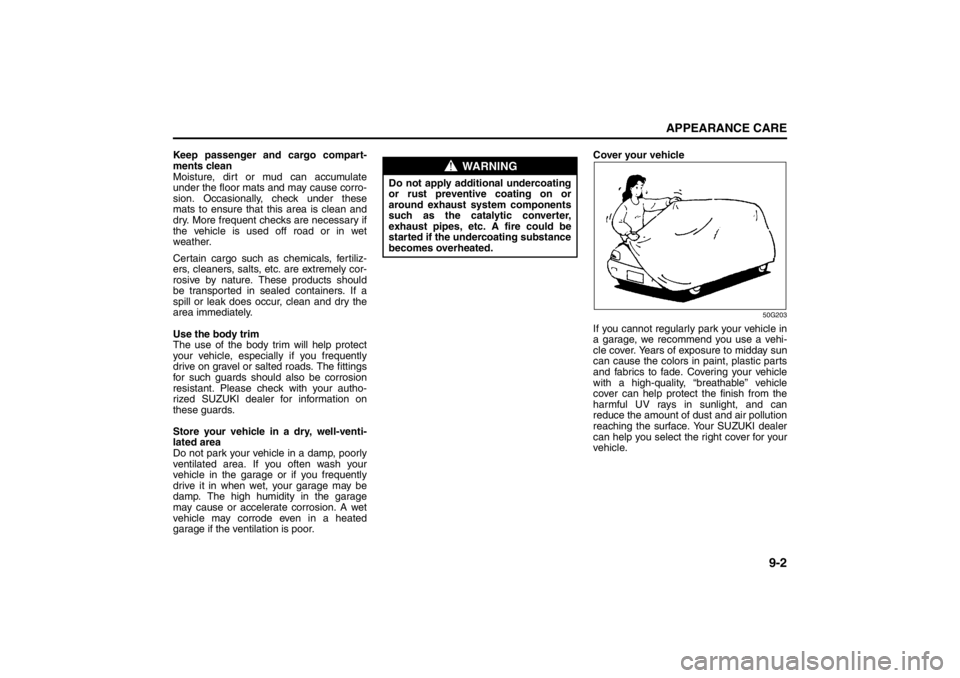
If you cannot regularly park your vehicle in
a garage, we recommend you use a vehi-
cle cover. Years of exposure to midday sun
can cause the colors in paint, plastic parts
and fabrics to fade. Covering your vehicle
with a high-quality, “breathable” vehicle
cover can help protect the finish from the
harmful UV rays in sunlight, and can
reduce the amount of dust and air pollution
reaching the surface. Your SUZUKI dealer
can help you select the right cover for your
vehicle.
WARNING
Do not apply additional undercoating
or rust preventive coating on or
around exhaust system components
such as the catalytic converter,
exhaust pipes, etc. A fire could be
started if the undercoating substance
becomes overheated.
Maintenance Schedule: 1, 2, 3, 4, 5, 6, 9, 10
Page 356 of 388
9-3APPEARANCE CARE
57L20-03E
Vehicle Cleaning
76G044S
Cleaning InteriorVinyl upholstery
Prepare a solution of soap or mild deter-
gent mixed with warm water. Apply the
solution to the vinyl with a sponge or soft
cloth and let it soak for a few minutes to
loosen dirt. Rub the surface with a clean,damp cloth to remove dirt and the soap
solution. If some dirt still remains on the
surface, repeat this procedure.
Fabric upholstery
Remove loose dirt with a vacuum cleaner.
Using a mild soap solution, rub stained
areas with a clean damp cloth. To remove
soap, rub the areas again with a cloth
dampened with water. Repeat this until the
stain is removed, or use a commercial fab-
ric cleaner for tougher stains. If you use a
fabric cleaner, carefully follow the manu-
facturer’s instructions and precautions.
Leather upholstery
Remove loose dirt with a vacuum cleaner.
Using a mild soap or saddle soap solution,
wipe dirt off with a clean damp soft cloth.
To remove soap, wipe the areas again with
a soft cloth dampened with water. Wipe the
areas dry with a soft dry cloth. Repeat this
until the dirt or stain is removed, or use a
commercial leather cleaner for tougher dirt
or stains. If you use a leather cleaner, care-
fully follow the manufacture’s instructions
and precautions. Do not use solvent type
cleaners or abrasive cleaners.
NOTE:
In order to keep leather upholstery look-
ing good, it should be cleaned at least
twice a year.
If leather upholstery becomes wet,
immediately wipe it dry with tissue paperor a soft cloth. Water may cause leather
to harden and shrink if it is not wiped off.
When parking on sunny days, select a
shady place or use a sunshade. If
leather upholstery is exposed to direct
sunlight for a long time, it may discolor
and shrink.
As is common with natural materials,
leather is inherently irregular in grain and
cowhide has spots in its natural state.
These do not affect the performance of
the leather in any way.
Seat belts
Clean seat belts with a mild soap and
water. Do not use bleach or dye on the
belts. They may weaken the fabric in the
belts.
Vinyl floor mats
Ordinary dirt can be removed from vinyl
with water or mild soap. Use a brush to
help loosen dirt. After dirt is loosened,
rinse the mat thoroughly with water and
dry it in the shade.
Carpets
Remove dirt and soil as much as possible
with a vacuum cleaner. Using a mild soap
solution, rub stained areas with a clean
damp cloth. To remove soap, rub the areas
again with a cloth dampened with water.
Repeat this until the stain is removed, or
use a commercial carpet cleaner for
tougher stains. If you use a carpet cleaner,
WARNING
When cleaning the interior or exterior
of the vehicle, NEVER USE flammable
solvents such lacquer thinners, gas-
oline, benzene or cleaning materials
such as bleaches and strong house-
hold detergents. The materials could
cause personal injury or damage to
the vehicle.
Periodic Maintenance Schedule: 1, 2, 3, 4, 5, 6, 9, 10