2010 SUZUKI KIZASHI seats
[x] Cancel search: seatsPage 69 of 388

2-50
BEFORE DRIVING
57L20-03E
NOTE:
Although there are three rear seating posi-
tions, you cannot install three LATCH type
child restraints in the rear seats. You can
install one or two LATCH restraint(s). Be
sure to install the LATCH type child
restraint(s) in the outboard seating posi-
tions.
If your LATCH restraint has flexible lower
connecting straps, these general instruc-
tions apply:
1) If possible, fold the seatback rearward
for easier installation.
73K017
2) Place the child restraint in the rear seat,
feeding the strap hooks through the
slots in the seat cushion or the slots in
the seatback bottom.
65D340
3) Snap the strap hooks to the anchors.
Take care not to pinch your fingers.
65D341
4) Return the seatback to the normal,
upright position. Tighten the lower
straps as described in the child restraint
owner’s manual. Attach the top tether
strap, if applicable.
EXAMPLE
EXAMPLE
EXAMPLE
Page 72 of 388

2-53BEFORE DRIVING
57L20-03E
directly behind the child restraint. Do
not attach the top strap to the luggage
restraint loops (if equipped).
57L21049
4) When routing the top strap, be sure to
pass the top strap as shown in the illus-
tration. (Refer to “Adjustable Head
Restraints” section for details on how to
raise or lower the head restraint.)
5) Make sure that cargo does not interfere
with routing of the top strap.
Seat Belt Extender
65D613
(1) Center of body
(2) Less than 152 mm (6 inches)
(3) Open end of extender buckle
If a seat belt cannot be fastened securely
because it is not long enough, see an
authorized SUZUKI dealer for a seat belt
extender. Seat belt extenders are available
for each seating position except for the
rear center position. After inspecting the
relationship between the seat belt length,
the occupant’s body size, and the seat
adjustment (the driver’s seat should always
be adjusted as far back as possible while
still maintaining control of the vehicle, and
other adjustable seats should be adjusted
as far back as possible), your dealer can
select the appropriate seat belt extender.
WARNING
Do not attach the child restraint top
strap to the luggage restraint loops
(if equipped). Incorrectly attached top
strap will reduce the intended effec-
tiveness of the child restraint system.Ty p e 2 Ty p e 1
Page 83 of 388

2-64
BEFORE DRIVING
57L20-03E
How the System WorksIn a frontal collision, the crash sensors will
detect rapid deceleration and send a signal
to the controller. If the controller judges
that the deceleration represents a severe
frontal crash, the controller will trigger the
inflators. The controller also judges:
Whether the front air bags should deploy
at reduced power or at full power accord-
ing to crash severity.
Whether the air bags should deploy at
reduced power or at full power according
to crash severity.
Whether the front passenger’s front air
bag should deploy or not based on clas-
sification of the occupant of the front
passenger’s seat.
Since your vehicle is equipped with front
side air bags, rear side air bags and side
curtain air bags, crash sensors will detect
a side collision, and if the controller judges
that the side collision is severe enough, it
will trigger the front side air bag, rear side
air bags and side curtain air bag inflators.
The inflators inflate the appropriate air
bags with nitrogen or argon gas. The
inflated air bags provide a cushion for your
head (front air bags and side curtain air
bags only) and upper body. The air bag
inflates and deflates so quickly that you
may not even realize that it has activated.
The air bag will neither hinder your view
nor make it harder to exit the vehicle.
WARNING
The front passenger sensing system
may not work properly in the follow-
ing situations:
The occupant is sitting near the
dashboard or is not sitting in the
proper position.
Objects placed under the seat are
pushing up on the seat cushion.
WARNING
If the “PASS AIR BAG OFF” indicator
on the instrument panel turns on
even though there is no occupant or
an adult occupant in the front pas-
senger’s seat, it means that some-
thing may be wrong with the
passenger sensing system. Have the
system inspected by an authorized
SUZUKI dealer as soon as possible.
WARNING
Do not spill any liquids on the seat.
Liquids can damage the sensors
under the front seat.
Have the front passenger’s sensor
mat inspected by your dealer after
a collision.
Do not replace the front seats. If
you replace them, the air bags and
front passenger sensing system
may not work properly.
Do not use a seat cover. If you use
a seat cover, the front passenger
sensing system may not work prop-
erly.
Page 84 of 388

2-65BEFORE DRIVING
57L20-03E
Air bags must inflate quickly and forcefully
in order to reduce the chance of serious or
fatal injuries. However, an unavoidable
consequence of the quick inflation is that
the air bag may irritate bare skin, such as
the facial area against a front air bag. Also,
upon inflation, a loud noise will occur and
some powder and smoke will be released.
These conditions are not harmful and do
not indicate a fire in the car. Be aware,
however, that some air bag components
may be hot for a while after inflation.
A seat belt helps keep you in the proper
position for maximum protection when an
air bag inflates. Adjust your seat as far
back as possible while still maintaining
control of the vehicle. Sit fully back in your
seat; sit up straight; do not lean over the
steering wheel or dashboard. Front occu-
pants should not lean on or sleep against
the door. Please refer to the “Seat Adjust-
ment” section and the “Seat Belts and
Child Restraint Systems” section in the
“BEFORE DRIVING” section for details on
proper seat and seat belt adjustments.
65D610
54G582
WARNING
The driver should not lean over the
steering wheel. The front passen-
ger should not rest his or her body
against the dashboard, or other-
wise get too close to the dash-
board. For vehicles with side air
bags, rear side air bags and side
curtain air bags, occupants should
not lean on or sleep against the
door. In these situations, the out-of-
position occupant would be too
close to an inflating air bag, and
may suffer severe injury.
Do not attach any objects to, or
place any objects over, the steering
wheel or dashboard. Do not place
any objects between the air bag
and the driver or front passenger.
These objects may interfere with air
bag operation or may be propelled
by the air bag in the event of a
crash. Either of these conditions
may cause severe injury.
For vehicles with front side air
bags, do not place seat covers on
the front seats, because seat cov-
ers could restrict the air bag’s infla-
tion. Also, do not place any cup
holders or other objects on the
door, as these objects could be
propelled by the air bag in the event
of a crash. Either of these condi-
tions may cause severe injury.
Page 141 of 388
3-10
OPERATING YOUR VEHICLE
57L20-03E
Steering lock warning buzzer
If the steering lock fails to engage due to a
fault in the system even when you press
the engine switch to change the ignition
mode to “LOCK” (OFF), the interior buzzer
will warn you of this condition with
repeated short beeps. If this happens,
have the vehicle inspected by an autho-
rized SUZUKI dealer.
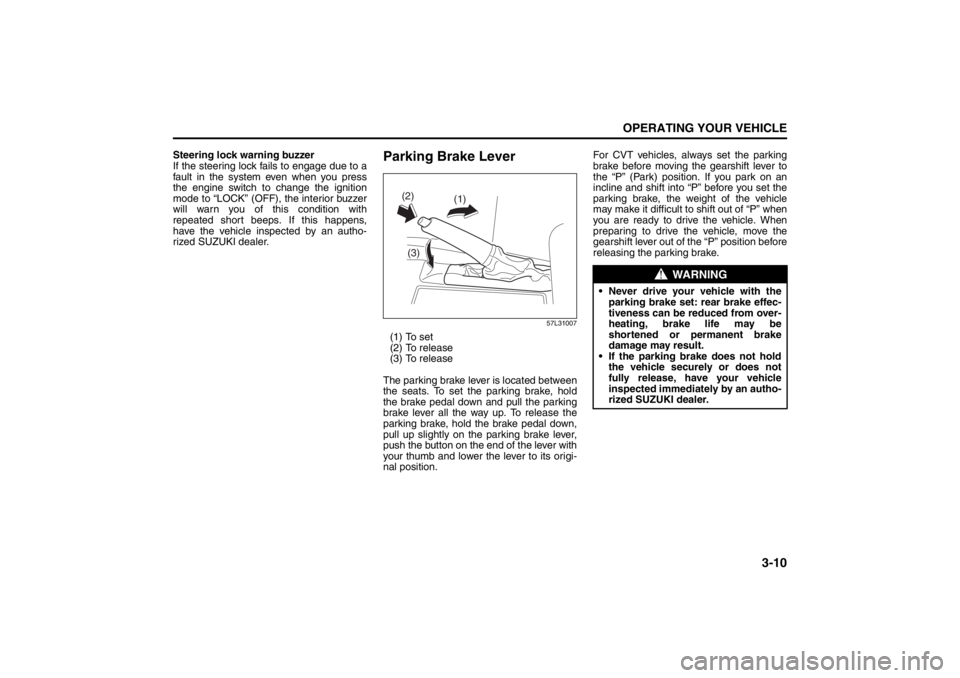
Parking Brake Lever
57L31007
(1) To set
(2) To release
(3) To release
The parking brake lever is located between
the seats. To set the parking brake, hold
the brake pedal down and pull the parking
brake lever all the way up. To release the
parking brake, hold the brake pedal down,
pull up slightly on the parking brake lever,
push the button on the end of the lever with
your thumb and lower the lever to its origi-
nal position. For CVT vehicles, always set the parking
brake before moving the gearshift lever to
the “P” (Park) position. If you park on an
incline and shift into “P” before you set the
parking brake, the weight of the vehicle
may make it difficult to
shift out of “P” when
you are ready to drive the vehicle. When
preparing to drive the vehicle, move the
gearshift lever out of the “P” position before
releasing the parking brake.
(1)
(2)
(3)
WARNING
Never drive your vehicle with the parking brake set: rear brake effec-
tiveness can be reduced from over-
heating, brake life may be
shortened or permanent brake
damage may result.
If the parking brake does not hold the vehicle securely or does not
fully release, have your vehicle
inspected immediately by an autho-
rized SUZUKI dealer.
Page 183 of 388

5-4
OTHER CONTROLS AND EQUIPMENT
57L20-03E
Driver’s temperature selector (1)/Pas-
senger’s temperature selector (2)
57L51003
Turn the temperature selector (1)/(2) to
adjust the temperature. The display (11)
shows the selected temperature.
NOTE:
If you turn the temperature selector (1)
until “HI” or “LO” appears on the display,
the climate control system will operate at
the maximum heating or cooling and the
blower will run at full speed. The tempera-
ture of the air from the outlets may change
suddenly while “LO” or “HI” is displayed,
but this is normal.“DUAL” switch (3)
Every time you press the “DUAL” switch
(3), the temperature control mode switches
between the following:
Individual control mode (indicatior ON):
The driver and passenger can make
temperature adjustments indepen-
dently from their own temperature
selectors.
Combined control mode (indicatior OFF):
If a temperature adjustment is made
from the driver’s temperature selector
(1), the same adjustment is made auto-
matically on the passenger side.
NOTE:
If the passenger’s temperature selector (2)
is turned while in the combined control
mode, the individual control mode is auto-
matically set.Blower speed selector (4)
57L51004
Air flows out at a higher rate when you
press the right switch and at a lower rate
when you press the left switch.
If the “AUTO” switch (9) is pushed, the
blower speed will vary automatically as the
climate control system maintains the
selected temperature.
(1)/(2)
(4)
(9)
Fuel Filler Cap: 5
Folding Rear Seats: 3
Page 184 of 388

5-5OTHER CONTROLS AND EQUIPMENT
57L20-03E
Air intake selector (5)
57L51005
Push the air intake selector (5) to change
between the following modes.
If the “AUTO” switch (9) is pushed, the air
intake will vary automatically as the climate
control system maintains the selected tem-
perature.
RECIRCULATED AIR (a)
When this mode is selected, outside air is
shut off and inside air is recirculated. This
mode is suitable when driving through an
area with polluted air such as a tunnel, or
when attempting to quickly cool down the
vehicle.FRESH AIR (b)
When this mode is selected, outside air is
introduced.
“FRESH AIR” and “RECIRCULATED AIR”
are selected alternately each time the air
intake selector is pushed.
NOTE:
If you select “RECIRCULATED AIR” for an
extended period of time, the air in the vehi-
cle can become contaminated. Therefore,
you should occasionally select “FRESH
AIR”.
“MODE” switch (6)
57L51006
Push the “MODE” switch (6) to change
among the following functions. The indica-
tion of the selected mode appears on the
display.If the “AUTO” switch (9) is pushed, the air
flow will vary automatically as the climate
control system maintains the selected tem-
perature.
Ventilation (c)
57L51007
Temperature-controlled air comes out of
the center, side and rear outlets.
(a)
(b)
(5)
(c)
(d)
(e)
(f)
(6)
Folding Rear Seats: 3
Page 185 of 388

5-6
OTHER CONTROLS AND EQUIPMENT
57L20-03E
Bi-level (d)
57L51008
Temperature-controlled air comes out of
the floor, center, side, rear and rear floor
outlets.
Heat (e)
57L51009
Temperature-controlled air comes out of
the floor, rear floor and the side outlets,
also comes out of the windshield defroster
outlets and also comes slightly out of the
side defroster outlets and the side outlets.
Heat & defrost (f)
57L51010
Temperature-controlled air comes out of
the floor and rear floor outlets, the wind-
shield defroster outlets, the side defroster
outlets and the side outlets.
All areas other than Mexico
NOTE:
When you select the “Heat & defrost” func-
tion, the air intake mode will automatically
switch to “FRESH AIR”.Defrost switch (7)
57L51011
Push the defrost switch (7) to turn on the
defroster.
Defrost
57L51012
(7)
Folding Rear Seats: 3