Page 266 of 388
5-87OTHER CONTROLS AND EQUIPMENT
57L20-03E
Lidded Instrument Panel Box
57L51032
Use this stowage to keep small articles.
You can open the lid (1) by pressing the
raised portion on it.
Cup Holder and Storage Area
(if equipped)
57L51069
Cup holders (1) are provided in the center
console.
You can open the lid (2) by pressing the
raised portion on it.
57L51046
The cup holder (1) for rear seat passen-
gers is extended ready for use when the
armrest is tilted down and the button (2) is
pressed. Push the cup holder backward to
store it.
WARNING
Never drive with the lid of the lidded
instrument panel box open. It could
cause injury if an accident occurs.
(1)
(1)(2)
(2)
(1)
Page 267 of 388
5-88
OTHER CONTROLS AND EQUIPMENT
57L20-03E
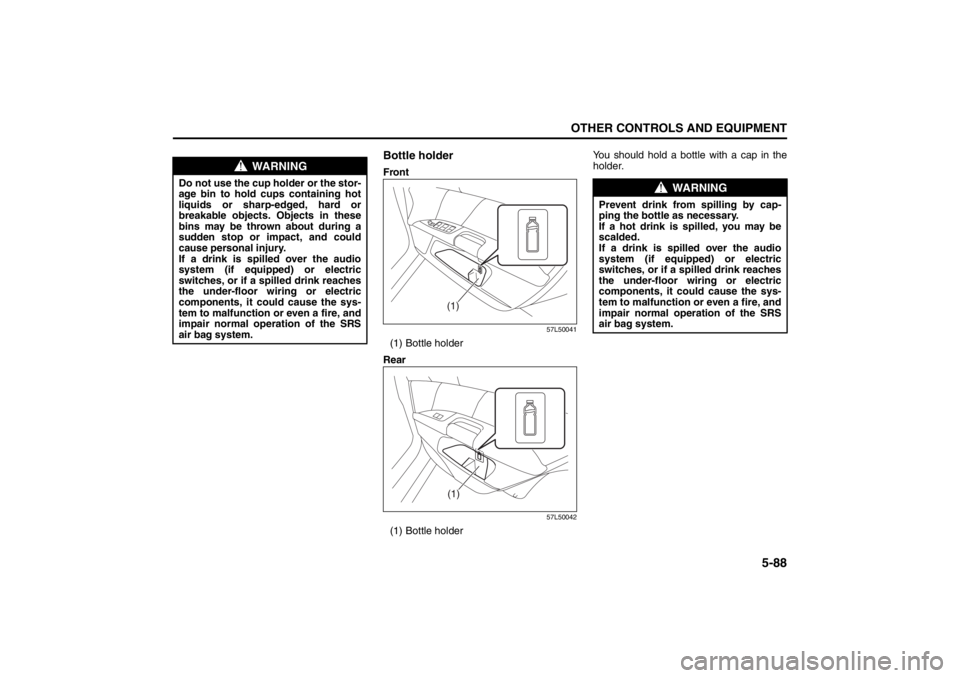
Bottle holderFront
57L50041
(1) Bottle holder
Rear
57L50042
(1) Bottle holderYou should hold a bottle with a cap in the
holder.
WARNING
Do not use the cup holder or the stor-
age bin to hold cups containing hot
liquids or sharp-edged, hard or
breakable objects. Objects in these
bins may be thrown about during a
sudden stop or impact, and could
cause personal injury.
If a drink is spilled over the audio
system (if equipped) or electric
switches, or if a spilled drink reaches
the under-floor wiring or electric
components, it could cause the sys-
tem to malfunction or even a fire, and
impair normal operation of the SRS
air bag system.
(1)(1)
WARNING
Prevent drink from spilling by cap-
ping the bottle as necessary.
If a hot drink is spilled, you may be
scalded.
If a drink is spilled over the audio
system (if equipped) or electric
switches, or if a spilled drink reaches
the under-floor wiring or electric
components, it could cause the sys-
tem to malfunction or even a fire, and
impair normal operation of the SRS
air bag system.
Page 268 of 388
5-89OTHER CONTROLS AND EQUIPMENT
57L20-03E
Front Seat Back Pocket
(if equipped)
57L50043
(1) Front seat back pocket
This pocket is provided for holding light
and soft things such as gloves, newspa-
pers or magazines.
Footrest
57L51033
Use the footrest (1) as a support for your
left foot.
Center Console BoxUse this stowage for keeping small arti-
cles.
The box consists of upper and lower com-
partments. The upper compartment forms
a tray, which also serves as a lid of the
lower compartment.Upper compartmentOpen the upper compartment by raising
the top lid (2) while keeping the lever (1)
up.
57L50045
WARNING
Do not put hard or breakable objects
in the pocket. If an accident occurs,
objects such as bottles, cans, etc.
can injure the occupants in the rear
seat.
(1)
(1)
(2)
(1)
Page 269 of 388

5-90
OTHER CONTROLS AND EQUIPMENT
57L20-03E
Lower compartmentOpen the lower compartment by raising
the top lid and tray (4) together while keep-
ing the lever (3) up.
57L51035
NOTE:
Always close the lid after you put some-
thing into or take something out of the
box.
The upper compartment (tray) and lower
compartment have slots on their edges
so that the cable of an appliance con-
nected to the accessory socket can be
led through them. When the top lid or the
top lid and tray combination is raised or
lowered to open or close the upper or
lower compartment, be careful not to
trap a cable under it.
ArmrestFront
57L50069
The lid of the center console box serves as
the front armrest when it is closed.
Rear
57L51047
The armrest (1) is stowed in the center of
the seatback. Tilt it down forward to use.
57L50070
(4)
(3)
(1)
(1)
WARNING
The seat belt must always be
passed under the armrest. It cannot
provide the intended protection if it
runs over the armrest.
In an accident or sudden stop, the
rear armrest could fall forward. If
there is a child in a rearfacing child
restraint in the center seating posi-
tion, the falling armrest could injure
the child. Make sure the armrest is
secured in the stowed position
when not in use.
(1)
(2)
Page 270 of 388
5-91OTHER CONTROLS AND EQUIPMENT
57L20-03E
NOTE:
There is a lid (1) behind the armrest stow-
age in the seatback.
When carrying a long cargo, the lid (1)
can be opened by folding it forward while
keeping the lever (2) pressed down.
When closing the lid (1), raise and push
it into position.
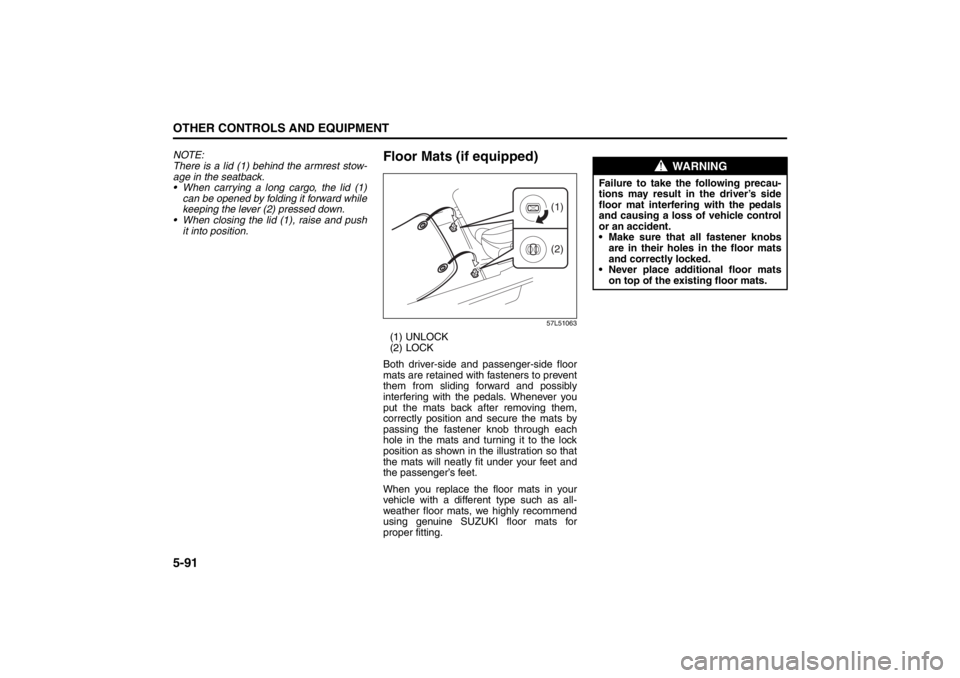
Floor Mats (if equipped)
57L51063
(1) UNLOCK
(2) LOCK
Both driver-side and passenger-side floor
mats are retained with fasteners to prevent
them from sliding forward and possibly
interfering with the pedals. Whenever you
put the mats back after removing them,
correctly position and secure the mats by
passing the fastener knob through each
hole in the mats and turning it to the lock
position as shown in the illustration so that
the mats will neatly fit under your feet and
the passenger’s feet.
When you replace the floor mats in your
vehicle with a different type such as all-
weather floor mats, we highly recommend
using genuine SUZUKI floor mats for
proper fitting.
(1)
(2)
WARNING
Failure to take the following precau-
tions may result in the driver’s side
floor mat interfering with the pedals
and causing a loss of vehicle control
or an accident.
Make sure that all fastener knobs
are in their holes in the floor mats
and correctly locked.
Never place additional floor mats
on top of the existing floor mats.
Page 272 of 388

5-93OTHER CONTROLS AND EQUIPMENT
57L20-03E
The gross weight of the roof rack plus
cargo must not exceed the loading
capacity (50 kg (110 lbs)). Also, do not
let the gross vehicle weight (fully loaded
vehicle including driver, passengers,
cargo, roof load and trailer tongue
weight) exceed the Gross Vehicle
Weight Rating (GVWR) listed in the
driver’s door lock pillar.
Mount and secure the cargo onto the
roof rack properly according to the
instructions provided. Be sure to stow
the heaviest items at the bottom and dis-
tribute the cargo as evenly as possible.
Do not carry items so large that they
hang over the bumpers or the sides of
the vehicle, or block your view.
Secure the front and rear ends of long
items – such as wood panels, surfboards
and so forth – to both the front and rear
of the vehicle. You should protect the
painted surfaces of the vehicle from
scuffing caused by tie-down ropes.
Check periodically to make sure the roof
rack is securely installed and free from
damage.
For vehicles with roof rack anchors,
make sure the anchors are covered with
the caps when not in use.
HomeLink
® (if equipped)
66J092
HomeLink
®: HomeLink
® is a registered
trademark of Johnson Controls Technology
Company.
The HomeLink
® Wireless Control System
provides a convenient way to replace up to
three hand-held radio-frequency (RF)
transmitters used to activate devices such
as gate operators, garage door openers,
entry door locks, security systems, even
home lighting. Additional HomeLink
® infor-
mation can be found on the Internet at
www.homelink.com
or by calling 1-800-
355-3515.
Before programming HomeLink
® to a
garage door opener or gate operator, make
sure that people and objects are out of the
way of the device to prevent potential harm
or damage. When programming a garage
door opener, it is advised to park outside of
the garage. Do not use HomeLink® with
any garage door opener that lacks safety
stop and reverse features as required by
U.S. federal safety standards (this includes
WARNING
Abrupt maneuvers or failure to
properly secure cargo can allow the
cargo to fly off the vehicle and hit
others, causing personal injury or
property damage.
Mount cargo securely and avoid
abrupt maneuvers such as “jack-
rabbit” starts, sharp turns, fast cor-
nering and sudden braking. Check
periodically to make sure that
cargo is securely fastened.
Large, bulky, long, or flat items can
affect vehicle aerodynamics or be
caught by the wind, and can reduce
vehicle control resulting in an acci-
dent and personal injury. Drive cau-
tiously at a safely reduced speed
when carrying this type of cargo.
Page 277 of 388
5-98
OTHER CONTROLS AND EQUIPMENT
57L20-03E
Side (3)
57L51043
57L5104457L51045
Frame hooks are provided on the front (1),
rear (2) and side (3) of the vehicle. The
hooks (1) and (2) are used for emergency
situations. The hooks (3) are used for
trailer/train shipping purposes.
The hook (4) is used for transportation by
ship.
To tow your vehicle on the road or highway,
follow the instruction of “Towing” in “EMER-
GENCY SERVICE” section.
(3)
Front
(3)
Rear
(4)
WARNING
Do not use the frame hooks to tow
another vehicle or to have your vehi-
cle towed on the road or highway.
The hooks (1) and (2) are designed
for use in emergency situations only,
such as if your vehicle or another
vehicle gets stuck in deep mud or
snow.
The hooks (3) are provided for trailer/
train shipping purpose.
The hook (4) is provided for transpor-
tation by ship.
CAUTION
Never use the hooks (1) and (2) for
transporting the vehicle by a trailer,
train or ship, as doing so may dam-
age the vehicle.
Page 280 of 388

6-1VEHICLE LOADING AND TOWING
57L20-03E
Vehicle Loading
57L61001
Your vehicle was designed for specific
weight capacities. The weight capacities of
your vehicle are indicated by the Gross
Vehicle Weight Rating (GVWR), the Gross
Axle Weight Rating (GAWR, front and rear)
and the Vehicle Capacity Weight. The
GVWR and GAWR (front and rear) are
listed on the Safety Certification Label
which is located below the driver’s side
door latch striker. The Vehicle Capacity
Weight is listed on the Tire Information
Label which is located below the Safety
Certification Label.
GVWR – Maximum permissible overall
weight of the fully loaded vehicle (including
all the occupants, accessories and cargo).
GAWR – (Front and Rear) Maximum per-
missible weight on an individual axle.Vehicle Capacity Weight – Maximum per-
missible load weight a vehicle can carry
including the weight of all the occupants,
accessories and cargo.
The weight of any accessories already
installed on your vehicle at the time of pur-
chase, or that you or the dealer install after
purchase, must be subtracted from the
Vehicle Capacity Weight to determine how
much capacity remains available for occu-
pants and cargo. Contact your dealer for
further information.
Actual weight of the loaded vehicle and
actual loads at the front and rear axles can
only be determined by weighing the vehicle
using a vehicle scale. To measure the
weight and load, try taking your vehicle to
a highway weighing station, shipping com-
pany or inspection station for trucks, etc.
Compare these weights to the GVWR and
GAWR (front and rear) listed on the Safety
Certification Label. If the gross vehicle
weight or the load on either axle exceeds
these ratings, you must remove enough
weight to bring the load down to the rated
capacity.
WARNING
Never overload your vehicle. The
gross vehicle weight (sum of the
weights of the loaded vehicle, driver
and passengers) must never exceed
the Gross Vehicle Weight Rating
(GVWR) listed on the Safety Certifica-
tion Label. In addition, never distrib-
ute a load so that the weight on either
the front or rear axle exceeds the
Gross Axle Weight Rating (GAWR)
listed on the Safety Certification
Label.
WARNING
Always distribute cargo evenly.
To avoid personal injury or damage
to your vehicle, always secure
cargo to prevent it from shifting if
the vehicle moves suddenly.
Place heavier objects on the floor
and as far forward in the trunk or in
the cargo area as possible.
Never pile cargo higher than the
top of the seat backs.
Exhaust Gas Warning: NO
Daily Inspection Checklist: NO


