2010 SUBARU OUTBACK wheel
[x] Cancel search: wheelPage 61 of 448
refer to“Seatbelts ”F 1-12.
. Do not sit or lean unnecessarily
close to the SRS airbag. Because
the SRS airbag deploys with
considerable speed –faster than
the blink of an eye –and force to
protect in high speed collisions,
the force of an airbag can injure
an occupant whose body is too
close to SRS airbag.
It is also important to wear your
seatbelt to help avoid injuries
that can result when the SRS
airbag contacts an occupant not
in proper position such as one
thrown forward during pre-acci-
dent braking.
Even when properly positioned,
there remains a possibility that
an occupant may suffer minor
injury such as abrasions and
bruises to the face or arms
because of the SRS airbag de-
ployment force.
. The SRS airbags deploy with
considerable speed and force.
Occupants who are out of proper
position when the SRS airbag
deploys could suffer very serious
injuries. Because the SRS airbag
needs enough space for deploy- ment, the driver should always
sit upright and well back in the
seat as far from the steering
wheel as practical while still
maintaining full vehicle control
and the front passenger should
move the seat as far back as
possible and sit upright and well
back in the seat.
. Do not place any objects over or
near the SRS airbag cover or
between you and the SRS airbag.
If the SRS airbag deploys, those
objects could interfere with its
proper operation and could be
propelled inside the vehicle and
cause injury.
WARNING
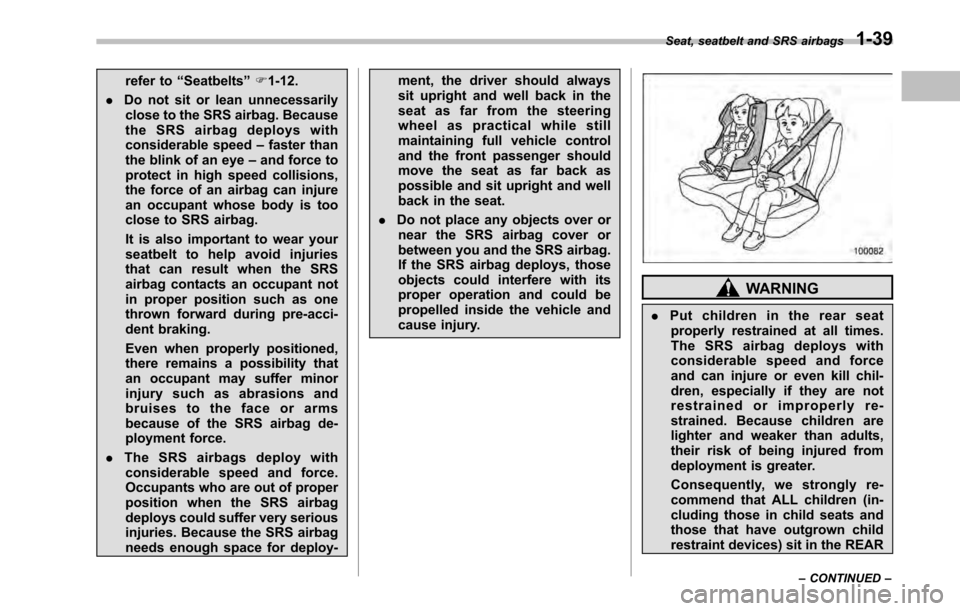
. Put children in the rear seat
properly restrained at all times.
The SRS airbag deploys with
considerable speed and force
and can injure or even kill chil-
dren, especially if they are not
restrained or improperly re-
strained. Because children are
lighter and weaker than adults,
their risk of being injured from
deployment is greater.
Consequently, we strongly re-
commend that ALL children (in-
cluding those in child seats and
those that have outgrown child
restraint devices) sit in the REAR
Seat, seatbelt and SRS airbags
1-39
– CONTINUED –
Page 65 of 448

&SUBARU advanced frontal
airbag system
Your vehicle is equipped with a SUBARU
advanced frontal airbag system that com-
plies with the new advanced frontal airbag
requirements in the amended Federal
Motor Vehicle Safety Standard (FMVSS)
No. 208.
The SUBARU advanced frontal airbag
system automatically determines the de-
ployment force of the driver ’s SRS frontal
airbag at the time of deployment as well as
whether or not to activate the frontpassenger ’s SRS frontal airbag and, if
activated, the deployment force of the
SRS frontal airbag at the time of deploy-ment.
Your vehicle has warning labels on the driver ’s and front passenger ’s sun visors
beginning with the phrase “EVEN WITH
ADVANCED AIR BAGS ”and a tag
attached to the glove box lid beginning
with the phrase “Even with Advanced Air
Bags ”. Make sure that you carefully read
the instructions on the warning labels and tag.
Always wear your seatbelt. The SUBARU
advanced frontal airbag system is a
supplemental restraint system and must
be used in combination with a seatbelt. All
occupants should wear a seatbelt or be
seated in an appropriate child restraint system.
The driver
’s SRS frontal airbag is stowed
in the center portion of the steering wheel.
The front passenger ’s SRS frontal airbag
is stowed near the top of the dashboard
under an “SRS AIRBAG ”mark.
In a moderate to severe frontal collision,
the driver ’s and front passenger ’s SRS
frontal airbags deploy and supplement the
seatbelts by reducing the impact on thedriver ’s and front passenger ’s head and
chest.
WARNING
NEVER INSTALL A REARWARD FA-
CING CHILD SAFETY SEAT IN THE
FRONTSEAT.DOINGSORISKS
SERIOUS INJURY OR DEATH TO THE CHILD BY PLACING THE
CHILD
’S HEAD TOO CLOSE TO
THE SRS AIRBAG.
WARNING
Never allow a child to stand up, or to
kneel on the front passenger ’s seat.
The SRS airbag deploys with con-
siderable force and can injure or
even kill the child. Seat, seatbelt and SRS airbags
1-43
– CONTINUED –
Page 66 of 448
1-44Seat, seatbelt and SRS airbags
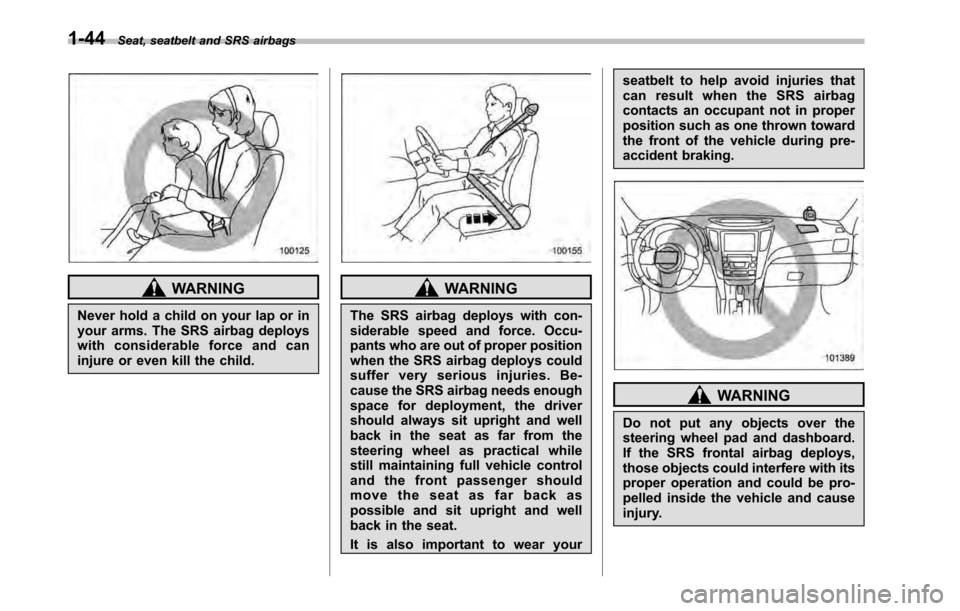
WARNING
Never hold a child on your lap or in
your arms. The SRS airbag deploys
with considerable force and can
injure or even kill the child.WARNING
The SRS airbag deploys with con-
siderable speed and force. Occu-
pants who are out of proper position
when the SRS airbag deploys could
suffer very serious injuries. Be-
cause the SRS airbag needs enough
space for deployment, the driver
should always sit upright and well
back in the seat as far from the
steering wheel as practical while
still maintaining full vehicle control
and the front passenger should
move the seat as far back as
possible and sit upright and well
back in the seat.
It is also important to wear your seatbelt to help avoid injuries that
can result when the SRS airbag
contacts an occupant not in proper
position such as one thrown toward
the front of the vehicle during pre-
accident braking.
WARNING
Do not put any objects over the
steering wheel pad and dashboard.
If the SRS frontal airbag deploys,
those objects could interfere with its
proper operation and could be pro-
pelled inside the vehicle and cause
injury.
Page 71 of 448
.Ensure that there is no article, book,
shoe, or other object trapped under the
seat, at the rear of the seat, or on the side
of the seat. . Ensure that the backward-forward po-
sition and seatback of front passenger ’s
seat are locked into place securely by
moving the seat back and forth. (Models
equipped with manual seats only) . Next, turn the ignition switch to the
“ ON ”position and wait 6 seconds to allow
the system to complete self-checking.
Following the system check, both indica-
tors turn off for 2 seconds. Now, the ON
indicator should illuminate while the OFF
indicator remains off.
If the OFF indicator still remains illumi-
nated while the ON indicator remains off,
ask the occupant to move to the rear seat
and immediately contact your SUBARU
dealer for an inspection. ! Effect vehicle modifications made
for persons with disabilities may
have on SUBARU advanced frontal
airbag system operation (U.S. only)
Changing or moving any parts of the front
seats, seat belts, front bumper, front side
frame, instrument panel, combination me-
ter, steering wheel, steering column, tire,
suspension or floor panel can affect the
operation of the SUBARU advanced air- bag system. If you have any questions,
you may contact the following SUBARUdistributors:
Subaru of America, Inc.
Customer Dealer Services Department
P.O. Box 6000
Cherry Hill, NJ 08034-6000
1-800-SUBARU3 (1-800-782-2783)
Servco Subaru Inc., dba Subaru Hawaii
2850 Pukoloa Street, Suite 202, Honolulu,
HI 96819 808-839-2273
’s Corporation dba Prestige Automo-
bile
491, East Marine Drive, Route 1 Dededo, Guam 671-633-2698
Trebol Motors
P.O. Box 11204, San Juan, Puerto Rico 00910 787-793-2828
There are currently no SUBARU distribu-
tors in any other U.S. territories. If you are in such an area, please contact the
SUBARU distributor or dealer from which
you bought your vehicle. !
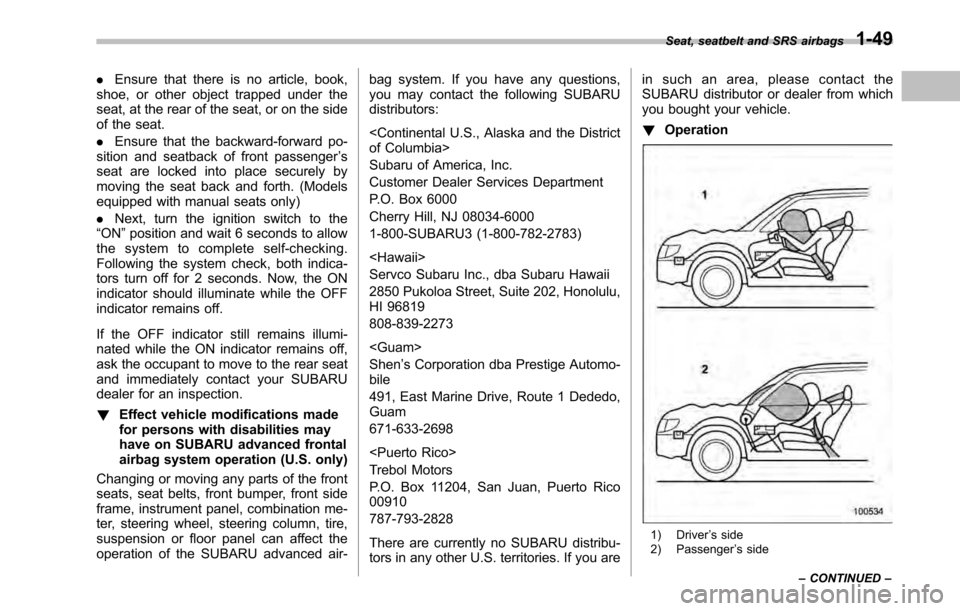
Operation
1) Driver ’s side
2) Passenger ’s side
Seat, seatbelt and SRS airbags
1-49
– CONTINUED –
Page 72 of 448

1-50Seat, seatbelt and SRS airbags
The SRS airbag can function only when
the ignition switch is in the “ON ”position.
The SUBARU advanced frontal airbag
system is designed to determine the
activation or deactivation condition of the
front passenger ’s SRS frontal airbag
depending on the total load on the frontpassenger ’s seat monitored by the front
passenger ’s occupant detection system
weight sensor. For this reason, only thedriver ’s SRS frontal airbag may deploy in
the event of a collision, but this does not
mean failure of the system.
If the front sub sensors inside both front
fenders and the impact sensors in the
airbag control module detect a predeter-
mined amount of force during a frontal
collision, the control module sends signals
to the airbag module(s) (only driver ’s
module or both driver ’s and front passen-
ger ’s modules) instructing the module(s)
to inflate the SRS frontal airbag(s). Thedriver ’s and front passenger ’s SRS frontal
airbags use dual stage inflators. The two
inflators of each airbag are triggered either
sequentially or simultaneously, depending
on the severity of impact in the case of thedriver ’s SRS frontal airbag and depending
on the severity of impact and the total load
on the seat in the case of the frontpassenger ’s SRS frontal airbag. After deployment, the SRS airbag imme-
diately starts to deflate so that the driver
’s
vision is not obstructed. The time required
from detecting impact to the deflation of
the SRS airbag after deployment is short-
er than the blink of an eye.
Both when only the driver ’s SRS frontal
airbag deploys and the driver ’s and front
passenger ’s SRS frontal airbags deploy,
the driver ’s and front passenger ’s seatbelt
pretensioners operate at the same time.
Although it is highly unlikely that the SRS
airbag would activate in a non-accident
situation, should it occur, the SRS airbag
will deflate quickly, not obscuring vision
and will not interfere with the driver ’s
ability to maintain control of the vehicle.
When the SRS airbag deploys, a sudden,
fairly loud inflation noise will be heard and
some smoke will be released. These
occurrences are a normal result of the
deployment. This smoke does not indicate
a fire in the vehicle.
CAUTION
Do not touch the SRS airbag system
components around the steering
wheel and dashboard with bare
hands right after deployment. Doing
so can cause burns because the components can be very hot as a
result of deployment.
The driver ’s SRS frontal airbag and front
passenger ’s SRS frontal airbag are de-
signed to deploy in the event of an
accident involving a moderate to severe
frontal collision. It is basically not designed
to deploy in lesser frontal impacts be-
cause the necessary protection can be
achieved by the seatbelt alone. Also, they
are basically not designed to deploy in
side or rear impacts or in roll-over acci-
dents because deployment of only thedriver ’s SRS frontal airbag or both driver ’s
and front passenger ’s SRS frontal airbags
would not help the occupant in those
situations. The driver ’s and front passen-
ger ’s SRS frontal airbags are designed to
function on a one-time-only basis.
SRS airbag deployment depends on the
level of force experienced in the passen-
ger compartment during a collision. That
level differs from one type of collision to
another, and it may have no bearing on
the visible damage done to the vehicleitself.
Page 78 of 448

1-56Seat, seatbelt and SRS airbags
near the SRS side airbags. In the
event of the SRS side airbag
deployment, they could be pro-
pelled dangerously toward thevehicle’s occupants and cause
injuries.
. Do not attach a hands-free micro-
phone or any other accessory to
a front pillar, a center pillar, a rear
pillar, the windshield, a side win-
dow, an assist grip, or any other
cabin surface that would be near
a deploying SRS curtain airbag.
A hands-free microphone or
other accessory in such a loca-
tion could be propelled through
the cabin with great force by the
curtain airbag, or it could prevent
correct deployment of the curtain
airbag. In either case, the result
could be serious injuries.
. Do not hang coat hangers or
other hard or pointed objects on
the coat hooks. If such items
were hanging on the coat hooks
during deployment of the SRS
curtain airbags, they could cause
serious injuries by coming off the
coat hooks and being thrown
through the cabin or by prevent-
ing deployment of the curtainairbags. Before hanging clothing on the
coat hooks, make sure there are
no sharp objects in the pockets.
Hang clothing directly on the
coat hooks without using hang-ers.
WARNING
Do not put any kind of cover or
clothes or other objects over either
front seatback and do not attach
labels or stickers to the front seat
surface on or near the SRS side
airbag. They could prevent proper
deployment of the SRS side airbag,
reducing protection available to the
front seat ’s occupant. !
Operation
The SRS side airbag and SRS curtain
airbag can function only when the ignition
switch is in the “ON ”position.
The driver ’s and front passenger ’s SRS
side airbags and SRS curtain airbags
deploy independently of each other since
each has its own impact sensor. There-
fore, they may not both deploy in the same
accident. Also, the SRS side airbag and
SRS curtain airbag deploys independently
of the driver ’s and front passenger ’s SRS
frontal airbags in the steering wheel and
instrument panel.
An impact sensor, which senses impact
force, is located in each of the left and
right center pillars and rear wheel houses.
Another impact sensor, which also senses
Page 79 of 448

impact force, is located in the airbag
control module.
If one of the center pillar impact sensors
and the impact sensor that is located in
the airbag control module together sense
an impact force above a predetermined
level in a side collision, the control module
causes both the SRS side airbag and
curtain airbag on the impacted side to
inflate regardless of whether the rear
wheel house impact sensor on the same
side senses an impact.
If one of the rear wheel house impact
sensors and the impact sensor that is
located in the airbag control module
together sense a sufficiently strong impact
force, the control module causes only the
SRS curtain airbag on the impacted side
to inflate.
After the deployment, the SRS side airbag
immediately starts to deflate. The time
required from detection of an impact to
deflation of an SRS side airbag after
deployment is shorter than the blink of
an eye.
The SRS curtain airbag remains inflated
for a while following deployment then
slowly deflates.
The SRS side airbag and SRS curtain
airbag deploy even when no one occupiesthe seat on the side on which an impact isapplied.
When the SRS side airbag and SRS
curtain airbag deploy, a sudden, fairly loud
inflation noise will be heard and some
smoke will be released. These occur-
rences are a normal result of the deploy-
ment. This smoke does not indicate a fire
in the vehicle.
CAUTION
Do not touch the SRS side airbag
system components around the
front seat seatback with bare hands
right after deployment. Doing so can
cause burns because the compo-
nents can be very hot as a result ofdeployment.
After deployment, do not touch any
part of the SRS curtain airbag
system (from the front pillar to the
part of the roof side over the rear
seat). Doing so can cause burns
because the components can be
very hot as a result of deployment.
The SRS side airbag and SRS curtain
airbag are designed to deploy in the event
of an accident involving a moderate to
severe side impact collision. It is basically
not designed to deploy in a lesser side impact. Also, it is basically not designed to
deploy in frontal or rear impacts because
SRS side airbag and SRS curtain airbag
deployment would not help the occupant
in those situations.
Each SRS side airbag and SRS curtain
airbag are designed to function on a one-
time-only basis.
SRS side airbag and SRS curtain airbag
deployment depend on the level of force
experienced in the passenger compart-
ment during a side impact collision. That
level differs from one type of collision to
another, and it may have no bearing on
the visible damage done to the vehicleitself.
Seat, seatbelt and SRS airbags
1-57
– CONTINUED –
Page 85 of 448

.Airbag control module (including im-
pact sensors (all models) and rollover
sensors (Outback)) . Frontal airbag module (driver ’s side)
. Frontal airbag module (front passen-
ger ’s side)
. Side airbag sensor (center pillar right-
hand side). Side airbag sensor (center pillar left-
hand side). Side airbag module (driver ’s side)
. Side airbag module (front passenger ’s
side). Curtain airbag sensor (rear wheel
house right-hand side). Curtain airbag sensor (rear wheel
house left-hand side). Curtain airbag module (right-hand side)
. Curtain airbag module (left-hand side)
. Seatbelt pretensioner (driver ’s side)
. Seatbelt pretensioner (front passen-
ger ’s side)
. Seatbelt buckle switch (front passen-
ger ’s side)
. Front passenger ’s occupant detection
system weight sensor. Front passenger ’s occupant detection
control module. Front passenger ’s frontal airbag ON
and OFF indicator .
All related wiring
WARNING
If the warning light exhibits any of
the following conditions, there may
be a malfunction in the seatbelt
pretensioners and/or SRS airbag
system. Immediately take your vehi-
cle to your nearest SUBARU dealer
to have the system checked. Unless
checked and properly repaired, the
seatbelt pretensioners and/or SRS
airbags will operate improperly (e.g.
SRS airbags may inflate in a very
minor collision or not inflate in a
severe collision), which may in-
crease the risk of injury. . Flashing or flickering of the warn-
ing light
. No illumination of the warning
light when the ignition switch is
first turned to the “ON ”position
. Continuous illumination of the
warning light
. Illumination of the warning light
while driving &
SRS airbag system servicingWARNING
. When discarding an airbag mod-
ule or scrapping the entire vehi-
cle damaged by a collision, con-
sult your SUBARU dealer.
. The SRS airbag has no user-
serviceable parts. Do not use
electrical test equipment on any
circuit related to the SRS airbag
system. For required servicing of
the SRS airbag, consult your
nearest SUBARU dealer. Tamper-
ing with or disconnecting the system ’s wiring could result in
accidental inflation of the SRS
airbag or could make the system
inoperative, which may result in
serious injury.
Seat, seatbelt and SRS airbags
1-63
– CONTINUED –