2010 SKODA YETI child lock
[x] Cancel search: child lockPage 163 of 271

Transporting children safely
162WARNING
The locking eyes have just been deve loped for child safety seats which use
the “ISOFIX” system. You should therefore never attach other child safety seats,
seat belts or objects to th e locking eyes - hazard!
Ask a specialist garage whether a child seat which you bought for another
vehicle is recommended for use in your vehicle before using a child seat with
“ISOFIX” system.
Certain child seats which use the “ISO FIX” system can be attached with
standard three-point seat belts. Please pay close attention to instructions from
the manufacturer of the child safety seat when installing and removing the seat.Note
Child seats which use the “ISOFIX” system are currently available for children
weighing from 9 up to 18 kg. This correspond s to an age range of from 9 months to 4
years.
The child seats can also be fitted with the “Top Tether” system page 162.
Attaching child seat using the “Top Tether” systemThe rear exterior seats and/or the middle seat (only valid for some countries) are
equipped as standard with the attachment syst em “Top Tether” at the rear of the seat
backrest for enhancing the child safety fig. 145 .
Always perform the installation and removal of the child seat using the “Top Tether”
system as stated in the instructions from the manufacturer of the child seat.
WARNING
Attach the child seats with the “Top Tether” system only to the points
provided for this purpose fig. 145 .
On no account should you equip your vehicle, e.g. mount screws or other
anchorage points.
Pay attention to the important safety information regarding the use of child
seats.Note
Store the remaining part of the belt for the “Top Tether” system in a textile pocket,
which is located at the child seat.
Fig. 145 Rear seat: Top Tether
s2ug.6.book Page 162 Friday, April 9, 2010 2:24 PM
Page 181 of 271

Driving and the Environment
180
In case the vehicle is stationary on a hillside at a steep angl e, do not exit the
vehicle when it is facing downhill. Throug h this the overall centre of gravity can
shift in such a way that the vehicle tilts and rolls down the hillside - hazard!
Always carefully exit your vehicle on the side facing uphill page 186.
A lack of experience and knowledge when driving off-road can lead to crit-
ical situations an d serious injuries.
Never choose a dangerous route and never take a risk which could jeop-
ardize your safety and that of your passengers. If you cannot go on or if you
doubt the safety of the route, turn back and choose another way. Even a terrain,
which looks harmless, can be difficult and dangerous, and may bring you and
your passengers into a critical situation.
If you have not fastened your seat belt correctly or you are not wearing your
seat belt at all, or you are holding the steering wheel incorrectly when driving
off-road, the risk of severe or even fata l injuries increases. Correctly fastened
seat belts reduce serious injuries in case of sudden braking manoeuvers and
accidents. As long as the vehicle is in motion, always have your seat belt and
those of your passen gers correctly fastened. Take yo ur thumbs off the steering
wheel when driving off-road. Should resist ance build up in front of the wheels,
the steering wheel may suddenly and unexpect edly spin and hur t you. Hold the
steering wheel with both hands firmly on the outer edge in the 9 o'clock and 3
o'clock position.
If you have not fastened your seat belt correctly or you are not wearing your
seat belt at all, or you are holding the steering wheel incorrectly when driving
off-road, the risk of severe or even fatal injuries increases.
Correctly fastened seat belts reduce serious injuries in case of sudden
braking manoeuvers and accidents. Th erefore you and your passengers must
always fasten your seat belts correctl y as long as the vehicle is moving.
Take your thumbs off the steering wh eel when driving off-road. If the
wheels hit an obstac le, the steering wheel may suddenly and unexpectedly spin
and hurt you!
Never use the cruise control system wh en driving off-road. The use of the
cruise control system when driving of f-road is unsuitable and can even be
dangerous.
Do not drive over embankments, ramps or hillsides at too high a speed. This
can lead to the wheels of the vehicle lifting off the ground so that you can no
longer steer and control the vehicle.
If the wheels lose contact with the ground, for example when the vehicle
rebounds while driving over corrugations, steer straight ahead. If the wheels
are turned when making the contact with the ground again, the vehicle can roll
over.
There should never be any person in front or behind the vehicle when rocks,
scrub, wood pieces or other objects ar e placed under the wheels in order to
achieve traction on a sandy or slippery ground. Turning the wheels can trans-
form these objects into dangerous “bullets” – hazard!
Warning of a rolloverVehicles of this type have a higher centre of gravity than ordinary vehicles. This
increases the risk of vehicle rollover when driving on-road and off-road. Therefore, you
must always pay attention to the safety information which is stated in the Owner's
Manual.
WARNING
In the event of a vehicle rollover, an occupant of the vehicle who is not
wearing a seat belt is exposed to a clearly higher risk of injury compared to an
occupant who is wearing a seat belt.
Luggage and other items, which are transported on the roof of the vehicle,
additionally raise the centre of gravity and thus increase the risk of a rollover.
Avoid driving at an angle on a hillside page 186.
Observe the important guidelines page 179.
Important informationOff-road driving is not suitable for everyone. Small children, expectant mothers and
elderly or physically di sabled persons are particularly at risk if the ride is rough and
help is far away.
WARNING (continued)
WARNING (continued)
s2ug.6.book Page 180 Friday, April 9, 2010 2:24 PM
Page 205 of 271

Inspecting and replenishing
204Caution
Never open the bonnet using the locking lever - danger of causing damage.
Ensure that the arms of the windscreen wipers are correctly in place against the
windscreen before opening the bonnet otherwise damage could occur to the
paintwork.
Working in the engine compartment
Particular care is required when carrying out any work in the engine
compartment!There is a risk of injuries, scalding, acci dents and fire when working in the engine
compartment, e.g. inspecting and replenishing oil and other fluids. For this
reason, it is essential to comply with the warning instructions stated below and
with the general applicable rules of safe ty. The engine compartment of your car
is a hazardous area .
WARNING
Never open the bonnet if you see that steam or coolant is flowing out of the
engine compartment - risk of scalding! Wait long enough until the steam or
coolant has stopped escaping.
Switch off the engine and pull out the ignition key.
Apply the handbrake firmly.
If your vehicle is fitted with a manual gearbox, move the gearshift lever into
Neutral, or if it is fitted with automatic gearbox, move the selector lever into
position P.
Allow the engine to cool down.
Keep children clear of the engine compartment.
Never spill oil and other fluids over the hot engine. Such fluids (e.g. the anti-
freeze contained in the coolant) may ignite!
Avoid short circuits in the electrical system - particularly on the battery.
Never place your hand into the radiator fan as long as the engine is still
warm. The fan might suddenly start running!
Never open the cap of the coolant expansion bottle as long as the engine is
still warm. The cooling system is pressurized!
Cover over the cap of the coolant expansion reservoir with a large cloth
when opening it as protection for your face, hands and arms from hot steam or
hot coolant.
Do not let objects, such as e.g cleaning cloth or tools lie in the engine
compartment.
If you wish to work under the vehicl e, you must secure the vehicle from
rolling away and support it with suitable supporting blocks: the car jack is not
sufficient for this - risk of injury!
In cases where it be necessary to carry out inspection work when the engine
is running there is an additional risk fr om rotating parts (e.g. the V-ribbed belt,
alternator, radiator fan) and from the high-voltage ignition system. Please
observe in addition the following:
Never touch the electrical cabl es of the ignition system.
Absolutely avoid any jewellery, loose it ems of clothing or long hair from
getting into the rotating parts of the engine - Hazard! Therefore remove any
jewellery beforehand, tie up your hair and wear tight fitting clothing.
Please also comply with the warnin g instructions stated below when
carrying out any essential work on the fuel system or on th e electrical system:
Always separate the car battery from the electrical system.
Do not smoke.
Never carry out any work close to naked flames.
Always keep a working fire extinguisher at hand.Caution
When replenishing fluids in the engine, always ensure that the fluids are on no account
mixed up. This may result in major oper ating problems and also vehicle damage!
WARNING (continued)
s2ug.6.book Page 204 Friday, April 9, 2010 2:24 PM
Page 209 of 271
Inspecting and replenishing
208
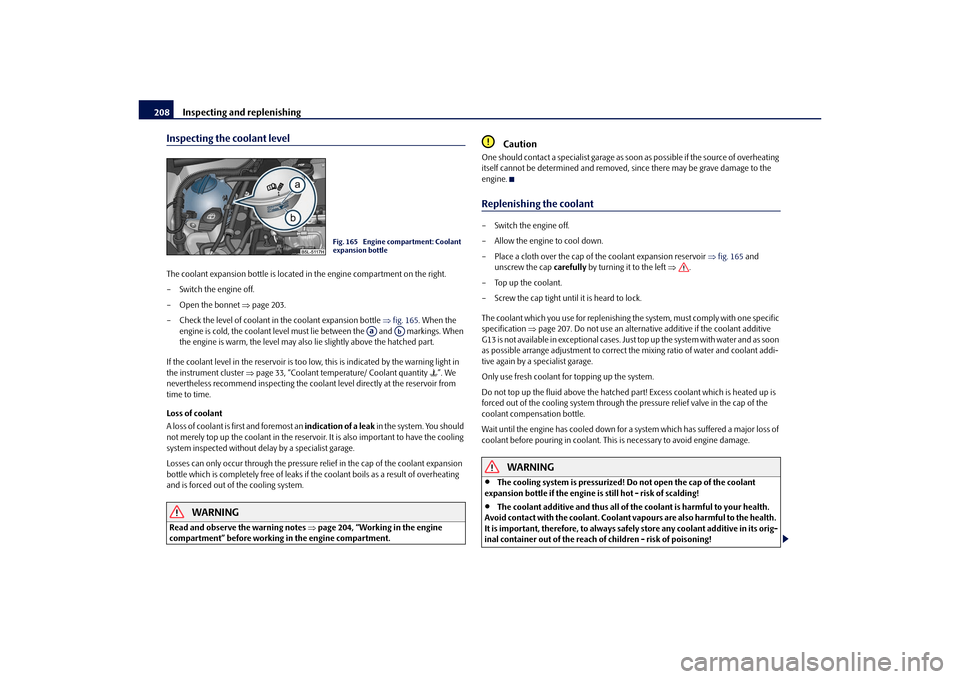
Inspecting the coolant levelThe coolant expansion bottle is located in the engine compartment on the right.
– Switch the engine off.
– Open the bonnet page 203.
– Check the level of coolant in the coolant expansion bottle fig. 165 . When the
engine is cold, the coolant level must lie between the and markings. When
the engine is warm, the level may also lie slightly above the hatched part.
If the coolant level in the reservoir is too lo w, this is indicated by the warning light in
the instrument cluster page 33, “Coolant temperature/ Coolant quantity ”. We
nevertheless recommend inspecting the cool ant level directly at the reservoir from
time to time.
Loss of coolant
A loss of coolant is first and foremost an indication of a leak in the system. You should
not merely top up the coolant in the reservoir. It is also important to have the cooling
system inspected without delay by a specialist garage.
Losses can only occur through the pressure relief in the cap of the coolant expansion
bottle which is completely free of leaks if the coolant boils as a result of overheating
and is forced out of the cooling system.
WARNING
Read and observe the warning notes page 204, “Working in the engine
compartment” before working in the engine compartment.
Caution
One should contact a specialist garage as s oon as possible if the source of overheating
itself cannot be determined and removed, since there may be grave damage to the
engine.Replenishing the coolant– Switch the engine off.
– Allow the engine to cool down.
– Place a cloth over the cap of the coolant expansion reservoir fig. 165 and
unscrew the cap carefully by turning it to the left .
–Top up the coolant.
– Screw the cap tight until it is heard to lock.
The coolant which you use for replenishing the system, must comply with one specific
specification page 207. Do not use an alternative additive if the coolant additive
G13 is not available in exceptional cases. Just top up the system with water and as soon
as possible arrange adjustment to correct the mixing ratio of water and coolant addi-
tive again by a specialist garage.
Only use fresh coolant for topping up the system.
Do not top up the fluid above the hatched pa rt! Excess coolant which is heated up is
forced out of the cooling system through the pressure relief valve in the cap of the
coolant compensation bottle.
Wait until the engine has cooled down for a system which has suffered a major loss of
coolant before pouring in coolant. This is necessary to avoid engine damage.
WARNING
The cooling system is pressurized! Do not open the cap of the coolant
expansion bottle if the engine is still hot - risk of scalding!
The coolant additive and thus all of the coolant is harmful to your health.
Avoid contact with the coolant. Coolant vapours are also harmful to the health.
It is important, therefore, to always safely store any coolant additive in its orig-
inal container out of the reach of children - risk of poisoning!
Fig. 165 Engine compartment: Coolant
expansion bottle
Aa
Ab
s2ug.6.book Page 208 Friday, April 9, 2010 2:24 PM
Page 261 of 271

Index
260
Charging the battery . . . . . . . . . . . . . . . . . . . . . . . . . 213
Warning light . . . . . . . . . . . . . . . . . . . . . . . . . . . . . . 36
Check engine oil level . . . . . . . . . . . . . . . . . . . . . . . . 205
Child safety . . . . . . . . . . . . . . . . . . . . . . . . . . . . . . . . . 156 Side airbag . . . . . . . . . . . . . . . . . . . . . . . . . . . . . . 158
Child safety lock . . . . . . . . . . . . . . . . . . . . . . . . . . . . . . . 39
Child safety seat on the front passenger seat . . . . . . . . . . . . . . . 157
Safety information . . . . . . . . . . . . . . . . . . . . . . . 156
Child seat . . . . . . . . . . . . . . . . . . . . . . . . . . . . . . . . . . . 158 Classification into groups . . . . . . . . . . . . . . . . . 158
ISOFIX system . . . . . . . . . . . . . . . . . . . . . . . . . . . 161
Use of child safety seats . . . . . . . . . . . . . . . . . . 159
Children and safety . . . . . . . . . . . . . . . . . . . . . . . . . . 156
Chrome parts . . . . . . . . . . . . . . . . . . . . . . . . . . . . . . . 195
Cigarette lighter . . . . . . . . . . . . . . . . . . . . . . . . . . . . . . . 87
Cleaning . . . . . . . . . . . . . . . . . . . . . . . . . . . . . . . . . . . . 193
Climatronic Defrosting windows . . . . . . . . . . . . . . . . . . . . . . 105
Recirculated air mode . . . . . . . . . . . . . . . . . . . . 104
Climatronic (automat ic air conditioning) . . . . . . 102
Clock . . . . . . . . . . . . . . . . . . . . . . . . . . . . . . . . . . . . . . . . . 19
Closing the panoramic sliding roof . . . . . . . . . . . . . . 49
Clothes hooks . . . . . . . . . . . . . . . . . . . . . . . . . . . . . . . . . 93
Cockpit General view . . . . . . . . . . . . . . . . . . . . . . . . . . . . . . . 9
Compartments . . . . . . . . . . . . . . . . . . . . . . . . . . . . . . . . 88
Computer . . . . . . . . . . . . . . . . . . . . . . . . . . . . . . . . . . . . 20
Convenience operation . . . . . . . . . . . . . . . . . . . . . . . . 49
Converting/masking over headlights . . . . . . . . . . 178 Coolant . . . . . . . . . . . . . . . . . . . . . . . . . . . . . . . . . . . . . 207
replenishing . . . . . . . . . . . . . . . . . . . . . . . . . . . . . 208
Warning light . . . . . . . . . . . . . . . . . . . . . . . . . . . . . 33
Coolant level Warning light . . . . . . . . . . . . . . . . . . . . . . . . . . . . . 33
Coolant quantity Warning light . . . . . . . . . . . . . . . . . . . . . . . . . . . . . 33
Coolant temperature gauge . . . . . . . . . . . . . . . . . . . 17
Coolant temperature/coolant level Warning light . . . . . . . . . . . . . . . . . . . . . . . . . . . . . 33
Cornering lights . . . . . . . . . . . . . . . . . . . . . . . . . . . . . . 55
Correct seated position . . . . . . . . . . . . . . . . . . . . . . 138
Counter for distance driven . . . . . . . . . . . . . . . . . . . 18
Cruise control system . . . . . . . . . . . . . . . . . . . . . . . . 118 Warning light . . . . . . . . . . . . . . . . . . . . . . . . . . . . . 30
Cup holder front . . . . . . . . . . . . . . . . . . . . . . . . . . . . . . . . . . . . . 85
rear . . . . . . . . . . . . . . . . . . . . . . . . . . . . . . . . . . . . . . 85
Ddaylight driving lights . . . . . . . . . . . . . . . . . . . . . . . . . 53
Deactivatingan airbag . . . . . . . . . . . . . . . . . . . . . . . . . . . . . . . . 154
Deactivating an airbag . . . . . . . . . . . . . . . . . . . . . . . 154
Defrosting rear window . . . . . . . . . . . . . . . . . . . . . . . 62
Defrosting windscreen . . . . . . . . . . . . . . . . . . . . . . . . 62
De-icing rear window . . . . . . . . . . . . . . . . . . . . . . . . . 62
De-icing the windows . . . . . . . . . . . . . . . . . . . . . . . . 195
De-icing windscreen . . . . . . . . . . . . . . . . . . . . . . . . . . 62
Detachable towing device . . . . . . . . . . . . . . . . . . . . 192
Diesel . . . . . . . . . . . . . . . . . . . . . . . . . . . . . . . . . . . . . . 200 Diesel engines
Starting the engine . . . . . . . . . . . . . . . . . . . . . . . 110
Diesel particle filter . . . . . . . . . . . . . . . . . . . . . . . . . . 170 Warning light . . . . . . . . . . . . . . . . . . . . . . . . . . . . . 30
Digital clock . . . . . . . . . . . . . . . . . . . . . . . . . . . . . . . . . . 19
Direction indicators . . . . . . . . . . . . . . . . . . . . . . . . . . . 59 Warning light . . . . . . . . . . . . . . . . . . . . . . . . . . . . . 29
Display . . . . . . . . . . . . . . . . . . . . . . . . . . . . . . . . . . . . . . 24
Displays . . . . . . . . . . . . . . . . . . . . . . . . . . . . . . . . . . . . . 16
Distance driven . . . . . . . . . . . . . . . . . . . . . . . . . . . . . . . 18
Door Child safety lock . . . . . . . . . . . . . . . . . . . . . . . . . . . 39
Driving economically . . . . . . . . . . . . . . . . . . . . . . . . 174
EEDL . . . . . . . . . . . . . . . . . . . . . . . . . . . . . . . . . . . . . . . . . 164
Electrically adjustable exterior mirror . . . . . . . . . . . 67
Electronic Differential Lock . . . . . . . . . . . . . . . . . . . 164
Electronic immobiliser . . . . . . . . . . . . . . . . . . . . . . . . 39
Electronic stability programme . . . . . . . . . . . . . . . 163
Electronic stability programme (ESP) Warning light . . . . . . . . . . . . . . . . . . . . . . . . . . . . . 34
Emergency wheel . . . . . . . . . . . . . . . . . . . . . . . . . . . . 224
Engine starting . . . . . . . . . . . . . . . . . . . . . . . . . . . . . . . . . . 109
switching off . . . . . . . . . . . . . . . . . . . . . . . . . . . . . 110
Engine compartment Safety information . . . . . . . . . . . . . . . . . . . . . . . . 204
Engine electronics Warning light . . . . . . . . . . . . . . . . . . . . . . . . . . . . . 32
s2ug.6.book Page 260 Friday, April 9, 2010 2:24 PM
Page 265 of 271

Index
264
Towing a trailer . . . . . . . . . . . . . . . . . . . . . . . . . . . . . . 190
Towing device . . . . . . . . . . . . . . . . . . . . . . . . . . . . . . . 192
towing vehicle . . . . . . . . . . . . . . . . . . . . . . . . . . . . . . 230
Tow-starting . . . . . . . . . . . . . . . . . . . . . . . . . . . . . . . . 230
Tow-starting and towing vehicle
Automatic gearbox . . . . . . . . . . . . . . . . . . . . . . . 124
Traction control system . . . . . . . . . . . . . . . . . . . . . . 165
Traction control system (TCS) Warning light . . . . . . . . . . . . . . . . . . . . . . . . . . . . . . 33
Trailer . . . . . . . . . . . . . . . . . . . . . . . . . . . . . . . . . . . . . . 190 General Maintenance . . . . . . . . . . . . . . . . . . . . 190
Transporting children . . . . . . . . . . . . . . . . . . . . . . . . 156
Tread depth . . . . . . . . . . . . . . . . . . . . . . . . . . . . . . . . . 217
Turn signal lights . . . . . . . . . . . . . . . . . . . . . . . . . . . . . . 59 Warning light . . . . . . . . . . . . . . . . . . . . . . . . . . . . . . 29
Two-way radio systems . . . . . . . . . . . . . . . . . . . . . . 128
Tyre . . . . . . . . . . . . . . . . . . . . . . . . . . . . . . . . . . . . . . . . 216
Tyre inflation pressure Warning light . . . . . . . . . . . . . . . . . . . . . . . . . . . . . . 34
Tyre repair kit Tyre repair . . . . . . . . . . . . . . . . . . . . . . . . . . . . . . 224
Tyres Winter tyres . . . . . . . . . . . . . . . . . . . . . . . . . . . . . 220UUnderbody protection . . . . . . . . . . . . . . . . . . . . . . . 197
Unlocking . . . . . . . . . . . . . . . . . . . . . . . . . . . . . . . . . . . . . 39Remote control . . . . . . . . . . . . . . . . . . . . . . . . . . . . 44
Uphill Start Assist . . . . . . . . . . . . . . . . . . . . . . . . . . . . 168
VVanity mirror . . . . . . . . . . . . . . . . . . . . . . . . . . . . . . . . . 62
Vehicle tool kit . . . . . . . . . . . . . . . . . . . . . . . . . . . . . . 223
Ventilation Auxiliary ventilation . . . . . . . . . . . . . . . . . . . . . . 105
Visors . . . . . . . . . . . . . . . . . . . . . . . . . . . . . . . . . . . . . . . . 62WWarning lights . . . . . . . . . . . . . . . . . . . . . . . . . . . . . . . . 28
Warning symbols . . . . . . . . . . . . . . . . . . . . . . . . . . . . . 28
Warning triangle . . . . . . . . . . . . . . . . . . . . . . . . . . . . . 223
Washing . . . . . . . . . . . . . . . . . . . . . . . . . . . . . . . . . . . . 193 with a high-pressure cleaner . . . . . . . . . . . . . . 194
Washing the vehicle . . . . . . . . . . . . . . . . . . . . . . . . . 193
Washing vehicle by hand . . . . . . . . . . . . . . . . . . . . . 194
Wax treatment . . . . . . . . . . . . . . . . . . . . . . . . . . . . . . 194
Wheel Changing . . . . . . . . . . . . . . . . . . . . . . . . . . . . . . . . 225
Spare . . . . . . . . . . . . . . . . . . . . . . . . . . . . . . . . . . . 224
Wheel bolts . . . . . . . . . . . . . . . . . . . . . . . . . . . . . . . . . 219
Wheel trim . . . . . . . . . . . . . . . . . . . . . . . . . . . . . . 216, 226
Wheels . . . . . . . . . . . . . . . . . . . . . . . . . . . . . . . . . . . . . 216
Windows . . . . . . . . . . . . . . . . . . . . . . . . . . . . . . . . . . . . 47 de-icing . . . . . . . . . . . . . . . . . . . . . . . . . . . . . . . . . 195
Windscreen Heater . . . . . . . . . . . . . . . . . . . . . . . . . . . . . . . . . . . 62
Windscreen heater . . . . . . . . . . . . . . . . . . . . . . . . . . . 62
Windscreen washer nozzles . . . . . . . . . . . . . . . . . . . 63
Windscreen washer system Warning light . . . . . . . . . . . . . . . . . . . . . . . . . . . . . 36 Windshield washer fluid reservoir . . . . . . . . . . . . . 214
Warning light . . . . . . . . . . . . . . . . . . . . . . . . . . . . . 36
Windshield washer system . . . . . . . . . . . . . . . . . . . 214
Windshield wiper . . . . . . . . . . . . . . . . . . . . . . . . . . . . . 63
Winter tyres . . . . . . . . . . . . . . . . . . . . . . . . . . . . . . . . . 220
Wiper blades Replacing the wiper blades . . . . . . . . . . . . . . . . . 65
XXenon headlights . . . . . . . . . . . . . . . . . . . . . . . . . . . . 236
s2ug.6.book Page 264 Friday, April 9, 2010 2:24 PM