2010 SKODA OCTAVIA TOUR run flat
[x] Cancel search: run flatPage 117 of 199

Intelligent Technology
116
Electromechanical power steeringThe power steering enables you to steer the vehicle with le ss physical force.
With the electromechanical power steering , the steering assist is automatically
adapted to the speed and to the steering angle.
It is still possible to fully steer the vehicle if the power steering fails or if the engine is
not running (vehicle being towed in). The only difference is that greater physical effort
is required.
If there is a fault in the power steering, the warning light
or lights up in the instru-
ment cluster page 24.
WARNING
Contact your specialist garage if the power steering is defective.Tyre inflation pressure-control system*The tyre inflation pressure-control system compares with the aid of the ABS sensors
the speed and also the rolling circumference of the individual wheels. If the rolling
circumference of a wheel is changed, the warning light
lights up in the instrument
cluster page 27 and an audible signal sounds. The rolling circumference of the tyre
can change if:
the tyre inflation pressure is too low,
the structure of the tyre is damaged,
the vehicle is loaded on one side,
the wheels of an axle are loaded heavily (e.g. when towing a trailer or when driving
uphill or downhill),
snow chains are mounted,
the temporary spare wheel is mounted,
one wheel per axle was changed.
Basic setting of tyre inflation pressure-control system
After changing the tyre inflation pressures, after changing one or several wheels, the
position of a wheel on the vehicle (e.g. ex changing the wheels between the axles) or
when the warning light lights up while drivin g, a basic setting of the system must be
carried out as follows.
Inflate all tyres to the specified inflation pressure page 151.
Switch on the ignition.
Press button fig. 113 for more than 2 seconds. While pressing the button,
the warning light
lights up. At the same time the memory of the system is erased
and the new calibration is started, which is confirmed with an audible signal and then
the warning light goes out.
If the warning light
does not go out after the basic setting, there is a fault in the
system. Have the vehicle inspected by your nearest specialist garage.
Warning light
lights up
I f t h e t y re i n f l a t i o n p re s s u re o f a t l e a s t o n e wheel is insufficiently inflated in comparison
to the stored basic va lue, the warning light
lights up.
Warning light
flashes
If the warning light flashes, there is a system fault. Have the vehicle inspected by your
nearest specialist garage.
WARNING
When the warning light
lights up, immediately reduce the speed and
avoid sudden steering and brake manoeuvr es. Please stop the vehicle without
delay at the nearest possible stop and in spect the tyres and their inflation pres-
sures.
Fig. 113 Button for setting the tyre
inflation pressure control value
s2bs.2.book Page 116 Monday, September 27, 2010 9:53 AM
Page 123 of 199

Driving and the Environment
122
Checking tyre inflation pressures
Tyres which are correctly inflated save fuel.Always ensure that your tyres are inflated to the correct pressure at all times. The rolling
resistance will be increased if the inflation pressure is too low. This will not only
increase fuel consumption but also tyre we ar and the driving behaviour will worsen.
Always check the inflation pr essure of the tyres when cold.
Do not drive with winter tyres all year round for this costs about 10 % more fuel.
Winter tyres are also louder.No unnecessary ballast
Transporting ballast costs fuel.The fact that every kilogram of extra weight increases your fuel consumption means
that it is worth taking a look in the lu ggage compartment to avoid transporting any
unnecessary ballast.
It is particularly in town traffic, when one is accelerating quite often, that the vehicle
weight will have a significant effect upon the fuel consumption. A rule of thumb here
is that an increase in weight of 100 kilogr ams will cause an increase in fuel consump-
tion of about 1 litre/100 kilometres.
You may frequently also leave a roof rack fitted on just out of convenience, although
you no longer need it. The increased aerodyna mic drag of your vehicle causes it to use
about 10 % more fuel than normal at a speed of 100 - 120 km/h, even when you are
not carrying a load on the roof.Saving electricity
Generating electricity costs fuel.– Switch off electrical components as soon as you no longer need them.
When the engine is running, the alternator generates and supplies electrical power.
The greater the load on the alternator as a result of having a large number of electrical
components switched on, the more fuel will be consumed for operating the
alternator.
Keeping a log of your fuel consumptionIf you really wish to keep a close check on your fuel consumption, it is best to enter
the figures in a logbook. This does not take much time but is a very worthwhile exer-
cise. It enables you to detect any change (p ositive and negative) at an early stage and
to take any appropriate action.
If you find that your fuel consumption is too high, you should reflect on how, where
and in what conditions you have driven the vehicle since you last refuelled.Environmental compatibilityEnvironmental protection has played a major role in the design, selection of materials
and manufacture of your new Škoda. Particular emphasis has been paid to a number
of aspects, including:
Design measures
Joints designed to be easily detached.
Simplified disassembly due to the modular structure system.
Improved purity of differ ent classes of materials.
Identification of all plastic parts in accordance with VDA Recommendation°260.
Reduced fuel consumption and exhaust emission CO
2.
Minimum fuel leakage during accidents.
Reduced noise.
Choice of materials
Extensive use of recyclable material.
Air conditioning filled wi th CFC-free refrigerant.
No cadmium.
No asbestos.
Reduction in the “vaporisation” of plastics.
Manufacture
Solvent-free cavity protection.
s2bs.2.book Page 122 Monday, September 27, 2010 9:53 AM
Page 139 of 199
Fuel
138
– Unscrew the fuel filler cap anti-clockwise and place the fuel filler cap from above
on the fuel filler flap page 137, fig. 119 - right.Closing fuel filler cap– Screw on the fuel filler cap by turning it to the right until it is heard to click.
– Lock the fuel filler cap on the fuel filler tube by turning the vehicle key to the right
and withdraw the key.
– Close the fuel filler flap until it locks.
The correct grade of fuel for your vehicle as well as the tyre size and inflation pressures
are stated on a sticker affixed to the inside of the fuel filler flap. Further information on
fuel page 136.
The fuel tank has a capa city of about 55 litres.
WARNING
Pay attention to any legal requirements if you do carry a spare canister in the
vehicle. We do not recommend carrying any fuel canisters in your vehicle for
safety reasons. The canister can be damaged in the event of an accident and fuel
may leak out.
Caution
Remove any fuel which has spilled onto th e paintwork of your vehicle immediately
- risk of paint damage!
Vehicles fitted with catalytic converter should never be allowed to let the fuel tank
to run completely empty. An irregular supply of fuel to the engine can result in misfiring
and unburnt fuel may get into the exhaust sy stem, which may result in overheating and
damage to the catalytic converter.
Make sure that the valve is not pressed into the filler tube when inserting the pump
nozzle into the filler tube. Otherwise you are unintentiona lly filling up the volume,
which in case of heat can cause an expansion of the fuel. This can lead to an overflow
of fuel or damage to parts of the fuel reservoir.
The fuel tank is full just as soon as th e pump nozzle switches off for the first time,
provided the nozzle has been operated prop erly. Do not continue refuelling - other-
wise the expansion volume is filled up.
s2bs.2.book Page 138 Monday, September 27, 2010 9:53 AM
Page 152 of 199

Wheels and Tyres151
Using the system
Safety
Driving Tips
General Maintenance
Breakdown assistance
Technical Data
Wheels and TyresWheelsGeneral information
New tyres do not offer optimal grip at first and should therefore be run in for about
500 km at a moderate speed and an appropri ately cautious style of driving. You will
also profit from longer tyre life.
The tread depth of new tyres may differ because of design features and the config-
uration of the tread (depending on the type of tyre and the manufacturer).
Drive over curbs on the side of the road and other such obstacles slowly and,
where possible, at a right angle in order to avoid damage to tyres and wheel trims.
Inspect your tyres from time to time for damage (punctures, cuts, splits and
bulges). Remove foreign bodies from the tyre profile.
Damage to tyres and wheels is frequently not visible. Unusual vi brations or pulling
of the vehicle to one side coul d be a sign of tyre damage. Please reduce your speed
immediately and stop if you su spect that a wheel is damaged. Inspect the tyres for
signs of damage (bulges, splits, etc.) If no vi sible damage is present, please drive at an
appropriately slow speed and carefully to the nearest specialist garage in order to have
your vehicle inspected.
Also protect your tyres from contact with oil, grease and fuel.
Immediately replace any dust caps of the valves which have got lost.
Mark wheels before removing them so that their previous direction of running can
be maintained when mounted them again.
Always store wheels or tyres which been removed in a cool, dry and, where
possible, dark place. Tyres which are not fixed to a wheel trim should be stored upright.
Unidirectional tyres*
The direction of rotation of the tyres is mark ed by arrows on the wall of the tyre. This
indicates the direction of rotation of the tyre, and it is essential that the tyres are fitted
on to run in this direction. Only then are the tyres able to provide the optimal proper-
ties in terms of grip, low nois e, wear-and-tear and aquaplaning.
Further information concerning th e use of unidirectional tyres page 155.
WARNING
New tyres during the first 500 km do not offer optimal grip and should
therefore be run appropriately - risk of accident!
Never drive with damaged tyres - risk of accident!Note
Please observe the various differing legal requirements regarding tyres.Ty re l i feThe life of your tyres very much depends on the following points:
Tyre pressure
The working life of tyres will be shortened considerably if the tyres are insufficiently or
over-inflated and this will have an adverse effect on the handling of your vehicle.
Correctly inflated tyres are of particular importance when travelling at high speeds. It
is therefore good to check the pressure at least once a month and also before setting
off on a long trip. Please do not forget the spare wheel when checking the tyres.
The tyre inflation pressures for summer tyres are indicated on the inside of the fuel
filler flap fig. 129 . The inflation pressures for winter tyres are 20 kPa (0.2 bar) higher
than those for summer tyres page 155.
Fig. 129 An opened fuel filler flap with a
tyre size and tyre inflation pressure table
s2bs.2.book Page 151 Monday, September 27, 2010 9:53 AM
Page 156 of 199

Wheels and Tyres155
Using the system
Safety
Driving Tips
General Maintenance
Breakdown assistance
Technical Data
Winter tyresThe handling of your vehicle will be signif icantly improved when driving on wintry
roads if you fit winter tyres. Summer tyres do not offer the same grip on ice, snow and
at temperatures below 7 °C because of thei r construction (width, rubber blend, tread
pattern). This particularly applies to vehicles which are equipped with low-profile
tyres or high-speed tyres (code index H or V on wall of tyre).
Winter tyres must be mounted on all four wheels to obtain the best handling charac-
teristics.
You must only fit those types of winter tyre which are approved for your vehicle. The
permissible sizes of winter tyres are stated in your vehicle documents. Approvals may
differ because of na tional legislation.
Please remember that the tyres should be inflated to 20 kPa (0.2 bar) more than is the
case for summer tyres page 151.
Winter tyres no longer offer the same winter performance once the tyre tread has
worn down to a depth of about 4 mm.
Ageing also causes winter tyres to lose most of their winter performance properties -
even in cases where the remaining tread depth is still clearly more than 4 mm.
Speed restrictions apply to winter tyres as well as to summer tyres page 153,
.
You can fit winter tyres of a lower speed catego ry to your vehicle provided that you also
do not drive faster than the permissible maximum speed for such tyres, even if the
possible maximum speed of your vehicle is higher. The corresponding tyre category
can damage the tyres when exceeding the permissible maximum speed.
Please pay attention to the notes if you decide to fit winter tyres page 151.
You can also fit so-called “all-year tyres” instead of winter tyres.
Please contact your specialist garage if there are any points which are not clear who will
be able to provide you with information regarding the maximum speed for your tyres.
WARNING
You must on no account drive your car at more than the permissible maximum
speed for your winter tyres - risk of an accident resulting from tyre damage and
loss of control over your car.
For the sake of the environment
Fit your summer tyres on again in good time since summer tyres offer you better grip
and handling on roads which are free of snow and ice as well as are temperatures
below 7 °C - the braking distance is shorter, there is less tyre noise, tyre wear is reduced
and fuel consumption is reduced.
Note
Please observe the various differing legal requirements regarding tyres.Unidirectional tyres*The direction of rotation of the tyres is marked by arrows on the wall of the tyre. This
indicates the direction of rotation of the tyre, and it is essential that the tyres are fitted
on to run in this direction. Only then are the tyres able to provide the optimal proper-
ties in terms of grip, low nois e, wear-and-tear and aquaplaning.
Should it be necessary to fit on a spare wheel in exceptional cases with a tyre not dedi-
cated to the running direction or in oppo site running direction, please adopt a
cautious style of driving as the tyre is no longer able to provide optimal grip and
handling in such a situation. This particular ly important on wet roads. Please refer to
the notes page 160, “Spare wheel*”.
You should have the defective tyre replaced as soon as possible and restore the correct
direction of rotation on all tyresSnow chainsSnow chains must only be mounted on the front wheels.
When driving on wintry roads, snow chains improve not only traction, but also the
braking performance.
For technical reasons, it is only permissi ble to fit snow chains with the following
wheel/tyre combinations:
s2bs.2.book Page 155 Monday, September 27, 2010 9:53 AM
Page 167 of 199
Breakdown assistance
166WARNING
A discharged battery may already freeze at temperatures just below 0 °C. In
case of frozen battery carry out no jump-starting - risk of explosion!
Please pay attention to the warning instructions relating to working in the
engine compartment page 140, “Working in the engine compartment”.Note
There must not be any contact between the two vehicles otherwise current may
flow as soon as the negative terminals are connected.
The discharged battery must be properly connected to the system of the vehicle.
Switch off any mobile phone, pay attention to the instructions for use of the mobile
phone in such a situation.
We recommend you buy jump-start cabl es from a car battery specialist.
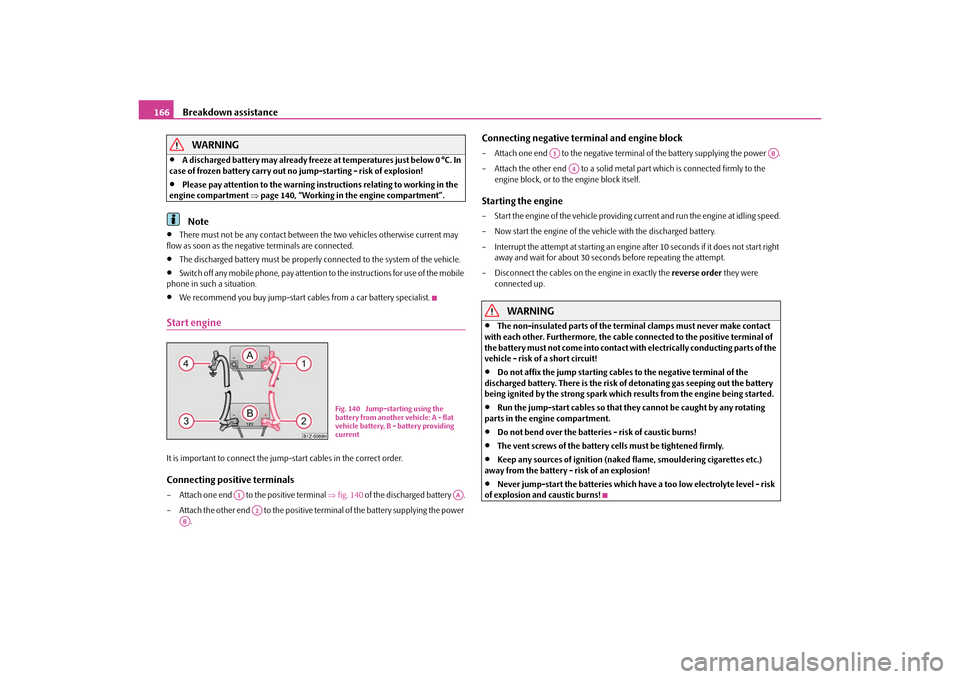
Start engineIt is important to connect the jump-start cables in the correct order.Connecting positive terminals– Attach one end to the positive terminal fig. 140 of the discharged battery .
– Attach the other end to the positive term inal of the battery supplying the power
.
Connecting negative term inal and engine block– Attach one end to the negative termin al of the battery supplying the power .
– Attach the other end to a solid metal part which is connected firmly to the engine block, or to the engine block itself.Starting the engine– Start the engine of the vehicle providing current and run the engine at idling speed.
– Now start the engine of the vehicle with the discharged battery.
– Interrupt the attempt at starting an engine after 10 seconds if it does not start right away and wait for about 30 seconds before repeating the attempt.
– Disconnect the cables on the engine in exactly the reverse order they were
connected up.
WARNING
The non-insulated parts of the terminal clamps must never make contact
with each other. Furthermore, the cable connected to the positive terminal of
the battery must not come into contact with electrically conducting parts of the
vehicle - risk of a short circuit!
Do not affix the jump starting cables to the negative terminal of the
discharged battery. There is the risk of detonating gas seeping out the battery
being ignited by the strong spark which results from the engine being started.
Run the jump-start cables so that they cannot be caught by any rotating
parts in the engine compartment.
Do not bend over the batteries - risk of caustic burns!
The vent screws of the battery cells must be tightened firmly.
Keep any sources of ignition (naked flame, smouldering cigarettes etc.)
away from the battery - risk of an explosion!
Never jump-start the batteries which ha ve a too low electrolyte level - risk
of explosion and caustic burns!
Fig. 140 Jump-starting using the
battery from another vehicle: A - flat
vehicle battery, B - battery providing
current
A1
AA
A2
AB
A3
AB
A4
s2bs.2.book Page 166 Monday, September 27, 2010 9:53 AM
Page 194 of 199

Index193
Using the system
Safety
Driving Tips
General Maintenance
Breakdown assistance
Technical Data
Stability system . . . . . . . . . . . . . . . . . . . . . . . . . . . . . . 111
Starting the engine . . . . . . . . . . . . . . . . . . . . . . . . . . . . 78
after fuel tank has run empty . . . . . . . . . . . . . . . 79
Diesel engines . . . . . . . . . . . . . . . . . . . . . . . . . . . . 79
Petrol engines . . . . . . . . . . . . . . . . . . . . . . . . . . . . . 79
Steering active driver-steering recommendation . . . . 113
Steering force assistance . . . . . . . . . . . . . . . . . . . . . 116
Storage compartments . . . . . . . . . . . . . . . . . . . . . . . . 65
Storage facilities . . . . . . . . . . . . . . . . . . . . . . . . . . . . . . 65
Sun visors . . . . . . . . . . . . . . . . . . . . . . . . . . . . . . . . . . . . 47
Switching lights on and off . . . . . . . . . . . . . . . . . . . . . 42
Switching off the engine . . . . . . . . . . . . . . . . . . . . . . . 79
TTaking care of your vehicle . . . . . . . . . . . . . . . . . . . 129
TCS Warning light . . . . . . . . . . . . . . . . . . . . . . . . . . . . . 26
Temperature outside . . . . . . . . . . . . . . . . . . . . . . . . . . . . . . . . . . . 20
the first 1 500 kilometres . . . . . . . . . . . . . . . . . . . . . 118
The roof luggage rack system . . . . . . . . . . . . . . . . . . 62
Thickness of brake pads Warning light . . . . . . . . . . . . . . . . . . . . . . . . . . . . . 28
Tool . . . . . . . . . . . . . . . . . . . . . . . . . . . . . . . . . . . . . . . . 159
Top Tether . . . . . . . . . . . . . . . . . . . . . . . . . . . . . . . . . . 109
Towing a trailer . . . . . . . . . . . . . . . . . . . . . . . . . . . . . . 125
Towing device . . . . . . . . . . . . . . . . . . . . . . . . . . . . . . . 126
towing vehicle . . . . . . . . . . . . . . . . . . . . . . . . . . . . . . . 167
Tow-starting . . . . . . . . . . . . . . . . . . . . . . . . . . . . . . . . . 167
Traction control system . . . . . . . . . . . . . . . . . . . . . . 112 Traction control system (TCS)
Warning light . . . . . . . . . . . . . . . . . . . . . . . . . . . . . . 26
Trailer . . . . . . . . . . . . . . . . . . . . . . . . . . . . . . . . . . . . . . . 125 General Maintenance . . . . . . . . . . . . . . . . . . . . . 125
Transporting children . . . . . . . . . . . . . . . . . . . . . . . . 103
Tread depth . . . . . . . . . . . . . . . . . . . . . . . . . . . . . . . . . 152
Turn signal lights . . . . . . . . . . . . . . . . . . . . . . . . . . . . . . 44 Warning light . . . . . . . . . . . . . . . . . . . . . . . . . . . . . . 23
Two-way radio systems . . . . . . . . . . . . . . . . . . . . . . . . 84
Tyre . . . . . . . . . . . . . . . . . . . . . . . . . . . . . . . . . . . . . . . . . 151
Tyre inflation pressure Warning light . . . . . . . . . . . . . . . . . . . . . . . . . . . . . . 27
Tyre repair kit . . . . . . . . . . . . . . . . . . . . . . . . . . . . . . . . 160
Tyres Winter tyres . . . . . . . . . . . . . . . . . . . . . . . . . . . . . . 155
UUnderbody protection . . . . . . . . . . . . . . . . . . . . . . . . 133
Unlocking . . . . . . . . . . . . . . . . . . . . . . . . . . . . . . . . . . . . 31Remote control . . . . . . . . . . . . . . . . . . . . . . . . . . . . 36VVehicle tool kit . . . . . . . . . . . . . . . . . . . . . . . . . . . . . . . 159
Visors . . . . . . . . . . . . . . . . . . . . . . . . . . . . . . . . . . . . . . . . 47WWarning lights . . . . . . . . . . . . . . . . . . . . . . . . . . . . . . . . 22
Warning symbols . . . . . . . . . . . . . . . . . . . . . . . . . . . . . 22
Warning triangle . . . . . . . . . . . . . . . . . . . . . . . . . . . . . 159 Washing . . . . . . . . . . . . . . . . . . . . . . . . . . . . . . . . . . . . 129
with a high-pressure cleaner . . . . . . . . . . . . . . 130
Washing the vehicle . . . . . . . . . . . . . . . . . . . . . . . . . 129
Washing vehicle by hand . . . . . . . . . . . . . . . . . . . . 130
Wax treatment . . . . . . . . . . . . . . . . . . . . . . . . . . . . . . 130
Wheel Changing . . . . . . . . . . . . . . . . . . . . . . . . . . . . . . . 161
Spare . . . . . . . . . . . . . . . . . . . . . . . . . . . . . . . . . . . 160
Wheel bolts . . . . . . . . . . . . . . . . . . . . . . . . . . . . . . . . . 154
Wheel trim . . . . . . . . . . . . . . . . . . . . . . . . . . . . . 151, 163
Wheels . . . . . . . . . . . . . . . . . . . . . . . . . . . . . . . . . . . . . 151
Window . . . . . . . . . . . . . . . . . . . . . . . . . . . . . . . . . . . . . . 39
Windows de-icing . . . . . . . . . . . . . . . . . . . . . . . . . . . . . . . . . 131
Windscreen washer nozzles . . . . . . . . . . . . . . . . . . . . 47
Windshield washer fluid reservoir . . . . . . . . . . . . 150
Windshield washer system . . . . . . . . . . . . . . . . . . . 150
Windshield wiper . . . . . . . . . . . . . . . . . . . . . . . . . . . . . 47
Winter tyres . . . . . . . . . . . . . . . . . . . . . . . . . . . . . . . . 155
Wiper blades Replacing the wiper blades . . . . . . . . . . . . . . . . . 49
s2bs.2.book Page 193 Monday, September 27, 2010 9:53 AM