2010 Seat Leon 5D trailer
[x] Cancel search: trailerPage 249 of 309

If and when247
Safety First
Operating Instructions
Practical Tips
Technical Specifications
Tyre repair kit*
The tyre repair kit (for vehicles not including a spare wheel) is
stored under the floor panel in the luggage compartment.Your vehicle is equipped with the Tyre Mobility System “Tyre repair kit”.
The tyre repair kit consists of a container with sealing compound to repair the
puncture and a compressor to generate the required tyre pressure. The kit will
reliably seal punctures up to a size of about 4 mm caused by the penetration
of a foreign body into the tyre.
Note
•Seek professional assistance if the repair of a tyre puncture is not
possible with the sealing compound.Changing a wheelPreparation work
What you must do before changing a wheel.– If you have a flat tyre or puncture, park the vehicle as far away from the flow of traffic as possible. Choose a location that is as
level as possible.
– All passengers should leave the vehicle. They should wait in a safe area (for instance behind the roadside crash barrier).
– Switch off the engine. Switch on the hazard warning lights.
–Apply the handbrake firmly. – Engage the
first gear, or put the selector lever to position P for
those vehicles with an automatic gearbox.
– If you are towing a trailer, unhitch it from your vehicle.
– Take the vehicle tools and the spare wheel out of the luggage
compartment.
WARNING
Put the hazard warning lights on and place the warning triangle in position.
This is for your own safety and also warns other road users.
Caution
If you have to change the wheel on a gradient, block the wheel opposite the
wheel being changed by placing a stone or similar object under it to prevent
the vehicle from rolling away.
Note
Please observe legal requirements when doing so.Changing a wheelChange the wheel as described below
–Pull off the hub cap. See ⇒ page 248, fig. 155 .
– Slacken the wheel bolts.
– Raise the car with the jack at the corresponding point.
Leon_EN.book Seite 247 Mittwoch, 1. September 2010 6:16 18
Page 259 of 309

If and when257
Safety First
Operating Instructions
Practical Tips
Technical Specifications
Fuses on left side of dash panelFusesNumber
Consumer
Amps
1
Diagnosis Switchboard/ Instrument lighting/
Headlight control switchboard/ Flow meter/
Heated wipers/ Engine management/ AFS Head-
lamps
10
2
Engine control unit/ ABS-ESP switchboard/ Auto-
matic gearbox/ Instrument panel/ Trailer switch-
board/ Light switch / Brake sensor/ Power
steering/ Right and left headlights
10
3
Airbag
5
4
Heating/ Reverse switch/ ASR-ESP switch/ Elec-
trochrome mirror/ Park Pilot/ Oil level sensor
5
5
Right xenon headlight
10
6
Left xenon headlight
10
7
Vaca n t
8
Trailer hook pre-installation assistant
5
9
Vaca n t
10
Vaca n t
11
Vaca n t
12
Central locking
15
13
Diagnosis/ Light switch/ Rain sensor/ Heated rear
window
10
14
Automatic gearbox / Heating/ Automatic gearbox
lever
10
15
Vaca n t
16
Vaca n t
17
Alarm
5
18
Kombi / levers with START STOP
5
19
Fog light aid
20
20
Navigation/radio with START STOP
15
21
Engine management
10
22
Fan switch
40
23
Electric windows (front)
30
24
Body Control Unit
20
25
Heated rear window
25
26
Rear electric windows
30
27
Engine (fuel control unit/pump relay)
15
28
Convenience controls
30
29
Vaca n t
30
Vaca n t
31
Vacu um pu m p
20
32
Vaca n t
33
Sunroof
25
34
Comfort switchboard/Central locking system
25
35
Vaca n t
36
Headlight washer system
20
37
Heated seats
30
38
Engine management
10
39
Telephone with START STOP
10
Number
Consumer
Amps
Leon_EN.book Seite 257 Mittwoch, 1. September 2010 6:16 18
Page 260 of 309
If and when
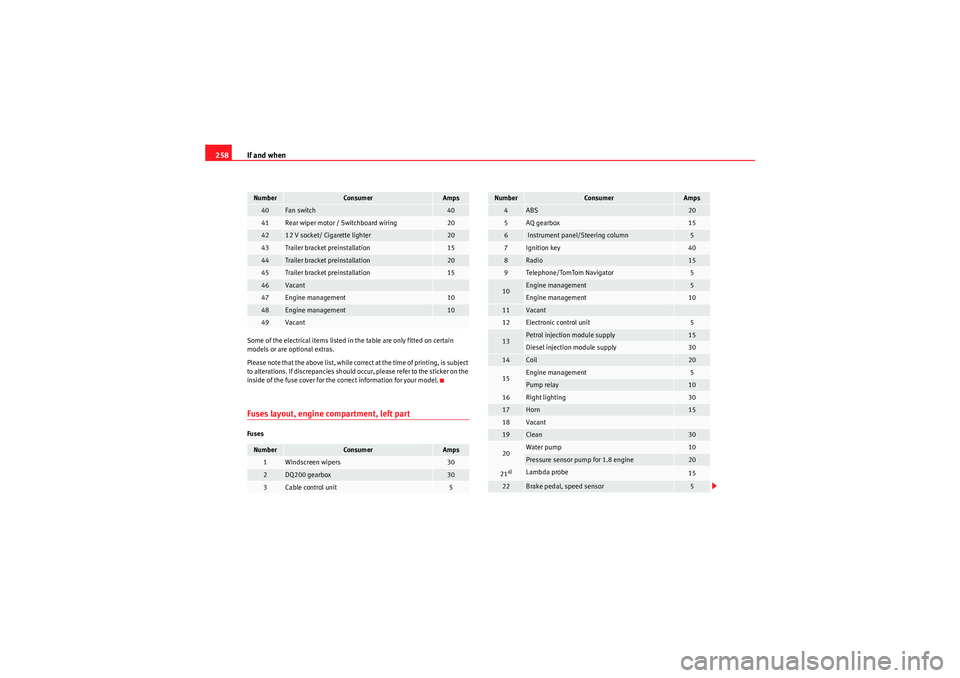
258Some of the electrical items listed in the table are only fitted on certain
models or are optional extras.
Please note that the above list, while correct at the time of printing, is subject
to alterations. If discrepancies should occur, please refer to the sticker on the
inside of the fuse cover for the correct information for your model.Fuses layout, engine compartment, left partFuses
40
Fan switch
40
41
Rear wiper motor / Switchboard wiring
20
42
12 V socket/ Cigarette lighter
20
43
Trailer bracket preinstallation
15
44
Trailer bracket preinstallation
20
45
Trailer bracket preinstallation
15
46
Vacant
47
Engine management
10
48
Engine management
10
49
Vacant
Number
Consumer
Amps
1
Windscreen wipers
30
2
DQ200 gearbox
30
3
Cable control unit
5
Number
Consumer
Amps
4
ABS
20
5
AQ gearbox
15
6
Instrument panel/Steering column
5
7
Ignition key
40
8
Radio
15
9
Telephone/TomTom Navigator
5
10
Engine management
5
Engine management
10
11
Vacant
12
Electronic control unit
5
13
Petrol injection module supply
15
Diesel injection module supply
30
14
Coil
20
15
Engine management
5
Pump relay
10
16
Right lighting
30
17
Horn
15
18
Vacant
19
Clean
30
20
Water pump
10
Pressure sensor pump for 1.8 engine
20
21a)
Lambda probe
15
22
Brake pedal, speed sensor
5
Number
Consumer
Amps
Leon_EN.book Seite 258 Mittwoch, 1. September 2010 6:16 18
Page 277 of 309

Description of specifications275
Safety First
Operating Instructions
Practical Tips
Technical Specifications
Information on fuel consumptionFuel consumption
The consumption and emission details shown on the vehicle
data sticker differ from one vehicle to another.The fuel consumption and CO
2 emissions of the vehicle can be found on the
vehicle data sticker.
The fuel consumption and emissions figures given are based on the vehicle
weight category, which is determined according to the engine/gearbox
combination and the equipment fitted.
The consumption and emission figures are calculated in accordance with the
tests indicated in regulations 715/2007/EC and 692/2008/EC.
Note
•Actual consumption may vary from quoted test values, depending on
personal driving style, road and traffic conditions, the weather and the
vehicle condition.WeightsKerb weight refers to the basic model with a fuel tank filled to 90% capacity
and without optional extras. The figure quoted includes 75 kg to allow for the
weight of the driver.
For special versions and optional equipment fittings or for the addition of
accessories, the weight of the vehicle will increase ⇒.
WARNING
•Please note that the centre of gravity may shift when transporting
heavy objects; this may affect the vehicle’s handling and lead to an acci-
dent. Always adjust your speed and driving style to suit road conditions
and requirements.•Never exceed the gross axle weight rating or the gross vehicle weight
rating. If the allowed axle load or the allowed total weight is exceeded, the
driving characteristics of the vehicle may change, leading to accidents,
injuries and damage to the vehicle.
To w i n g a t r a i l e rTrailer weightsTrailer weight
The trailer weights and drawbar loads approved are selected in intensive
trials according to precisely defined criteria. The approved trailer weights are
valid for vehicles in the EU for maximum speeds of 80 km/h (in certain
circumstances up to 100 km/h). The figures may be different in other coun-
tries. All data in the official vehicle documents take precedence over these
data ⇒ .
Drawbar load
The maximum permitted drawbar load on the ball joint of the towing bracket
must not exceed 75 kg.
In the interest of road safety, we recommend that you always tow
approaching the maximum drawbar load. The response of the trailer on the
road will be poor if the drawbar load is too small.
Leon_EN.book Seite 275 Mittwoch, 1. September 2010 6:16 18
Page 278 of 309
Description of specifications
276If the maximum permissible drawbar load cannot be met (e.g. with small,
empty and light-weight single axle trailers or tandem axle trailers with a
wheelbase of less than 1 metre), at least 4% of the actual trailer weight is a
legal stipulation for a drawbar load.
WARNING
•For safet y reas ons , d o not excee d the 8 0 k m/h limit . Th is is als o valid in
countries where higher speeds are permitted.•Never exceed the maximum trailer weights or the drawbar load. If the
permissible axle load or the permissible total weight is exceeded, the
driving characteristics of the vehicle may change, leading to accidents,
injuries and damage to the vehicle.
WheelsTyre pressure, snow chains, wheel boltsTyre pressures
The sticker with the tyre pressure values can be found on the inside of the
tank flap. The tyre pressure values given there are for cold tyres. Do not
reduce the slightly raised pressures of warm tyres ⇒.
Snow chains
Snow chains may be fitted only to the front wheels.
Consult the chapter “wheels” of this manual.
Wheel bolts
After the wheels have been changed, the tightening torque of the wheel bolts
s ho uld b e che cke d as s o on as p ossible wit h a to rqu e w re nch ⇒. The tight-
ening torque for steel and alloy wheels is 120 Nm.
WARNING
•Check the tyre pressure at least once per month. Checking the tyre
pressure is very important. If the tyre pressure is too high or too low, there
is an increased danger of accidents, particularly at high speeds.•If the torque of the wheel bolts is too low, they could loosen while the
vehicle is in motion. Risk of accident! If the tightening torque is too high,
the wheel bolts and threads can be damaged.Note
We recommend that you ask your Authorised Service Centre for information
about appropriate wheel, tyre and snow chain size.
Leon_EN.book Seite 276 Mittwoch, 1. September 2010 6:16 18
Page 280 of 309

Technical Specifications
278Petrol engine 1.4 63 kW (85 PS)Engine specifications
Performance
Weights
Trailer weight Power output in kW (PS)
rpm 63 (85)/ 5000
Maximum torque in Nm at rpm 132/ 3800
No. of cylinders/ capacity in cm
3
4/ 1390
Fuel Super 95 RON or Normal 91 RON
a)
a)Slight power loss.Maximum speedin km/h 172
Acceleration from 0-80 km/h in sec. 9.2
Acceleration from 0-100 km/h in sec. 14.1
Gross vehicle weight in kg 1745
Weight in running order (with driver) in kg 1250
Gross front axle weight in kg 900
Gross rear axle weight in kg 895
Permitted roof load in kg 75
Trailer without brakes 620
Trailer with brakes, gradients up to 8% 1200
Trailer with brakes, gradients up to 12% 800
Leon_EN.book Seite 278 Mittwoch, 1. September 2010 6:16 18
Page 282 of 309

Technical Specifications
280Weights
Trailer weight
Engine oil capacityPetrol engine 1.2 77 kW (105 PS)Engine specifications Running on LPG
Running on petrol
Gross vehicle weight in kg 18361775
Weight in running order (with driver) in kg 13411280
Gross front axle weight in kg 935936
Gross rear axle weight in kg 950890
Permitted roof load in kg 7575
Trailer without brakes 670
Trailer with brakes, gradients up to 8% 1500
Trailer with brakes, gradients up to 12% 1200
Approximate engine oil capacity with oil filter change 4.1 litres
Power output in kW (PS) rpm 77 (105)/5000
Maximum torque in Nm at rpm 175/1550-4100
No. of cylinders/ capacity in cm
3
4/ 1197
Fuel Super 95 RON
a)/Normal 91 RON
b)
a)Research- Octane- Number = Anti-detonation rating of the petrol.b)With a slight power loss
Leon_EN.book Seite 280 Mittwoch, 1. September 2010 6:16 18
Page 283 of 309

Technical Specifications281
Safety First
Operating Instructions
Practical Tips
Technical Specifications
Performance
Weights
Trailer weight
Engine oil capacity
without Start&Stop
with Start&Stop
Maximum speed in km/h 187187
Acceleration from 0-80 km/h in sec. 7.27.2
Acceleration from 0-100 km/h in sec. 10.910.9
without Start&Stop with Start&Stop
Gross vehicle weight in kg 17701775
Weight in running order (with driver) in kg 12751280
Gross front axle weight in kg 940940
Gross rear axle weight in kg 890890
Permitted roof load in kg 7575
without Start&Stop with Start&Stop
Trailer without brakes 630640
Trailer with brakes, gradients up to 8% 15001500
Trailer with brakes, gradients up to 12% 12001200
Approximate engine oil capacity with oil filter change 3.3 litres
Leon_EN.book Seite 281 Mittwoch, 1. September 2010 6:16 18