2010 Seat Ibiza 5D ignition
[x] Cancel search: ignitionPage 186 of 266
Checking and refilling levels
184•If any work has to be performed when the engine is started or with the
engine running, there is an additional, potentially fatal, safety risk from the
rotating parts, such as the drive belts, alternator, radiator fan, etc., and
from the high-voltage ignition system. You should also observe the
following points:
−Never touch the electrical wiring of the ignition system.
− Ensure that jewellery, loose clothing and long hair do not get
trapped in rotating engine parts. Da nger of death. Before starting any
work remove jewellery, tie back and cover hair, and wear tight-fitting
clothes.
− Never accelerate with a gear engaged without taking the necessary
precautions. The vehicle could move, even if the handbrake is applied.
Danger of death.•If work has to be carried out on the fuel system or on electrical compo-
nents, you must observe the following safety notes in addition to the above
warnings:
−Always disconnect the battery. The vehicle must be unlocked when
this is done, otherwise the alarm will be triggered.
− Do not smoke.
− Never work near naked flames.
− Always have a fire extinguisher on hand.Caution
When topping up service fluids, make sure not to mistake them. Using the
wrong fluids could cause serious malfunctions and engine damage!
For the sake of the environment
Service fluids leaks are harmful to the environment. For this reason you
should make regular checks on the grou nd underneath your vehicle. If you find spots of oil or other fluids, have your vehicle inspected at a specialised
workshop.
WARNING (continued)
Ibiza_EN.book Seite 184 Mittwoch, 1. September 2010 5:24 17
Page 195 of 266

Checking and refilling levels193
Safety First
Operating Instructions
Practical Tips
Technical Specifications
Changing windscreen wiper blades
If the windscreen wiper blades are in perfect condition, you
will benefit from an improved visibility. Damaged wiper
blades should be replaced immediately.To change the blades it is necessary to change the rest position of
the wipers to the service position.
Service position (For changing wiper blades)
– Ensure that the wiper blades are not frozen.
– Turn ignition on and off and then (before approx. 9 sec.) move
the windscreen wiper lever to the intermittent wipe position. The
windscreen wipers will move to the service position.
Removing the wiper blade
– Lift the windscreen wiper arm. – Press on the securing tab.
– Extract the wiper blade from the wiper arm.
Fitting the wiper blade
– Insert the wiper blade onto the windscreen wiper arm until it
clicks into place.
– Make sure that the blade faces down when fitting a blade with integrated deflector blade.
– Place the wiper arms to their initial position.
If the windscreen wipers smear , t h e y s h o u l d b e r e p la ce d i f t h e y a r e d a m a ge d ,
or cleaned if they are soiled.
If this does not produce the desired results, the setting angle of the wind-
screen wiper arms might be incorrect. They should be checked by a special-
ised workshop and corrected if necessary.
WARNING
Do not drive unless you have good visibility through all windows!•Clean the windscreen wiper blades and all windows regularly.•The wiper blades should be changed once or twice a year.Caution
•Damaged or dirty windscreen wipers could scratch the windscreen.•Never use fuel, nail varnish remover, paint thinner or similar products to
clean the windows. This could damage the windscreen wiper blades.•Never move the windscreen wiper or windscreen wiper arm manually. This
could cause damage.
Fig. 122 Change wind-
screen wiper blade
Ibiza_EN.book Seite 193 Mittwoch, 1. September 2010 5:24 17
Page 199 of 266

Checking and refilling levels197
Safety First
Operating Instructions
Practical Tips
Technical Specifications
charge. Never short the battery terminals. High-energy sparks can cause
injury.
•A highly explosive mixture of gases is released when the battery is
under charge. The batteries should be charged in a well-ventilated room
only.•Keep children away from acid and batteries.•Before working on the electrical system, you must switch off the
engine, the ignition and all consumers. The negative cable on the battery
must be disconnected. When a light bulb is changed, you need only switch
off the light.•Deactivate the anti-theft alarm by unlocking the vehicle before you
disconnect the battery! The alarm will otherwise be triggered.•When disconnecting the battery from the vehicle electrical system,
disconnect first the negative cable and then the positive cable.•Switch off all electrical consumers before reconnecting the battery.
Reconnect first the positive cable and then the negative cable. Never
reverse the polarity of the connections. This could cause an electrical fire.•Never charge a frozen battery, or one which has thawed. This could
result in explosions and chemical burns. Always replace a battery which
has frozen. A flat battery can freeze at temperatures around 0 °C.•Ensure that the vent hose is always connected to the battery.•Never use a defective battery. This could cause an explosion. Replace a
damaged battery immediately.•For vehicles with the battery in the luggage compartment: Check that
the battery gas ventilation hose is securely attached.Caution
•Never disconnect the battery if the ignition is switched on or if the engine
is running. This could damage the electrical system or electronic compo-
nents.
•Do not expose the battery to direct sunlight over a long period of time, as
the intense ultraviolet radiation can damage the battery housing.•If the vehicle is left standing in cold conditions for a long period, protect
the battery from freezing. If it freezes it will be damaged.Checking the electrolyte level
The electrolyte level should be checked regularly in high-
mileage vehicles, in hot countries and in older batteries.– Open the engine bonnet and the battery cover ⇒ in “Safety
instructions on working in the engine compartment” on
page 183 ⇒ in “Warnings on handling the battery” on
page 196. For vehicles with the battery under the spare wheel,
open the tailgate and lift the floor covering. The battery is located
next to the spare wheel.
– Check the colour display in the "magic eye" on the top of the battery.
– If there are air bubbles in the window, tap the window gently until they disperse.The position of the battery is shown in the corresponding engine compart-
ment diagram ⇒page 235. The location of the battery in the luggage
compartment can be seen in ⇒page 235, fig. 159 .
The “magic eye” indicator, located on the top of the battery changes colour,
depending on the charge state and electrolyte level of the battery.
There are two different colours:•Black: correct charge status.
WARNING (continued)
Ibiza_EN.book Seite 197 Mittwoch, 1. September 2010 5:24 17
Page 214 of 266
If and when
212Tyre repair
The following sections describe the procedures for repairing
a tyre.Using the sealing compound
– The instructions on the containe r give detailed information on
how to use the sealing compound.
Inflating the tyre.
– Remove the air compressor and hose from the container.
– Screw the retaining nut onto the valve.
– Plug the compressor cable into a 12 volt power socket.
– Turn on compressor and monitor the pressure shown on the pres- sure gauge.
Completing the repair
– Remove the compressor hose from the valve.
– Fit the valve cap.
– Unplug the compressor from the socket.
– Return all tools to their proper storing location.
NoteThe compressor should never be allowe d to run for longer than 6 minutes.
FusesChanging a fuse
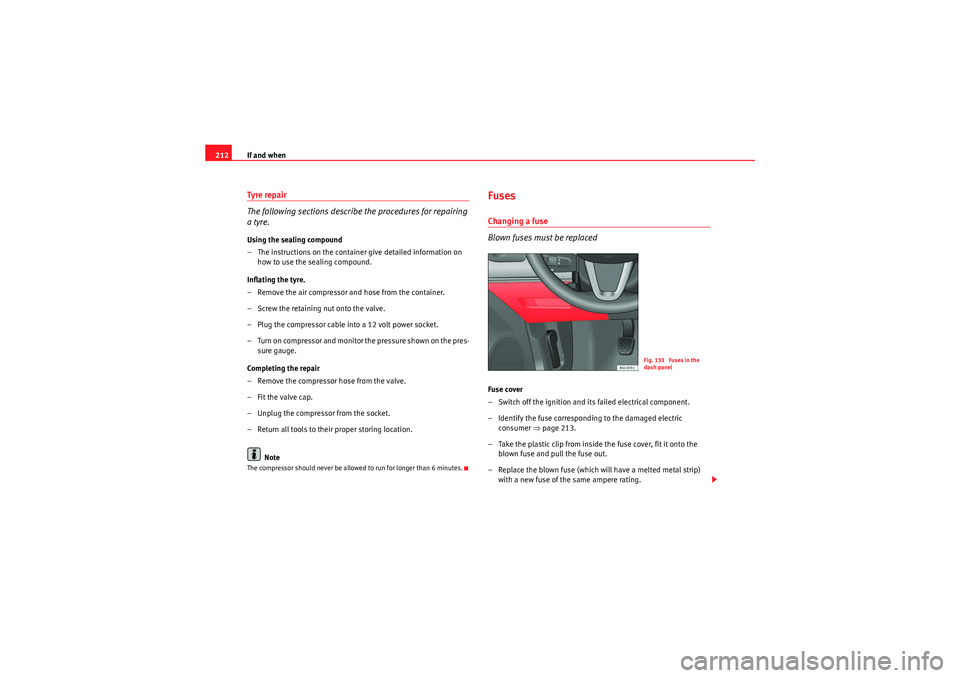
Blown fuses must be replacedFuse cover
– Switch off the ignition and its failed electrical component.
– Identify the fuse corresponding to the damaged electric
consumer ⇒page 213.
– Take the plastic clip from inside the fuse cover, fit it onto the blown fuse and pull the fuse out.
– Replace the blown fuse (which will have a melted metal strip) with a new fuse of the same ampere rating.
Fig. 133 Fuses in the
dash panel
Ibiza_EN.book Seite 212 Mittwoch, 1. September 2010 5:24 17
Page 227 of 266

If and when225
Safety First
Operating Instructions
Practical Tips
Technical Specifications
Jump leads
Jump leads must comply with standard
DIN 72553 (see manufacturer’s docu-
mentation). The wire cross section must be at least 25 mm
2 for petrol engines
and at least 35 mm
2 for diesel engines.
Note
•The vehicles must not touch each other, otherwise electricity could flow as
soon as the positive terminals are connected.•The discharged battery must be properly connected to the vehicle elec-
trical system.How to jump start: description
Jump lead terminal connections
1. Switch off the ignition of both vehicles ⇒.
2. Connect one end of the red jump lead to the positive terminal
⇒ fig. 153 or ⇒fig. 154 of the vehicle with the flat
battery .
3. Connect the other end of the red jump lead to the positive
terminal in the vehicle providing assistance .
4. On vehicles with no Start-Stop system, connect one end of the
black jump lead to the negative terminal in the vehicle
providing assistance ⇒fig. 153 .
5. On vehicles with the Start-Stop system , connect one end of the
black jump lead to a suitable ground terminal, to a solid metal
part bolted to the engine block or to the engine block itself
⇒ fig. 154 .
Fig. 153 Diagram for
connecting jump leads if
the vehicle providing
assistance the current is
not fitted with the Start-
Stop system: flat battery
and battery providing
current .AA
AB
Fig. 154 Diagram for
connecting jump leads if
the vehicle providing
assistance is fitted with
the Start-Stop system:
flat battery and
battery providing current .
AA
AB
A+
A+
AAA+
AB
A-
AB
AX
Ibiza_EN.book Seite 225 Mittwoch, 1. September 2010 5:24 17
Page 229 of 266

If and when227
Safety First
Operating Instructions
Practical Tips
Technical Specifications
Towing and tow-startingTo w - s t a r t i n g *
The use of jump leads is pr eferable to tow-starting.We recommend that you do not tow-start your vehicle. Jump-starting
is preferable ⇒page 224.
However, if your vehicle has to be tow-started:
– Engage the 2nd or the 3rd gear.
– Keep the clutch pressed down.
– Switch the ignition on.
– Once both vehicles are moving, release the clutch.
– As soon as the engine starts, press the clutch and move the gear lever into neutral. This helps to prevent driving into the towing
vehicle.
WARNING
The risk of accidents is high when tow-starting. The vehicle being towed
can easily collide with the towing vehicle.
Caution
When tow-starting, fuel could enter the catalytic converter and damage it.
CommentsPlease observe the following po ints if you use a tow-rope:
Notes for the driver of the towing vehicle
– Drive slowly at first until the tow-rope is taut. Then accelerate gradually.
– Begin and change gears cautiously. If you are driving an auto- matic vehicle, accelerate gently.
– Remember that the brake servo and power steering are not working in the vehicle you are towing. Brake sooner than normal
and pressing the pedal gently.
Notes for the driver of the towed vehicle
– Ensure that the tow-rope remains taut at all times when towing.Tow-rope or tow-bar
It is easier and safer to tow a vehicle with a tow-bar. You should only use a
tow-rope if you do not have a tow-bar.
A tow-rope should be slightly elastic to reduce the loading on both vehicles.
It is advisable to use a tow-rope made of synthetic fibre or similarly elastic
material.
Attach the tow-rope or the tow-bar only to the towing eyes provided or a
towing bracket.
Driving style
Towing requires some experience, especially when using a tow-rope. Both
drivers should be familiar with the technique required for towing. Inexperi-
enced drivers should not attempt to tow.
Ibiza_EN.book Seite 227 Mittwoch, 1. September 2010 5:24 17
Page 230 of 266
If and when
228Do not pull too hard with the towing vehicle and take care to avoid jerking the
tow-rope. When towing on an unpaved road, there is always a risk of over-
loading and damaging the anchorage points.
The ignition of the vehicle being towed must be switched on to prevent the
steering wheel from locking and also to allow the use of the turn signals,
horn, windscreen wipers and washers.
As the brake servo does not work if the engine is not running, you must apply
considerably more pressure to the brake pedal than you normally would.
As the power assisted steering does not work if the engine is not running, you
will need more strength to steer than you normally would.
Towing vehicles with an automatic gearbox•Put the selector lever into position “N”.•Do not drive faster than 50 km/h.•Do not tow further than 50 km.•If a breakdown vehicle is used, the vehicle must be towed with the front
wheels raised.Note
•Observe legal requirements when towing or tow-starting.•Switch on the hazard warning lights of both vehicles. However, observe
any regulations to the contrary.•For technical reasons, vehicles with an automatic gearbox must not be
tow-started.•If damage to your vehicle means that there is no lubricant in the gearbox,
you must raise the drive wheels while the vehicle is being towed.•If the vehicle has to be towed more than 50 km, the front wheels should
be raised during towing, and towing should be carried out by a qualified
person.
•The steering wheel is locked when the vehicle has no electrical power. The
vehicle must then be towed with the front wheels raised. Towing should be
carried out by a qualified person.•The towing eye should always be kept in the vehicle.To w i n g e y e sFitting the towing eye
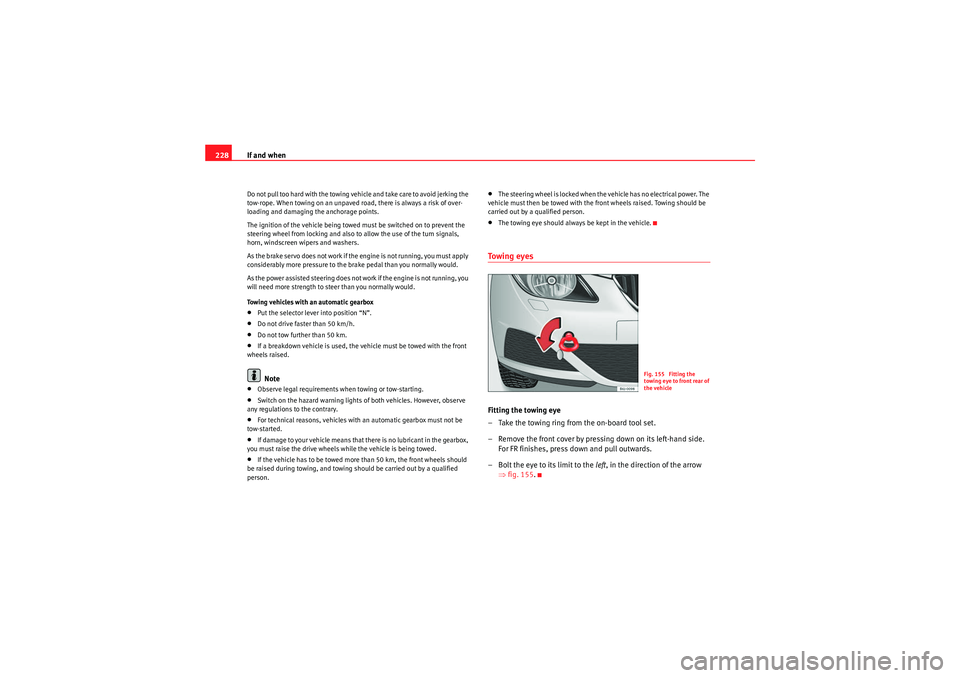
– Take the towing ring from the on-board tool set.
– Remove the front cover by pressing down on its left-hand side. For FR finishes, press down and pull outwards.
– Bolt the eye to its limit to the left, in the direction of the arrow
⇒ fig. 155 .
Fig. 155 Fitting the
towing eye to front rear of
the vehicle
Ibiza_EN.book Seite 228 Mittwoch, 1. September 2010 5:24 17
Page 260 of 266
Index
258Fog lights . . . . . . . . . . . . . . . . . . . . . . . . . . . . . . . 89
Fog lights with cornering function . . . . . . . . . . . 92
Front airbags . . . . . . . . . . . . . . . . . . . . . . . . . . . . 29
Description . . . . . . . . . . . . . . . . . . . . . . . . . . 29
Operation . . . . . . . . . . . . . . . . . . . . . . . . . . . . 30
Safety notes . . . . . . . . . . . . . . . . . . . . . . . . . . 31
Front ashtray . . . . . . . . . . . . . . . . . . . . . . . . . . . 114
Front cup holder* . . . . . . . . . . . . . . . . . . . . . . . 113
Front interior light . . . . . . . . . . . . . . . . . . . . . . . . 96
Front passenger airbag deactivation . . . . . . . . . 35
Front reading light . . . . . . . . . . . . . . . . . . . . . . . . 97
Front seat adjustment Lumbar support . . . . . . . . . . . . . . . . . . . . . . 107
Fuel Diesel . . . . . . . . . . . . . . . . . . . . . . . . . . . . . . 182
Petrol . . . . . . . . . . . . . . . . . . . . . . . . . . . . . . 181
Fuel level Indicator . . . . . . . . . . . . . . . . . . . . . . . . . . . . . 50
Fuel reserve . . . . . . . . . . . . . . . . . . . . . . . . . . . . . 64
Fuel Tank Opening the fuel tank flap . . . . . . . . . . . . . 180
Fuel tank See Fuel reserve . . . . . . . . . . . . . . . . . . . . . . 64
Fuel: save . . . . . . . . . . . . . . . . . . . . . . . . . . . . . . 161
Fuses . . . . . . . . . . . . . . . . . . . . . . . . . . . . . . . . . 212GG 12 . . . . . . . . . . . . . . . . . . . . . . . . . . . . . . . . . . 190
Gear shift pattern . . . . . . . . . . . . . . . . . . . . . . . 136
General overview of the engine compartment 235 Glove compartment . . . . . . . . . . . . . . . . . . . . . . 110
Glow plug system . . . . . . . . . . . . . . . . . . . . . . . 133
Warning lamp . . . . . . . . . . . . . . . . . . . . . . . . 60
GRA . . . . . . . . . . . . . . . . . . . . . . . . . . . . . . . . . . . 148
HHandbrake . . . . . . . . . . . . . . . . . . . . . . . . . . . . . 144 Warning lamp . . . . . . . . . . . . . . . . . . . . 63, 145
Hazard warning lights . . . . . . . . . . . . . . . . . . . . . 94
HBA . . . . . . . . . . . . . . . . . . . . . . . . . . . . . . . . . . 153
Head restraints Adjusting . . . . . . . . . . . . . . . . . . . . . . . 105, 106
Adjustment of the head restraint angle . . . 106
Removing . . . . . . . . . . . . . . . . . . . . . . . . . . . 106
Headlight flashers . . . . . . . . . . . . . . . . . . . . . . . . 95
Headlight range control . . . . . . . . . . . . . . . . . . . 91
Headlights Driving abroad . . . . . . . . . . . . . . . . . . . . . . . 163
Fog lights . . . . . . . . . . . . . . . . . . . . . . . . . . . . 89
Headlight washer . . . . . . . . . . . . . . . . . . . . 101
Heated exterior mirrors* . . . . . . . . . . . . . . . . . . 102
Heated front seats . . . . . . . . . . . . . . . . . . . . . . . 108
Heated rear window Heating element wires . . . . . . . . . . . . . . . . 170
Heating . . . . . . . . . . . . . . . . . . . . . . . . . . . . . . . 119
Heating system . . . . . . . . . . . . . . . . . . . . . . . . . 120
High pressure cleaners . . . . . . . . . . . . . . . . . . . 168
Hill-start assist . . . . . . . . . . . . . . . . . . . . . . . . . 146
Horn . . . . . . . . . . . . . . . . . . . . . . . . . . . . . . . . . . . 47
How to jump start description . . . . . . . . . . . . . 225 Hydraulic Brake Assist
Automatic hazard warning lights activation . . .153
IIdentification number . . . . . . . . . . . . . . . . . . . . 232
Identification plate . . . . . . . . . . . . . . . . . . . . . . 232
Ignition key . . . . . . . . . . . . . . . . . . . . . . . . . . . . 130
Ignition lock . . . . . . . . . . . . . . . . . . . . . . . . . . . . 130
Information in the multifunction display
Memory displays . . . . . . . . . . . . . . . . . . . . . . 52
Instrument and switch lighting . . . . . . . . . . . . . 91
Instrument lighting . . . . . . . . . . . . . . . . . . . . . . . 47
Instrument panel Service interval display . . . . . . . . . . . . . . . . 54
Instruments . . . . . . . . . . . . . . . . . . . . . . . . . . . . . 49
Interior mirror . . . . . . . . . . . . . . . . . . . . . . . . . . 101
Interior monitoring and anti-towing alarm* Activation . . . . . . . . . . . . . . . . . . . . . . . . . . . . 81
ISOFIX system . . . . . . . . . . . . . . . . . . . . . . . . . . . 42JJump leads . . . . . . . . . . . . . . . . . . . . . . . . . . . . . 224
Jump-starting . . . . . . . . . . . . . . . . . . . . . . . . . . . 224KKeys . . . . . . . . . . . . . . . . . . . . . . . . . . . . . . . . . . . 77
Ibiza_EN.book Seite 258 Mittwoch, 1. September 2010 5:24 17