2010 Seat Exeo ST clock
[x] Cancel search: clockPage 227 of 325

Checking and refilling levels225
Safety First
Operating Instructions
Practical Tips
Technical Specifications
Checking and refilling levelsRefuellingThe tank flap is released manually. The tank holds approxi-
mately 70 litres.The flap that covers the tank cap is unlocked and locked automati-
cally by the central locking.
Unscrewing the tank cap
– Press the right side of the flap to open it.
– Unscrew the fuel tank cap anti-clockwise.
– Hook the cap onto the support fitted to the open tank flap
⇒fig. 174 . Closing the tank cap
– Screw the tank cap clockwise into the filler opening until it you
hear it click into position.
– Close the tank flap.
The tank flap is at the rear of the vehicle on the right.
If the automatic filler nozzle is operated correctly, it will switch itself off as
soon as the tank is “full”. Never attempt to fill beyond this point, as this will
fill the expansion chamber. Fuel may leak out if ambient conditions are warm.
The correct fuel grade for your vehicle is given on a sticker on the inside of the
fuel tank flap. Here you will find further information on fuel.
Releasing the fuel tank flap manually*
If the central locking system fails, the fuel tank flap can be opened manually
as follows:•Open the tailgate•Remove the cover from the right side trim in the luggage compartment.•Insert a hand and pull the locking device back•Open the cap and take out the plug.WARNING
•Fuel is highly flammable and can cause serious burns and other inju-
ries.
−Never smoke or use an open flame when filling the fuel tank of the
vehicle, or a spare fuel canister, with fuel. This is an explosion hazard.
− Follow legal requirements for the use of spare fuel canisters.
Fig. 174 Fuel tank flap
with tank cap attached
ExeoST_EN.book Seite 225 Freitag, 3. September 2010 11:41 11
Page 237 of 325

Checking and refilling levels235
Safety First
Operating Instructions
Practical Tips
Technical Specifications
The coolant level should be checked with the engine switched off.
The coolant level is monitored by a warning lamp on the instrument panel
display
⇒page 78. However, we recommend that it should be checked occa-
sionally.
Coolant fluid loss
Any loss of coolant fluid normally indicates a leak in the cooling system. In
this case the cooling system should be inspected by a qualified workshop
without delay. It is not sufficient merely to top up the coolant fluid.
If there are no leaks in the system, a loss of coolant fluid can only occur if the
coolant boils and is forced out of the system as a result of overheating.
Caution
Radiator sealants must not be added to the coolant fluid. Such additives
could seriously impair the function of the cooling system.Topping up the coolant fluid
Be careful when topping up with coolant fluid.– Switch the engine off.
– Wait for the engine to cool down.
– Cover the cap on the expansion tank ⇒fig. 179 with a cloth, and
carefully unscrew the cap anti-clockwise ⇒.
– Add coolant fluid.
– Screw on the cap tightly.
Make sure that the coolant fluid meets the required specifications
⇒page 233, “Coolant fluid”. Do not use a different type of antifreeze if
G12++ antifreeze is not available. In this case, use only water and bring the
antifreeze concentration back up to the correct level as soon as possible.
Always top up with new coolant fluid.
Do not fill above the “max” mark. Excess coolant fluid is forced out of the
system through the valve in the filler cap when the engine gets hot.
If a lot of coolant fluid has been lost, wait for the engine to cool down before
putting in cold coolant. Failure to do so could result in serious engine
damage.
WARNING
•The cooling system is under pressure. Do not unscrew the cap on the
expansion tank when the engine is hot. Failure to comply could result in
burns.•The antifreeze and coolant fluid can be a health hazard. Therefore, the
antifreeze should be stored in the original container in a safe place out of
reach of children. Failure to comply could result in poisoning.For the sake of the environment
Drained off coolant should not be used again. Drain off the used coolant into
a suitable container and dispose of it in the proper manner (observe environ-
mental regulations).
ExeoST_EN.book Seite 235 Freitag, 3. September 2010 11:41 11
Page 258 of 325

If and when
256Spare steel rim wheel
The spare steel rim wheel is carried in the wheel well under
the floor panel in the luggage compartment. It is only
intended for temporary use over short distances.Taking out the spare wheel
–Turn the plastic knob ⇒fig. 192 anti-clockwise.
– Take out the spare wheel.
Securing the defective wheel in the spare wheel well
– Place wheel in spare wheel well in the luggage compartment.
– Secure the wheel by turning plastic knob clockwise.
– Replace the floor panel before closing the tailgate.
Your vehicle can be factory-equipped with a spare steel wheel. The spare
wheel does not usually meet the same performance standards as the wheels
fitted on the vehicle because of the wheel/tyre dimensions, rubber composi-
tion, tread pattern, etc. Therefore, note the following restrictions:•The spare steel wheel is designed only for your vehicle model. Do not
attempt to mount the wheel on any vehicle but your own.•Your vehicle will have different driving characteristics when the spare
steel rim wheel is mounted ⇒ .•The spare wheel is only intended for temporary use after having a flat tyre.
Replace the spare wheel with a normal wheel that has the proper tyre dimen-
sions as soon as possible.•If the size of the spare steel rim wheel is different to that of the other
wheels, it is unlikely that snow chains suitable for the other wheels will fit it.WARNING
•After mounting the spare steel rim wheel, the tyre pressure must be
checked and corrected as soon as possible. The tyre pressure must corre-
spond to the vehicle load (consult the table containing the inflation pres-
sures). Otherwise there is danger of causing an accident. Use the highest
tyre pressure as indicated in the table.•Do not drive faster than 80 km/h, as higher speeds can cause an acci-
dent.•Avoid heavy acceleration, hard braking and fast cornering, as this could
cause an accident.
Fig. 192 Spare steel rim
wheel
ExeoST_EN.book Seite 256 Freitag, 3. September 2010 11:41 11
Page 260 of 325

If and when
258
–The inflation pressure of the newly fitted spare tyre must be
checked as soon as possible.
–Have the tightening torque of the wheel bolts checked as soon
as possible with a torque wrench. It must be 120 Nm (always
when cold)
–Have the flat tyre replaced as quickly as possible.
Note•If you notice that the wheel bolts are rusty and difficult to turn when
changing a wheel, they must be replaced before having the tightening torque
checked.•For your safety, drive at moderate speeds until the wheel bolt tightening
torque has been checked.
Loosening and tightening the wheel bolts
The wheel bolts must be loosened before raising the vehicle.Loosening
–Fit the box spanner as far as it will go over the wheel bolt
4).
– Grip the box spanner as close to the end as po ssible an d turn t he
wheel bolts about one turn anti-clockwise ⇒ fig. 193 -arrow- .
Tightening
– Fit the box spanner as far as it will go over the wheel bolt4).
– Grip the box spanner as close to the end as possible and tighten
the bolt firmly by turning clockwise.
4)An adapter is required to unscrew or tighten the anti-theft wheel bolts* ⇒page 261.
Fig. 193 Changing the
wheel: Loosen the wheel
bolts
ExeoST_EN.book Seite 258 Freitag, 3. September 2010 11:41 11
Page 272 of 325

If and when
270Changing the turn signal bulb
The procedure for changing the bulb is the same on both
sides.– Switch off the ignition and the lights.
– Raise the bonnet.
– Turn the bulb holder anti-clockwise, pulling it by the grip
⇒fig. 205 and removing the bulb holder and the bulb.
– Replace the blown bulb in the bulb holder (press and turn anti- clockwise to remove) with a new bulb (press and turn clockwise
to insert).
– Installation is done in the reverse order.
– Check whether the new bulb is working. Note
Although it is not necessary, previously remove the rigid cover
⇒page 272,
fig. 208 for easier turn signal bulb changes.
Fig. 205 Turn signal
ExeoST_EN.book Seite 270 Freitag, 3. September 2010 11:41 11
Page 274 of 325

If and when
272Changing the dipped beam headlight bulb
The procedure for changing the bulb is the same on both
sides.
– Switch off the ignition and the lights.
– Raise the bonnet.
– Move the brace ⇒ fig. 208 in the direction of the arrow and
remove the rigid cover, separating the brace side and then
removing the two tabs from the other end of the cover.
– Pull the connector ⇒ fig. 209 from the bulb.
– Unclip the retainer spring ⇒fig. 209 pressing inwards to the
right.
– Remove the bulb and fit the new one in the headlight casing with the tab upwards, starting to position it from below.
– Clip on the spring, raising it and pressing it slightly while turning
it anti-clockwise. To ensure correct lighting, the filament must be
vertical. When changing the bulb, you can check the position of
the bulb through the headlight glass.
– Connect the connector to the bulb.
– Fit the cover, first inserting the side tabs and then closing the cover and the brace. Make sure that the gasket sits well on the
casing cover during the operation.
– Check whether the new bulb is working.
– Have the headlight settings checked as soon as possible.
Fig. 208 Dipped beam
headlightsFig. 209 Dipped beam
headlights
A1A2
A3
ExeoST_EN.book Seite 272 Freitag, 3. September 2010 11:41 11
Page 275 of 325

If and when273
Safety First
Operating Instructions
Practical Tips
Technical Specifications
Changing the side light bulb (outside of vehicle)
The procedure for changing the bulb is the same on both
sides.
– Switch off the ignition and the lights.
– Raise the bonnet.
– Move the brace ⇒fig. 210 in the direction of the arrow and
remove the rigid cover, separating the brace side and then
removing the two tabs from the other end of the cover.
– Gently press on the bulb holder tabs ⇒fig. 211 and pull the
cover upwards (it can also be removed by pulling on the bulb
holder wires).
– Separate the bulb from the bulb holder by pulling both pieces anti-clockwise.
– Fit the new bulb by pressing on the bulb holder.
– Insert the bulb into the socket and press on the bulb holder. Fit the cover, first inserting the side tabs and then closing the cover
and the brace. Make sure that the gasket sits well on the casing
cover during the operation.
– Check whether the new bulb is working.
Fig. 210 Side light bulb
(outside of vehicle)Fig. 211 Side light bulb
(outside of vehicle)
A1
ExeoST_EN.book Seite 273 Freitag, 3. September 2010 11:41 11
Page 276 of 325
If and when
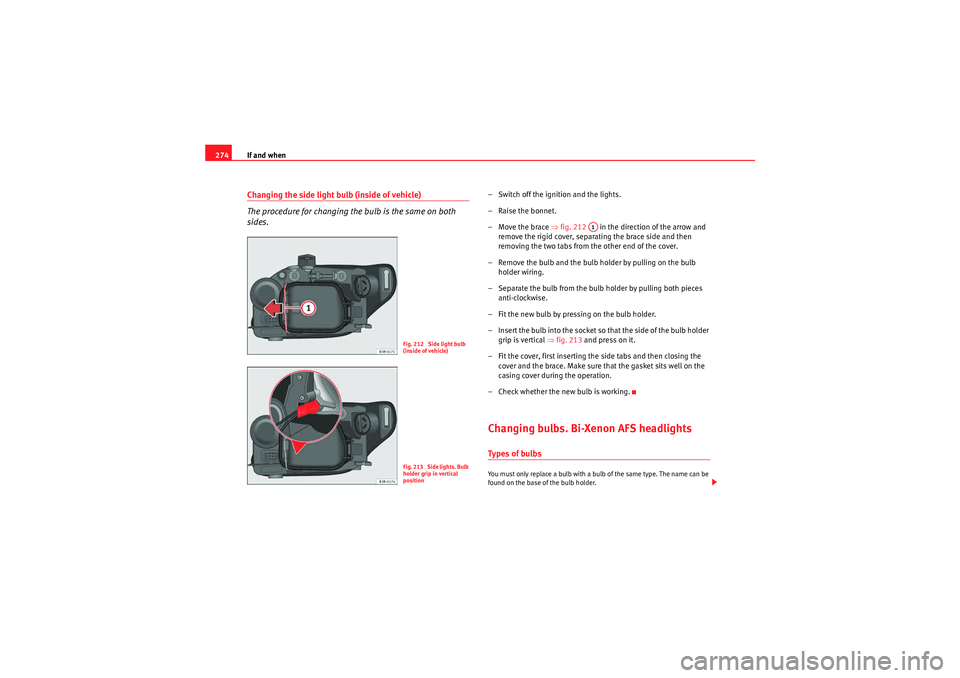
274Changing the side light bulb (inside of vehicle)
The procedure for changing the bulb is the same on both
sides.
– Switch off the ignition and the lights.
– Raise the bonnet.
– Move the brace ⇒ fig. 212 in the direction of the arrow and
remove the rigid cover, separating the brace side and then
removing the two tabs from the other end of the cover.
– Remove the bulb and the bulb holder by pulling on the bulb holder wiring.
– Separate the bulb from the bulb holder by pulling both pieces anti-clockwise.
– Fit the new bulb by pressing on the bulb holder.
– Insert the bulb into the socket so that the side of the bulb holder grip is vertical ⇒fig. 213 and press on it.
– Fit the cover, first inserting the side tabs and then closing the cover and the brace. Make sure that the gasket sits well on the
casing cover during the operation.
– Check whether the new bulb is working.Changing bulbs. Bi-Xenon AFS headlightsTypes of bulbsYou must only replace a bulb with a bulb of the same type. The name can be
found on the base of the bulb holder.
Fig. 212 Side light bulb
(inside of vehicle)Fig. 213 Side lights. Bulb
holder grip in vertical
position
A1
ExeoST_EN.book Seite 274 Freitag, 3. September 2010 11:41 11