2010 Seat Altea lock
[x] Cancel search: lockPage 80 of 310
Cockpit
78
WARNING
•Failure to observe warning lamps and warning messages can result in
serious personal injury or damage to your vehicle.
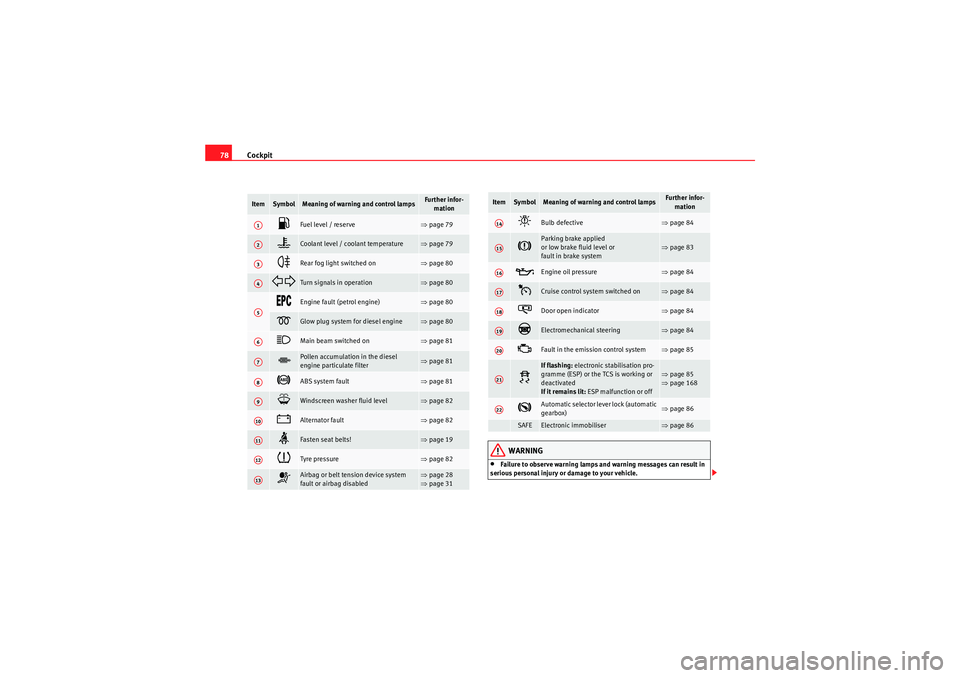
Item
Symbol
Meaning of warning and control lamps
Further infor- mation
Fuel level / reserve
⇒page 79
Coolant level / coolant temperature
⇒page 79
Rear fog light switched on
⇒page 80
Turn signals in operation
⇒page 80
Engine fault (petrol engine)
⇒page 80
Glow plug system for diesel engine
⇒page 80
Main beam switched on
⇒page 81
Pollen accumulation in the diesel
engine particulate filter
⇒page 81
ABS system fault
⇒page 81
Windscreen washer fluid level
⇒page 82
Alternator fault
⇒page 82
Fasten seat belts!
⇒page 19
Tyre pressure
⇒page 82
Airbag or belt tension device system
fault or airbag disabled
⇒page 28
⇒ page 31
A1A2A3A4A5A6A7A8A9A10A11A12A13
Bulb defective
⇒page 84
Parking brake applied
or low brake fluid level or
fault in brake system
⇒page 83
Engine oil pressure
⇒page 84
Cruise control system switched on
⇒page 84
Door open indicator
⇒page 84
Electromechanical steering
⇒page 84
Fault in the emission control system
⇒page 85
If flashing: electronic stabilisation pro-
gramme (ESP) or the TCS is working or
deactivated
If it remains lit: ESP malfunction or off
⇒page 85
⇒ page 168
Automatic selector lever lock (automatic
gearbox)
⇒page 86
SAFE
Electronic immobiliser
⇒page 86
Item
Symbol
Meaning of warning and control lamps
Further infor-
mation
A14A15A16A17A18A19A20A21A22
altea_EN Seite 78 Mittwoch, 26. August 2009 6:00 18
Page 83 of 310

Cockpit81
Safety First
Operating instructions
Practical tips
Technical Data
Main beam headlights
This warning lamp lights up when the main beams are on.The warning lamp
is switched on once main beams are on or once the
headlight flasher is operating.
Further information ⇒ page 120.
Soot accumulation in the diesel engine particulate filter
If the indicator lights
you may help the filter clear itself by driving in the
appropriate manner.
To do this, drive about 15 minutes in 4t h or 5th gear (automatic gearbox: S
gear range) at a speed of 60 km/h, with the engine running at approximately
2000 rpm. In this way, the pollen build up in the filter is burned. When
cleaning is successful, the indicator turns off.
If the indicator
is not deactivated, bring the vehicle to a specialised work-
shop to repair the fault.
WARNING
•Always drive according to the road weather conditions, the terrain and
traffic. Driving recommendations should never lead to illegal manoeuvres
in surrounding traffic.•The diesel engine particulate filter may reach extremely high tempera-
tures; it should not enter into contact with flammable materials under-
neath the vehicle. Failure to comply could result in fire.
Anti-lock brake system (ABS)
A warning lamp system monitors the ABS.
The warning lamp
should light up for a few seconds when the ignition is
switched on. It goes out again after the system has run through an automatic
test sequence.
There is a fault in the ABS if:
•The warning lamp
does not light up when the ignition is switched on.
•The warning lamp does not go out again after a few seconds.•The warning lamp lights up when the vehicle is moving.
The vehicle can still be braked in the normal way (except that the ABS control
function will not function). Please take the vehicle to a qualified workshop as
soon as possible. For further information on the ABS see the ⇒ page 193.
If a fault occurs in the ABS, the ESP* warning lamp will also light up.
Brake system fault
If the ABS warning lamp
lights up together with the brake warning lamp
, this indicates not only a fault in the ABS function, but also a possible fault
in the brake system ⇒.
WARNING
•Before opening the bonnet, read and observe the warnings on
⇒ page 226, “Working in the engine compartment”.•If the brake warning lamp
should light up together with the ABS
warning lamp
, stop the vehicle immediately and check the brake fluid
level in the reservoir ⇒ page 239, “Brake fluid”. If the fluid level has
dropped below the “MIN” mark you must not drive on. Risk of accident.
Obtain technical assistance.
•If the brake fluid level is correct, the fault in the brake system may have
been caused by a failure of the ABS system. This could cause the rear
altea_EN Seite 81 Mittwoch, 26. August 2009 6:00 18
Page 84 of 310
Cockpit
82wheels to lock quickly when you brake. This could cause the rear to break
away. Risk of skidding. Stop the vehicle and seek technical assistance.Washer fluid
This warning lamp lights up to indicate that the windscreen
washer level is too low.This serves as a reminder to fill up the reservoir at the earliest opportunity
⇒ page 235
The following message is shown on the dash panel display*
12): REFILL
WINDSCREEN WASHER FLUID .
Alternator
This warning lamp signals a fault in the alternator.
The warning lamp
lights up when the ignition is switched on. It should go
out when the engine has started running.
If the warning lamp lights up while driving, the alternator is no longer
charging the battery. You should immediately drive to the nearest qualified
workshop.
You should avoid using electrical equipment that is not absolutely necessary
because this will drain the battery.
Tyre pressure
The tyre pressure control system controls the tyre speed and
the frequency spectrum of each tyre.The tyre monitor
13) compares wheel revolutions and with this information,
the diameter of each wheel using the ESP sensors. If the diameter of a wheel
changes, the tyre monitor indicator lights . The wheel diameter changes
when:
•Tyre pressure is insufficient.•The tyre structure is damaged.•The vehicle is unbalanced because of a load.•The wheels of one axle are under more pressure (for example, driving with
a trailer or on extreme slopes).•The vehicle is fitted with snow chains.•The emergency wheel is fitted.
12)Depending on the version of the model.WARNING (continued)
13)Depending on the model version
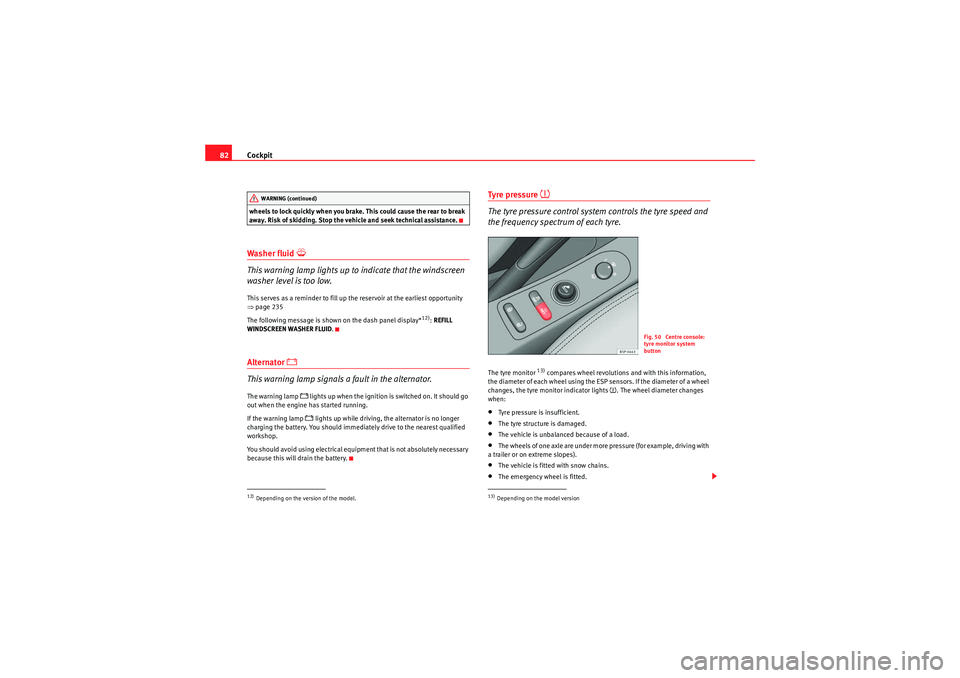
Fig. 50 Centre console:
tyre monitor system
button
altea_EN Seite 82 Mittwoch, 26. August 2009 6:00 18
Page 85 of 310

Cockpit83
Safety First
Operating instructions
Practical tips
Technical Data
•The wheel on one axle is changed.
Tyre pressure adjustment
Following the modification to tyre pressure or after changing one or more
wheels, the button ⇒page 82, fig. 50 must be kept pressed while the igni-
tion is on until an acoustic signal is heard and the warning lamp goes out.
If the wheels are under excessive load (for example, driving with a trailer or
heavy load), the tire pressure must be increased to the recommended value
for a full load (see the sticker on the inside of the fuel flap). If the tyre monitor
system button is pressed down, the new tyre pressures are confirmed.
The tyre pressure monitor indicator
lights up
If the tyre pressure of one or more wheels is much lower than the value set by
the driver, then the tyre control warning lamp lights up ⇒.
The tyre pressure monitor indicator flashes
If the tyre pressure indicator flashes, this indicates a fault. Go to the nearest
specialist workshop.
WARNING
•When the tyre pressure indicator lights, reduce speed immediately and
avoid any sudden manoeuvre or braking. Stop when possible, and check
the tyre pressure and status.•The driver is responsible for correct tyre pressure. For this reason, tyre
pressure must be regularly checked.•Under certain circumstances (for example, in a sports situation, in
winter conditions or on a dirt track) the tyre monitor indicator may light or
function incorrectly.Note
If the battery is disconnected, the yellow indicator
lights up after turning
the ignition on. This should turn off after a brief journey.
Brake system* / handbrake
The warning lamp lights up if the handbrake is applied, if the
brake fluid level falls too low or if there is a fault in the brake
system.
This warning lamp
lights up if
•If the handbrake is on.
If you drive faster than 6 km/h with the handbrake on, the following message
will appear on the dash panel display
14): HANDBRAKE ON. Also, an audible
warning is given.
•If the brake fluid level is too low ⇒page 239.
The dash panel displays the following message
14): STOP BRAKE FLUID
INSTRUCTION MANUAL .
•If there is a fault in the brake system.
The dash panel displays the following message
14): BRAKE SYSTEM FAULT
INSTRUCTIONS MANUAL .
This warning lamp can light up together with the anti-lock brake system
warning lamp.
WARNING
•Before opening the bonnet, read and observe the warnings on
⇒ page 226.•If the brake warning lamp does not go out, or if it lights up when
driving, the brake fluid level ⇒page 239, “Brake fluid” in the reservoir is
too low. Risk of accident. Stop the vehicle and do not drive on. Obtain tech-
nical assistance.
14)Depending on the version of the model.
altea_EN Seite 83 Mittwoch, 26. August 2009 6:00 18
Page 86 of 310

Cockpit
84•If the brake warning lamp
lights up together with the ABS warning
lamp
, the control function of the ABS could be out of action. This could
cause the rear wheels to lock quickly when you brake. This could cause the
rear to break away. Risk of skidding. Stop the vehicle and seek technical
assistance.
Bulb defect
The warning lamp lights up when a bulb in the vehicle's exte-
rior lighting is defective.The warning lamp
lights up when a bulb in the vehicle's exterior lighting
(e.g. left-hand main beam) is defective.
The dash panel displays the following m essage
15): LEFT FULL BEAM
FAULTY .
Engine oil pressure
This warning lamp indicates that the engine oil pressure is
too low.If this warning symbol starts to flash, and is accompanied by three audible
warnings , switch off the engine and check the oil level. If the oil level is too
low, add more engine oil ⇒page 229. The dash panel displays the following message
16):
STOP ENGINE OIL
PRESSURE INSTRUCTIONS MANUAL .
If the symbol flashes although the oil level is correct, do not drive on. The
engine must not even run at idle speed. Obtain technical assistance.
Cruise control system*
The warning lamp comes on when the cruise control system
is switched on.The warning lamp
lights up when the cruise control system is switched on.
Further notes on the cruise control system ⇒page 188.
Indicator for open doors or tailgate*
This indicator lights if one of the doors or the tailgate is open.The warning light
should go off when all the doors are closed correctly.
The system also works when the ignition is switched off. It should go off
approx. 15 seconds after the vehicle is locked.
Power steering system*
For vehicles with power steering, the level of steering assistance depends on
the vehicle's speed and on the steering angle.
15)Depending on the version of the model.WARNING (continued)
16)Depending on the version of the model.
altea_EN Seite 84 Mittwoch, 26. August 2009 6:00 18
Page 88 of 310

Cockpit
86Differential lock fault (EDL)*
EDL operates along with the ABS in vehicles equipped with an
Electronic Stabilisation Program (ESP)*A malfunction in the EDL is indicated by the ABS warning lamp
. Please
take the vehicle to a qualified workshop as soon as possible. For further infor-
mation on the EDL ⇒page 196, “Electronic differential lock (EDL)*”.
Traction control system (TCS)*
The traction control system prevents the driven wheels from
spinning when the vehicle is acceleratingThe warning lamp lights up when the ignition is switched on and should turn
out after about 2 seconds.
When the TCS is operating while driving, the warning lamp flashes. If the
system is deactivated or if there is any fault in the same, the warning lamp will
remain lit.
It will also come on if a fault should occur in the ABS because the TCS oper-
ates in conjunction with the ABS. For further information, see ⇒page 193,
“Brakes”.
If the TCS button is activated, the TCS function deactivates and the warning
lamp remains lit.
By pressing again, TCS function is reactivated and the warning lamp switched
off.
Operating the foot brake
The footbrake must be depressed when this warning lamp lights up. This is
necessary when the automatic gearbox* selector lever is moved out of the
positions P or N.Electronic immobiliser* “Safe”
This warning lamp flashes if an unauthorised key is used.Inside the key there is a chip that deactivates the electronic immobiliser auto-
matically when the key is inserted into the ignition. The immobiliser will be
activated again automatically as soon as you pull the key out of the ignition
lock.
The dash panel displays the following message
18): SAFE . The vehicle cannot
be used in that case ⇒ page 170.
The engine can, however, be started if the appropriate coded SEAT genuine
key is used.
Note
A perfect operation of the vehicle is ensured if genuine SEAT keys are used.18)Depending on the version of the model.
altea_EN Seite 86 Mittwoch, 26. August 2009 6:00 18
Page 97 of 310

Unlocking and locking95
Safety First
Operating instructions
Practical tips
Technical Data
Unlocking and lockingCe n t ra l l o cki n gBasic functions
The central locking system enables you to lock and unlock all
doors with just pushing on the key button.Description
Central locking can be activated by using any of the following options:•the key, by inserting it into the driver's door cylinder and rotating it manu-
ally,•the central locking button in the passenger compartment as an electronic
control ⇒page 98,•the radio frequency remote control , using the buttons on the key
⇒ page 102.
Various functions are available to improve the vehicle safety:
– Locking system “Safe”
– Selective unlocking system*
– Automatic speed-dependent locking and unlocking system*
– Self-locking system to prevent involuntary unlocking
– Emergency unlocking system
Unlocking the vehicle*
– Press button ⇒page 102, fig. 64 on remote control to unlock all the
doors and tailgate. Locking the vehicle*
–Press button ⇒
page 102, fig. 64 on the remote control to lock all
doors and the tailgate or turn the key in the door to lock all doors and the
tailgate.
WARNING
•Never leave children or disabled persons in the vehicle. In case of emer-
gency, they may not be able to leave the vehicle and not manage on their
own.•Never allow children to play in or around the vehicle. A locked vehicle
can be subjected to extremely high and low temperatures, depending on
the time of year, thus causing serious injuries/illness. It could even have
fatal consequences. Close and lock both the tailgate and all the other doors
when you are not using the vehicle.•Always take you car keys with you when you leave the vehicle. Misuse
of the keys, for example, by children, may result in serious damage and
accident.
−The engine may accidentally be started and be out of control.
− If the ignition is switched on, the electric equipment could be acti-
vated with risk of injury, for example, in the electric windows.
− The doors can be locked using the remote control key. This could
make assistance difficult in an emergency situation.
− Always take the key with you when you leave the vehicle.•Never remove the key from the ignition if the vehicle is in motion. The
steering lock could suddenly engage, and you would not be able to steer
the vehicle.
altea_EN Seite 95 Mittwoch, 26. August 2009 6:00 18
Page 98 of 310

Unlocking and locking
96
Note•While the driver's door is open, the vehicle can not be locked with the
remote control. This avoids the user from forgetting his key inside the vehicle.•If the driver's door is unlocked with the key shaft, only the driver's door is
unlocked, the rest of the doors remain locked. When the ignition is switched
on, the door "safe" deadlock is deactivated (although the doors remain
locked) and the central locking button is activated. See ⇒page 104.•If the central locking or anti-theft alarm are faulty, the driver's door
warning lamp remains lit for approx. 30 seconds after locking the vehicle.•For anti-theft security, only the driver's door is fitted with a lock cylinder.Safety system “Safe*”
The "safe" deadlock makes it more difficult to break into the
vehicle because the door release lever and the central locking
button are not active (depending upon country).Activating deadlock
– Press once the locking button on the remote control. or
–Turn the key once in the driver's door lock to lock. A warning lamp
in the driver door flashes to indicate the "safe" deadlock is
working. The warning lamp flashes for approx. two seconds at
short intervals and then more slowly. Deactivating deadlock when the vehicle is locked
–Press
twice the locking button on the remote control within
two seconds. The vehicle is locked without activating the dead-
lock. The driver's door warning lamp flashes for approx. two
seconds and then goes out. After approx. 30 seconds it starts
flashing again.
The doors can be unlocked and opened from the inside if the "safe" deadlock
has not been activated. You will have to pull the door release lever once.
When the "safe" deadlock is off, the antitheft alarm* ⇒page 104 remains
active. The vehicle interior monitoring system* and the anti-tow system are
deactivated*.
WARNING
Nobody should remain in the vehicle if the anti-tow system deadlock mech-
anism has been activated. It is not possible to open the doors from the
inside. Locked doors could make it more difficult to assist vehicle occu-
pants in the event of an accident. People could become trapped inside in an
emergency.Selective unlocking system*
T hi s sy ste m all o w s t o u nl o c k ei t h e r j u st t h e d r iv e r ' s d o o r o r a ll
the vehicle.Using the remote control, press the unlock button on the remote once. The
“Safe” system for all the vehicle is deactivated, only the driver's door is
unlocked and both the alarm and the light indicator are also turned off.
altea_EN Seite 96 Mittwoch, 26. August 2009 6:00 18