2010 PORSCHE CAYMAN Speed
[x] Cancel search: SpeedPage 232 of 284
230
Practical Tips, Emergency Service
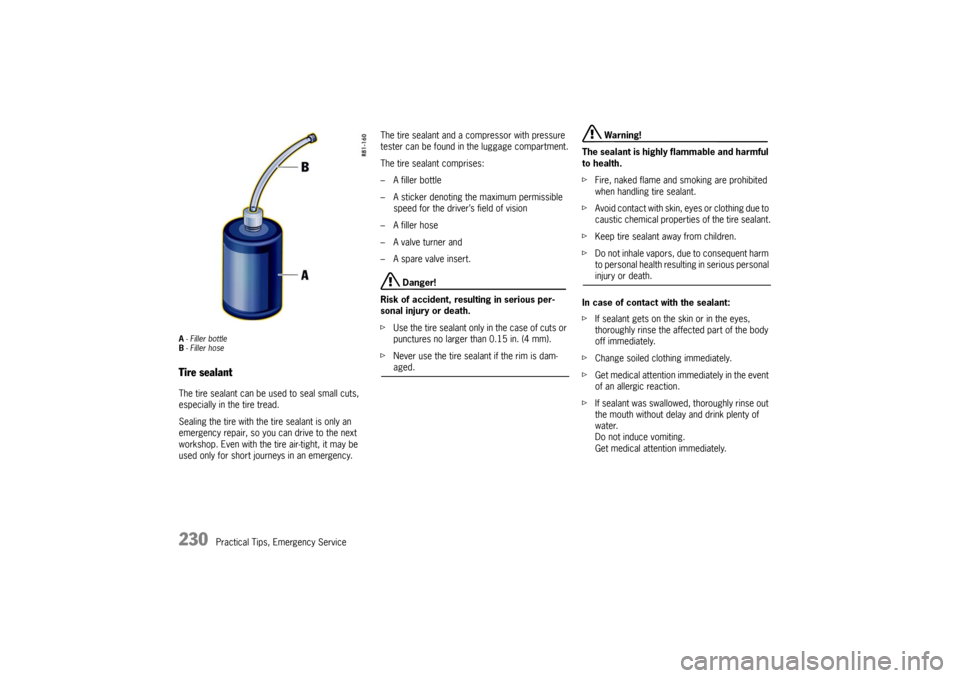
A- Filler bottle
B - Filler hoseTire sealantThe tire sealant can be used to seal small cuts,
especially in the tire tread.
Sealing the tire with the tire sealant is only an
emergency repair, so you can drive to the next
workshop. Even with the tire air-tight, it may be
used only for short journeys in an emergency. The tire sealant and a compressor with pressure
tester can be found in the luggage compartment.
The tire sealant comprises:
– A filler bottle
– A sticker denoting the maximum permissible
speed for the driver’s field of vision
– A filler hose
– A valve turner and
– A spare valve insert.
Danger!
Risk of accident , resulting in serious per-
sonal injury or death.
f Use the tire sealant only in the case of cuts or
punctures no larger than 0.15 in. (4 mm).
f Never use the tire sealant if the rim is dam-aged.
Warning!
The sealant is highly flammable and harmful
to health.
f Fire, naked flame and smoking are prohibited
when handling tire sealant.
f Avoid contact with skin, ey es or clothing due to
caustic chemical properties of the tire sealant.
f Keep tire sealant away from children.
f Do not inhale vapors, due to consequent harm
to personal health resulting in serious personal injury or death.
In case of contact with the sealant:
f If sealant gets on the skin or in the eyes,
thoroughly rinse the affect ed part of the body
off immediately.
f Change soiled clothing immediately.
f Get medical attention immediately in the event
of an allergic reaction.
f If sealant was swallowed, thoroughly rinse out
the mouth without delay an d drink plenty of
water.
Do not induce vomiting.
Get medical attention immediately.
Page 233 of 284

Practical Tips, Emergency Service
231
A- Filler bottle
B - Filler hose
C - Plug of the filler hose
D -Valve turner
E -Valve insert
F - Tire valveInserting sealant
1. Leave the object that caused the puncture in the tire.
2. Remove compressor, sealant and the enclosed sticker from the luggage compart-
ment.
3. Adhere the sticker in the driver's field of vision.
4. Shake filler bottle A. 5. Screw filler hose B
onto the filler bottle.
The filler bottle is now open.
6. Unscrew valve cap from tire valve F.
7. Remove valve insert E from the tire valve with
valve turner D.
Keep the valve insert in a clean and dry place.
8. Remove plug C of the filler hose B.
9. Push filler hose onto the tire valve.
10.Hold filler bottle higher than the level of the tire valve and press it together forcefully until the
bottle is completely emptied into the tire.
11.Pull filler hose off the tire valve.
12.Twist the valve insert fi rmly into the tire valve
using the valve turner.
13.Connect the compressor to the cigarette light- er and inflate the tire to the prescribed tire
pressure.
Please see the chapter “TIRE PRESSURE FOR
COLD TIRES (68 °F/ 20 °C)” on Page 267.
14.Screw valve cap onto the tire valve.
15.Check the tire pressure after driving for around 10 minutes.
If the tire pressure is less than 22 psi (1.5 bar),
do not continue driving.
If a value of more than 22 psi (1.5 bar) is indi-
cated, correct the pressure to the prescribed
value. 16.Please consult your authorized Porsche
dealer.
Note on operation for vehicles with
Tire Pressure Monitoring
17.On vehicles with Tire Pressure Monitoring, the settings on the on-board computer must be
updated after the wheel change.
Please see the chapter “TPM TIRE PRESSURE
MONITORING” on Page 151.
Care Instructions
After drying, any sealan t that emerges can be
peeled off like a film.
Warning!
Risk of accident , resulting in serious per-
sonal injury or death.
f Have the tire replaced by an authorized
Porsche dealer immediately.
f Avoid hard acceleration and high cornering
speeds.
f Do not exceed maximum speed of 50 mph
(80 km/h).
f Please always observe the safety and opera-
ting instructions, which can be found in the
separate operating instructions for the sealant and on the compressor.
Page 241 of 284

Practical Tips, Emergency Service
239
Battery The battery is located in the front luggage
compartment under a black plastic cover.
f Please see the chapter “EMERGENCY OPERA-
TION – PULLING OUT THE IGNITION KEY” on
Page 74.
f Please see the chapter “EMERGENCY UNLO-
CKING OF THE FRONT LUGGAGE COMPART-
MENT LID” on Page 238.
Warning!
Risk of short circuit, fire and damage to al-
ternator and electronic control units, result-
ing in serious personal injury or death.
f Observe all warning notes on the battery.
f Disconnect the negative terminal on the bat-
tery during all work on the electrical system.
f Do not lay tools or other metal objects on the
battery as they could cause a short circuit
across the battery terminal.
Hydrogen gas generated by the battery
could cause an explosion, resulting in
serious personal injury or death.
f Do not expose the battery to an open flame,
electrical spark or a lit cigarette.
f Do not wipe battery with a dry cloth.
Risk of serious personal injury or death and
damage to the fabric, metal or paint. f
Wear eye protection.
f Do not allow battery acid to come in contact
with your skin, eyes, fabric or painted
surfaces.
f If you get electrolyte, which is an acid, in your
eyes or on your skin, immediately rinse with
cold water for several minutes and call a doc-
tor.
f Spilled electrolyte must be rinsed off at once
with a solution of baki ng soda and water to
neutralize the acid.
Battery posts, terminals and related acces-
sories contain lead and lead compounds,
chemicals known to the State of California to
cause cancer and reproductive harm.
f Always protect your skin by washing thorough-
ly with soap and water.
Risk of explosion as a result of static charge,
resulting in serious personal injury or death.
f Do not wipe the battery with a dry cloth.
f Eliminate potential electrostatic charge by
touching the vehicle before touching the bat-
tery.
Charge state A well-charged battery prevents starting problems
and has a longer service life.
Traffic density, requirements regarding noise, ex-
haust gas and fuel consumption reduce the engine
speed and, hence, the alternator output.
However, the large number of electrical loads has
markedly increased the demand for electrical
power.
In order to avoid discharging the battery
unintentionally:
f Switch off unnecessary electrical loads in city
traffic, on short trips or in a line or traffic.
f Always remove the ignition key from the igni-
tion switch when leaving the car.
f Avoid frequent operation of the Porsche Com-
munication Management system and audio
system when the engine is not running.
f In the cold season in particular or if the vehicle
is used primarily for short journeys, it may be
necessary to recharge the battery from time to
time.
Page 248 of 284

246
Practical Tips, Emergency Service
Connect jumper cables in the following
sequence: Always observe the sequence below:
1. Connect the positive lead (red) to the
positive terminal of the discharged battery
first, then connect it to th e positive terminal of
the donor battery.
2. First connect the negative cable (black) to
the negative terminal of the donor battery, then
connect it to a suitable grounding point on the
vehicle with the discharged battery.
This grounding point must lie as far as possible
from the battery.
For example, a solid metal part or the engine
block are suitable grounding points.
If no suitable grounding points are to be found
on either vehicle, the negative cable must
carefully be connected directly to the negative
terminal of the battery.
If a suitable grounding point is to be found only
on the donor vehicle, the negative cable must
first be connected to the terminal of the
discharged battery, then to the grounding point
of the donor vehicle.
3. Run the engine of the donor car at a higher speed. 4. Start the engine.
An attempted start using jumper cables should
not last more than 15 seconds. Then allow a
waiting period of at least one minute.
f Note
Before disconnecting the jumper cables, elec-
trical loads such as the heated rear window
and the heating fan blower should be switched
on (the vehicle’s lights must not be switched
on). This reduces voltage peaks which may oc-
cur when disconnecting the jumper cables.
With the engine running, remove both jumper
cables in reverse order.
Page 268 of 284

266
Technical Data
Technical DataEngine data
CaymanCayman S
Type MA120C MA121C
Horizontally opposed engine, liquid cooled Horizontally opposed engine, liquid cooled
Number of cylinders 6 6
Bore 3.5 in./89 mm 3.8 in./97 mm
Stroke 3.1 in./77.5 mm 3.1 in./77.5 mm
Cubic capacity 176.5 cu. in./2893 cm
3 209.7 cu. in./3436 cm
3
Net-horsepower 265 hp/195 kW 320 hp/235 kW
at crankshaft speed 7200 rpm 7200 rpm
Net torque 221 ft. lb./300 Nm 273 ft. lb./370 Nm
at crankshaft speed 4400 - 6000 rpm 4750 rpm
Engine oil consumption up to 1.6 quarts/622 miles (1.5 liters/1000 km) up to 1.6 quarts/622 m iles (1.5 liters/1000 km)
Page 270 of 284

268
Technical Data
Tires, Rims, Tracks CaymanTiresRim Rim offset Track
Summer tires front205/55 ZR 17 91Y 7 J x 17 H2 55 mm 58.7 in./1490 mm
rear 235/50 ZR 17 96Y 8.5 J x 17 H2 40 mm 60.4 in./1534 mm
or front 235/40 ZR 18 91Y 8 J x 18 H2 57 mm 58.5 in./1486 mm
rear 265/40 ZR 18 101Y XL 9 J x 18 H2 43 mm 60.2 in./1528 mm
or front 235/35 ZR 19 87Y 8 J x 19 H2 57 mm 58.5 in./1486 mm
rear 265/35 ZR 19 94Y 9.5 J x 19 H2 46 mm 59.9 in./1522 mm
or front 235/35 ZR 19 87Y 8.5 J x 19 H2 55 mm 58.7 in./1490 mm
rear 265/35 ZR 19 94Y 10 J x 19 H2 42 mm 60.2 in./1530 mm
Snow tires front205/55 R 17 91V M+S 7 J x 17 H2 55 mm 58.7 in./1490 mm
rear * 235/50 R 17 96V M+S 8.5 J x 17 H2 40 mm 60.4 in./1534 mm
or front 235/40 R 18 91V M+S 8 J x 18 H2 57 mm 58.5 in./1486 mm
rear * 255/40 R 18 95V M+S 9 J x 18 H2 43 mm 60.2 in./1528 mm
The load capacity coefficient (e.g. ”91“) and maximum speed code letter (e.g. ”V“) are minimum requirements.
Page 271 of 284

Technical Data
269
fWhen changing tires or fitting new ones: Please see the chapter “WHEEL BOLTS” on Page 226.
Danger!
Installation of sizes not authorized by
Porsche may have a dangerous effect on
the driving stability and could result in
serious personal injury or death.
f Before mounting new tires, check with yourPorsche dealer about the current release status.
Cayman S Tires Rim Rim offset Track
Summer tires
front 235/40 ZR 18 91Y 8 J x 18 H2 57 mm 58.5 in./1486 mm
rear 265/40 ZR 18 101Y XL 9 J x 18 H2 43 mm 60.2 in./1528 mm
or front 235/35 ZR 19 87Y 8 J x 19 H2 57 mm 58.5 in./1486 mm
rear 265/35 ZR 19 94Y 9.5 J x 19 H2 46 mm 59.9 in./1522 mm
or front 235/35 ZR 19 87Y 8.5 J x 19 H2 55 mm 58.7 in./1490 mm
rear 265/35 ZR 19 94Y 10 J x 19 H2 42 mm 60.2 in./1530 mm
Snow tires front235/40 R 18 91V M+S 8 J x 18 H2 57 mm 58.5 in./1486 mm
rear * 255/40 R 18 95V M+S 9 J x 18 H2 43 mm 60.2 in./1528 mm
The load capacity coefficient (e.g. ”91“) and maximum sp eed code letter (e.g. ”Y“) are minimum requirements.
Tire and rim sizes Extensive tests are performed before specific tires and wheels are approved by Porsche. Your Porsche dealer has information
about approved tires and wheels and is happy to assist you. If aftermarket tires and/or wheels are installed which are not
approved by Porsche, the vehicle’s roadability and handling characteristics might be impaired. Since Porsche has no data on
such combinations, Porsche cannot st and behind the safety or durability of these aftermarket combinations.
Snow chains Can be mounted only on the rear wheels; maximum speed 30 mph/50 km/h. Use only Porsche authorized fine-link
cross-type or edge chains. Snow chain clearance can be guaranteed only with the tire + rim combination marked*
without spacers. Please see the chapter “SPACERS” on Page 233.
Page 272 of 284

270
Technical Data
Driving Performance* * At DIN empty weight and half load, without performance-inhibiting extra equipment.
Cayman Manual transmission Porsche Doppelkupplung
Top track speed
6-speed transmission 165 mph/265 km/h 163 mph/263 km/h
Acceleration 0 – 60 mph 5.5 seconds
5.4 seconds
Acceleration 0 – 60 mph with Sport+ 5.2 seconds
Acceleration 0 – 100 km/h (6 2 mph) 5.8 seconds5.7 seconds
Acceleration 0 – 100 km/h (62 mph) with Sport+ 5.5 seconds
Cayman S Manual transmission Porsche Doppelkupplung
Top track speed 172 mph/277 km/h 171 mph/275 km/h
Acceleration 0 – 60 mph 4.9 seconds4.8 seconds
Acceleration 0 – 60 mph with Sport+ 4.6 seconds
Acceleration 0 – 100 km/h (6 2 mph) 5.2 seconds5.1 seconds
Acceleration 0 – 100 km/h (62 mph) with Sport+ 4.9 seconds