2010 PORSCHE CAYMAN Speed
[x] Cancel search: SpeedPage 219 of 284

Practical Tips, Emergency Service
217
Danger!
Driving on worn tires can result in loss of con-
trol of the vehicle an d could cause serious
personal injuries or death.
f Do not drive with worn tires or tires showing
cuts or bruises as they may lead to sudden
deflation and loss of control which could cause
severe personal injury.
f Specialized high performance tires on high
performance sports cars exhibit more wear
than those on a family sedan, or even a high
performance sedan.
Therefore, it is important to check your tire
pressure and condition at least every two weeks.
If you notice that tires are wearing unevenly, con-
sult your Porsche dealer.
Uneven wear may not always be due to improper
wheel alignment. It can be the result of individual
driving habits such as cornering at high speeds. If
the tire pressure is not checked and adjusted
regularly, abnormal tire wear can also occur.
Tire care f Avoid damaging tires and wheel rims.
f If you must drive over a curb or other obstacle,
drive slowly and at an obtuse angle.
f Check tires for uneven wear and damage
before driving off.
f Remove imbedded material.
f Replace worn or damaged tires immediately.
f Keep oil, fuel, brake fluid, etc. away from tires.
f Replace missing valve stem caps.
f Keep tires inflated correctly.
f Wash tires when washing the vehicle. Also
clean inner side of wheels.
f Do not use abrasive cleaners when washing
the wheels.
f Check wheel rims for corrosion.
f Remove road salt, if driving in winter.
Tire damage, puncture High-pressure cleaning units can damage the
tires.
f Please see the chapter “HIGH-PRESSURE
CLEANING UNITS, STEAM CLEANERS” on
Page 203.
f Check tires for imbedded material, cuts, punc-
tures, cracks and bulges (side wall) before driv-
ing off.
In case of tire damage, where it is uncertain wheth-
er there is a break in the ply with all its conse-
quences or tire damage caused by thermal or me-
chanical overloading due to loss of pressure or
any other prior damage, we recommend that the
tire be replaced for safety reasons.
If one faulty tire is replaced it should be noted that
the difference in tread depth on one axle must not
exceed 30%.
Handling inconsistencies may result.
f Perform a visual inspection if necessary.
Page 220 of 284

218
Practical Tips, Emergency Service
Danger!
Risk of serious personal injury or death.
Driving the vehicle with low tire pressure
increases risk of a tire failure and resulting
loss of control. Furthermore, low tire pres-
sure increases rate of wear of the affected
tires.
f Check tires – including sidewalls – regularly for
foreign bodies, nicks, cuts, cracks and bulges.
f After driving off road, examine tires for signs
of damage such as cuts, tears, bulges or for-
eign objects stuck in the tread. Replace a dam-
aged tire if necessary.
f Cross curb edges slowly and at right angles if
possible.
Avoid driving over steep or sharp curbs.
f In cases of doubt, have the wheel (particularly
the inner side) checked by an authorized Porsche dealer.
Tire replacements If in doubt, contact your Porsche dealer.
Use only tire makes and types approved by
Porsche.
If you do not use a Porsche recommended
replacement tire, make sure that you
purchase your new tires from a reputable tire
dealer and that the dealer complies with all
manufacturers warnings for those tires.
Only tires with the same make and with the
same specification code (e.g. “N0”, “N1”...)
can be mounted.
Before mounting new tires, check with your
Porsche dealer about the current release
status.
Use tires with “ZR” quality standards. There
are currently no standards concerning tire
strength at speeds above 150 mph (240 km/h).
Tires should be replaced no less than on one axle
at the time.
Only tires of the same make and type must be
used. Mixed tires are not permissible.
Initially, new tires do not have their full traction.
You should therefore drive at moderate speeds
during the first 60 - 120 miles (100 - 200 km). If new tires are installed only on one axle, a notice-
able change in handling occurs due to the different
tread depth of the other tires.
This happens especially if only rear tires are re-
placed. However, this condition disappears as the
new tires are broken in.
f
Please adjust your driving style accordingly.
Installation of new tires sh ould only be done by a
qualified tire technician.
Valves
Rubber valve stems must be replaced every time
a tire is replaced.
For metal valves, the installation and replacement
instructions must be observed.
f Use only genuine Porsche metal valves.
f Protect the valve inserts against soiling with
valve caps.
Soiled valve inserts can cause a gradual loss
of air.
f Use only plastic valve caps.
Page 221 of 284

Practical Tips, Emergency Service
219
Parking at the curb
Warning!
Hard impacts against curbs (or traffic
islands) are dangerous and may cause hid-
den tire damage which is not noticeable until
later. Such damage can result in accidents at
high speeds causing serious personal injury
or death.
Depending on the force of impact, the edge
of the rim can also be damaged.
f If you are in doubt, have the wheel checked by
an expert, particularly if you suspect damage
on the inside.
f If you must drive over a curb or other obstacle,
drive slowly and at an obtuse angle. Exercise care when parking along curbs.
Wheel alignment, wheel balancing As a precaution, have wheels with summer tires
balanced in the spring, and those with mud and
snow tires before winter.
Unbalanced wheels may affect car handling and
tire life.
Only the specified weight s may be used for wheel
balancing.
Self-adhesive weights must not come into contact
with cleaning agents, since they could drop off.
Uneven tread wear indicates wheel imbalance. In
this event, the vehicle should be checked at an au-
thorized Porsche dealer.
Warning!
If, during a trip, uneven running or vibrations
occur that could be caused by damage to
tires or the car, the speed must be reduced
immediately, but without braking sharply.
If you continue your trip without having the
cause of the fault reme died, you might lose
control of your vehicle which could cause se-
rious personal injury or death.
f Stop the vehicle and check the tires.
f If no cause for the fault can be found, drive
carefully to the nearest authorized Porsche dealer.
Wheels with Tire Pressure Monitoring
(TPM) sensorsBefore changing wheels, make sure that the
wheels are compatible with your vehicle's TPM.
f Check this with your authorized Porsche
dealer.Removing and storing tires fAfter changing, adjust tire pressure and torque
wheel bolts diagonally to 94 ftlb (130 Nm).
Tires must always remain on the same side of
the vehicle.
When wheels are removed, the direction of
rotation and position of each wheel should be
marked.
Example
FR (front right), FL, RR and RL.
Wheels must always be fitted in accordance with
their marking.
The perception that tire durability and perform-
ance are immune to the effects of storage and
age is unfounded.
Chemical additives, whic h make the rubber elas-
tic, lose their effectivene ss in the course of time
and the rubber becomes brittle and cracks.
Therefore, the tires should be inspected from
time to time.
Page 222 of 284

220
Practical Tips, Emergency Service
Note
Under no circumstances sh
ould tires older than 6
years be used on your Porsche.
The age of the tire can be obtained from the “DOT”
code number. If, for example, the last four num-
bers read 1208, then the ti re was produced in the
12th week of 2008.
f Store tires in a cool and dry place.
Snow tires For a better grip on snow and ice, use radial M+S
tires with studs.
Check with your local Motor Vehicle Bureau for
possible restrictions.
Danger!
Risk of loss of control and damage to the
vehicle as well as seri ous personal injury or
death.
The standard tires prof ile and rubber mixture
are optimized for wet and dry driving condi-
tions, and may not prove favorable for snow
conditions.
f Therefore install M+S tires before driving in such conditions. Before mounting snow tires, consult with
your Porsche dealer. He has the technical
information necessary to advise you on
wheel and tire compatibility.
Snow tires should have the same load capacity as
original equipment tires and should be mounted on
all four wheels.
Snow tires with studs should be run at moderate
speeds when new in order to give the studs time
to settle.
Danger!
Tires with badly worn treads and studs are
very dangerous and could cause accidents
resulting in serious personal injuries or
death.
f Make sure they are replaced immediately.
f Do not drive a vehicle equipped with snow tires
at prolonged high speed.
Snow tires do not have the same degree of
traction on dry, wet or snowfree roads as a
normal tire.
Furthermore, snow tires wear rapidly under
these conditions.
Comply with all state and local laws
governing snow tire and tread depth
requirements.
Danger!
Risk of accident and se rious personal injury
or death due to excessive speed.
f Always check the maximum speed rating on
the tire sidewall on any tire on the vehicle.
f Never exceed the maximum speed rating of the tires.
f Fit winter tires to both axles well before the
cold season begins.
Your authorized Porsche dealer will be pleased
to advise you.
Maintenance note
We recommend fitting snow tires on the vehicle at
temperatures below 45 °F (7 °C) since the driving
performance of summer tires is reduced at low
temperatures. Summer tires may be permanently
damaged at extremely low temperatures.
Winter tires lose their traction capability when their
tread depth falls below 5/32 in. (4 mm).
Page 223 of 284

Practical Tips, Emergency Service
221
Snow chains
Caution!
Risk of damage to body, axle or brake com-
ponents.
f Fit snow chains only to the rear wheels, and
only with the tire/rim combination listed in the
Technical Data.
To ensure adequate clearance between chain
and body, Porsche recommends only the use
of fine-link chains such as those approved by
Porsche.
f Follow instructions issued by the supplier of the chains.
Different states and countries have varying statu-
tory requirements regarding maximum speed.
Check with local authorities for possible restric-
tions.
f Remove chains as soon as the roads are free
of ice and snow. Fitting snow chains
The use of snow chains is not permitted when
5 mm spacers are mounted.
Caution!
Risk of damage to the wheel housings if the
5 mm spacers are not removed before fitting
snow chains.
f To permit the fitting of snow chains, have the 5 mm spacers removed on all 4 wheels.
f To fit/remove the spacers:
Please consult an authorized Porsche dealer.
f Please see the chapter “SPACERS” on
Page 233.
Tire designations Due to new speed and load ratings for radial tires,
new designations have come into force for snow
tires for your Porsche.
The designation to be used for ZR tires is e.g.,
265/40 ZR 18 (Z = code letter for radial tires for
speeds above 150 mph / 240 km/h).
Page 224 of 284

222
Practical Tips, Emergency Service
Example of InscriptionInscription on radial tireATire size
Example: P 295/30 ZR 19 100 Y
–P - The tire is designed for Passenger vehicle.
This information is not included on all tires.
– 295 - Indication of tire width in mm
– 30 - Indication of tire height to tire width ratio
in percent –
ZR - code letter for radial tires for speeds
above 150 mph / 240 km/h
There are currently no standards concerning
tire strength at speeds above 150 mph
(240 km/h).
– R - Belt type code letter for radial
– 19 - Indication of rim diameter in inches
– 100 - Load capacity coefficient
– Y - Speed code letter
– XL (Extra Load) - Tire with increased load rat-
ing
B TIN (Tire Identification Number)
Example: DOT xx xx xxxx xxxx
–DOT
The DOT symbol indicates that the tires com-
ply with the requirements of the US Depart-
ment of Transportation and provides informa-
tion about:
– first two-digit code means manufacturer’s iden- tification mark.
– second two-digit code means tire size.
– third four-digit code means tire type code.
– fourth four-digit code means date of manufac- ture.
If, for example, the last four numbers read
0208, the tire was produced in the 2nd week
of 2008.
C Tire ply composition and material
The number of layers in the tread and sidewalls
and their material composition.
D Maximum permissible inflation pressure
The maximum permissible cold inflation pressure
to which a tire can be inflated.
f Do not exceed the permissible inflation
pressure.
Page 225 of 284
Practical Tips, Emergency Service
223
E Maximum Load rating
The maximum load in kilograms and pounds can
be carried by the tire. If you replace tires always
use a tire that has the same maximum load rating
as the factory installed tire.
FRadial
The identification indicates if the tire has radial
structure.
G Term of tubeless or tube tire
Identification for tubeless tires.Speed code letterThe speed code letter indicates the maximum per-
missible speed for the tire.
This code letter is shown on the tire sidewall.Tip on driving
Tires with a maximum speed rating that is lower
than the specified maximum vehicle speed may be
mounted only if they bear an M+S identification on
the tire sidewall.
f
Please note that in addition to the winter tires,
all-season and all-terrain tires are also subject
to speed limits and bear this identification.
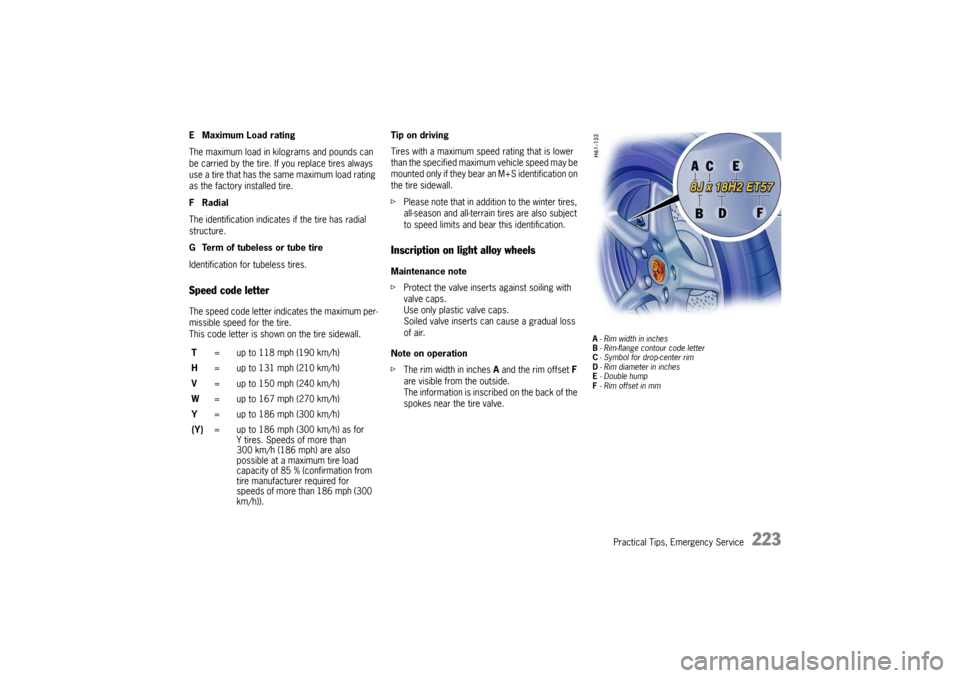
Inscription on light alloy wheelsMaintenance note
fProtect the valve inserts against soiling with
valve caps.
Use only plastic valve caps.
Soiled valve inserts can cause a gradual loss
of air.
Note on operation
f The rim width in inches A and the rim offset F
are visible from the outside.
The information is inscri bed on the back of the
spokes near the tire valve.
A - Rim width in inches
B - Rim-flange contour code letter
C - Symbol for drop-center rim
D - Rim diameter in inches
E -Double hump
F - Rim offset in mm
T = up to 118 mph (190 km/h)
H = up to 131 mph (210 km/h)
V = up to 150 mph (240 km/h)
W = up to 167 mph (270 km/h)
Y = up to 186 mph (300 km/h)
(Y) = up to 186 mph (300 km/h) as for
Y tires. Speeds of more than
300 km/h (186 mph) are also
possible at a maximum tire load
capacity of 85 % (confirmation from
tire manufacturer required for
speeds of more than 186 mph (300
km/h)).
Page 231 of 284

Practical Tips, Emergency Service
229
Flat Tire
Warning!
Failure to follow these instructions may result
in serious personal injury to you or to by-
standers.
f If you have a flat tire, move a safe distance off
the road. Turn the emergency flasher on and
use other warning devices to alert other motor-
ists. Set the parking brake.
f Do not park your vehicl e where it may contact
dry grass, brush or other flammable materials.
The hot parts of the exhaust system could set
such materials on fire, thereby causing both
property damage and serious personal injury or death.
A tire sealant and compressor with pressure
tester are located in the luggage compartment.
f Please observe the safety and operating in-
structions on the special sealant bottle with a
special Porsche part number and on the com-
pressor – these are essential. Important note
Sealing the tire with the tire repair kit is only
an emergency repair. Even with the tire air-
tight, it may be used only for short journeys
in an emergency.
The maximum permitted speed is 50 mph
(80 km/h).
f
Do not use commercially available sealant or
tire inflating bottles.
Use only the tire sealant located in the luggage
compartment.
Warning!
Risk of accident, resulting in serious
personal injury or death.
f Have tires replaced by a specialist workshop
as soon as possible.
f Avoid hard acceleration and high cornering speeds.