2010 PONTIAC VIBE window
[x] Cancel search: windowPage 45 of 318

The right front passenger frontal
airbag is in the instrument panel on
the passenger’s side.
If the vehicle has seat-mounted side
impact airbags for the driver and right
front passenger, they are in the side
of the seatbacks closest to the door.If the vehicle has roof-rail airbags for
the driver, right front passenger, and
second row outboard passengers,
they are in the ceiling above the side
windows.
{CAUTION
If something is between an
occupant and an airbag, the airbag
might not inflate properly or it might
force the object into that person
causing severe injury or even
death. The path of an inflating
airbag must be kept clear. Do not
put anything between an occupant
and an airbag, and do not attach or
put anything on the steering wheel
hub or on or near any other airbag
covering.
(Continued)
CAUTION (Continued)
Do not use seat accessories
that block the inflation path of a
seat-mounted side impact airbag.
Never secure anything to the roof
of a vehicle with roof-rail airbags
by routing a rope or tie down
through any door or window
opening. If you do, the path of
an inflating roof-rail airbag will
be blocked.
Driver Side shown,
Passenger Side similar
Seats and Restraints 2-25
Page 47 of 318

The vehicle has seat-mounted
side impact and roof-rail airbags.
SeeAirbag System on page 2-23 .
Seat-mounted side impact and
roof-rail airbags are intended to
inflate in moderate to severe side
crashes. Seat-mounted side impact
and roof-rail airbags will inflate if the
crash severity is above the system’s
designed threshold level. The vehicle
has sensors which detect side
impacts. These sensors signal the
appropriate side impact airbag to
inflate. The threshold level can vary
with specific vehicle design.
Seat-mounted side impact and
roof-rail airbags are not intended to
inflate in frontal impacts, near-frontal
impacts, rollovers, or rear impacts.
A seat-mounted side impact airbag is intended to deploy on the side of
the vehicle that is struck. A roof-rail
airbag is intended to deploy on the
side of the vehicle that is struck. It is
possible that, in a crash involving the
rear side of your vehicle, that only the
roof-mounted airbag will deploy.
In any particular crash, no one
can say whether an airbag should
have inflated simply because of
the damage to a vehicle or because
of what the repair costs were.
For frontal airbags, inflation is
determined by what the vehicle
hits, the angle of the impact, and
how quickly the vehicle slows down.
For seat-mounted side impact and
roof-rail airbags, deployment is
determined by the location and
severity of the side impact.What Makes an Airbag
Inate?
In a deployment event, the sensing
system sends an electrical signal
triggering a release of gas from the
inflator. Gas from the inflator fills the
airbag causing the bag to break out
of the cover and deploy. The inflator,
the airbag, and related hardware are
all part of the airbag module.
Frontal airbag modules are located
inside the steering wheel and
instrument panel. For vehicles with
seat-mounted side impact airbags,
there are airbag modules in the side
of the front seatbacks closest to the
door. For vehicles with roof-rail
airbags, there are airbag modules in
the ceiling of the vehicle, near the
side windows that have occupant
seating positions.
Seats and Restraints 2-27
Page 48 of 318

How Does an Airbag
Restrain?
In moderate to severe frontal or
near frontal collisions, even belted
occupants can contact the steering
wheel or the instrument panel.
In moderate to severe side collisions,
even belted occupants can contact
the inside of the vehicle.
Airbags supplement the protection
provided by safety belts. Frontal
airbags distribute the force of the
impact more evenly over the
occupant’s upper body, stopping
the occupant more gradually.
Seat-mounted side impact and
roof-rail airbags distribute the force
of the impact more evenly over the
occupant’s upper body.
But airbags would not help in many
types of collisions, primarily because
the occupant’s motion is not toward
those airbags. SeeWhen Should an
Airbag Inate? on page 2-26 for
more information.
Airbags should never be regarded
as anything more than a supplement
to safety belts.
What Will You See After
an Airbag Inates?
After the frontal airbags and
seat-mounted side impact airbags
inflate, they quickly deflate, so
quickly that some people may not
even realize an airbag inflated.
Roof-rail airbags may still be at least
partially inflated for some time after
they deploy. Some components of
the airbag module may be hot for
several minutes. For location of the
airbag modules, see What Makes
an Airbag Inate? on page 2-27 .
The parts of the airbag that come
into contact with you may be warm,
but not too hot to touch. There may
be some smoke and dust coming
from the vents in the deflated
airbags. Airbag inflation does not
prevent the driver from seeing out
of the windshield or being able to
steer the vehicle, nor does it prevent
people from leaving the vehicle.
{CAUTION
When an airbag inflates, there
may be dust in the air. This dust
could cause breathing problems
for people with a history of asthma
or other breathing trouble.
To avoid this, everyone in the
vehicle should get out as soon
as it is safe to do so. If you have
breathing problems but cannot get
out of the vehicle after an airbag
inflates, then get fresh air by
opening a window or a door. If you
experience breathing problems
following an airbag deployment,
you should seek medical attention.
The vehicle has a feature that may
automatically unlock the doors, turn
the interior lamps on, and turn the
hazard warning flashers on when
the airbags inflate. You can lock
the doors, turn the interior lamps off,
and turn the hazard warning flashers
off by using the controls for those
features.
2-28 Seats and Restraints
Page 62 of 318
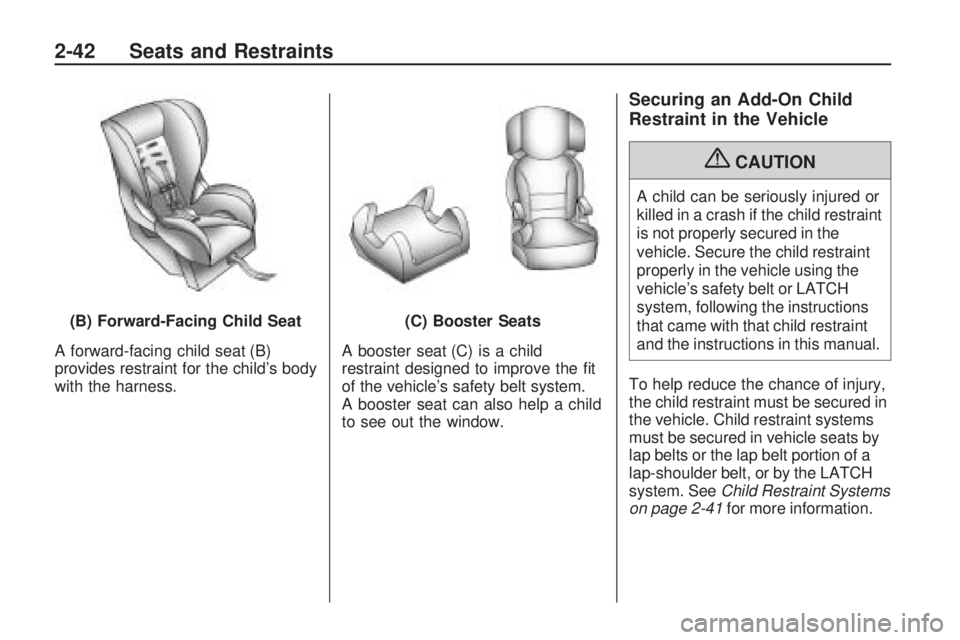
A forward-facing child seat (B)
provides restraint for the child’s body
with the harness.A booster seat (C) is a child
restraint designed to improve the fit
of the vehicle’s safety belt system.
A booster seat can also help a child
to see out the window.
Securing an Add-On Child
Restraint in the Vehicle
{CAUTION
A child can be seriously injured or
killed in a crash if the child restraint
is not properly secured in the
vehicle. Secure the child restraint
properly in the vehicle using the
vehicle’s safety belt or LATCH
system, following the instructions
that came with that child restraint
and the instructions in this manual.
To help reduce the chance of injury,
the child restraint must be secured in
the vehicle. Child restraint systems
must be secured in vehicle seats by
lap belts or the lap belt portion of a
lap-shoulder belt, or by the LATCH
system. See Child Restraint Systems
on page 2-41 for more information.
(B) Forward-Facing Child Seat
(C) Booster Seats
2-42 Seats and Restraints
Page 83 of 318

Instruments and
Controls
Instrument Panel OverviewInstrument Panel Overview.....4-2
ControlsSteering Wheel Adjustment.....4-4
Steering Wheel Controls .........4-4
Horn ...................................
.4-5
Windshield Wiper/Washer .......4-5
Rear Window Wiper/Washer . . . .4-6
Power Outlets (Accessory Power Outlets) ....................
.4-6
Power Outlets (115 Volt Alternating Current) .............
.4-7
Cigarette Lighter ..................
.4-8
Ashtrays .............................
.4-8
Warning Lights, Gages, and
Indicators
Warning Lights, Gages, and
Indicators ..........................
.4-8
Instrument Cluster ................
.4-9
Speedometer .....................
.4-10
Odometer ..........................
.4-10
Trip Odometer ....................
.4-10
Tachometer .......................
.4-10
Fuel Gage .........................
.4-10
Engine Coolant Temperature Gage .............4-11
Safety Belt Reminders ..........4-11
Airbag Readiness Light .........4-12
Passenger Airbag Status Indicator ..........................
.4-13
Charging System Light .........4-14
Malfunction Indicator Lamp .................
.4-14
Brake System Warning Light ...............................
.4-17
Antilock Brake System (ABS) Warning Light ...........4-17
Service All-Wheel Drive Light ...............................
.4-18Speed Sensitive Power
Steering (SSPS) Warning
Light ...............................
.4-18
StabiliTrak®Indicator Light . . . .4-18
Traction Control System (TCS) Warning Light ...........4-19
Tire Pressure Light .............
.4-19
Engine Oil Pressure Light .....4-19
Low Fuel Warning Light ........4-20
Security Light .....................
.4-20
High-Beam on Light .............4-20
Fog Lamp Light ..................
.4-20
Lamps on Reminder .............4-20
Taillamp Indicator Light .........4-21
Low Washer Fluid Warning Light ...............................
.4-21
Cruise Control Light .............4-21
Door Ajar Light ...................
.4-21
Vehicle PersonalizationVehicle Personalization .........4-21
OnStar SystemOnStar®System.................
.4-23
Instruments and Controls 4-1
Page 88 of 318

Rear Window
Wiper/Washer
Z
Rear Wiper:Turn the end of
the lever to low or high, to turn
on the rear window wiper.
y(Low): Slow wipes.
x(High): Fast wipes.
=(Rear Washer): Turn the end of
the lever up or down as far as it will
go, to spray washer fluid on the rear
window. The knob automatically
returns from these positions after
it is released.
The windshield washer reservoir is
used for the windshield and the rear
window. Check the fluid level in the
reservoir if either washer is not
working. See Washer Fluid on
page 9-24.
{CAUTION
In freezing weather, do not use
your washer until the windshield
is warmed. Otherwise the washer
fluid can form ice on the
windshield, blocking your vision.
Power Outlets
(Accessory Power
Outlets)
Accessory power outlets can be
used to plug in electrical equipment,
such as a cellular phone.
The vehicle has an accessory
power outlet on the center floor
console below the shift lever.
To use the outlet, the ignition
must be in ON/RUN or ACC/
ACCESSORY. Pull down the
small cover to access the outlet.
Notice: Leaving electrical
equipment on for extended
periods will drain the battery. Always turn off electrical
equipment when not in use and
do not plug in equipment that
exceeds the maximum amperage
rating.
This circuit is protected by a fuse
and has a maximum current level.
Do not use equipment exceeding
the maximum amperage rating.
Certain power accessory plugs
may not be compatible to the power
accessory outlet and could result
in a blown vehicle or adapter fuse.
See your dealer/retailer for additional
information on the power accessory
plugs.
Notice:
Adding any electrical
equipment to the vehicle can
damage it or keep other
components from working as
they should. The repairs would
not be covered by the vehicle
warranty. Do not use equipment
exceeding maximum amperage
rating of 20 amperes. Check
with your dealer/retailer before
adding electrical equipment.
4-6 Instruments and Controls
Page 129 of 318

Climate Controls
Climate Control SystemsClimate Control Systems........7-1
Air VentsAir Vents............................
.7-4
MaintenancePassenger Compartment
Air Filter ............................
.7-4
Climate Control Systems
The heating, cooling, and ventilation for the vehicle can be controlled with
this system.
A. Air Delivery Mode Control
B. Fan Control
C. Temperature Control D. Recirculation
E. Rear Window Defogger
F. Air Conditioning
Climate Controls 7-1
Page 130 of 318

Fan Control
9(Fan):Turn the center knob
toward 4 to turn the system on or
increase fan speed.
If the airflow seems low when the
fan is at the highest setting, the
passenger compartment air filter
may need to be replaced. For
more information, see Passenger
Compartment Air Filter on page 7-4
and Scheduled Maintenance on
page 10-3.
Temperature Control
Turn the right knob clockwise or
counterclockwise to increase or
decrease the temperature inside the
vehicle. Air Delivery Mode Control
Turn the left knob to select from the
following modes:
H(Vent):
Air is directed to the
upper instrument panel outlets.
)(Bi-Level): Air is directed to the
upper instrument panel outlets
and the floor outlets.
6(Floor): Air is directed to the
floor and side window outlets.
-(Defog): Air is directed between
the windshield, side windows,
instrument panel outlets and the floor
outlets. Use the defog mode to clear the
inside of the windshield of fog
or moisture and to warm the
passengers. The air conditioning
compressor runs automatically in this
setting without pressing A/C, unless
the outside temperature is at or
below 32°F (0°C).
1(Defrost):
Air is directed to the
windshield, instrument panel
outlets and the side windows.
Use the defrost mode to remove
fog or frost from the outside of the
windshield more quickly. The air
conditioning compressor runs
automatically in this setting without
pressing A/C, unless the outside
temperature is at or below
32°F (0°C).
Do not drive the vehicle until all the
windows are clear.
7-2 Climate Controls