Page 493 of 594
7-4 Vehicle care and maintenance
7Engine hood
N00937500435
To openUse the engine hood release lever (located under the instrument
panel near the driver’s door) to unlock the engine hood.
Pull the lever toward you to release the engine hood latch.
CAUTION
!�
To avoid the risk of being burned, do not touch the
air outlets (A) and air scoop (B) on the engine hood
when the engine compartment is hot (when the
engine is running or immediately after the vehicle
has been driven).
WA R N I N G
!�
Never use the release lever to unlatch the engine
hood while the vehicle is in motion.
�
Do not drive your vehicle unless the engine hood is
locked.
BK0105501US.book 4 ページ 2009年8月10日 月曜日 午前10時32分
Page 496 of 594
Vehicle care and maintenance
7-7
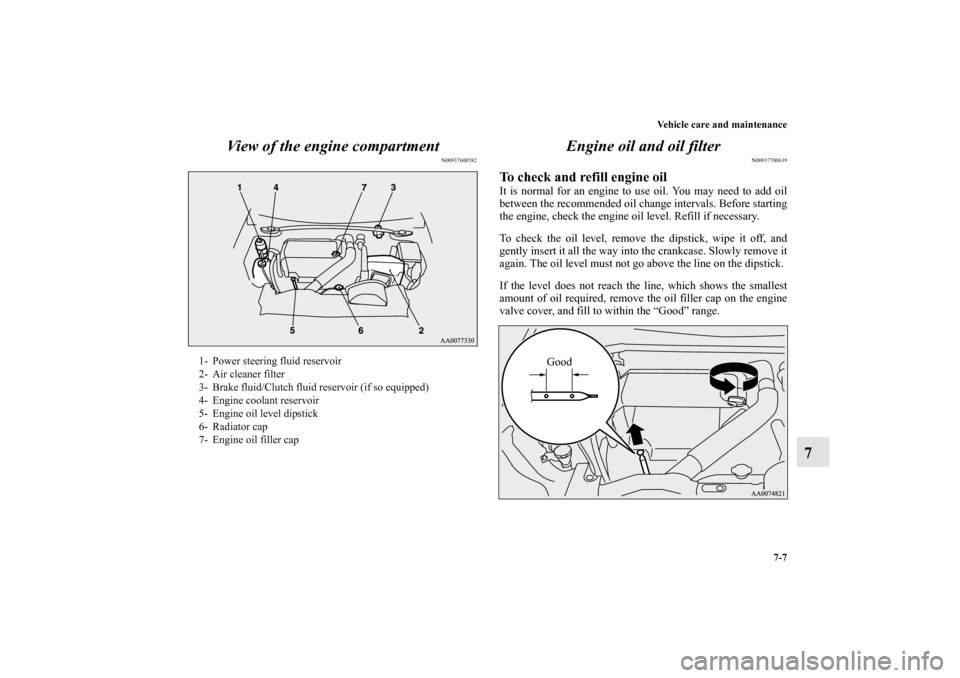
7 View of the engine compartment
N00937600582
Engine oil and oil filter
N00937700639
To check and refill engine oil It is normal for an engine to use oil. You may need to add oil
between the recommended oil change intervals. Before starting
the engine, check the engine oil level. Refill if necessary.
To check the oil level, remove the dipstick, wipe it off, and
gently insert it all the way into the crankcase. Slowly remove it
again. The oil level must not go above the line on the dipstick.
If the level does not reach the line, which shows the smallest
amount of oil required, remove the oil filler cap on the engine
valve cover, and fill to within the “Good” range.
1- Power steering fluid reservoir
2- Air cleaner filter
3- Brake fluid/Clutch fluid reservoir (if so equipped)
4- Engine coolant reservoir
5- Engine oil level dipstick
6- Radiator cap
7- Engine oil filler cap
Good
BK0105501US.book 7 ページ 2009年8月10日 月曜日 午前10時32分
Page 500 of 594

Vehicle care and maintenance
7-11
7
To add coolant Use Mitsubishi Genuine Coolant or an equivalent.
Mitsubishi Genuine Coolant provides excellent protection
against corrosion and rust formation on all metals, including
aluminum, and prevents blockages in the radiator, heater, cyl-
inder head, engine block, etc.
If you need to add coolant often, or if the level in the reserve
tank does not drop when the engine cools, the cooling system
should be pressure-tested for leaks. Take your vehicle to an
authorized Mitsubishi Motors dealer or a repair facility of your
choice for testing.
Radiator capThe radiator cap must be tight sealed to prevent losing coolant
which may result in engine damage. Only use a Genuine Mit-
subishi Parts radiator cap, or an approved equivalent.Points to remember �
Do not overfill the reserve tank.
�
Your vehicle uses a special radiator cap that stays sealed
and lets the coolant flow from the reserve tank back to the
radiator when the engine cools down. If you need to
change the cap, use the exact same kind.
�
Check the coolant freeze point in the radiator with the
proper gauge, and only when it is safe. If you add anti-
freeze, the contents of the reserve tank must be protected
against freezing.
�
Keep the front of the radiator and condenser clean.
CAUTION
!�
Do not use alcohol or methanol antifreeze or any
engine coolants that contain them. Using the wrong
antifreeze can corrode aluminum parts.
�
When you need to add coolant to the reserve tank,
use at least a 50 % concentration of ethylene-glycol
antifreeze in water. Do not overfill. Use a higher con-
centration (not over 60 %) when the outside temper-
ature is -31 °F (-35 °C) or lower. When the engine is
working very hard (for example, during mountain
driving and/or when the outside temperature is
high), use a 50 % concentration. You can check the
concentration level with a gauge from an automotive
supply store, or your authorized Mitsubishi Motors
dealer or service station can check it for you. Use
only high quality ethylene-glycol antifreeze coolant
that is made to prevent corrosion of all cooling sys-
tem metals.
�
Do not top off the tank with plain water only. Water
by itself boils at a lower temperature and does not
stop rust or freezing. If the water freezes, it will
damage your cooling system. Do not use tapwater. It
can cause corrosion and rust. WA R N I N G
!�
Wait for the engine to cool down before opening the
radiator cap. Otherwise hot steam or boiling coolant
could spray up from the radiator and scald you. CAUTION
!
BK0105501US.book 11 ページ 2009年8月10日 月曜日 午前10時32分
Page 501 of 594
7-12 Vehicle care and maintenance
7
�
If the temperature of the engine coolant does not rise after
the engine is warmed-up, take your vehicle to an autho-
rized Mitsubishi Motors dealer or a repair facility of your
choice to have the thermostat checked, and replaced if
necessary.
Air cleaner filter
N00937900309
The air cleaner filter will get dirty and dusty from use and not
filter properly. Replace it with a new filter using the schedule
in the “WARRANTY AND MAINTENANCE MANUAL”.
1. Unclamp and take out the air cleaner filter.
BK0105501US.book 12 ページ 2009年8月10日 月曜日 午前10時32分
Page 502 of 594
Vehicle care and maintenance
7-13
7
2. Install the air cleaner filter and put the cover back on in its
original position. NOTE�
Genuine Mitsubishi Motors Parts are recommended when
replacing the air cleaner filter.
�
After replacing the air cleaner filter, make sure that the
hinges at the bottom of cover are firmly set.
Manual transaxle oil
(if so equipped)
N00938200152
Whenever the manual transaxle oil level is checked, add oil to
maintain the proper level, if necessary.
Refill or change the oil according to the table.Oil type
LubricantDiaQueen NEW MULTI GEAR OIL
API Classification GL-3
Viscosity range SAE 75W-80
BK0105501US.book 13 ページ 2009年8月10日 月曜日 午前10時32分
Page 503 of 594

7-14 Vehicle care and maintenance
7Twin Clutch Sportronic shift transmission
(Twin Clutch SST) fluid
(if so equipped)
N00938000554
The Twin Clutch Sportronic shift transmission (Twin Clutch
SST) should be maintained and serviced by an authorized Mit-
subishi Motors dealer or a repair facility of your choice to
obtain the best performance and longest life. It is important that
the transmission fluid is kept at the correct level. Fluid typeUse only Mitsubishi DiaQueen SSTF-I to ensure optimum
transmission performance. Special additives Mitsubishi Motors Corporation does not recommend the addi-
tion of any fluid additives to the transmission.
Transfer oil
N00938400141
Whenever the transfer oil level is checked, add oil as necessary
to maintain the proper level. Fill or change the oil according to
the table.Oil type
CAUTION
!�
Using the improper transmission fluid may damage
the transaxle.
Lubricant DiaQueen LSD gear oil or equivalent
BK0105501US.book 14 ページ 2009年8月10日 月曜日 午前10時32分
Page 505 of 594

7-16 Vehicle care and maintenance
7Wa s h e r f l u i d
N00938600257
The windshield washer fluid reservoir is in the trunk.
Check the washer fluid level at regular intervals and add
washer fluid to reservoir if necessary. NOTE�
Do not spill the fluid onto the trunk. If the fluid spilled,
wipe it up immediately.
During cold weatherWhen freezing weather is anticipated, flush out the water in the
reservoir by operating the pump. Fill the reservoir with wind-
shield antifreeze (not radiator antifreeze), and operate the sys-
tem for a few seconds to flush out the residual water.
Brake fluid/Clutch fluid
(if so equipped)
N00938700232
The brake fluid and the clutch fluid share the reservoir tank.To check the fluid levelThe fluid level must be between the “MAX” and “MIN” marks
on the reservoir.
The fluid level falls slightly with wear of the brake pads, but
this does not indicate any abnormality.
The fluid in the master cylinder should be checked when doing
other work under the engine hood. The brake system should
also be checked for leaks at the same time.
If the fluid level falls markedly in a short length of time, it indi-
cates leaks from the brake system.
If this occurs, have the vehicle checked by an authorized Mit-
subishi Motors dealer or a repair facility of your choice.
MAX
MIN
BK0105501US.book 16 ページ 2009年8月10日 月曜日 午前10時32分
Page 512 of 594
Vehicle care and maintenance
7-23
7
Tire inflation pressures
N00939300701
Proper tire inflation pressure is essential for the safe and satis-
factory operation of your vehicle. The wrong tire pressure will
cause problems in three major areas:�
Safety
Too little pressure increases flexing in the tire and can
cause tire failure. Too much pressure can cause a tire to
lose its ability to cushion shock. Objects on the road and
potholes could then cause tire damage that may result in
tire failure.
�
Economy
The wrong tire pressure can cause uneven wear patterns in
the tire tread. These abnormal wear patterns will reduce
the tread life, and the tire will have to be replaced sooner.
Too little pressure also makes it harder for the tire to roll,
and this uses up more fuel.
�
Ride comfort and vehicle stability
The superior riding experience built into your vehicle
partly depends on the correct tire pressure. Too much
pressure gives an uncomfortable and jarring ride. Too lit-
tle pressure feels as if your vehicle is slow to respond.
Unequal tire pressures can make steering your vehicle
uneven and unpredictable.
The correct tire pressure for your vehicle is listed on the plac-
ard attached to the driver’s door sill.
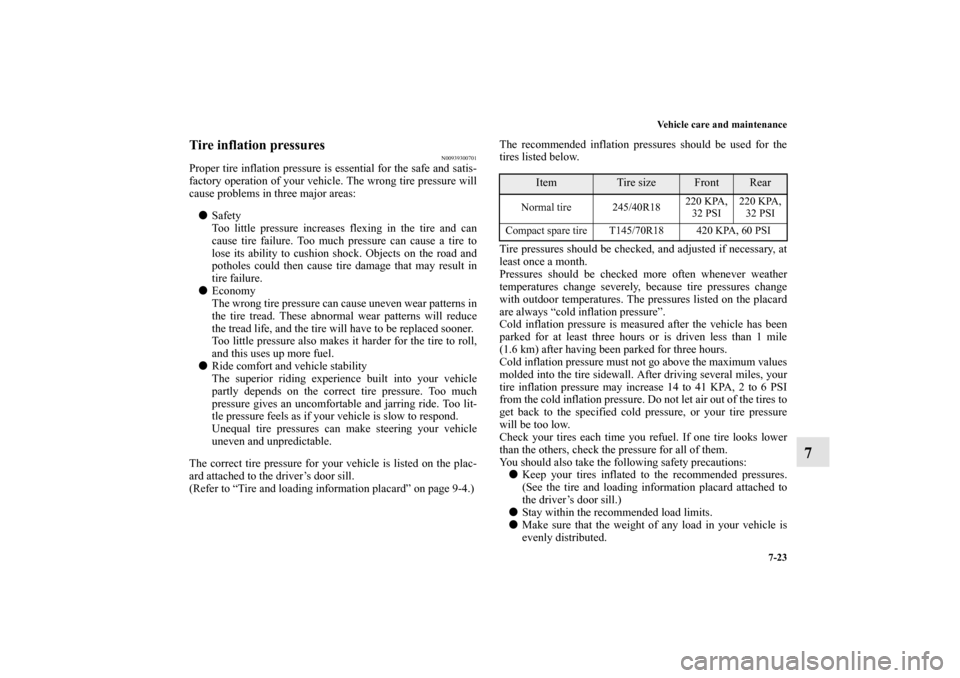
(Refer to “Tire and loading information placard” on page 9-4.)The recommended inflation pressures should be used for the
tires listed below.
Tire pressures should be checked, and adjusted if necessary, at
least once a month.
Pressures should be checked more often whenever weather
temperatures change severely, because tire pressures change
with outdoor temperatures. The pressures listed on the placard
are always “cold inflation pressure”.
Cold inflation pressure is measured after the vehicle has been
parked for at least three hours or is driven less than 1 mile
(1.6 km) after having been parked for three hours.
Cold inflation pressure must not go above the maximum values
molded into the tire sidewall. After driving several miles, your
tire inflation pressure may increase 14 to 41 KPA, 2 to 6 PSI
from the cold inflation pressure. Do not let air out of the tires to
get back to the specified cold pressure, or your tire pressure
will be too low.
Check your tires each time you refuel. If one tire looks lower
than the others, check the pressure for all of them.
You should also take the following safety precautions:
�
Keep your tires inflated to the recommended pressures.
(See the tire and loading information placard attached to
the driver’s door sill.)
�
Stay within the recommended load limits.
�
Make sure that the weight of any load in your vehicle is
evenly distributed.
Item
Tire size
Front
Rear
Normal tire 245/40R18220 KPA,
32 PSI220 KPA,
32 PSI
Compact spare tire T145/70R18 420 KPA, 60 PSI
BK0105501US.book 23 ページ 2009年8月10日 月曜日 午前10時32分