Page 2 of 390
Locks and Security 141
Keys 141
Locks 141
Anti-theft system 147
Seating and Safety Restraints 157
Seating 157
Safety restraints 175
Airbags 190
Child restraints 205
Tires, Wheels and Loading 224
Tire information 226
Tire inflation 229
Tire Pressure Monitoring System (TPMS) 241
Vehicle loading 246
Trailer towing 254
Recreational towing 260
Driving 261
Starting 261
Brakes 266
AdvanceTrac�269
Transmission operation 277
Reverse sensing system 282
Roadside Emergencies 292
Getting roadside assistance 292
Hazard flasher control 293
Fuel pump shut-off switch 294
Fuses and relays 295
Changing tires 302
Wheel lug nut torque 311
Jump starting 312
Wrecker towing 318
Table of Contents
2
2010 Mountaineer(mnt)
Owners Guide(own2002), 1st Printing
USA(fus)
Page 4 of 390

CONGRATULATIONS
Congratulations on acquiring your new Mercury. Please take the time to
get well acquainted with your vehicle by reading this handbook. The
more you know and understand about your vehicle, the greater the
safety and pleasure you will derive from driving it.
For more information on Ford Motor Company and its products visit the
following website:
•In the United States: www.ford.com
•In Canada: www.ford.ca
•In Mexico: www.ford.com.mx
•In Australia: www.ford.com.au
Additional owner information is given in separate publications.
This Owner’s Guide describes every option and model variant available
and therefore some of the items covered may not apply to your
particular vehicle. Furthermore, due to printing cycles it may describe
options before they are generally available.
Remember to pass on the Owner’s Guide when reselling the vehicle. It is
an integral part of the vehicle.
WARNING: Fuel pump shut-off switch:In the event of an
accident the safety switch will automatically cut off the fuel
supply to the engine. The switch can also be activated through sudden
vibration (e.g. collision when parking). To reset the switch, refer to the
Fuel pump shut-off switchin theRoadside Emergencieschapter.
SAFETY AND ENVIRONMENT PROTECTION
Warning symbols in this guide
How can you reduce the risk of personal injury to yourself or others? In
this guide, answers to such questions are contained in comments
highlighted by the warning triangle symbol. These comments should be
read and observed.
Introduction
4
2010 Mountaineer(mnt)
Owners Guide(own2002), 1st Printing
USA(fus)
Page 8 of 390

•how far (if at all) the driver was depressing the accelerator
and/or the brake pedal;
•how fast the vehicle was traveling;
•where the driver was positioning the steering wheel; and
•longitude and latitude of vehicle at last location, using GPS
technology and advanced vehicle sensors.
To access this information, special equipment must be directly
connected to the recording modules. Ford Motor Company and
Ford of Canada do not access event data recorder information
without obtaining consent, unless pursuant to court order or
where required by law enforcement, other government authorities
or other third parties acting with lawful authority. Other parties
may seek to access the information independently of Ford Motor
Company and Ford of Canada. To the extent that any law
pertaining to Event Data Recording applies to SYNC�or its
features, please note the following: Once 911 Assist (if equipped)
is enabled (set ON), 911 Assist may, through any paired and
connected cell phone, disclose to emergency services that the
vehicle has been in a crash involving the deployment of an airbag
or, in certain vehicles, the activation of the fuel pump shut-off.
Certain versions or updates to 911 Assist may also be capable of
electronically or verbally disclosing to 911 operators the vehicle
location, and/or other details about the vehicle or crash to assist
911 operators to provide the most appropriate emergency
services. If you do not want to disclose this information, do not
activate the feature. See your SYNC�supplement for more
information. Additionally, when you connect to Traffic, Directions
and Information (if equipped, U.S. only), the service uses GPS
technology and advanced vehicle sensors to collect the vehicle’s
current location, travel direction, and speed (“vehicle travel
information”) only to help provide you with the directions, traffic
reports, or business searches you request. If you do not want
Ford or its vendors to receive this information, do not activate
the service. Ford Motor Company and the vendors it uses to
provide you with this information do not store your vehicle travel
information. For more information, see Traffic, Directions and
Information, Terms and Conditions. See your SYNC�supplement
for more information.
Introduction
8
2010 Mountaineer(mnt)
Owners Guide(own2002), 1st Printing
USA(fus)
Page 10 of 390
These are some of the symbols you may see on your vehicle.
Vehicle Symbol Glossary
Safety Alert
See Owner’s Guide
Fasten Safety BeltAirbag - Front
Airbag - SideChild Seat Lower
Anchor
Child Seat Tether
AnchorBrake System
Anti-Lock Brake SystemParking Brake System
Brake Fluid -
Non-Petroleum BasedParking Aid System
Stability Control SystemSpeed Control
Master Lighting SwitchHazard Warning Flasher
Fog Lamps-FrontFuse Compartment
Fuel Pump ResetWindshield Wash/Wipe
Windshield
Defrost/DemistRear Window
Defrost/Demist
Introduction
10
2010 Mountaineer(mnt)
Owners Guide(own2002), 1st Printing
USA(fus)
Page 20 of 390

Refer toUNITSlater in this section to switch the display from Metric to
English.
MILES (km) TO E
This displays an estimate of approximately how far you can drive with
the fuel remaining in your tank under normal driving conditions.
Remember to turn the ignition off when refueling to allow this feature to
correctly detect the added fuel.
The DTE function will display LOW FUEL LEVEL when you have
approximately 50 miles (80 km), to empty. Press RESET to clear this
warning message. It will return at approximately 25 miles (40 km),
10 miles (16 km) and 0 miles (0 km) miles to empty.
DTE is calculated using a running average fuel economy, which is based
on your recent driving history of 500 miles (800 km). This value is not
the same as the average fuel economy display. The running average fuel
economy is re-initialized to a factory default value if the battery is
disconnected.
AVERAGE FUEL XX.X MPG (L/100km)
Average fuel economy displays your average fuel economy in miles/gallon
or liters/100 km.
If you calculate your average fuel economy by dividing distance traveled
by gallons of fuel used (liters of fuel used by 100 kilometers traveled),
your figure may be different than displayed for the following reasons:
•Your vehicle was not perfectly level during fill-up
•Differences in the automatic shut-off points on the fuel pumps at
service stations
•Variations in top-off procedure from one fill-up to another
•Rounding of the displayed values to the nearest 0.1 gallon (liter)
1. Drive the vehicle at least 5 miles (8 km) with the speed control
system engaged to display a stabilized average.
2. Record the highway fuel economy for future reference.
It is important to press the RESET button (press and hold RESET for
two seconds in order to reset the function) after setting the speed
control to get accurate highway fuel economy readings.
For more information refer toEssentials of good fuel economyin the
Maintenance and Specificationschapter.
Instrument Cluster
20
2010 Mountaineer(mnt)
Owners Guide(own2002), 1st Printing
USA(fus)
Page 294 of 390
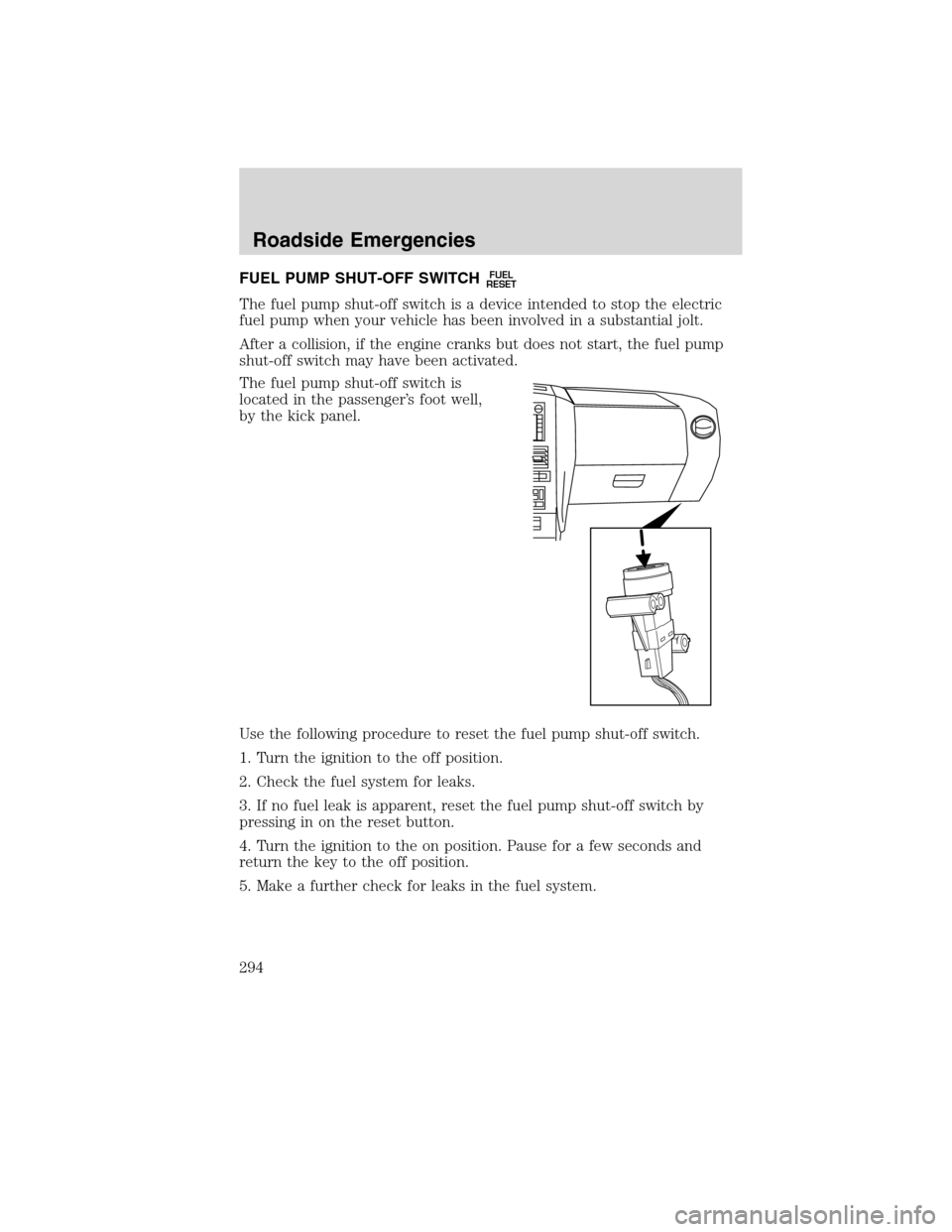
FUEL PUMP SHUT-OFF SWITCHFUEL
RESET
The fuel pump shut-off switch is a device intended to stop the electric
fuel pump when your vehicle has been involved in a substantial jolt.
After a collision, if the engine cranks but does not start, the fuel pump
shut-off switch may have been activated.
The fuel pump shut-off switch is
located in the passenger’s foot well,
by the kick panel.
Use the following procedure to reset the fuel pump shut-off switch.
1. Turn the ignition to the off position.
2. Check the fuel system for leaks.
3. If no fuel leak is apparent, reset the fuel pump shut-off switch by
pressing in on the reset button.
4. Turn the ignition to the on position. Pause for a few seconds and
return the key to the off position.
5. Make a further check for leaks in the fuel system.
Roadside Emergencies
294
2010 Mountaineer(mnt)
Owners Guide(own2002), 1st Printing
USA(fus)
Page 297 of 390

Fuse/RelayLocation Fuse Amp
Rating Protected Circuits
5 5A Moon roof, Door lock switch illumination, Auto dimming rear
view mirror
6 20A Liftglass release motor, Door unlock/lock
7 15A Trailer stop/turn
8 15A Ignition switch power, Passive anti-theft system (PATS), Cluster
9 2A 6R Transmission control module/Powertrain control
module (Ignition RUN/START),
Fuel pump relay
10 5A Front wiper RUN/ACC relay in
power distribution box (PDB)
11 5A Radio start
12 5A Rear wiper motor RUN/ACC,
Trailer battery charge relay in
PDB, Radio
13 15A Heated mirror, Manual climate
rear defrost indicator
14 20A Horn
15 10A Reverse lamps
16 10A Trailer reverse lamps
17 10A Restraints control module,
Passenger occupancy
18 10A Reverse park aid, Roll stability
control™ (RSC �) switch, RSC�,
All wheel drive (AWD) module,
Heated seat switches, Auxiliary
climate control
19 — Not used
20 10A Climate control system, Brake
shift
Roadside Emergencies
297
2010 Mountaineer (mnt)
Owners Guide (own2002), 1st Printing
USA (fus)
Page 299 of 390
The high-current fuses are coded as follows:
Fuse/Relay
LocationFuse Amp
RatingProtected Circuits
1 50A** Battery feed 2 (passenger
compartment fuse panel)
2 50A** Battery feed 3 (passenger
compartment fuse panel)
3 50A** Battery feed 1 (passenger
compartment fuse panel)
4 30A** Fuel pump, Injectors
5 30A** Third row seat (left)
6 40A** Anti-lock brake system (ABS) pump
7 40A** Powertrain control module (PCM)
8 — Not used
9 — Not used
10 30A** Power seat (right)
11 30A** Starter
12 30A** Third row seat (right)
Roadside Emergencies
299
2010 Mountaineer(mnt)
Owners Guide(own2002), 1st Printing
USA(fus)