2010 MERCEDES-BENZ SLK300 lamps
[x] Cancel search: lampsPage 15 of 312
Rear lamps
see Tail lamps
Rear window defroster ..................... 170
Recommended tire inflation
pressure ..................................... 198, 218
Refrigerant, air conditioning ............ 303
Refueling ............................................ 190
Regular checks .................................. 191
Reminder, Seat belt see Seat belts, Telltale
Remote control
see Key, SmartKey
Remote door unlock (Tele Aid) .........182
Replacing
Key .................................................. 58
Replacing bulbs ................................. 267
Reporting safety defects .................... 21
Research Octane Number see RON
Reserve fuel
Messages in the multifunction
display ........................................... 251
Warning lamp ........................... 26, 261
Reset button .................................. 27, 92
Restraint systems see Occupant safety
Retractable hardtop ..........................170
Locking .......................................... 172
Luggage cover ............................... 173
Messages in the multifunction
display ........................................... 246
Operating manually ........................ 266
Wind screen ................................... 173
Rims ........................................... 218, 297
Roadside Assistance ...................19, 180
RON (Research Octane Number) ..... 303
Roof see Retractable hardtop
Rubber parts, cleaning ...................... 230 S
Safety Driving safety systems ..................... 47
Occupant safety ...............................
32
Reporting defects ............................ 21
Safety belts
see Seat belts Satellite radio ....................................
125
Seat belt force limiter ......................... 43
Seat belts ............................................. 40
Children in the vehicle .....................45
Cleaning .........................................
231
Fastening ......................................... 42
Proper use of ................................... 41
Safety guidelines ............................. 34
Safety notes ..................................... 40
Telltale ..................................... 26, 259
Seat heating ......................................... 65
Seating capacity ................................ 206
Seats ..................................................... 62 Adjustment ...................................... 62
Easy-entry/exit feature ....................67
Heating ............................................ 65
Memory function .............................. 70
Selective setting
see Key, SmartKey
Selector lever
see Gear selector lever
Self-test
OCS (Occupant Classification
System) ........................................... 39
Tele Aid .......................................... 178
Service
see Maintenance
Service, parts .................................... 292
Service and warranty information .....18
Service intervals see Maintenance System, Service
indicator message
Service life (tires) .............................. 210
Settings Factory setting (SmartKey) ..............57
Memory function .............................. 70
Menu ............................................. 102
Selective setting (SmartKey) ............57
Shelf behind roll bars ........................ 175
Side marker lamps
Cleaning lenses ............................. 229
Messages in the multifunction
display ........................................... 252
Sidewall (tires) .................................. 219
Side windows see Power windows Index
13 171_AKB; 3; 60, en-US
d2ureepe,
Version: 2.11.8.1 2009-05-11T16:00:23+02:00 - Seite 13
Page 16 of 312

SmartKey
see Key, SmartKey
Snow chains ...................................... 220
Snow tires see Winter tires
Spare wheel ....................................... 297
Mounting ....................................... 277
Storage location ............................ 235
Speed settings
Cruise control ................................ 160
Resume function ............................ 161
SRS (Supplemental Restraint System)
Indicator lamp ................... 26, 32, 260
Messages in the multifunction
display ........................................... 245
Standing water, driving through ......224
Starter switch positions SmartKey ......................................... 61
Starting difficulties (engine) ..............80
Starting the engine ............................. 80
Steering column see Multifunction steering wheel,
Adjustment
Steering wheel
see Multifunction steering wheel
Steering wheel gearshift control .......89
Stolen Vehicle Recovery Services ...183
Storage compartments .....................174
Storing tires ....................................... 210
Sun visors .......................................... 176T
Tachometer .......................................... 93
Overspeed range ............................. 93
Tail lamps
Cleaning lenses
............................. 229
Messages in the multifunction
display ........................................... 254
Tar stains ........................................... 228
Technical data Air conditioning refrigerant ............ 303
Brake fluid ..................................... 303
Capacities fuels, coolants,
lubricants etc. ................................ 300
Coolant .......................................... 304
Engine oil additives ........................303
Engine oils ..................................... 302Fuel requirements .......................... 303
Gasoline additives
.......................... 304
Identification labels .......................292
Premium unleaded gasoline ...........303
Rims and tires ................................ 297
Spare wheel ................................... 300
Vehicle specification SLK 300 .......294
Vehicle specification SLK 350 .......295
Vehicle specification SLK 55 AMG . 296
Washer and headlamp cleaning
system ................................... 302, 306
Technical data (dimensions)
see Vehicle specification
Technical data (electrical system)
see Vehicle specification
Technical data (engine)
see Vehicle specification
Technical data (weights)
see Vehicle specification
Tele Aid ............................................... 178
Emergency calls ............................. 179
Information button .........................181
Initiating an emergency call
manually ........................................ 180
Messages in the multifunction
display ........................................... 245
Remote door unlock ...................... 182
Roadside Assistance button .......... 180
Search & Send ............................... 182
SOS button .................................... 180
Stolen Vehicle Recovery Services .. 183
System self-test ............................. 178
Telephone .................................... 27, 146
Answering/ending a call ................ 110
Call lists ......................................... 156
Emergency calls “911” .................. 152
Hands-free microphone ...................30
Making calls ................................... 156
Menu ............................................. 110
Operation ....................................... 110
Phone book ........................... 111, 153
Redialing ........................................ 111
Temperature
Interior temperature ......................166
Outside .................................... 97, 104
Tightening torque
Wheels ........................................... 281
Time setting ....................................... 10514
Index 171_AKB; 3; 60, en-US
d2ureepe,
Version: 2.11.8.1 2009-05-11T16:00:23+02:00 - Seite 14
Page 18 of 312

Indicator lamps ................................
26
Messages in the multifunction
display
........................................... 255U
Uniform Tire Quality Grading
Standards .................................. 210, 219
Units Selecting speedometer display
mode ............................................. 104
Unleaded gasoline, premium ........... 303
Unlocking the vehicle
Manually
........................................ 264
SmartKey ......................................... 56
Upholstery, cleaning .........................231
USB devices (media interface) .........139
Useful features .................................. 176V
Valet locking ........................................ 61
Vehicle
Battery ........................................... 282
Care ............................................... 227
Control system ................................ 93
Identification Number (VIN) ........... 292
Locking/unlocking
........................... 56
Lowering (wheel change) ...............281
Modifications and alterations,
Operating safety .............................. 20
Towing ........................................... 285
Unlocking/locking manually .......... 264
Vehicle dimensions
see Vehicle specification
Vehicle Identification Number
(VIN) ................................................... 292
Vehicle jack see Jack
Vehicle lighting .................................... 70
Vehicle loading
Load limit ....................................... 206
Terminology ................................... 217
Vehicle maximum load on the tire ... 219
Vehicle specification
SLK 300 ......................................... 294
SLK 350 ......................................... 295
SLK 55 AMG .................................. 296Vehicle status message memory ....
101
Vehicle tool kit .................................. 234
Vehicle washing see Vehicle care
Vehicle weights
see Vehicle specification W
Warning sounds Driver’s or passenger’s seat belt
.....42
Parking brake ................................ 244
Seat belt telltale ............................ 259
Warranty coverage ............................ 292
Washer and headlamp cleaning
system ................................................ 306
Washer fluid
Messages in the multifunction
display ........................................... 247
Mixing ratio .................................... 306
Refilling .......................................... 196
Washing the vehicle .......................... 227
Wear pattern (tires) ..........................212
Weights (vehicle) see Vehicle specification
Wheel
Changing ....................................... 273
Removing ....................................... 278
Spare ............................................. 273
Tightening torque ........................... 281
Wheels, sizes ..................................... 297
Wheels, Tires and .............................. 197
Windows see Power windows
Windows, cleaning ............................229
Wind screen ....................................... 173
Windshield Cleaning wiper blades .................... 229
Defogging ...................................... 169
Washer fluid ................................... 306
Wipers ............................................. 76
Windshield wipers
Replacing wiper blades .................. 271
Winter driving
Instructions .................................... 220
Snow chains .................................. 220
Tires ............................................... 219
Winter tires ................................ 219, 297 16
Index 171_AKB; 3; 60, en-US
d2ureepe,
Version: 2.11.8.1 2009-05-11T16:00:23+02:00 - Seite 16
Page 26 of 312
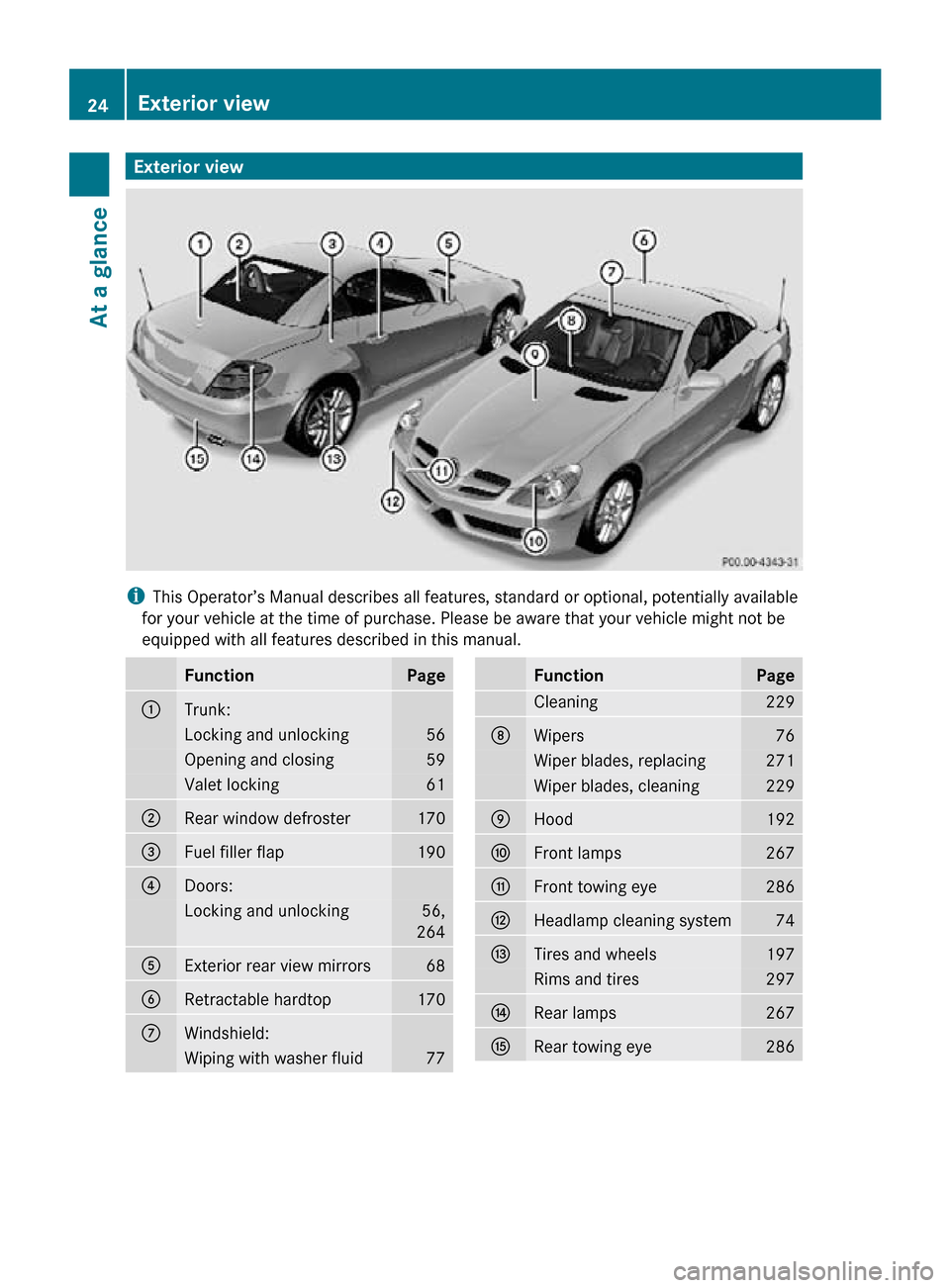
Exterior view
i
This Operator’s Manual describes all features, standard or optional, potentially available
for your vehicle at the time of purchase. Please be aware that your vehicle might not be
equipped with all features described in this manual. Function Page
:
Trunk:
Locking and unlocking 56
Opening and closing 59
Valet locking 61
;
Rear window defroster 170
=
Fuel filler flap 190
?
Doors:
Locking and unlocking 56,
264 A
Exterior rear view mirrors 68
B
Retractable hardtop 170
C
Windshield:
Wiping with washer fluid 77 Function Page
Cleaning 229
D
Wipers 76
Wiper blades, replacing 271
Wiper blades, cleaning 229
E
Hood 192
F
Front lamps 267
G
Front towing eye 286
H
Headlamp cleaning system 74
I
Tires and wheels 197
Rims and tires 297
J
Rear lamps 267
K
Rear towing eye 28624
Exterior viewAt a glance
171_AKB; 3; 60, en-US
d2ureepe,
Version: 2.11.8.1 2009-05-11T16:00:23+02:00 - Seite 24
Page 46 of 312

R
rear view mirror adjustment
R fastening of seat belts Steering wheel
G
Observe Safety notes, see page 66.
X Position steering wheel : properly. See
(Y page 66) for manual adjustment and
(Y page 66) for electrical adjustment.
Make sure:
R You can reach the steering wheel with your
arms slightly bent at the elbows.
R You can move your legs freely.
R All displays (including malfunction and
indicator lamps) on the instrument cluster
are clearly visible.
Seat belt G
Observe Safety notes, see page 40.
X Fasten and position your seat belt ;
correctly (Y page 42). Make sure:
R
The seat belt is always fitted snugly.
R Adjust the seat belt so that the shoulder
section is located as close as possible to
the middle of the shoulder.
R Place the lap portion of the seat belt as low
as possible on your hips.
Seat and head restraint G
Observe Safety notes, see page 62.
X Position seat = and head restraint
properly. See ( Y page 63) for seat and
head restraint adjustment.
Observe the following points:
R Always be in a properly seated position.
R The position should be as far rearward from
the front air bag in the steering wheel as
possible, while still permitting proper
operation of vehicle controls.
R Adjust the seat to a comfortable seating
position that still allows you to reach the
accelerator/brake pedal safely.
R The seat must be adjusted so that you can
correctly fasten and position your seat belt.
R The seat backrest must be in a position that
is as nearly upright as possible.
R Adjust the seat cushion so that the front
edge of the seat cushion lightly supports
your legs.
R Adjust the head restraint so that it is as
close to the head as possible and the
center of the head restraint supports the
back of the head at eye level.
R Never place hands under the seat or near
any moving parts while the seat is being
adjusted. 44
Occupant safetySafety and security
171_AKB; 3; 60, en-US
d2ureepe,
Version: 2.11.8.1 2009-05-11T16:00:23+02:00 - Seite 44
Page 49 of 312
A child’s risk of serious or fatal injuries is
significantly increased if the child restraints
are not properly secured in the vehicle and/
or the child is not properly secured in the child
restraint.
Children too big for a toddler restraint must
ride in seats using regular seat belts. Position
shoulder belt across chest and shoulder, not
face or neck. A booster seat may be
necessary to achieve proper seat belt
positioning for children over 41 lb (18 kg) until
they reach a height where a lap/shoulder belt
fits properly without a booster.
When the child restraint is not in use, remove
it from the vehicle or secure it with the seat
belt to prevent the child restraint from
becoming a projectile in the event of an
accident.
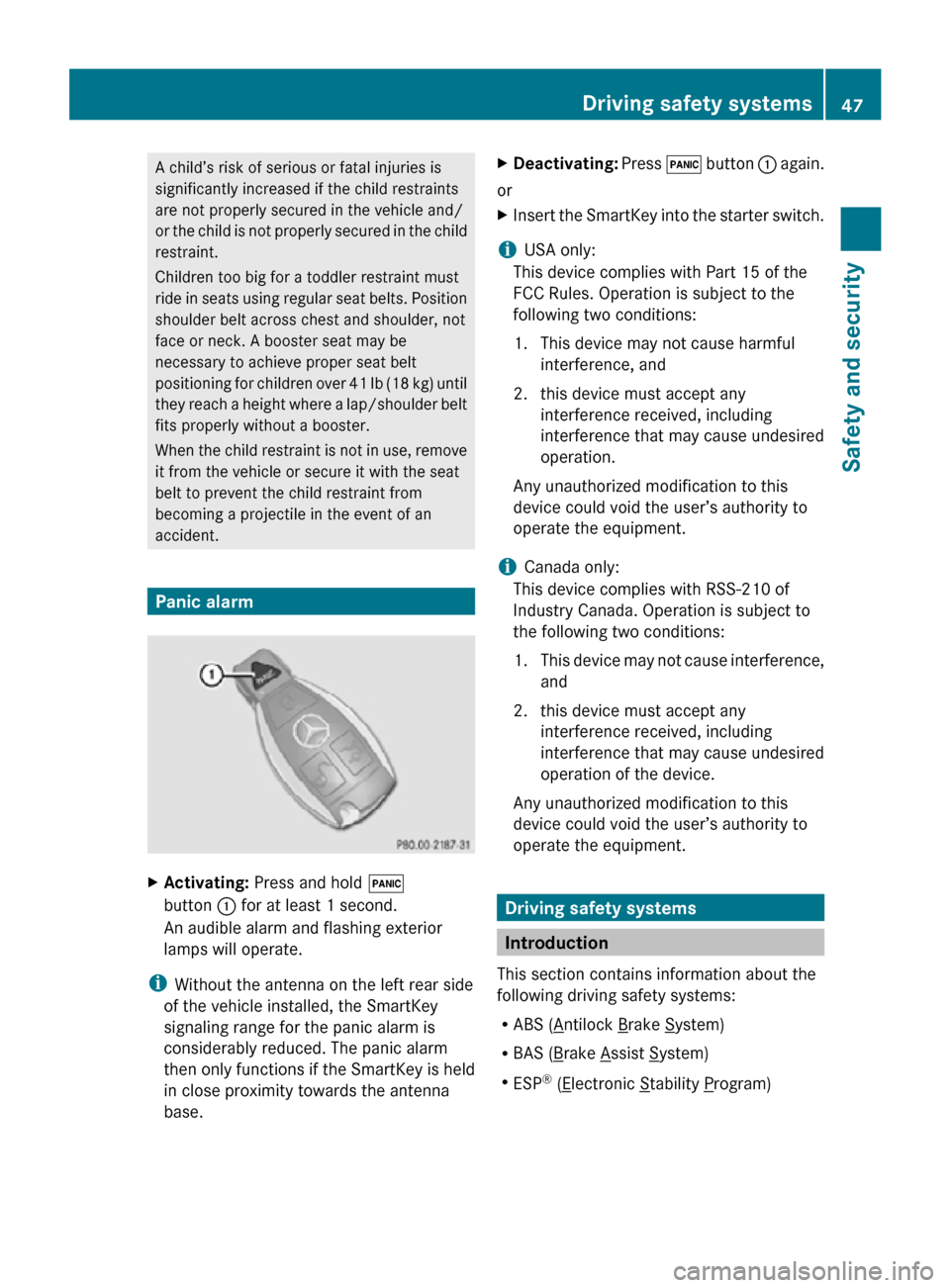
Panic alarm
X
Activating: Press and hold !
button : for at least 1 second.
An audible alarm and flashing exterior
lamps will operate.
i Without the antenna on the left rear side
of the vehicle installed, the SmartKey
signaling range for the panic alarm is
considerably reduced. The panic alarm
then only functions if the SmartKey is held
in close proximity towards the antenna
base. X
Deactivating: Press ! button : again.
or
X Insert the SmartKey into the starter switch.
i USA only:
This device complies with Part 15 of the
FCC Rules. Operation is subject to the
following two conditions:
1. This device may not cause harmful interference, and
2. this device must accept any interference received, including
interference that may cause undesired
operation.
Any unauthorized modification to this
device could void the user’s authority to
operate the equipment.
i Canada only:
This device complies with RSS-210 of
Industry Canada. Operation is subject to
the following two conditions:
1. This device may not cause interference, and
2. this device must accept any interference received, including
interference that may cause undesired
operation of the device.
Any unauthorized modification to this
device could void the user’s authority to
operate the equipment. Driving safety systems
Introduction
This section contains information about the
following driving safety systems:
R ABS ( Antilock Brake System)
R BAS ( Brake Assist System)
R ESP ®
( Electronic Stability Program)Driving safety systems
47Safety and security
171_AKB; 3; 60, en-US
d2ureepe, Version: 2.11.8.1 2009-05-11T16:00:23+02:00 - Seite 47 Z
Page 50 of 312
i
In winter operation, the maximum
effectiveness of most of the driving
systems described in this section is only
achieved with winter tires, or snow chains
as required.
Safety notes G
Warning!
The following factors increase the risk of
accidents:
R Excessive speed, especially in turns
R Wet and slippery road surfaces
R Following another vehicle too closely
The driving safety systems described in this
section cannot reduce these risks or prevent
the
natural laws of physics from acting on the
vehicle. They cannot increase braking or
steering efficiency beyond that afforded by
the condition of the vehicle brakes and tires
or the traction afforded.
Only a safe, attentive, and skillful driver can
prevent accidents.
The capabilities of a vehicle equipped with the
driving safety systems described in this
section must never be exploited in a reckless
or dangerous manner which could jeopardize
the user’s safety or the safety of others.
Always adjust your driving style to the
prevailing road and weather conditions and
keep a safe distance to other road users and
objects on the street.
If a driving system malfunctions, other driving
safety systems may also switch off. Observe
indicator and warning lamps that may come
on as well as messages in the multifunction
display that may appear. ABS
G
Observe Safety notes, see page 48. G
Warning!
Do not pump the brake pedal. Use firm, steady
brake pedal pressure instead. Pumping the
brake pedal defeats the purpose of the ABS
and significantly reduces braking
effectiveness.
The Antilock Brake System (ABS) regulates
the
brake pressure so that the wheels do not
lock during braking. This allows you to
maintain the ability to steer your vehicle.
The ABS is functional above a speed of
approximately 5 mph (8 km/h) independent
of road surface conditions.
On slippery road surfaces, the ABS will
respond even to light brake pressure.
The ABS indicator lamp ! in the
instrument cluster comes on when you switch
on the ignition. It goes out when the engine
is running.
Braking At the instant one of the wheels is about to
lock up, a slight pulsation can be felt in the
brake pedal. The pulsation indicates that the
ABS is in the regulating mode.
X
Keep firm and steady pressure on the brake
pedal while you feel the pulsation.
Continuous, steady brake pedal pressure
yields the advantages provided by the ABS,
namely
braking power and the ability to steer
the vehicle.
The pulsating brake pedal can be an
indication of hazardous road conditions and
functions as a reminder to take extra care
while driving.
Emergency brake maneuver X
Keep continuous full pressure on the brake
pedal. 48
Driving safety systems
Safety and security
171_AKB; 3; 60, en-US
d2ureepe,
Version: 2.11.8.1 2009-05-11T16:00:23+02:00 - Seite 48
Page 51 of 312
G
Warning!
If the ABS malfunctions, other driving safety
systems such as the BAS or the ESP ®
are also
switched off. Observe indicator and warning
lamps that may come on as well as messages
in the multifunction display that may appear.
If the ABS malfunctions, the wheels may lock
during hard braking, reducing steering
capability and extending the braking distance. BAS
G
Observe Safety notes, see page 48.
The Brake Assist System (BAS) operates in
emergency
situations. If you apply the brakes
very quickly, the BAS provides full brake
boost automatically, thereby potentially
reducing the braking distance.
X Apply continuous full braking pressure until
the emergency braking situation is over.
The ABS will prevent the wheels from
locking.
When you release the brake pedal, the brakes
function again as normal. The BAS is then
deactivated. G
Warning!
If the BAS malfunctions, the brake system still
functions, but without the additional brake
boost available that the BAS would normally
provide in an emergency braking maneuver.
Therefore,
the braking distance may increase. ESP
® G
Observe Safety notes, see page 48.
The Electronic Stability Program (ESP ®
) is
operational
as soon as the engine is running.
It monitors the vehicle’s traction (force of
adhesive friction between the tires and the
road surface) and handling.
The ESP ®
recognizes that the vehicle deviates
from the direction of travel as intended by the
driver. By applying brakes to individual wheels and by limiting the engine output, the
ESP
®
works to stabilize the vehicle. The
ESP ®
is especially useful while driving off and
on wet or slippery road surfaces. The ESP ®
also stabilizes the vehicle during braking and
steering maneuvers.
The ESP ®
warning lamp d in the
instrument cluster comes on when you switch
on the ignition. It goes out when the engine
is running.
The ESP ®
warning lamp d in the
instrument cluster flashes when the ESP ®
is
engaged. G
Warning!
Never switch off the ESP ®
when you see the
ESP ®
warning lamp d flashing in the
instrument cluster. In this case proceed as
follows:
R When driving off, apply as little throttle as
possible.
R While driving, ease up on the accelerator
pedal.
R Adapt your speed and driving style to the
prevailing road conditions.
Failure to observe these guidelines could
cause the vehicle to skid. The ESP ®
cannot
prevent accidents resulting from excessive
speed.
! Because the ESP ®
operates
automatically,
the engine and ignition must
be shut off (SmartKey in starter switch
position 0 or 1) when the parking brake is
being tested on a brake test dynamometer
or when the vehicle is being towed with the
front axle raised.
Active braking action through the ESP ®
may otherwise seriously damage the brake
system which is not covered by the
Mercedes-Benz Limited Warranty.
! The ESP ®
will only function properly if you
use wheels of the recommended tire size Driving safety systems
49
Safety and security
171_AKB; 3; 60, en-US
d2ureepe, Version: 2.11.8.1 2009-05-11T16:00:23+02:00 - Seite 49 Z