2010 MERCEDES-BENZ G55AMG spare wheel
[x] Cancel search: spare wheelPage 204 of 272

XOpen lock : using the screwdriver.
iYou can also use a coin to open the lock.
XFold tab ; downwards.XPull cover ring = slightly outwards in
direction of arrows and remove.
XPull cover plate ? towards you.XRemove cover plate ?.XUnscrew mounting screws C.XRemove the spare wheel.GWarning!
Make sure no one is injured when removing
the spare wheel.
Grip wheel from the sides.
Keep hands from beneath the wheel.
After mounting the spare wheel:
XTransport the damaged wheel on the spare
wheel carrier, see “Storing the spare wheel
after use” for instructions.
XRepair or replace the damaged tire as soon
as possible and return the spare tire as
original spare.
For information on mounting the spare wheel,
see “Flat tire” (Y page 239).
Storing the spare wheel after use
XSecure the spare wheel with mounting
screws C on the spare wheel carrier
(Y page 202). Make sure the spare wheel
cannot come loose.
XMake sure catch B engages in recess A
when mounting cover plate 4
(Y page 202).
XMake sure tab ; (Y page 202) faces
downwards when mounting cover ring =
(Y page 202).
XFor safety reasons, check regularly that the
spare wheel is securely fastened.
202Where will I find ...?Practical hints
463_AKB; 3; 35, en-USd2ureepe,Version: 2.11.8.12009-07-16T20:59:56+02:00 - Seite 202
Page 208 of 272
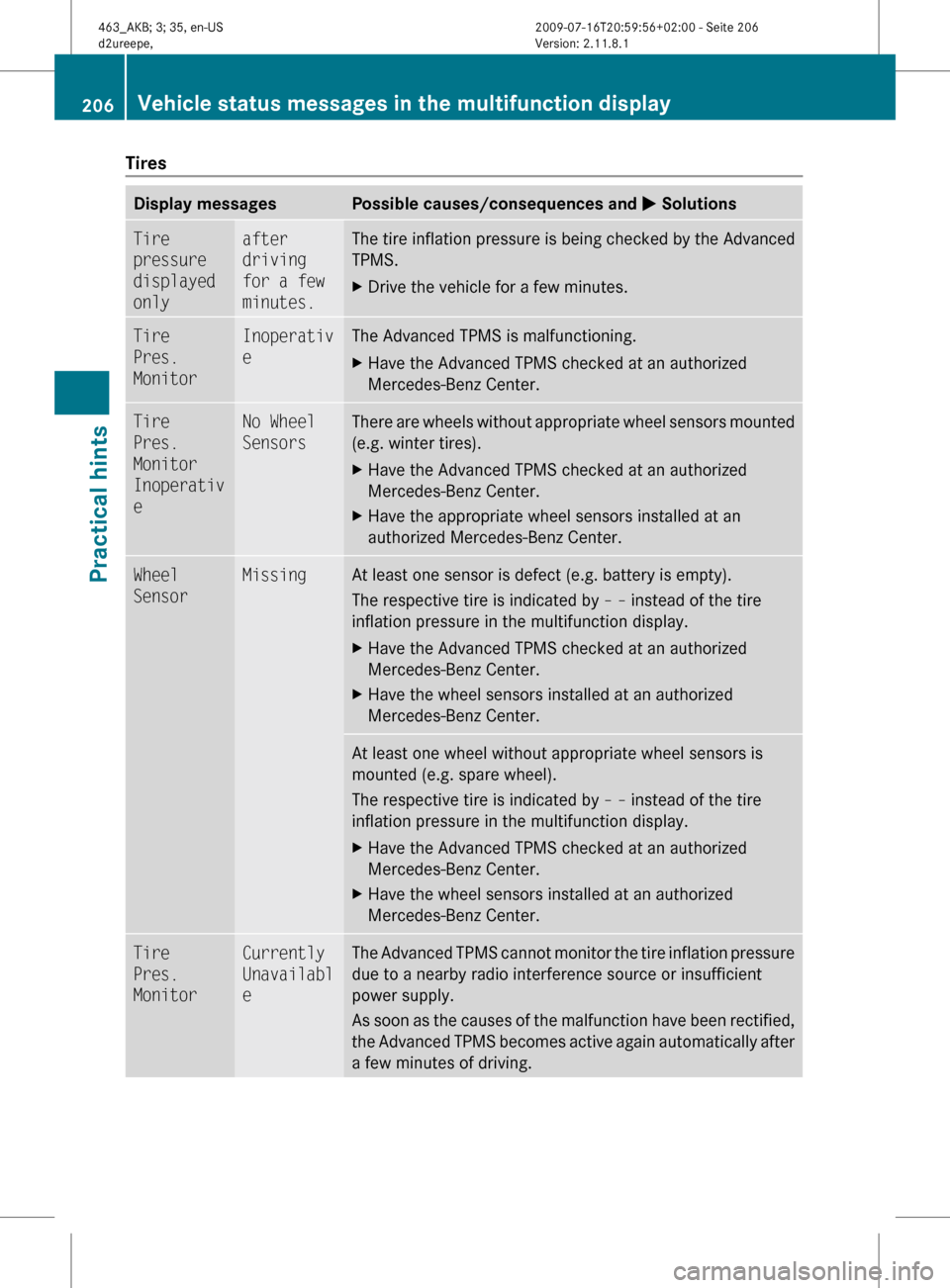
TiresDisplay messagesPossible causes/consequences and M SolutionsTire
pressure
displayed
onlyafter
driving
for a few
minutes.The tire inflation pressure is being checked by the Advanced
TPMS.XDrive the vehicle for a few minutes.Tire
Pres.
MonitorInoperativ
eThe Advanced TPMS is malfunctioning.XHave the Advanced TPMS checked at an authorized
Mercedes-Benz Center.Tire
Pres.
Monitor
Inoperativ
eNo Wheel
SensorsThere are wheels without appropriate wheel sensors mounted
(e.g. winter tires).XHave the Advanced TPMS checked at an authorized
Mercedes-Benz Center.XHave the appropriate wheel sensors installed at an
authorized Mercedes-Benz Center.Wheel
SensorMissingAt least one sensor is defect (e.g. battery is empty).
The respective tire is indicated by – – instead of the tire
inflation pressure in the multifunction display.XHave the Advanced TPMS checked at an authorized
Mercedes-Benz Center.XHave the wheel sensors installed at an authorized
Mercedes-Benz Center.At least one wheel without appropriate wheel sensors is
mounted (e.g. spare wheel).
The respective tire is indicated by – – instead of the tire
inflation pressure in the multifunction display.XHave the Advanced TPMS checked at an authorized
Mercedes-Benz Center.XHave the wheel sensors installed at an authorized
Mercedes-Benz Center.Tire
Pres.
MonitorCurrently
Unavailabl
eThe Advanced TPMS cannot monitor the tire inflation pressure
due to a nearby radio interference source or insufficient
power supply.
As soon as the causes of the malfunction have been rectified,
the Advanced TPMS becomes active again automatically after
a few minutes of driving.206Vehicle status messages in the multifunction displayPractical hints
463_AKB; 3; 35, en-USd2ureepe,Version: 2.11.8.12009-07-16T20:59:56+02:00 - Seite 206
Page 241 of 272

GWarning!
Wiper blades are components that are subject
to wear and tear. Replace the wiper blades
twice a year, preferably in the spring and fall.
Otherwise the windows will not be wiped
properly. As a result, you may not be able to
observe surrounding traffic conditions and
could cause an accident.
! Never open the hood when a front wiper
arm is folded forward.
Hold on to the wiper when folding a wiper
arm back. If released, the force of the
impact from the tensioning spring could
crack the windshield or the rear window.
Do not allow a wiper arm to contact the
windshield glass or the rear window
without a wiper blade inserted.
Mercedes-Benz recommends that you have
this work carried out at an authorized
Mercedes-Benz Center.
XRemove the SmartKey from the starter
switch.
Removing wiper blades
! Do not pull on the wiper blade inserts.
They could tear.
XFold the wiper arm forward until it snaps
into place.
XTurn wiper blade ; at a right angle to wiper
arm =.
XPress safety tab : of attachment link ?
down and slide wiper blade ; from the end
of wiper arm =.
XRemove wiper blade ;.
Installing wiper blades
XGuide wiper blade : so that opening goes
through wiper arm ?.
XPress wiper blade : into wiper arm ?
until safety tab ; engages in attachment
link =.
XFold the wiper arm backward to rest on the
windshield.
! Make sure the wiper blades are installed
properly. Improperly installed wiper blades
may cause windshield damage.
Flat tire
Safety notes
When you replace the vehicle’s tires, you can
use the spare wheel as a regular road wheel.
However, the spare tire may not be older than
6 years. In addition, the rim and tire must be
of same size and model as the regular road
wheels.
Flat tire239Practical hints463_AKB; 3; 35, en-USd2ureepe,Version: 2.11.8.12009-07-16T20:59:56+02:00 - Seite 239Z
Page 242 of 272

GWarning!
If the spare tire is more than 6 years old or is
not the same model as the regular tires, have
the spare tire replaced with a new tire at the
nearest Mercedes-Benz Center.
Never operate the vehicle with more than one
spare wheel mounted.
GWarning!
G 55 AMG:
Rim and tire size of spare wheel and regular
wheel differ. Handling will be adversely
affected when the spare wheel is used.
Do not exceed the maximum speed of 50
mph (80 km/h).
Preparing the vehicle
XWhenever possible, park the vehicle in a
safe distance from moving traffic on a hard,
flat surface.XTurn on the hazard warning flasher.XTurn the steering wheel so that the front
wheels are in a straight-ahead position.XEngage the parking brake.XShift the automatic transmission into park
position P.XTurn off the engine.XRemove the SmartKey from the starter
switch.XHave any passenger exit the vehicle at a
safe distance from the roadway. Open
doors only when conditions are safe to do
so.
Mounting the spare wheel
Introduction
XPrepare the vehicle as described
( Y page 240).GWarning!
You must remove the spare wheel from the
spare wheel carrier before lifting the vehicle.
Otherwise the vehicle could fall off the jack
and injure you or others.
XRemove the spare wheel from the spare
wheel carrier.XTake the vehicle tool kit out of the vehicle.XTake the jack out of the vehicle.
For information on where to find the
respective items, see “Where will I find ...?”
( Y page 200) and ( Y page 201).
i Vehicles without spare wheel are not
factory-equipped with the tools required for
a wheel change such as a jack or a wheel
wrench. Some tools required for a wheel
change are specific to your vehicle.
Contact an authorized Mercedes-Benz
Center to obtain the tools approved for
your vehicle. This section describes the
wheel change using the tools approved and
recommended for your vehicle.
Lifting the vehicle
GWarning!
When jacking up the vehicle, only use the jack
which has been specifically approved by
Mercedes-Benz for your vehicle.
The jack is designed exclusively for jacking up
the vehicle under the axle housing. Make sure
the jack is positioned correctly under the axle
housing. The jack must always be vertical
when in use, especially on inclines or
declines.
The jack is intended only for lifting the vehicle
briefly for wheel changes. It is not suited for
performing maintenance work under the
vehicle. To help avoid personal injury, use the
jack only to lift the vehicle during a wheel
change.
Never get beneath the vehicle while it is
supported by the jack. Keep hands and feet
away from the area under the lifted vehicle.
240Flat tirePractical hints
463_AKB; 3; 35, en-USd2ureepe,Version: 2.11.8.12009-07-16T20:59:56+02:00 - Seite 240
Page 244 of 272

! Do not place wheel bolts in sand or dirt.
This could result in damage to the wheel
bolts and wheel hub threads.
XRemove the wheel.
Attaching the spare wheel
GWarning!
Always replace wheel bolts that are damaged
or rusted.
Never apply oil or grease to wheel bolts.
Damaged wheel hub threads should be
repaired immediately. Do not continue to
drive under these circumstances! Contact an
authorized Mercedes-Benz Center or call
Roadside Assistance.
Incorrect wheel bolts or improperly tightened
wheel bolts can cause the wheel to come off.
This could cause an accident. Make sure to
use the correct wheel bolts.
GWarning!
Only use genuine Mercedes-Benz wheel bolts.
Other wheel bolts may come loose.
Do not tighten the wheel bolts when the
vehicle is raised. Otherwise the vehicle could
fall off the jack.
XClean contact surfaces of wheel and wheel
hub.
! To avoid paint damage, place wheel flat
against hub and hold it there while
installing first wheel bolt.
XGuide the spare wheel onto the wheel hub
and push it on.
XInsert the wheel bolts and tighten them
slightly.
Lowering the vehicle
XUsing the pump handle, turn the release
bolt of the jack counterclockwise
approximately one turn.
iNever turn the release bolt of the jack
more than one or two revolutions.
Otherwise hydraulic fluid can escape.
XLower the vehicle until the vehicle is resting
fully on its own weight.
XRemove the jack.XTighten the five wheel bolts evenly,
following the diagonal sequence illustrated
(: to A), until all bolts are tight. Observe
a tightening torque of 96 lb-ft (130 Nm).
GWarning!
Have the tightening torque checked after
changing a wheel. The wheels could come
loose if they are not tightened to a torque of
96 lb-ft (130 Nm).
XDisassemble the pump handle.XPress the jack piston in and close the
release bolt.
XStore the jack and the other vehicle tools
in the designated storage space.
XAfter changing the wheel, secure the
damaged wheel on the spare wheel carrier
(Y page 201). Make sure the wheel cannot
come loose.
XCheck the tire inflation pressure and
correct it if necessary.
Follow recommended cold tire inflation
pressures listed on the Tire and Loading
Information placard on the driver’s door
B-pillar (Y page 166).
242Flat tirePractical hints
463_AKB; 3; 35, en-USd2ureepe,Version: 2.11.8.12009-07-16T20:59:56+02:00 - Seite 242
Page 251 of 272

In case of rear axle damage
When the rear axle is raised, the vehicle can
only be towed with a wheel lift or a dolly
placed under its front wheels.
Stranded vehicle
Freeing a stranded vehicle, on which the
wheels are dug into sand or mud, should be
done with the greatest of care, especially if
the vehicle is heavily loaded.
Note the following when freeing a stranded
vehicle:
RAvoid pulling the vehicle abruptly or
diagonally, since it could result in damage
to the chassis alignment.
RNever try to free a vehicle that is still
coupled to a trailer.
RIf possible, a vehicle equipped with a trailer
hitch receiver should be pulled backward in
its own previously made tracks.
Fuses
Introduction
The electrical fuses in your vehicle serve to
switch off malfunctioning power circuits.
If a fuse is blown, the components and
systems secured by that fuse will stop
operating.
GWarning!
Only use fuses approved by Mercedes-Benz
with the specified amperage for the system in
question and do not attempt to repair or
bridge a blown fuse. Using other than
approved fuses or using repaired or bridged
fuses may cause an overload leading to a fire,
and/or cause damage to electrical
components and/or systems. Have the cause
determined and remedied by an authorized
Mercedes-Benz Center.
A blown fuse must be replaced by an
appropriate spare fuse (recognizable by its
color or the fuse rating given on the fuse) of
the amperage recommended in the fuse
chart. Any Mercedes-Benz Center will be glad
to advise you on this subject.
iIn case of a blown fuse contact Roadside
Assistance or an authorized Mercedes-
Benz Center.
If a newly inserted fuse blows again, have the
cause determined and rectified by an
authorized Mercedes-Benz Center.
The fuse chart is located in the fuse box in the
passenger compartment. The fuse chart
explains the fuse allocation and fuse
amperages.
Before replacing fuses
XEngage the parking brake.XMake sure the automatic transmission is in
park position P.
XSwitch off all electrical consumers.XTurn off the engine.XRemove the SmartKey from the starter
switch.
Fuse boxes in passenger
compartment
Fuse box in dashbord
Fuses249Practical hints463_AKB; 3; 35, en-USd2ureepe,Version: 2.11.8.12009-07-16T20:59:56+02:00 - Seite 249Z
Page 258 of 272

Vehicle specification G 550 (463.237)
The quoted data apply only to the standard
vehicle. Contact an authorized Mercedes-
Benz Center for the corresponding data of all
special bodies and special equipment.Engine G 550Engine, type273Mode of operation4-stroke engine,
gasoline injectionNo. of cylinders8Bore3.86 in (98.00 mm)Stroke3.56 in (90.50 mm)Total piston
displacement333.3 cu in
(5 461 cm 3
)Compression
ratio10.7:1Output acc. to
SAE J 1349 10382 hp/6
000 rpm
(285 kW/6 000 rpm)Maximum torque
acc. to SAE J 1349391 lb-ft/
2 800 - 4 800 rpm
(530 Nm/
2 800 - 4 800 rpm)Maximum engine
speed6 500 rpmFiring order1-5-4-2-6-3-7-8Poly-V-belt2 404 mmElectrical system G 550Alternator14 V/180 AStarter motor12 V/1.4 kWElectrical system G 550Battery12 V/95 AhSpark plugs, typeNGK PLKR 7ASpark plugs,
electrode gap0.031 in (0.8 mm)Spark plugs,
tightening torque15 - 18 lb-ft
(20 - 25 Nm)Main dimensions G 550Overall vehicle
length 11186.2 in (4
730 mm)Overall vehicle
width 1279.7 in (2
025 mm)Overall vehicle
height77.8 in (1 977 mm)Wheelbase112.2 in (2 850 mm)Track, front59.7 in (1 515 mm)Track, rear59.7 in (1 515 mm)Ground
clearance, front8.5 in (217 mm)Ground
clearance, rear8.1 in (205 mm)Turning circle43.6 ft (13.3 m)10 Premium fuel required. Performance may vary with fuel octane rating.
11 Inc. spare wheel.
12 Exterior rear view mirrors folded out.256Vehicle specification G 550 (463.237)Technical data
463_AKB; 3; 35, en-USd2ureepe,Version: 2.11.8.12009-07-16T20:59:56+02:00 - Seite 256
Page 259 of 272

Weights and ratings G 550Gross Vehicle
Weight Rating
(GVWR) 136
615 lb (3 000 kg)Gross Axle
Weight Rating
(GAWR), front 143
110 lb (1 410 kg)Gross Axle
Weight Rating
(GAWR), rear 143
965 lb (1 800 kg)
Vehicle specification G 55 AMG
(463.271)
The quoted data apply only to the standard
vehicle. Contact an authorized Mercedes-
Benz Center for the corresponding data of all
special bodies and special equipment.
Engine G 55 AMGEngine, type113Mode of operation4-stroke engine,
gasoline injectionNo. of cylinders8Bore3.82 in (97.00 mm)Stroke3.62 in (92.00 mm)Total piston
displacement331.9 cu in
(5 439 cm 3
)Compression
ratio9.0:1Output acc. to
SAE J 1349 15500 hp/6
100 rpm
(373 kW/6 100 rpm)Engine G 55 AMGMaximum torque
acc. to SAE J 1349516 lb-ft/
2 750 - 4 000 rpm
(700 Nm/
2 750 - 4 000 rpm)Maximum engine
speed6 500 rpmFiring order1-5-4-2-6-3-7-8Poly-V-beltBelt one: 1 289 mm
Belt two: 2 449 mmElectrical system G 55 AMGAlternator14 V/180 AStarter motor12 V/1.7 kWBattery12 V/90 AhSpark plugs, typeNGK ILFR 6ASpark plugs,
electrode gap0.039 in (1.0 mm)Spark plugs,
tightening torque15 - 22 lb-ft
(20 - 30 Nm)Main dimensions G 55 AMGOverall vehicle
length186.2 in
(4 730 mm) 16188.2 in
(4 780 mm) 17Overall vehicle
width 1879.7 in (2
025 mm)13
The GVWR is the maximum permissible vehicle weight. The Gross Vehicle Weight (GVW) comprises weight
of vehicle including fuel, tools, spare wheel, installed accessories, passengers, cargo, and if applicable, trailer
tongue load. The GVW must never exceed the GVWR.
14 The GAWR is the maximum permissible axle weight.
15 Premium fuel required. Performance may vary with fuel octane rating.
16 Inc. spare wheel.
17 Inc. spare wheel and brush guard (U.S. vehicles only).
18 Exterior rear view mirrors folded out.Vehicle specification G 55 AMG (463.271)257Technical data463_AKB; 3; 35, en-USd2ureepe,Version: 2.11.8.12009-07-16T20:59:56+02:00 - Seite 257Z