2010 LINCOLN MKZ fuel pump
[x] Cancel search: fuel pumpPage 285 of 318

•Thesymbol will illuminate.
If the engine reaches a preset over-temperature condition, the engine
will automatically switch to alternating cylinder operation. Each disabled
cylinder acts as an air pump and cools the engine.
When this occurs the vehicle will still operate. However:
•The engine power will be limited.
•The air conditioning system will be disabled.
Continued operation will increase the engine temperature and the engine
will completely shut down, causing steering and braking effort to
increase.
Once the engine temperature cools, the engine can be re-started. Take
your vehicle to an authorized dealer as soon as possible to minimize
engine damage.
When fail-safe mode is activated
You have limited engine power when in the fail-safe mode, so drive the
vehicle with caution. The vehicle will not be able to maintain high-speed
operation and the engine will run rough. Remember that the engine is
capable of completely shutting down automatically to prevent engine
damage, therefore:
1. Pull off the road as soon as safely possible and turn off the engine.
2. Arrange for the vehicle to be taken to an authorized dealer.
3. If this is not possible, wait a short period for the engine to cool.
4. Check the coolant level and replenish if low.
WARNING:Never remove the coolant reservoir cap while the
engine is running or hot.
5. Re-start the engine and take your vehicle to an authorized dealer.
Driving the vehicle without repairing the engine problem
increases the chance of engine damage. Take your vehicle to an
authorized dealer as soon as possible.
FUEL FILTER
Your vehicle is equipped with a lifetime fuel filter that is integrated with
the fuel tank. Regular maintenance or replacement is not needed.
2010 MKZ(378)
Owners Guide, 1st Printing
USA(fus)
Maintenance and Specifications
285
Page 287 of 318

clothing and wash skin thoroughly with soap and water. Repeated or
prolonged skin contact with fuel liquid or vapor causes skin irritation.
•Be particularly careful if you are taking “Antabuse” or other forms of
disulfiram for the treatment of alcoholism. Breathing gasoline vapors,
or skin contact could cause an adverse reaction. In sensitive
individuals, serious personal injury or sickness may result. If fuel is
splashed on the skin, promptly wash skin thoroughly with soap and
water. Consult a physician immediately if you experience an adverse
reaction.
WARNING:When refueling always shut the engine off and
never allow sparks or open flames near the filler neck. Never
smoke while refueling. Fuel vapor is extremely hazardous under certain
conditions. Care should be taken to avoid inhaling excess fumes.
WARNING:The flow of fuel through a fuel pump nozzle can
produce static electricity, which can cause a fire if fuel is
pumped into an ungrounded fuel container.
Refueling
WARNING:Fuel vapor burns violently and a fuel fire can cause
severe injuries. To help avoid injuries to you and others:
•Read and follow all the instructions on the pump island;
•Turn off your engine when you are refueling;
•Do not smoke if you are near fuel or refueling your vehicle;
•Keep sparks, flames and smoking materials away from fuel;
•Stay outside your vehicle and do not leave the fuel pump unattended
when refueling your vehicle — this is against the law in some places;
•Keep children away from the fuel pump; never let children pump
fuel.
Use the following guidelines to avoid electrostatic charge build-up when
filling an ungrounded fuel container:
•Place approved fuel container on the ground.
•DO NOT fill a fuel container while it is in the vehicle (including the
cargo area).
•Keep the fuel pump nozzle in contact with the fuel container while
filling.
2010 MKZ(378)
Owners Guide, 1st Printing
USA(fus)
Maintenance and Specifications
287
Page 288 of 318

•DO NOT use a device that would hold the fuel pump handle in the fill
position.
Easy Fuel™ “no cap” fuel system
Your fuel tank is equipped with an Easy Fuel™ “no cap” fuel filler
system. This allows you to simply open the fuel filler door and insert the
fuel filler nozzle into the fuel system. The Easy Fuel™ system is
self-sealing and protected against dust, dirt, water and snow/ice.
When fueling your vehicle:
1. Turn the engine off.
2. Open the fuel filler door.
3. Slowly insert the fuel filler nozzle fully into the fuel system. Pump fuel
as normal.
4. After you are done pumping fuel, slowly remove the fuel filler
nozzle—allow about five seconds after pumping fuel before removing the
fuel filler nozzle. This allows residual fuel to drain back into the fuel tank
and not spill onto the vehicle.
Note:A fuel spillage concern may occur if overfilling the fuel tank. Do
not overfill the tank to the point that the fuel is able to bypass the fuel
filler nozzle. The overfilled fuel may run down the drain located below
and in front of the fuel filler door.
If the Check Fuel Fill Inlet lamp or Check Fuel Fill Inlet message comes
on, the fuel fill inlet may not have properly closed. The inlet may have
stuck open or debris may be preventing the inlet from fully closing. At
the next opportunity, safely pull off the road, turn off the engine, open
the fuel filler door and remove any visible debris from the fuel fill
opening. Insert either the fuel fill nozzle or the fuel fill funnel (see
Refilling with a portable fuel containerfor funnel location) provided
with the vehicle several times to dislodge any debris and/or allow the
inlet to close properly. If this action corrects the problem, the Check
Fuel Fill Inlet lamp or Check Fuel Fill Inlet message may not reset
immediately. It may take several driving cycles for the Check Fuel Fill
Inlet lamp or Check Fuel Fill Inlet message to turn off. A driving cycle
consists of an engine start-up (after four or more hours with the engine
off) followed by city/highway driving. Continuing to drive with the Check
Fuel Fill Inlet lamp or Check Fuel Fill Inlet message on may cause the
Service Engine Soon lamp to turn on as well.
2010 MKZ(378)
Owners Guide, 1st Printing
USA(fus)
Maintenance and Specifications
288
Page 289 of 318
WARNING:The fuel system may be under pressure. If you hear
a hissing sound near the fuel filler door (Easy Fuel™ “no cap”
fuel system), do not refuel until the sound stops. Otherwise, fuel may
spray out, which could cause serious personal injury.
Choosing the right fuel
Use only UNLEADED fuel or UNLEADED fuel blended with a maximum
of 10% ethanol. Do not use fuel ethanol (E85), diesel, methanol, leaded
fuel or any other fuel. The use of leaded fuel is prohibited by law and
could damage your vehicle.
Your vehicle was not designed to use fuel or fuel additives with metallic
compounds, including manganese-based additives.
Note:Use of any fuel other than those recommended may cause
powertrain damage, a loss of vehicle performance, and repairs may not
be covered under warranty.
Octane recommendations
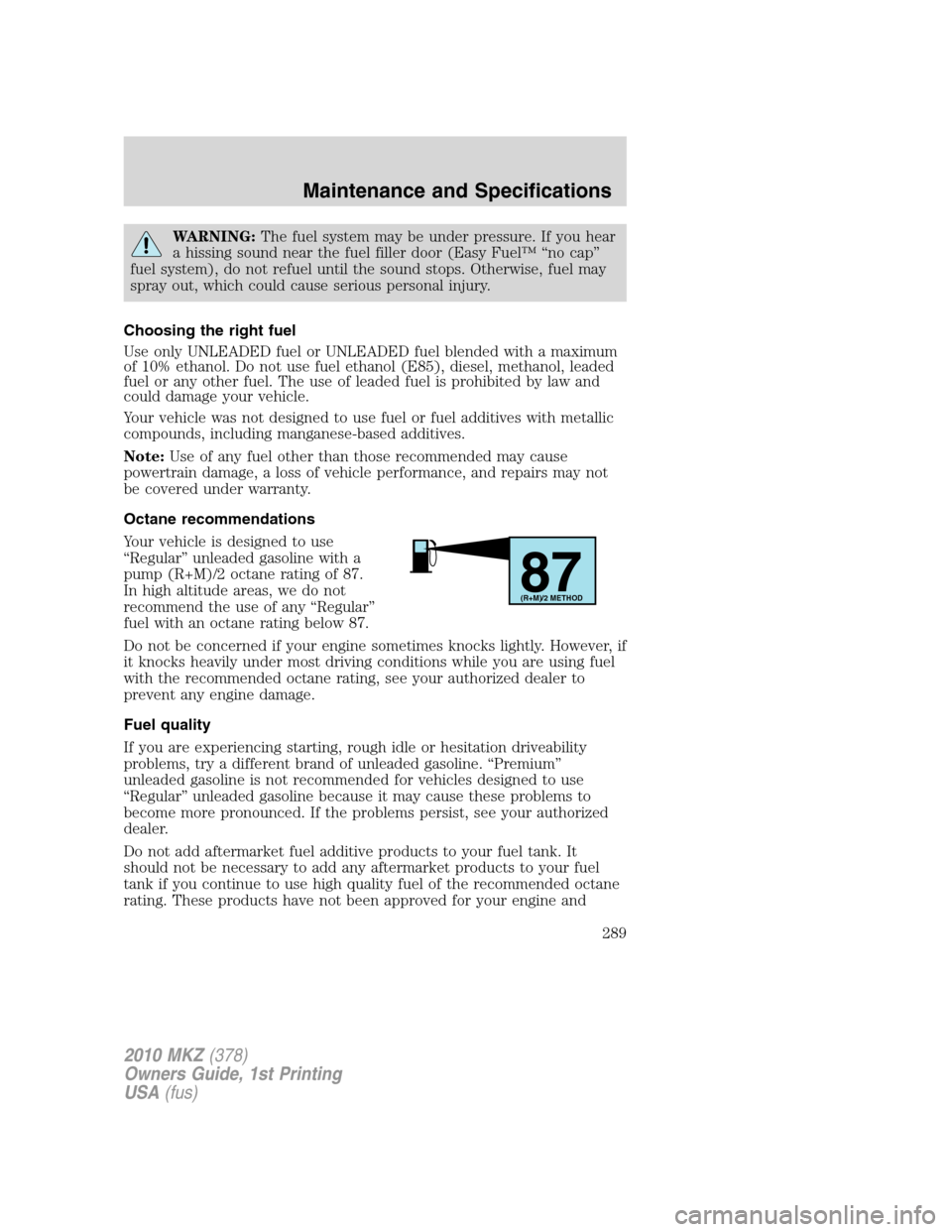
Your vehicle is designed to use
“Regular” unleaded gasoline with a
pump (R+M)/2 octane rating of 87.
In high altitude areas, we do not
recommend the use of any “Regular”
fuel with an octane rating below 87.
Do not be concerned if your engine sometimes knocks lightly. However, if
it knocks heavily under most driving conditions while you are using fuel
with the recommended octane rating, see your authorized dealer to
prevent any engine damage.
Fuel quality
If you are experiencing starting, rough idle or hesitation driveability
problems, try a different brand of unleaded gasoline. “Premium”
unleaded gasoline is not recommended for vehicles designed to use
“Regular” unleaded gasoline because it may cause these problems to
become more pronounced. If the problems persist, see your authorized
dealer.
Do not add aftermarket fuel additive products to your fuel tank. It
should not be necessary to add any aftermarket products to your fuel
tank if you continue to use high quality fuel of the recommended octane
rating. These products have not been approved for your engine and
87(R+M)/2 METHOD
2010 MKZ(378)
Owners Guide, 1st Printing
USA(fus)
Maintenance and Specifications
289
Page 290 of 318

could cause damage to the fuel system. Repairs to correct the effects of
using an aftermarket product in your fuel may not be covered by your
warranty.
Many of the world’s automakers approved the World-Wide Fuel Charter
that recommends gasoline specifications to provide improved
performance and emission control system protection for your vehicle.
Gasolines that meet the World-Wide Fuel Charter should be used when
available. Ask your fuel supplier about gasolines that meet the
World-Wide Fuel Charter.
Cleaner air
Ford endorses the use of reformulated “cleaner-burning” gasolines to
improve air quality, per the recommendations in theChoosing the right
fuelsection.
Running out of fuel
Avoid running out of fuel because this situation may have an adverse
effect on powertrain components.
If you have run out of fuel:
•You may need to cycle the ignition from off to on several times after
refueling to allow the fuel system to pump the fuel from the tank to
the engine. On restarting, cranking time will take a few seconds longer
than normal.
•Normally, adding 1 gallon (3.8L) of fuel is enough to restart the
engine. If the vehicle is out of fuel and on a steep grade, more than
1 gallon (3.8L) may be required.
•TheService engine soon
indicator may come on. For more
information on the “service engine soon” indicator, refer toWarning
lights and chimesin theInstrument Clusterchapter.
Refilling with a portable fuel container
With the Easy Fuel™ “no cap” fuel system, use the following directions
when filling from a portable fuel container:
WARNING:Do not insert the nozzle of portable fuel containers
or aftermarket funnels into the Easy Fuel™ system. This could
damage the fuel system and its seal, and may cause fuel to run onto
the ground instead of filling the tank, which could result in serious
personal injury.
2010 MKZ(378)
Owners Guide, 1st Printing
USA(fus)
Maintenance and Specifications
290
Page 292 of 318

The advertised capacity is the amount of the indicated capacity and the
empty reserve combined. Indicated capacity is the difference in the
amount of fuel in a full tank and a tank when the fuel gauge indicates
empty. Empty reserve is the small amount of fuel remaining in the fuel
tank after the fuel gauge indicates empty.
The amount of usable fuel in the empty reserve varies and should
not be relied upon to increase driving range. When refueling your
vehicle after the fuel gauge indicates empty, you might not be
able to refuel the full amount of the advertised capacity of the
fuel tank due to the empty reserve still present in the tank.
For consistent results when filling the fuel tank:
•Turn the engine/ignition switch to the off position prior to refueling,
an error in the reading will result if the engine is left running.
•Use the same filling rate setting (low — medium — high) each time
the tank is filled.
•Allow no more than two automatic click-offs when filling.
•Always use fuel with the recommended octane rating.
•Use a known quality gasoline, preferably a national brand.
•Use the same side of the same pump and have the vehicle facing the
same direction each time you fill up.
•Have the vehicle loading and distribution the same every time.
Your results will be most accurate if your filling method is consistent.
Calculating fuel economy
1. Fill the fuel tank completely and record the initial odometer reading
(in miles or kilometers).
2. Each time you fill the tank, record the amount of fuel added (in
gallons or liters).
3. After at least three to five tank fill-ups, fill the fuel tank and record
the current odometer reading.
4. Subtract your initial odometer reading from the current odometer
reading.
5. Follow one of the simple calculations in order to determine fuel
economy:
Calculation 1:Divide total miles traveled by total gallons used.
Calculation 2:Multiply liters used by 100, then divide by total
kilometers traveled.
2010 MKZ(378)
Owners Guide, 1st Printing
USA(fus)
Maintenance and Specifications
292
Page 315 of 318

fail-safe cooling .......................284
idle speed control ...................278
lubrication specifications .......302
refill capacities ........................302
service points ..........................272
starting after a collision .........233
Engine block heater .................201
Engine oil ..................................274
change oil soon warning,
message center .......................274
checking and adding ..............274
dipstick ....................................274
filter, specifications ........277, 301
recommendations ...................277
refill capacities ........................302
specifications ..........................302
Event data recording ....................7
Exhaust fumes ..........................201
F
Fail safe cooling ........................284
Floor mats ...................................87
Fluid capacities .........................302
Fog lamps ....................................54
Four-Wheel Drive vehicles
driving off road .......................226
Fuel ............................................286
calculating fuel
economy ............................20, 291
cap ...........................................288
capacity ...................................302
choosing the right fuel ...........289
comparisons with EPA fuel
economy estimates .................294
detergent in fuel .....................290
filler funnel .............................290
filling your vehicle with
fuel ...........................286, 288, 291filter, specifications ........285, 301
fuel pump shut-off switch .....233
improving fuel economy ........291
octane rating ...................289, 305
quality ......................................289
running out of fuel .........248, 290
safety information relating to
automotive fuels .....................286
Fuel pump shut-off switch .......233
Fuses ..................................234–235
G
Gas cap (see Fuel cap) ............288
Gas mileage (see Fuel
economy) ...................................291
Gauges .........................................17
H
Hazard flashers .........................233
Headlamps ...................................53
aiming ........................................56
autolamp system .......................53
bulb specifications ....................59
daytime running lights .............54
flash to pass ..............................55
high beam .................................55
replacing bulbs .........................61
turning on and off ....................53
Heating
heating and air conditioning
system .................................45, 48
Homelink wireless control
system ..........................................83
Hood ..........................................271
I
Ignition ...............................198, 305
2010 MKZ(378)
Owners Guide, 1st Printing
USA(fus)
Index
315