Page 225 of 611

223
2-4. Using other driving systems
2
When driving
HS250h_U_75033U(Canada)
NOTICE
■In the following situations, the LKA will not work, or will not perform reliably:
●When lane markers are interrupted or are not present, such as before a tollbooth.
●When lane markers are only on one side of the road.
●When driving on a sharp curve.
●When lanes are extremely narrow or extremely wide.
●When the vehicle leans to one side an unusual amount due to a heavy load or
improper tire inflation pressure.
●When the following distance between your vehicle and the vehicle ahead is
extremely short.
●When the lane markers are broken, “Botts’ dots”, or “Raised pavement marker”.
●When lane markers are obscured or partially obscured by sand, dirt, etc.
●When driving on a particularly bright road surface, such as concrete.
●When driving on a road surface that is bright due to reflected light.
●When driving in a location where the light level changes rapidly, such as the
entrance to or exit from a tunnel.
●When sunlight or the headlights of oncoming vehicles are shining directly into the
camera lens.
●When driving on roads that are branching or merging.
●When pavement lane markers are difficult to see due to rain, snow, fog, etc.
●When driving on a road surface that is wet due to rain, previous rainfall, standing
water, etc.
●When the vehicle experiences strong up-and-down motion such as when driving
on an extremely rough road or on a seam in the pavement.
●When headlight brightness is reduced due to dirt on the lenses, or when the
headlights are misaligned.
●When driving with a strong crosswind.
Page 231 of 611
229
2-4. Using other driving systems
2
When driving
HS250h_U_75033U(Canada)
CAUTION
■Replacing tires
Make sure that all tires are of the specified size, brand, tread pattern and total load
capacity. In addition, make sure that the tires are inflated to the recommended tire
inflation pressure level.
The ABS and VSC systems will not function correctly if different tires are installed
on the vehicle.
Contact your Lexus dealer for further information when replacing tires or wheels.
■Handling of tires and the suspension
Using tires with any kind of problem or modifying the suspension will affect the driv-
ing assist systems, and may cause a system to malfunction.
Page 401 of 611

399
3-7. Other interior features
3
Interior features
HS250h_U_75033U(Canada)■
Emergency Assistance Button (“SOS”)
In the event of an emergency on the road, push the “SOS” button to
reach the Safety Connect response center. The answering agent will
determine your vehicle’s location, assess the emergency, and dispatch
the necessary assistance required.
If you accidentally press the “SOS” button, tell the response-center agent
that you are not experiencing an emergency.
■Enhanced Roadsi de Assistance
Enhanced Roadside Assistance adds GPS data to the already
included warranty-based Lexus roadside service.
Subscribers can press the “SOS” button to reach a Safety Connect
response-center agent, who can help with a wide range of needs, such
as: towing, flat tire, fuel delivery, etc. For a description of the Roadside
Assistance services and their limitations, please see the Safety Con-
nect Terms and Conditions, which are available at Lexus.com.
Safety information for Safety Connect
Important! Read this information before using Safety Connect.
■ Exposure to radio frequency signals
The Safety Connect system installed in your vehicle is a low-power
radio transmitter and receiver. It receives and also sends out radio fre-
quency (RF) signals.
In August 1996, the Federal Communications Commission (FCC)
adopted RF exposure guidelines with safety levels for mobile wireless
phones. Those guidelines are consistent with the safety standards pre-
viously set by the following U.S. and international standards bodies.
● ANSI (American National Stan dards Institute) C95.1 [1992]
● NCRP (National Council on Radiation Protection and Measure-
ment) Report 86 [1986]
● ICNIRP (International Commission on Non-Ionizing Radiation Pro-
tection) [1996]
Page 403 of 611
Maintenance and care4
401
HS250h_U_75033U(Canada)
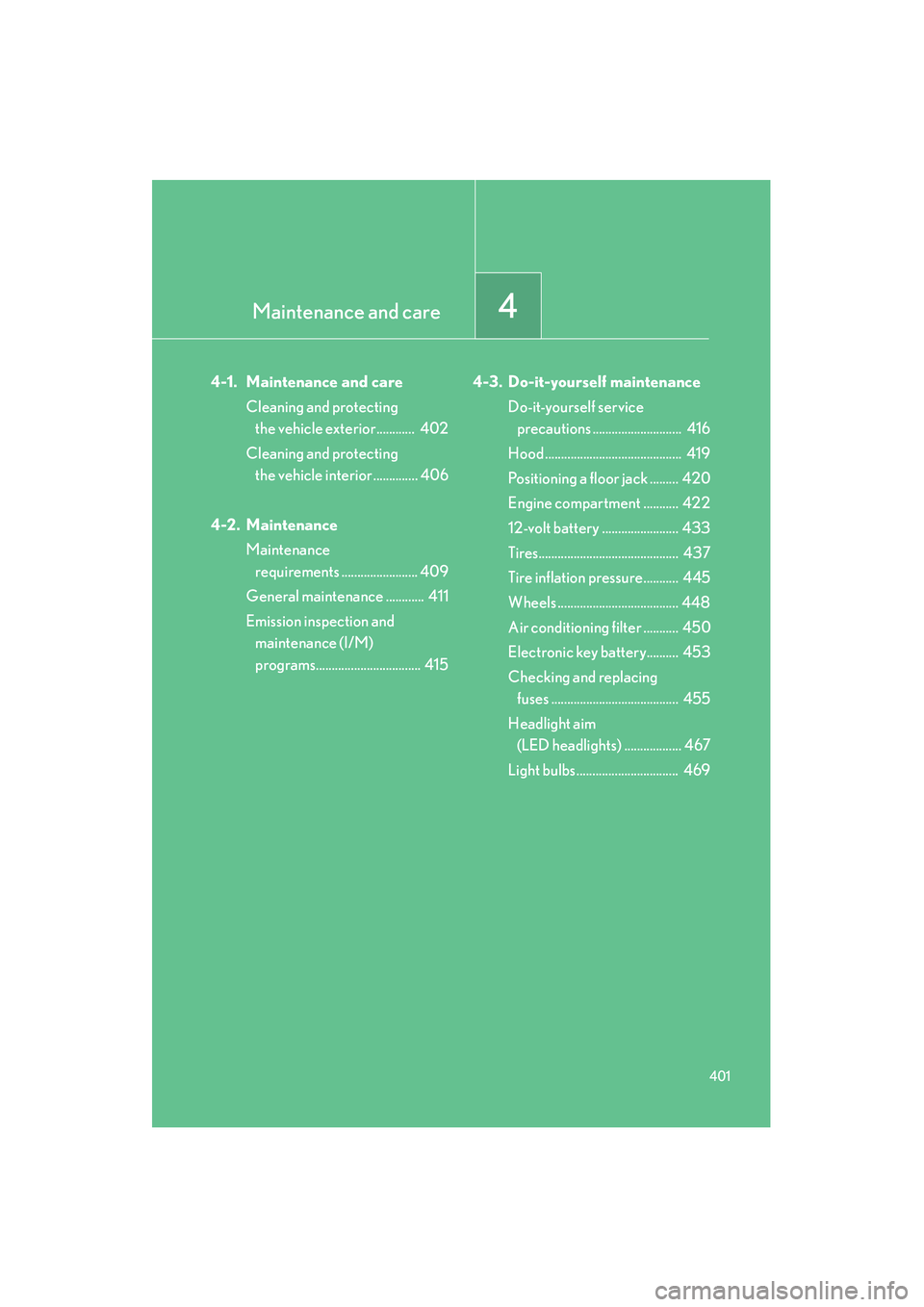
4-1. Maintenance and careCleaning and protecting the vehicle exterior............ 402
Cleaning and protecting the vehicle interior .............. 406
4-2. Maintenance Maintenance requirements ........................ 409
General maintenance ............ 411
Emission inspection and maintenance (I/M)
programs................................. 415 4-3. Do-it-yourself maintenance
Do-it-yourself service precautions ............................ 416
Hood ........................................... 419
Positioning a floor jack ......... 420
Engine compartment ........... 422
12-volt battery ........................ 433
Tires............................................ 437
Tire inflation pressure........... 445
Wheels ...................................... 448
Air conditioning filter ........... 450
Electronic key battery.......... 453
Checking and replacing fuses ........................................ 455
Headlight aim (LED headlights) .................. 467
Light bulbs................................ 469
Page 416 of 611
414
4-2. Maintenance
HS250h_U_75033U(Canada)
Vehicle exterior
ItemsCheck points
Doors/trunk• Do the doors and trunk operate smoothly?
Engine hood• Does the engine hood lock system work properly?
Fluid leaks
• There should not be any signs of fluid leakage after the vehicle has
been parked.
Ti r e s
• Is the tire inflation pressure cor-rect?
• The tires should not be damaged or excessively worn.
• Have the tires been rotated
according to the maintenance
schedule?
• The wheel nuts should not be loose.
CAUTION
■If the hybrid system is operating
Turn the hybrid system off and ensure that there is adequate ventilation before per-
forming maintenance checks.
Page 419 of 611
417
4-3. Do-it-yourself maintenance
4
Maintenance and care
HS250h_U_75033U(Canada)
ItemsParts and tools
Engine oil level (→P. 4 2 4 )
• “Toyota Genuine Motor Oil” or
equivalent
•Rag or paper towel
• Funnel (used only for adding
engine oil)
Fuses (→ P. 4 5 5 )• Fuse with same amperage rating as
original
Headlight aim ( →P. 4 6 7 )• Phillips-head screwdriver
Light bulbs (→ P. 4 6 9 )
• Bulb with same number and watt-
age rating as original
• Phillips-head screwdriver
•Flathead screwdriver
•Wrench
Radiator and condenser (→P. 4 3 0 )
Tire inflation pressure ( →P. 4 4 5 )• Tire pressure gauge
• Compressed air source
Wa s h e r f l u i d ( →P. 4 3 2 )
• Water or washer fluid containing
antifreeze (for winter use)
• Funnel (used only for adding water
or washer fluid)
Page 439 of 611
437
4-3. Do-it-yourself maintenance
4
Maintenance and care
HS250h_U_75033U(Canada)
Ti r e s
Replace or rotate tires in accordance with maintenance schedules and
treadwear.
■Checking tires
New tread
Treadwear indicator
Worn tread
The location of treadwear indi-
cators is shown by the “TWI” or
“∆ ” marks, etc., molded on the
sidewall of each tire.
Check spare tire condition and
pressure if not rotated.
■ Tire rotation
Rotate the tires in the order
shown.
To equalize tire wear and extend
tire life, Lexus recommends that
tire rotation is carried out at the
same interval as tire inspection.
P225/45R18 91W tires:
Do not fail to initialize the tire
pressure warning system after
tire rotation.
■Tire pressure warning system
Your vehicle is equipped with a tire pressure warning system that
uses tire pressure warning valves and transmitters to detect low tire
inflation pressure before serious problems arise. ( →P. 495, 504,
505)
Front
Page 440 of 611
438
4-3. Do-it-yourself maintenance
HS250h_U_75033U(Canada)
Installing tire pressure warning valves and transmitters
When replacing tires or wheels, tire pressure warning valves and trans-
mitters must also be installed.
When new tire pressure warning valves and transmitters are installed,
new ID codes must be registered in the tire pressure warning computer
and the tire pressure warning system must be initialized. Have tire pres-
sure warning valve and transmitter ID codes registered by your Lexus
dealer. ( →P. 4 3 9 )
Initializing the tire pressure warning system
■ The tire pressure warning system must be initialized in the following
circumstances:
●Vehicles with P225/45R18 91W tires: When rotating front and rear
tires which have different tire inflation pressures
● When changing the tire size
When the tire pressure warning system is initialized, the current tire
inflation pressure is set as the benchmark pressure.


