2010 KIA Sportage engine
[x] Cancel search: enginePage 337 of 371
Maintenance
28
7
1
2
3
4
5
6
7
8
9
LUBRICANTS AND FLUIDS
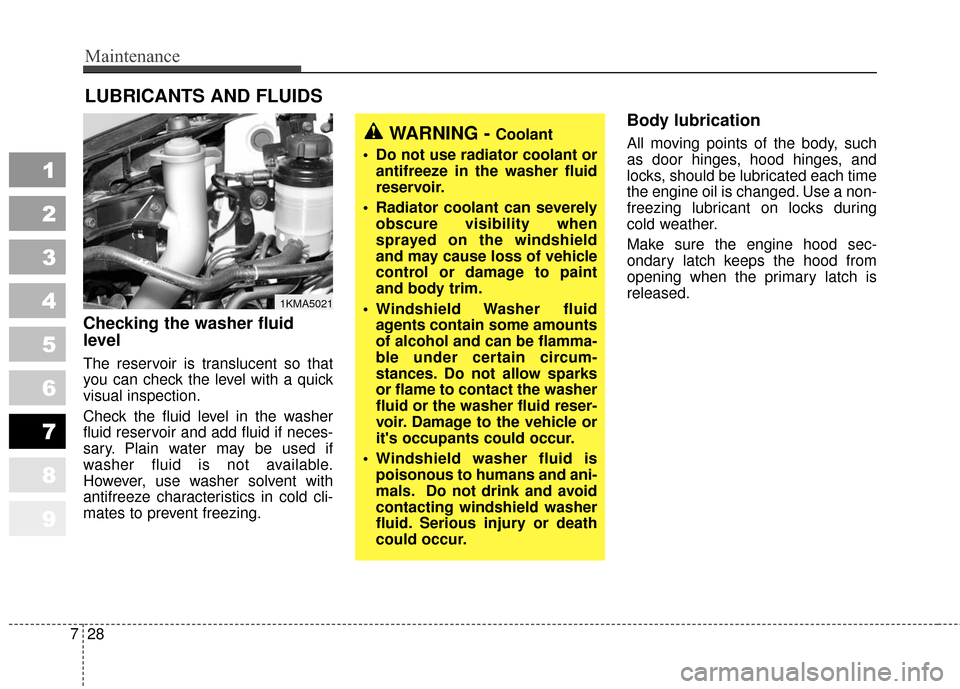
Checking the washer fluid
level
The reservoir is translucent so that
you can check the level with a quick
visual inspection.
Check the fluid level in the washer
fluid reservoir and add fluid if neces-
sary. Plain water may be used if
washer fluid is not available.
However, use washer solvent with
antifreeze characteristics in cold cli-
mates to prevent freezing.
Body lubrication
All moving points of the body, such
as door hinges, hood hinges, and
locks, should be lubricated each time
the engine oil is changed. Use a non-
freezing lubricant on locks during
cold weather.
Make sure the engine hood sec-
ondary latch keeps the hood from
opening when the primary latch is
released.
1KMA5021
WARNING - Coolant
Do not use radiator coolant or antifreeze in the washer fluid
reservoir.
Radiator coolant can severely obscure visibility when
sprayed on the windshield
and may cause loss of vehicle
control or damage to paint
and body trim.
Windshield Washer fluid agents contain some amounts
of alcohol and can be flamma-
ble under certain circum-
stances. Do not allow sparks
or flame to contact the washer
fluid or the washer fluid reser-
voir. Damage to the vehicle or
it's occupants could occur.
Windshield washer fluid is poisonous to humans and ani-
mals. Do not drink and avoid
contacting windshield washer
fluid. Serious injury or death
could occur.
Page 338 of 371
729
Maintenance
1
2
3
4
5
6
7
8
9
AIR CLEANER
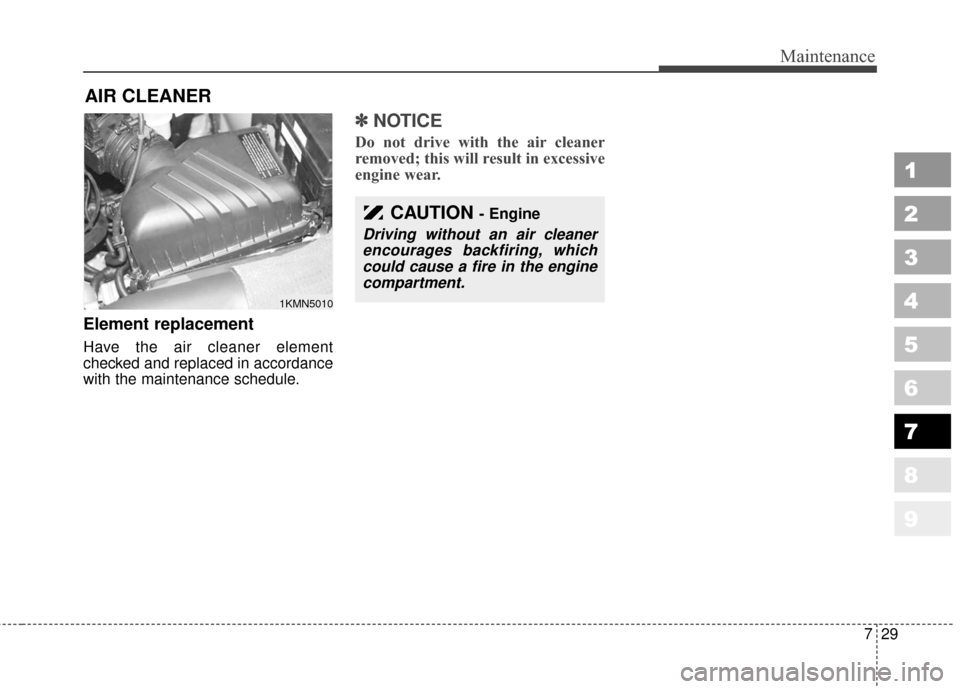
Element replacement
Have the air cleaner element
checked and replaced in accordance
with the maintenance schedule.
✽ ✽NOTICE
Do not drive with the air cleaner
removed; this will result in excessive
engine wear.
1KMN5010
CAUTION - Engine
Driving without an air cleaner
encourages backfiring, whichcould cause a fire in the enginecompartment.
Page 343 of 371
Maintenance
34
7
1
2
3
4
5
6
7
8
9
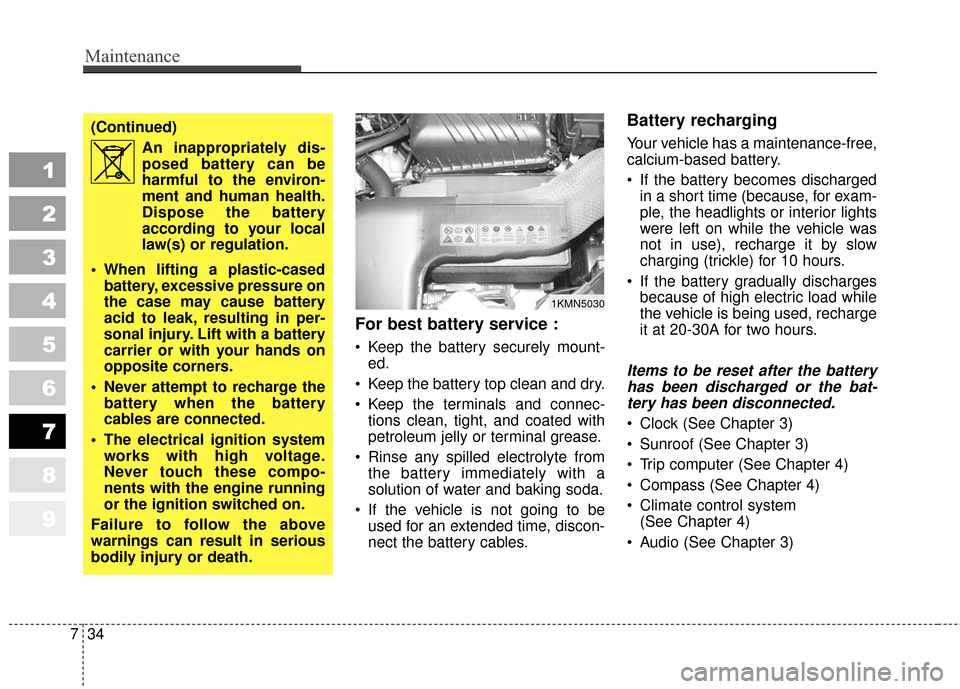
For best battery service :
Keep the battery securely mount-
ed.
Keep the battery top clean and dry.
Keep the terminals and connec- tions clean, tight, and coated with
petroleum jelly or terminal grease.
Rinse any spilled electrolyte from the battery immediately with a
solution of water and baking soda.
If the vehicle is not going to be used for an extended time, discon-
nect the battery cables.
Battery recharging
Your vehicle has a maintenance-free,
calcium-based battery.
If the battery becomes dischargedin a short time (because, for exam-
ple, the headlights or interior lights
were left on while the vehicle was
not in use), recharge it by slow
charging (trickle) for 10 hours.
If the battery gradually discharges because of high electric load while
the vehicle is being used, recharge
it at 20-30A for two hours.
Items to be reset after the batteryhas been discharged or the bat-tery has been disconnected.
Clock (See Chapter 3)
Sunroof (See Chapter 3)
Trip computer (See Chapter 4)
Compass (See Chapter 4)
Climate control system (See Chapter 4)
Audio (See Chapter 3)
1KMN5030
(Continued) An inappropriately dis-
posed battery can be
harmful to the environ-
ment and human health.
Dispose the battery
according to your local
law(s) or regulation.
When lifting a plastic-cased battery, excessive pressure on
the case may cause battery
acid to leak, resulting in per-
sonal injury. Lift with a battery
carrier or with your hands on
opposite corners.
Never attempt to recharge the battery when the battery
cables are connected.
The electrical ignition system works with high voltage.
Never touch these compo-
nents with the engine running
or the ignition switched on.
Failure to follow the above
warnings can result in serious
bodily injury or death.
Page 344 of 371
735
Maintenance
1
2
3
4
5
6
7
8
9
✽ ✽NOTICE
• Before performing maintenance
or recharging the battery, turn off
all accessories and stop the engine.
• The negative battery cable must be removed first and installed last
when the battery is disconnected. WARNING- Recharging
battery
When recharging the battery,
observe the following precau-
tions:
The battery must be removed from the vehicle and placed in
an area with good ventilation.
Do not allow cigarettes, sparks, or flame near the bat-
tery.
Watch the battery during charging, and stop or reduce
the charging rate if the battery
cells begin gassing (boiling)
violently or if the temperature
of the electrolyte of any cell
exceeds 49°C (120°F).
Wear eye protection when checking the battery during
charging.
(Continued)(Continued)
Disconnect the battery charg-er in the following order.
1. Turn off the battery charger main switch.
2. Unhook the negative clamp from the negative battery ter-
minal.
3. Unhook the positive clamp from the positive battery ter-
minal.
Page 360 of 371
751
Maintenance
1
2
3
4
5
6
7
8
9
Waxing
Wax the vehicle when water will no
longer bead on the paint.
Always wash and dry the vehicle
before waxing. Use a good quality
liquid or paste wax, and follow the
manufacturer’s instructions. Wax all
metal trim to protect it and to main-
tain its luster.
Removing oil, tar, and similar materi-
als with a spot remover will usually
strip the wax from the finish. Be sure
to re-wax these areas even if the rest
of the vehicle does not yet need wax-
ing.
✽ ✽NOTICE
• Wiping dust or dirt off the body
with a dry cloth will scratch the
finish.
• Do not use steel wool, abrasive cleaners, or strong detergents con-
taining highly alkaline or caustic
agents on chrome-plated or
anodized aluminum parts. This
may result in damage to the pro-
tective coating and cause discol-
oration or paint deterioration.
Finish damage repair
Deep scratches or stone chips in the
painted surface must be repaired
promptly. Exposed metal will quickly
rust and may develop into a major
repair expense.
✽ ✽ NOTICE
If your vehicle is damaged and
requires any metal repair or
replacement, be sure the body shop
applies anti-corrosion materials to
the parts repaired or replaced. OJB037800
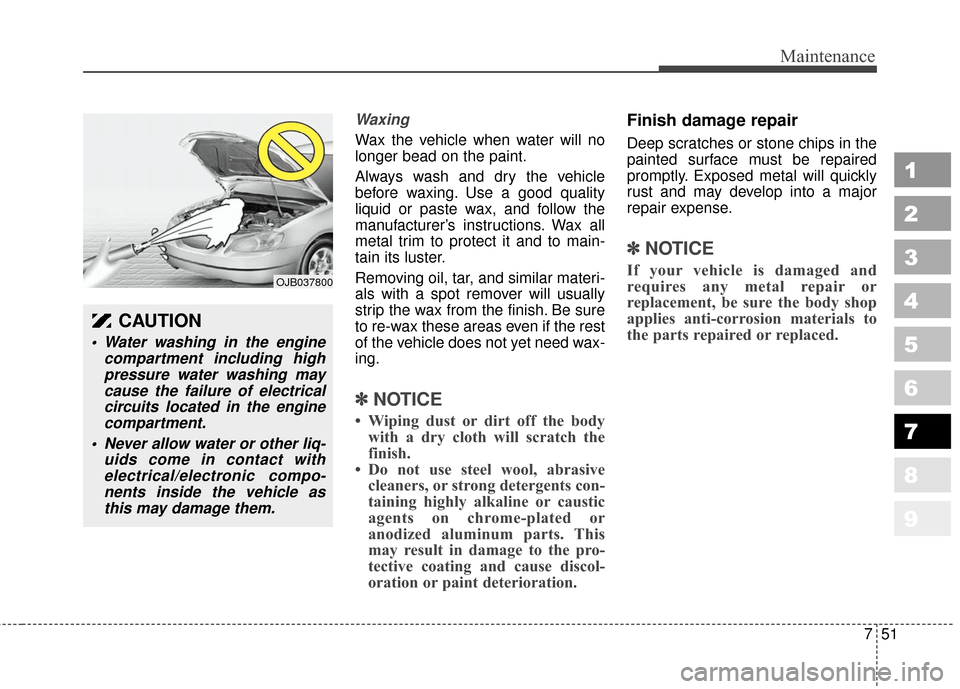
CAUTION
Water washing in the engine
compartment including highpressure water washing maycause the failure of electricalcircuits located in the enginecompartment.
Never allow water or other liq- uids come in contact withelectrical/electronic compo-nents inside the vehicle asthis may damage them.
Page 366 of 371

Specifications
48
1
2
3
4
5
6
7
8
9
RECOMMENDED LUBRICANTS AND CAPACITIES
*1Refer to the recommended SAE viscosity numbers on the next page.
*2Engine oils labeled Energy Conserving Oil are now available. Along with other additional benefits, they contribute to fuel econo my by reducing
the amount of fuel necessary to overcome engine friction. Often, these improvements are difficult to measure in everyday driving, but in a year’s
time, they can offer significant cost and energy savings.
*
3If the API service SM engine oil is not available in your country, you are able to use API service SL
Lubricant Volume Classification
Engine oil *
1*24.0 l(4.2 qts.) API Service SM*3, ILSAC GF-4 or above
(with filter change) 4.5 l(4.8 qts.) API Service SL or SM, ILSAC GF-3 or above
Manual transaxle fluid 2.10 l (2.22 qts.) API Service GL-4 (SAE 75W-85, fill for-life)
Automatic transaxle fluid 7.8 l (8.2 qts.) DIAMOND ATF SP-III or SK ATF SP-III
Transfer case fluid (4WD) 0.8 l (0.85 qts.) API Service GL-5 or above
Rear differential fluid (4WD) 0.75 l (0.79 qts.) (SAE 80W-90, SHELL SPIRAX AX or equivalent)
Power steering 0.9 l (0.95 qts.) PSF-III
Coolant 7.0 l (7.4 qts.) Ethylene glycol base for aluminum radiator
Brake/Clutch fluid 0.7~0.8 l(0.7~0.8 qts.) FMVSS116 DOT-3 or DOT-4
Fuel 58
l (15.3 gal.)
Unleaded gasoline with AKI 87 or higher
65 l (17.2 gal.)2.0L
2.7L
2.0L
2.7L
To help achieve proper engine and powertrain performance and durability, use only lubricants of the proper quality. The correct
lubricants also help promote engine efficiency that results in improved fuel economy.
These lubricants and fluids are recommended for use in your vehicle.
Page 367 of 371

85
1
2
3
4
5
6
7
8
9
Specifications
Recommended SAE viscosity
number Engine oil viscosity (thickness) has
an effect on fuel economy and cold
weather operating (starting and oil
flow). Lower viscosity engine oils can
provide better fuel economy and cold
weather performance, however,
higher viscosity engine oils are
required for satisfactory lubrication in
hot weather. Using oils of any viscos-
ity other than those recommended
could result in engine damage.When choosing an oil, consider the
range of temperature your vehicle
will be operated in before the next oil
change. Proceed to select the rec-
ommended oil viscosity from the
chart.
Temperature Range for SAE Viscosity Numbers
Temperature
Gasoline
Engine Oil *
1 *2
°C
(°F)-30 -20 -10 0 10 20 30 40 50 -10 0 20 40 60 80 100 120
10W-30
5W-20, 5W-30
1. Gasoline Engine 2.0L - For better fuel economy, it is recommended to use the engine oil of a
viscosity grade SAE 5W-20 (API SM / ILSAC GF-4). However, if the engine oil is not available
in your country, select the proper engine oil using the engine oil viscosity chart.
2. Gasoline Engine 2.7L - For better fuel economy, it is recommended to use the engine oil of a viscosity grade SAE 5W-20, 5W-30 (API SL or SM / ILSAC GF-3). However, if the engine oil
is not available in your country, select the proper engine oil using the engine oil viscosity chart.
CAUTION
Always be sure to clean the areaaround any filler plug, drainplug, or dipstick before check-ing or draining any lubricant.This is especially important industy or sandy areas and whenthe vehicle is used on unpavedroads. Cleaning the plug anddipstick areas will prevent dirtand grit from entering theengine and other mechanismsthat could be damaged.
Page 369 of 371

Index
29
1
2
3
4
5
6
7
8
9
Air cleaner. . . . . . . . . . . . . . . . . . . . . . . . . . . . . . . . . . 7-29\
Airbags-supplemental restraint system . . . . . . . . . . 3-55
Audio system . . . . . . . . . . . . . . . . . . . . . . . . . . . . . . . 3-105
Automatic climate control system. . . . . . . . . . . . . . . 4-71
Automatic transaxle . . . . . . . . . . . . . . . . . . . . . . 4-6, 7-25
Battery . . . . . . . . . . . . . . . . . . . . . . . . . . . . . . . . . . . . \
. 7-33
Before driving . . . . . . . . . . . . . . . . . . . . . . . . . . . . . . . . 5-5
Brake system . . . . . . . . . . . . . . . . . . . . . . . . . . . . . . . . 4-18
Brakes and clutch . . . . . . . . . . . . . . . . . . . . . . . . . . . . 7-22
Climate control air filter . . . . . . . . . . . . . . . . . . . . . . 7-30
Compass . . . . . . . . . . . . . . . . . . . . . . . . . . . . . . . . . . . 4-\
51
Cruise control system. . . . . . . . . . . . . . . . . . . . . . . . . 4-26
Defroster . . . . . . . . . . . . . . . . . . . . . . . . . . . . . . . . . . . 4-\
61
Door locks . . . . . . . . . . . . . . . . . . . . . . . . . . . . . . . . . . . 3-\
9
Electrical circuit protection . . . . . . . . . . . . . . . . . . . . . 6-7
Electronic stability control . . . . . . . . . . . . . . . . . . . . 4-30
Emergency starting . . . . . . . . . . . . . . . . . . . . . . . . . . . 6-4Emission control system . . . . . . . . . . . . . . . . . . . . . . . 5-3
Engine compartment . . . . . . . . . . . . . . . . . . . . . . . . . 7-15
Engine cooling system . . . . . . . . . . . . . . . . . . . . . . . . 7-19
Engine oil and oil filter . . . . . . . . . . . . . . . . . . . . . . . 7-17
Explanation of scheduled maintenance items . . . . . . 7-8
Exterior care . . . . . . . . . . . . . . . . . . . . . . . . . . . . . . . . 7-50
Four wheel drive (4WD) . . . . . . . . . . . . . . . . . . . . . . 4-12
Fuel filler lid . . . . . . . . . . . . . . . . . . . . . . . . . . . . . . . . 3-81
Fuel requirements . . . . . . . . . . . . . . . . . . . . . . . . . . . . 5-2
Gauges . . . . . . . . . . . . . . . . . . . . . . . . . . . . . . . . . . . . \
. 4-34
Hazard warning flasher . . . . . . . . . . . . . . . . . . . . . . . 4-62
Homelink® wireless control system . . . . . . . . . . . . . 5-45
Hood. . . . . . . . . . . . . . . . . . . . . . . . . . . . . . . . . . \
. . . . . 3-80
How to use this manual . . . . . . . . . . . . . . . . . . . . . . . . 1-2
If you have a flat tire . . . . . . . . . . . . . . . . . . . . . . . . . 6-19
Ignition switch . . . . . . . . . . . . . . . . . . . . . . . . . . . . . . . 4-2
Immobilizer system . . . . . . . . . . . . . . . . . . . . . . . . . . . 3-6
In case of an emergency while driving . . . . . . . . . . . . 6-2
Instrument cluster . . . . . . . . . . . . . . . . . . . . . . . . . . . 4-33
A
B
C
D
E
G
F
H
I