Page 410 of 522
WARNING! (Continued)
•If working on or near a roadway, be extremely
careful of motor traffic.
•To assure that spare tires, flat or inflated, are
securely stowed, spares must be stowed with the
valve stem facing the ground.
•Turn on the Hazard Warning flasher.
1. Remove spare tire. 2. Remove jack and tools from mounting bracket. As-
semble the tools by connecting the driver to the exten-
sion, and then to the lug wrench.
3. Loosen (but do not remove) the wheel lug nuts by
turning them to the left one turn while the wheel is still
on the ground.
Jack Warning Label
6
WHAT TO DO IN EMERGENCIES 409
Page 412 of 522
WARNING!
Raising the vehicle higher than necessary can make
the vehicle less stable and cause an accident. It could
slip off the jack and hurt someone near it. Raise the
vehicle only enough to remove the tire.
6. Remove the lug nuts and wheel.
7. Position the spare wheel/tire on the vehicle and install
lug nuts with the cone-shaped end toward the wheel.
Lightly tighten the nuts. To avoid the risk of forcing the
vehicle off the jack, do not tighten the nuts fully until the
vehicle has been lowered.
8. Lower the vehicle by turning the jack screw to the left,
and remove the jack and wheel blocks. 9. Finish tightening the lug nuts. Push down on the
wrench while tightening for increased leverage. Alternate
nuts until each nut has been tightened twice. The correct
wheel nut tightness is 95 ft lb (130 N·m). If in doubt about
the correct tightness, have them checked with a torque
wrench by your authorized dealer or at a service station.
10. Lower the jack to it’s fully closed position.
WARNING!
A loose tire or jack, thrown forward in a collision or
hard stop, could endanger the occupants of the ve-
hicle. Always stow the jack parts and the spare tire in
the places provided.
11. Secure the tire, jack, and tools in their proper
locations.
6
WHAT TO DO IN EMERGENCIES 411
Page 413 of 522
JUMP-STARTING
Do not attempt to push or tow your vehicle to get it started.
Vehicles equipped with an automatic transmission cannot
be started this way. Also, there is a greater risk of an
accident when a vehicle is being pushed or towed. If the
vehicle has a discharged battery, booster cables may be
used to obtain a start from a booster battery or the battery
in another vehicle. This type of start can be dangerous if
done improperly, so follow this procedure carefully.
WARNING!
•Take care to avoid the radiator cooling fan when-
ever the hood is raised. It can start anytime the
ignition switch is ON. You can be hurt by the fan.
•Remove any metal jewelry such as watch bands or
bracelets that might make an inadvertent electrical
contact. You could be seriously injured.(Continued)
WARNING! (Continued)
•Battery fluid is a corrosive acid solution that can
cause serious burns; do not allow battery fluid to
contact eyes, skin or clothing. Wear safety glasses
and protect your eyes at all times. If acid splashes
in eyes or on skin, flush contaminated area imme-
diately with large quantities of water.
•A battery generates hydrogen gas which is flam-
mable and explosive. Keep flame or spark away
from the vent holes. Do not lean over battery when
attaching clamps or allow the clamps to touch each
other.
•Do not use a booster battery or any other booster
source that has a greater than 12 Volt system, i.e.,
do not use a 24 Volt power source.
1. Wear eye protection and remove all metal jewelry such
as watchbands or bracelets that might make an unin-
tended electrical contact.
412 WHAT TO DO IN EMERGENCIES
Page 415 of 522
7. If the vehicle is equipped with Sentry Key�Immobi-
lizer, turn the ignition switch to the ON position for three
seconds before moving the ignition switch to the START
position.
8. Start the engine in the vehicle that has the booster
battery, let the engine idle a few minutes, and then start
the engine in the vehicle with the discharged battery.
9. When removing the jumper cables, reverse the above
sequence exactly. Be careful of the moving belts and fan.
WARNING!
Any procedure other than above could result in:
•Personal injury caused by electrolyte squirting out
the battery vent.
•Personal injury or property damage due to battery
explosion.
CAUTION!
Any procedure other than above could result in
damage to the charging system of the booster vehicle
or of the immobilized vehicle.
TOWING A DISABLED VEHICLE
Proper towing or lifting equipment is required to prevent
damage to your vehicle. Use of safety chains is recom-
mended. Attach towing device to main structural mem-
bers of the vehicle — not to bumpers or associated
brackets. State and local laws, applying to vehicles
under tow, must be observed.
414 WHAT TO DO IN EMERGENCIES
Page 416 of 522
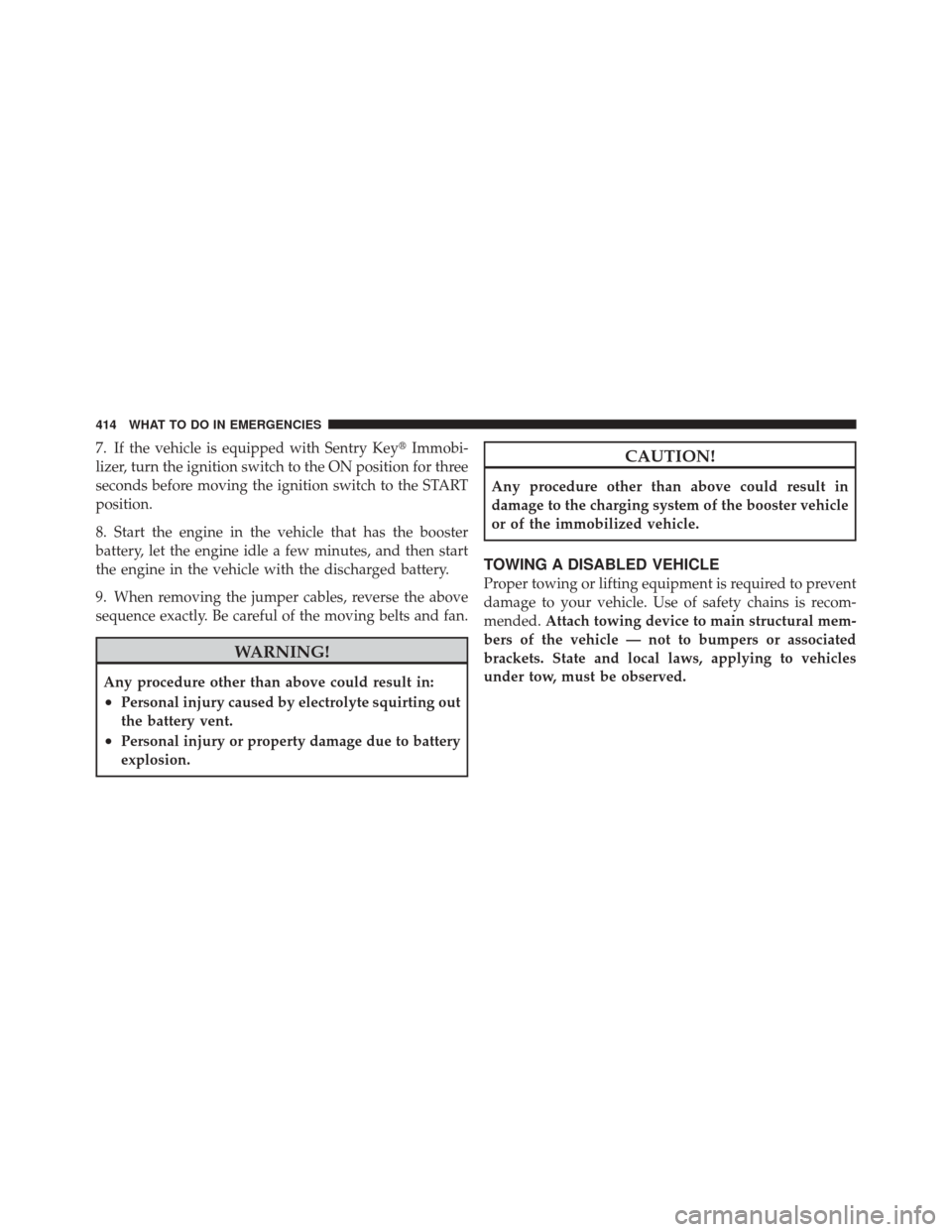
TOWING METHODS
NOTE: When towing a 4x4 model, the transfer case must be in NEUTRAL and the transmission must be in
PARK. Model Flat Towing (all four wheels ON theground) Flatbed Towing (all
four wheels sus-pended OFF the ground) Front Wheels
Raised, Rear Wheels on the Ground Rear Wheels Raised,
Front Wheels on the Ground
2 Wheel Drive Rear driveshaft must be removedRecommended
MethodSpeed less than
30 mph (48 km/h)
and distance less
than 15 miles
(24 km)Speed less than
30 mph (48 km/h)
and distance less
than 15 miles
(24 km)
4 Wheel Drive Transfer case must be in NEUTRAL and
transmission must be
in PARKRecommended
Method
NOT Permitted NOT Permitted
6
WHAT TO DO IN EMERGENCIES 415
Page 421 of 522
ONBOARD DIAGNOSTIC SYSTEM — OBD II
Your vehicle is equipped with a sophisticated Onboard
Diagnostic system called OBD II. This system monitors
the performance of the emissions, engine, and automatic
transmission control systems. When these systems are
operating properly, your vehicle will provide excellent
performance and fuel economy, as well as engine emis-
sions well within current government regulations.
If any of these systems require service, the OBD II system
will turn on the “Malfunction Indicator Light (MIL).” It
will also store diagnostic codes and other information to
assist your service technician in making repairs. Al-
though your vehicle will usually be drivable and not
need towing, see your authorized dealer for service as
soon as possible.CAUTION!
•Prolonged driving with the MIL on could cause
further damage to the emission control system. It
could also affect fuel economy and drivability. The
vehicle must be serviced before any emissions
tests can be performed.
•If the MIL is flashing while the engine is running,
severe catalytic converter damage and power loss
will soon occur. Immediate service is required.
Loose Fuel Filler Cap Message
If the vehicle diagnostic system determines that the fuel
filler cap is loose, improperly installed, or damaged, a
“gASCAP” message will display in the odometer or a
“CHECK GASCAP” message will be displayed in the
Electronic Vehicle Information Center (EVIC). Refer to
“Electronic Vehicle Information Center” in Section 4 of
420 MAINTAINING YOUR VEHICLE
Page 433 of 522
NOTE:Life expectancy of wiper blades varies depend-
ing on geographical area and frequency of use. Poor
performance of blades may be present with chattering,
marks, water lines or wet spots. If any condition is
present please proceed to clean wiper blades with humid
cloth removing any debris that may be affecting its
function.
Adding Washer Fluid
The windshield and rear window washers share the same
fluid reservoir. The fluid reservoir is located in the front
of the engine compartment. Be sure to check the fluid
level in the reservoir at regular intervals. Fill the reservoir
with windshield washer solvent (not radiator antifreeze)
and operate the system for a few seconds to flush out the
residual water. When refilling the washer fluid reservoir, take some
washer fluid and apply it to a cloth or towel and wipe
clean the wiper blades, this will help blade performance.
To prevent freeze-up of your windshield washer system
in cold weather, select a solution or mixture that meets or
exceeds the temperature range of your climate. This
rating information can be found on most washer fluid
containers.
WARNING!
Commercially available windshield washer solvents
are flammable. They could ignite and burn you. Care
must be exercised when filling or working around
the washer solution.
432 MAINTAINING YOUR VEHICLE
Page 436 of 522
To minimize the possibility of catalytic converter dam-
age:
•Do not shut off the engine or interrupt the ignition
when the transmission is in gear and the vehicle is in
motion.
•Do not try to start the engine by pushing or towing the
vehicle.
•Do not idle the engine with any ignition coil connec-
tors disconnected for prolonged periods.
•Do not idle the engine for prolonged periods during
very rough idle or malfunctioning operating condi-
tions.
•Do not allow vehicle to run out of fuel.
Cooling System
WARNING!
•You or others can be badly burned by hot coolant
or steam from your radiator. If you see or hear
steam coming from under the hood, do not open
the hood until the radiator has had time to cool.
Never try to open a cooling system pressure cap
when the radiator is hot.
Engine Coolant Checks
Check the engine coolant (antifreeze) protection every
12 months (before the onset of freezing weather, where
applicable). If the engine coolant (antifreeze) is dirty or
rusty in appearance, the system should be drained,
flushed, and refilled with fresh coolant. Check the front
of the A/C condenser (if equipped) or radiator for any
accumulation of bugs, leaves, etc. If dirty, clean by gently
7
MAINTAINING YOUR VEHICLE 435