Page 361 of 522

WARNING! (Continued)
•Failure to equip your vehicle with tires having
adequate speed capability can result in sudden tire
failure and loss of vehicle control.
CAUTION!
Replacing original tires with tires of a different size
may result in false speedometer and odometer read-
ings.
TIRE CHAINS
Use only compact chains, or other traction aids that meet
SAE type “Class S” specifications. Chains must be the
proper size for the vehicle, as recommended by the chain
manufacturer. In addition, only install tire chains on
P225/75R16 or smaller tires.
CAUTION!
To avoid damage to your vehicle, tires, or chains,
observe the following precautions:
•Do not use tire chains on vehicles equipped with
tires other than P225/75R16 or smaller tires. There
may not be adequate clearance for the chains and
you are risking structural or body damage to your
vehicle.
•Because of limited chain clearance between tires
and other suspension components, it is important
that only chains in good condition are used. Bro-
ken chains can cause serious vehicle damage. Stop
the vehicle immediately if noise occurs that could
suggest chain breakage. Remove the damaged
parts of the chain before further use.(Continued)
360 STARTING AND OPERATING
Page 363 of 522
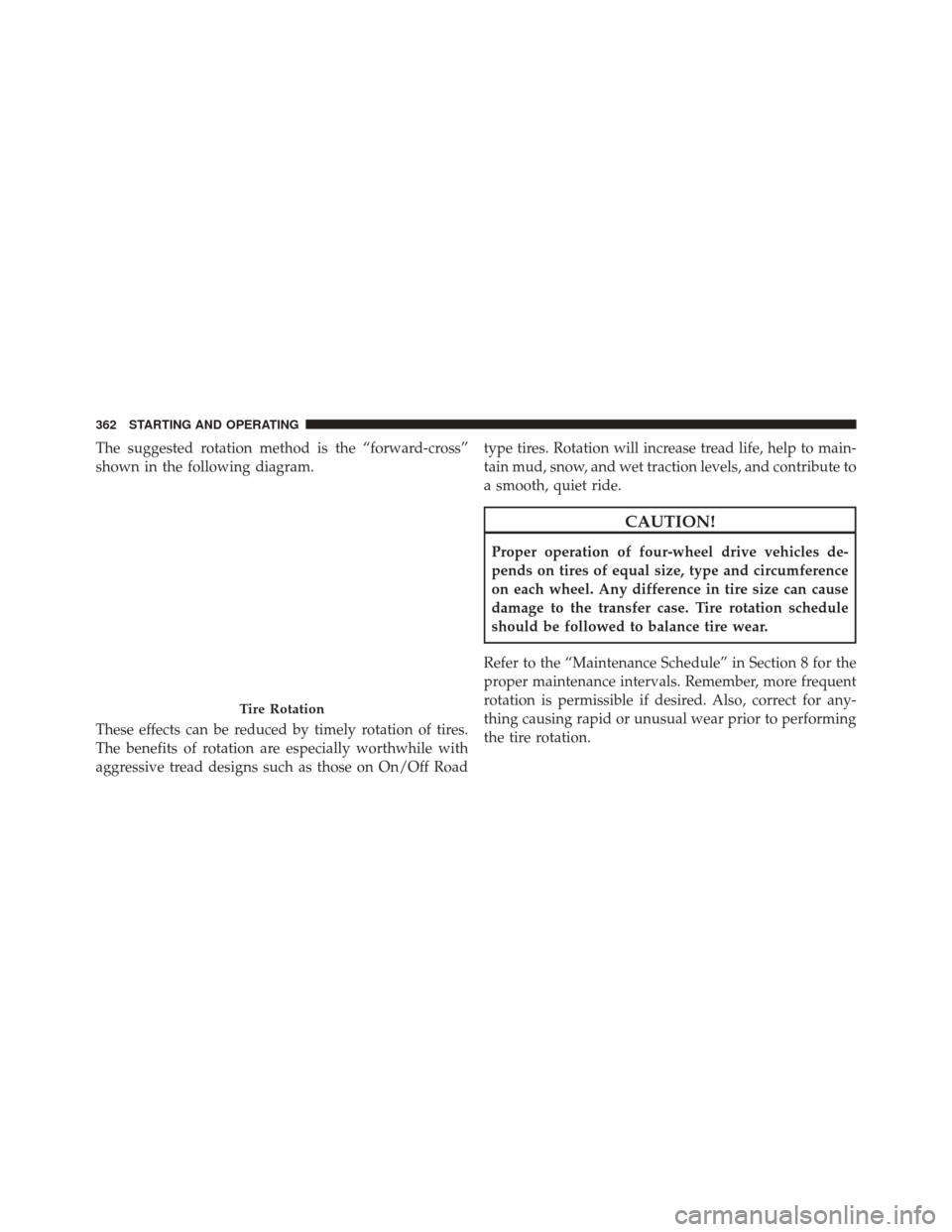
The suggested rotation method is the “forward-cross”
shown in the following diagram.
These effects can be reduced by timely rotation of tires.
The benefits of rotation are especially worthwhile with
aggressive tread designs such as those on On/Off Roadtype tires. Rotation will increase tread life, help to main-
tain mud, snow, and wet traction levels, and contribute to
a smooth, quiet ride.
CAUTION!
Proper operation of four-wheel drive vehicles de-
pends on tires of equal size, type and circumference
on each wheel. Any difference in tire size can cause
damage to the transfer case. Tire rotation schedule
should be followed to balance tire wear.
Refer to the “Maintenance Schedule” in Section 8 for the
proper maintenance intervals. Remember, more frequent
rotation is permissible if desired. Also, correct for any-
thing causing rapid or unusual wear prior to performing
the tire rotation.
Tire Rotation
362 STARTING AND OPERATING
Page 365 of 522
For example, your vehicle may have a recommended
cold (parked for more than three hours) placard pressure
of 33 psi (227 kPa). If the ambient temperature is 68°F
(20°C) and the measured tire pressure is 28 psi (193 kPa),
a temperature drop to 20°F (-7°C) will decrease the tire
pressure to approximately 24 psi (165 kPa). This tire
pressure is low enough to turn ON the “Tire Pressure
Monitoring Telltale Light.” Driving the vehicle may cause
the tire pressure to rise to approximately 28 psi (193 kPa),
but the “Tire Pressure Monitoring Telltale Light” will still
be on. In this situation, the “Tire Pressure Monitoring
Telltale Light” will turn off only after the tires are inflated
to the vehicle’s recommended cold placard pressure
value.CAUTION!
•The TPMS has been optimized for the original
equipment tires and wheels. TPMS pressures and
warning have been established for the tire size
equipped on your vehicle. Undesirable system
operation or sensor damage may result when us-
ing replacement equipment that is not of the same
size, type, and/or style. Aftermarket wheels can
cause sensor damage. Do not use aftermarket tire
sealants or balance beads if your vehicle is
equipped with a TPMS, as damage to the sensors
may result.
•After inspecting or adjusting the tire pressure,
always reinstall the valve stem cap. This will
prevent moisture and dirt from entering the valve
stem, which could damage the Tire Pressure Moni-
toring Sensor.
364 STARTING AND OPERATING
Page 407 of 522
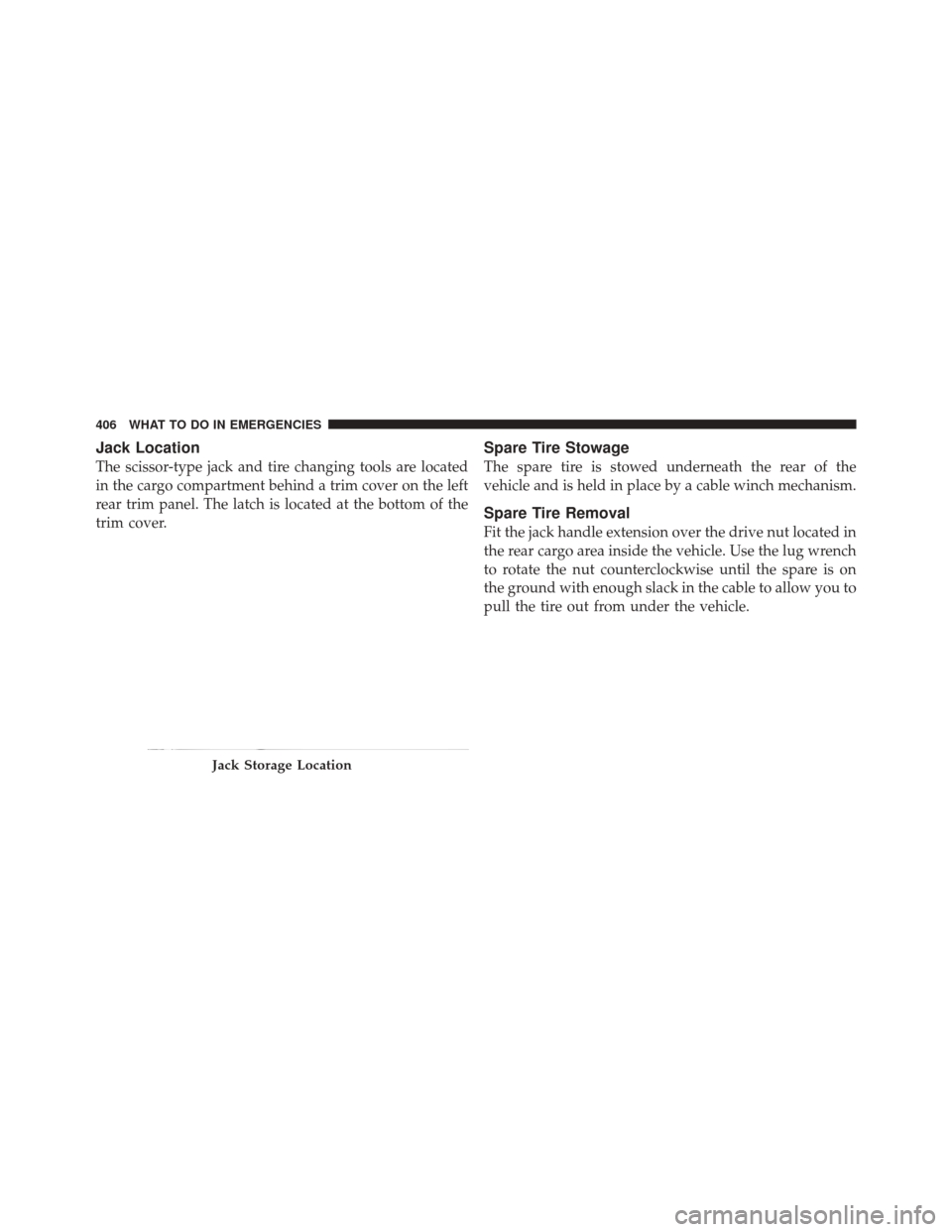
Jack Location
The scissor-type jack and tire changing tools are located
in the cargo compartment behind a trim cover on the left
rear trim panel. The latch is located at the bottom of the
trim cover.
Spare Tire Stowage
The spare tire is stowed underneath the rear of the
vehicle and is held in place by a cable winch mechanism.
Spare Tire Removal
Fit the jack handle extension over the drive nut located in
the rear cargo area inside the vehicle. Use the lug wrench
to rotate the nut counterclockwise until the spare is on
the ground with enough slack in the cable to allow you to
pull the tire out from under the vehicle.
Jack Storage Location
406 WHAT TO DO IN EMERGENCIES
Page 437 of 522
spraying water from a garden hose vertically down the
face of the A/C condenser (if equipped) or the back of the
radiator core.
Check the engine cooling system hoses for brittle rubber,
cracking, tears, cuts, and tightness of the connection at
the coolant recovery bottle and radiator. Inspect the
entire system for leaks.
With the engine at normal operating temperature (but
not running), check the cooling system pressure cap for
proper vacuum sealing by draining a small amount of
engine coolant (antifreeze) from the radiator drain cock.
If the cap is sealing properly, the engine coolant (anti-
freeze) will begin to drain from the coolant recovery
bottle. DO NOT REMOVE THE COOLANT PRESSURE
CAP WHEN THE COOLING SYSTEM IS HOT.Cooling System — Drain, Flush, and Refill
If the engine coolant (antifreeze) is dirty or contains a
considerable amount of sediment, clean and flush with a
reliable cooling system cleaner. Follow with a thorough
rinsing to remove all deposits and chemicals. Properly
dispose of the old engine coolant (antifreeze).
Refer to the “Maintenance Schedule” in Section 8 for the
proper maintenance intervals.
Selection of Engine Coolant
Use only the manufacturer’s recommended engine cool-
ant (antifreeze). Refer to “Fluids, Lubricants, and Genu-
ine Parts” in this section for the correct fluid type.
436 MAINTAINING YOUR VEHICLE
Page 448 of 522
•Scrub in all directions, covering an area of about two
square feet at a time. Avoid heavy scrubbing.
•Rinse the entire vehicle with water to remove all soap
and dirt from the top fabric and to prevent streaking
on painted and chrome surfaces.
•Allow the top to dry before opening. Vacuuming the
top with a wet/dry shop vacuum will decrease the
tops drying time, ensure removal of all dirt, and delete
streaks in the material.
•Multiple cleanings may be necessary to remove stub-
born stains. If stains persist, contact your local autho-
rized dealership for further suggestions.
CAUTION!
Never use an abrasive type cleaner or bleaches.
Cleaners should not contain silicones, organic sol-
vents, petroleum distillates, or plasticizers. Always
wait until the top is thoroughly dry before opening
it.
Additional Cleaning Procedure
For additional cleaning assistance in removing stubborn
stains, apply MOPAR�Convertible Cloth Top Cleaner or
equivalent to the complete stain, extending 2 in (50 mm)
beyond the stain. With a soft bristle brush, scrub in all
directions over the stain. Avoid heavy scrubbing. Rinse
the area with warm water. If the stain is still apparent,
repeat the cleaning procedure. When the stain is no
longer showing, rinse the complete top with warm water.
Let the top dry before opening it.
7
MAINTAINING YOUR VEHICLE 447
Page 473 of 522
Once a Month
•Check tire pressure and look for unusual wear or
damage.
•Inspect the battery and clean and tighten the terminals
as required.
•Check the fluid levels of the coolant reservoir and
brake master cylinder, and add as needed.
•Check all lights and other electrical items for correct
operation.
At Each Oil Change
•Change the engine oil filter.
•Inspect the brake hoses and lines.
CAUTION!
•Failure to perform the required maintenance items
may result in damage to the vehicle.
•Proper operation of four-wheel drive vehicles de-
pends on tires of equal size, type and circumfer-
ence on each wheel. Any difference in tire size can
cause damage to the transfer case. Tire rotation
schedule should be followed to balance tire wear.
Required Maintenance Intervals
Refer to the Maintenance Schedules on the following
pages for the required maintenance intervals.
8
M A I
N T
E
N A
N CE
S
C
H E
D
U L
E
S472 MAINTENANCE SCHEDULES
Page 515 of 522
Radio Remote Controls.................... 279
Radio, Satellite (uconnect� studios)........... 273
Rear Axle (Differential) .................... 445
Rear Park Sense System ................... 163
Rear Seat, Folding ....................... 139
Rear Window Defroster ................... 200
Rear Window Features .................... 199
Rear Wiper/Washer ...................... 199
Rearview Mirrors ........................ 94
Reclining Front Seats ..................... 133
Recreational Towing ...................... 397
Reformulated Gasoline .................... 373
Refrigerant ............................ 430
Release, Hood .......................... 146
Reminder, Lights On ..................... 151
Reminder, Seat Belt ....................... 53
Remote Control Starting System ........................ 26
Remote Keyless Entry (RKE) ................. 19Remote Sound System (Radio) Controls
........ 279
Remote Starting System .................... 26
Replacement Bulbs ....................... 461
Replacement Keys ........................ 15
Replacement Parts ....................... 422
Replacement Tires ....................... 359
Reporting Safety Defects ................... 494
Resetting Oil Change Indicator ...........220,226
Restraint, Head ......................... 136
Restraints, Child ......................... 75
Restraints, Occupant ...................... 40
Retractable Cargo Area Cover ............... 197
Roll Over Warning ........................ 4
Roof Sky Slider Power ................... 183,446
Roof Type Carrier ....................... 201
Rotation, Tires .......................... 361
Safety Checks Inside Vehicle ................. 87
514 INDEX