Page 408 of 522
CAUTION!
The winch mechanism is designed for use with the
jack extension tube only. Use of an air wrench or
other power tools is not recommended and they can
damage the winch.When the spare is clear, tilt the retainer at the end of the
cable, and pull it through the center of the wheel.
Preparations For Jacking
1. Park the vehicle on a firm level surface as far from the
edge of the roadway as possible. Avoid icy or slippery
areas.
WARNING!
Do not attempt to change a tire on the side of the
vehicle close to moving traffic. Pull far enough off
the road to avoid being hit when operating the jack
or changing the wheel.
2. Set the parking brake.
3. Place the shift lever into PARK (automatic transmis-
sion) or REVERSE (manual transmission).
4. Turn the ignition to the LOCK position.
Lowering/Raising Spare Tire6
WHAT TO DO IN EMERGENCIES 407
Page 413 of 522
JUMP-STARTING
Do not attempt to push or tow your vehicle to get it started.
Vehicles equipped with an automatic transmission cannot
be started this way. Also, there is a greater risk of an
accident when a vehicle is being pushed or towed. If the
vehicle has a discharged battery, booster cables may be
used to obtain a start from a booster battery or the battery
in another vehicle. This type of start can be dangerous if
done improperly, so follow this procedure carefully.
WARNING!
•Take care to avoid the radiator cooling fan when-
ever the hood is raised. It can start anytime the
ignition switch is ON. You can be hurt by the fan.
•Remove any metal jewelry such as watch bands or
bracelets that might make an inadvertent electrical
contact. You could be seriously injured.(Continued)
WARNING! (Continued)
•Battery fluid is a corrosive acid solution that can
cause serious burns; do not allow battery fluid to
contact eyes, skin or clothing. Wear safety glasses
and protect your eyes at all times. If acid splashes
in eyes or on skin, flush contaminated area imme-
diately with large quantities of water.
•A battery generates hydrogen gas which is flam-
mable and explosive. Keep flame or spark away
from the vent holes. Do not lean over battery when
attaching clamps or allow the clamps to touch each
other.
•Do not use a booster battery or any other booster
source that has a greater than 12 Volt system, i.e.,
do not use a 24 Volt power source.
1. Wear eye protection and remove all metal jewelry such
as watchbands or bracelets that might make an unin-
tended electrical contact.
412 WHAT TO DO IN EMERGENCIES
Page 414 of 522
2. When boosting from a battery in another vehicle, park
that vehicle within booster cable reach, but without
allowing the vehicles to touch.
WARNING!
Do not permit vehicles to touch each other as this
could establish a ground connection and personal
injury could result.
3. Set the parking brake, place the automatic transmis-
sion in PARK (or NEUTRAL for manual transmission),
and turn the ignition OFF for both vehicles.
4. Turn off the heater, radio and all unnecessary electrical
loads.
5. Connect one end of the jumper cable to the positive
battery post. Connect the other end of the same cable to
the positive terminal of the booster battery. 6. Connect the other cable, first to the negative terminal
of the booster battery and then to the engine ground of
the vehicle with the discharged battery. Make sure you
have a good contact on the engine ground.WARNING!
•Do not connect the cable to the negative post of the
discharged battery. The resulting electrical spark
could cause the battery to explode and could result
in personal injury
•During cold weather when temperatures are be-
low the freezing point, electrolyte in a discharged
battery may freeze. Do not attempt jump-starting
because the battery could rupture or explode and
cause personal injury. Battery temperature must be
brought above freezing point before attempting a
jump-start.6
WHAT TO DO IN EMERGENCIES 413
Page 415 of 522
7. If the vehicle is equipped with Sentry Key�Immobi-
lizer, turn the ignition switch to the ON position for three
seconds before moving the ignition switch to the START
position.
8. Start the engine in the vehicle that has the booster
battery, let the engine idle a few minutes, and then start
the engine in the vehicle with the discharged battery.
9. When removing the jumper cables, reverse the above
sequence exactly. Be careful of the moving belts and fan.
WARNING!
Any procedure other than above could result in:
•Personal injury caused by electrolyte squirting out
the battery vent.
•Personal injury or property damage due to battery
explosion.
CAUTION!
Any procedure other than above could result in
damage to the charging system of the booster vehicle
or of the immobilized vehicle.
TOWING A DISABLED VEHICLE
Proper towing or lifting equipment is required to prevent
damage to your vehicle. Use of safety chains is recom-
mended. Attach towing device to main structural mem-
bers of the vehicle — not to bumpers or associated
brackets. State and local laws, applying to vehicles
under tow, must be observed.
414 WHAT TO DO IN EMERGENCIES
Page 422 of 522
this manual. Tighten the gas cap until a�clicking�sound
is heard. This is an indication that the gas cap is properly
tightened.
Press the odometer reset button to turn the message off.
If the problem persists, the message will appear the next
time the vehicle is started. This might indicate a damaged
cap. If the problem is detected twice in a row, the system
will turn on the MIL. Resolving the problem will turn the
MIL light off.
EMISSIONS INSPECTION AND MAINTENANCE
PROGRAMS
In some localities, it may be a legal requirement to pass
an inspection of your vehicle’s emissions control system.
Failure to pass could prevent vehicle registration.
For states that require an Inspection and Mainte-
nance (I/M), this check verifies the “Malfunction Indicator Light (MIL)” is functioning and is not on when
the engine is running, and that the OBD II system is
ready for testing.
Normally, the OBD II system will be ready. The OBD II
system may
notbe ready if your vehicle was recently
serviced, recently had a dead battery or a battery replace-
ment. If the OBD II system should be determined not
ready for the I/M test, your vehicle may fail the test.
Your vehicle has a simple ignition key-actuated test,
which you can use prior to going to the test station. To
check if your vehicle’s OBD II system is ready, you must
do the following:
1. Insert your ignition key into the ignition switch.
2. Turn the ignition switch to the ON position, but do not
crank or start the engine.
3. If you crank or start the engine, you will have to start
this test over.7
MAINTAINING YOUR VEHICLE 421
Page 423 of 522
4. As soon as you turn the ignition switch to the ON
position, you will see the MIL symbol come on as part of
a normal bulb check.
5. Approximately 15 seconds later, one of two things will
happen:a. The MIL will flash for about 10 seconds and then
return to being fully illuminated until you turn OFF
the ignition or start the engine. This means that your
vehicle’s OBD II system is not readyand you should
not proceed to the I/M station.
b. The MIL will not flash at all and will remain fully
illuminated until you turn OFF the ignition or start the
engine. This means that your vehicle’s OBD II system
is ready and you can proceed to the I/M station.
If your OBD II system is not ready,you should see your
authorized dealer or repair facility. If your vehicle was
recently serviced or had a battery failure or replacement, you may need to do nothing more than drive your
vehicle as you normally would in order for your OBD II
system to update. A recheck with the above test routine
may then indicate that the system is now ready.
Regardless of whether your vehicle’s OBD II system is
ready or not, if the MIL is illuminated during normal
vehicle operation you should have your vehicle serviced
before going to the I/M station. The I/M station can fail
your vehicle because the MIL is on with the engine
running.
REPLACEMENT PARTS
Use of genuine MOPAR�
parts for normal/scheduled
maintenance and repairs is highly recommended to en-
sure the designed performance. Damage or failures
caused by the use of non-MOPAR� parts for maintenance
and repairs will not be covered by the manufacturer’s
warranty.
422 MAINTAINING YOUR VEHICLE
Page 436 of 522
To minimize the possibility of catalytic converter dam-
age:
•Do not shut off the engine or interrupt the ignition
when the transmission is in gear and the vehicle is in
motion.
•Do not try to start the engine by pushing or towing the
vehicle.
•Do not idle the engine with any ignition coil connec-
tors disconnected for prolonged periods.
•Do not idle the engine for prolonged periods during
very rough idle or malfunctioning operating condi-
tions.
•Do not allow vehicle to run out of fuel.
Cooling System
WARNING!
•You or others can be badly burned by hot coolant
or steam from your radiator. If you see or hear
steam coming from under the hood, do not open
the hood until the radiator has had time to cool.
Never try to open a cooling system pressure cap
when the radiator is hot.
Engine Coolant Checks
Check the engine coolant (antifreeze) protection every
12 months (before the onset of freezing weather, where
applicable). If the engine coolant (antifreeze) is dirty or
rusty in appearance, the system should be drained,
flushed, and refilled with fresh coolant. Check the front
of the A/C condenser (if equipped) or radiator for any
accumulation of bugs, leaves, etc. If dirty, clean by gently
7
MAINTAINING YOUR VEHICLE 435
Page 456 of 522
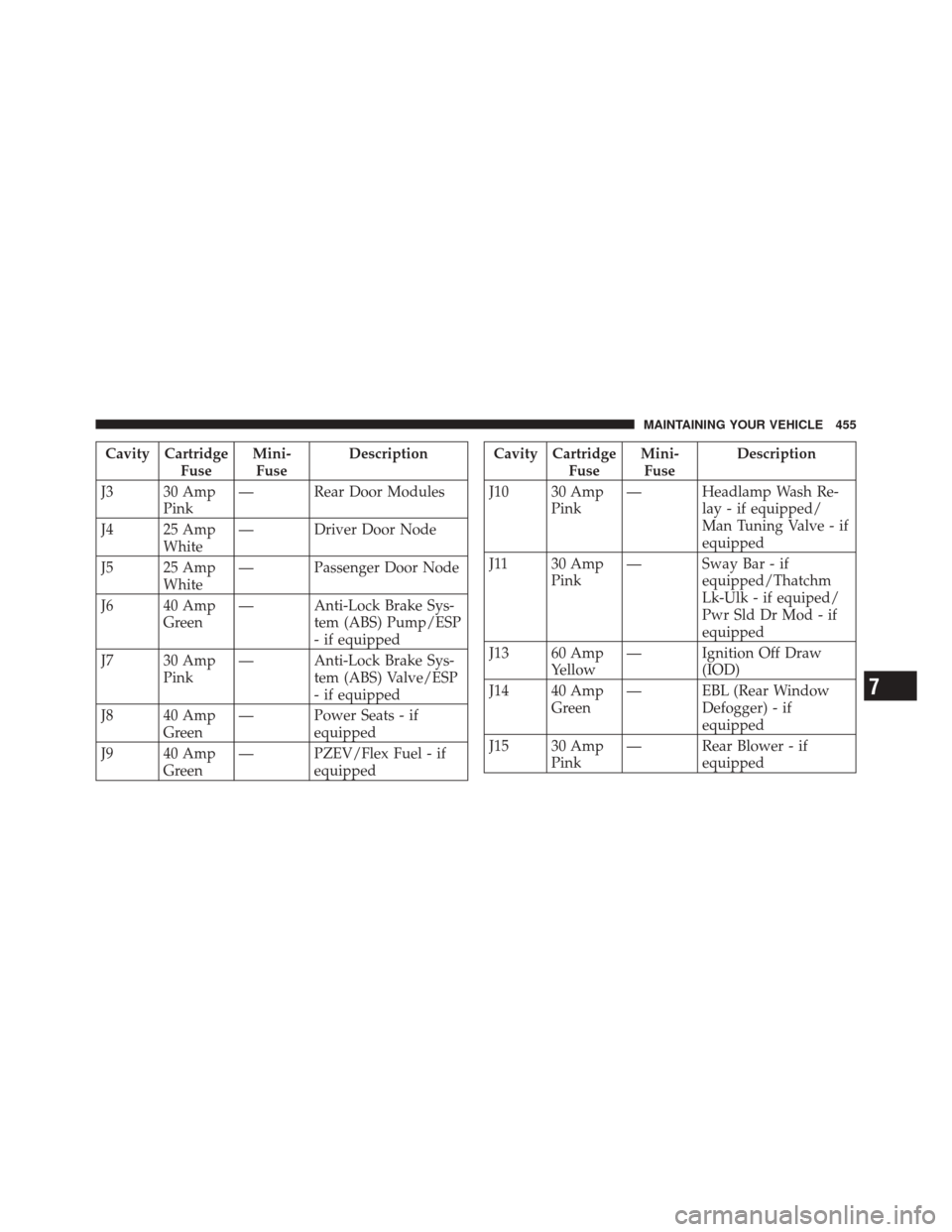
Cavity CartridgeFuseMini-
Fuse Description
J3 30 Amp Pink — Rear Door Modules
J4 25 Amp White — Driver Door Node
J5 25 Amp White — Passenger Door Node
J6 40 Amp Green — Anti-Lock Brake Sys-
tem (ABS) Pump/ESP
- if equipped
J7 30 Amp Pink — Anti-Lock Brake Sys-
tem (ABS) Valve/ESP
- if equipped
J8 40 Amp Green — Power Seats - if
equipped
J9 40 Amp Green — PZEV/Flex Fuel - if
equippedCavity CartridgeFuseMini-
Fuse Description
J10 30 Amp Pink — Headlamp Wash Re-
lay - if equipped/
Man Tuning Valve - if
equipped
J11 30 Amp Pink — Sway Bar - if
equipped/Thatchm
Lk-Ulk - if equiped/
Pwr Sld Dr Mod - if
equipped
J13 60 Amp Yellow — Ignition Off Draw
(IOD)
J14 40 Amp Green — EBL (Rear Window
Defogger) - if
equipped
J15 30 Amp Pink — Rear Blower - if
equipped
7
MAINTAINING YOUR VEHICLE 455