Page 65 of 466

•If the belt still cannot be tightened, or if pulling and
pushing on the restraint loosens the belt, disconnect
the latch plate from the buckle, turn the buckle
around, and insert the latch plate into the buckle
again. If you still cannot make the child restraint
secure, try a different seating position.
•Buckle the child into the restraint exactly as the
manufacturer’s instructions tell you.
•When your child restraint is not in use, secure it in the
vehicle with the seat belt or remove it from the vehicle.
Do not leave it loose in the vehicle. In a sudden stop or
collision, it could strike the occupants or seatbacks and
cause serious personal injury.
NOTE: For additional information, refer to
www.seatcheck.org or call 1–866–SEATCHECK.
Canadian residents, should refer to Transport
Canada’s website for additional information.
http://www.tc.gc.ca/roadsafety/safedrivers/childsafety/index.htm
Older Children and Child Restraints
Children who weigh more than 20 lbs (9 kg), and who are
older than one year, can ride forward-facing in the
vehicle. Forward-facing child seats and convertible child
seats used in the forward-facing direction are for children
who weigh 20 to 40 lbs (9 to 18 kg), and who are older
than one year. These child seats are also held in the
vehicle by the lap/shoulder belt or the LATCH child
restraint anchorage system (Refer to LATCH — Child
Seat Anchorage System.)
The belt-positioning booster seat is for children weighing
more than 40 lbs (18 kg), but who are still too small to fit
the vehicle’s seat belts properly. If the child cannot sit
with knees bent over the vehicle’s seat cushion while the
child’s back is against the seatback, they should use a
belt-positioning booster seat. The child and belt-
positioning booster seat are held in the vehicle by the
lap/shoulder belt.
64 THINGS TO KNOW BEFORE STARTING YOUR VEHICLE
Page 90 of 466
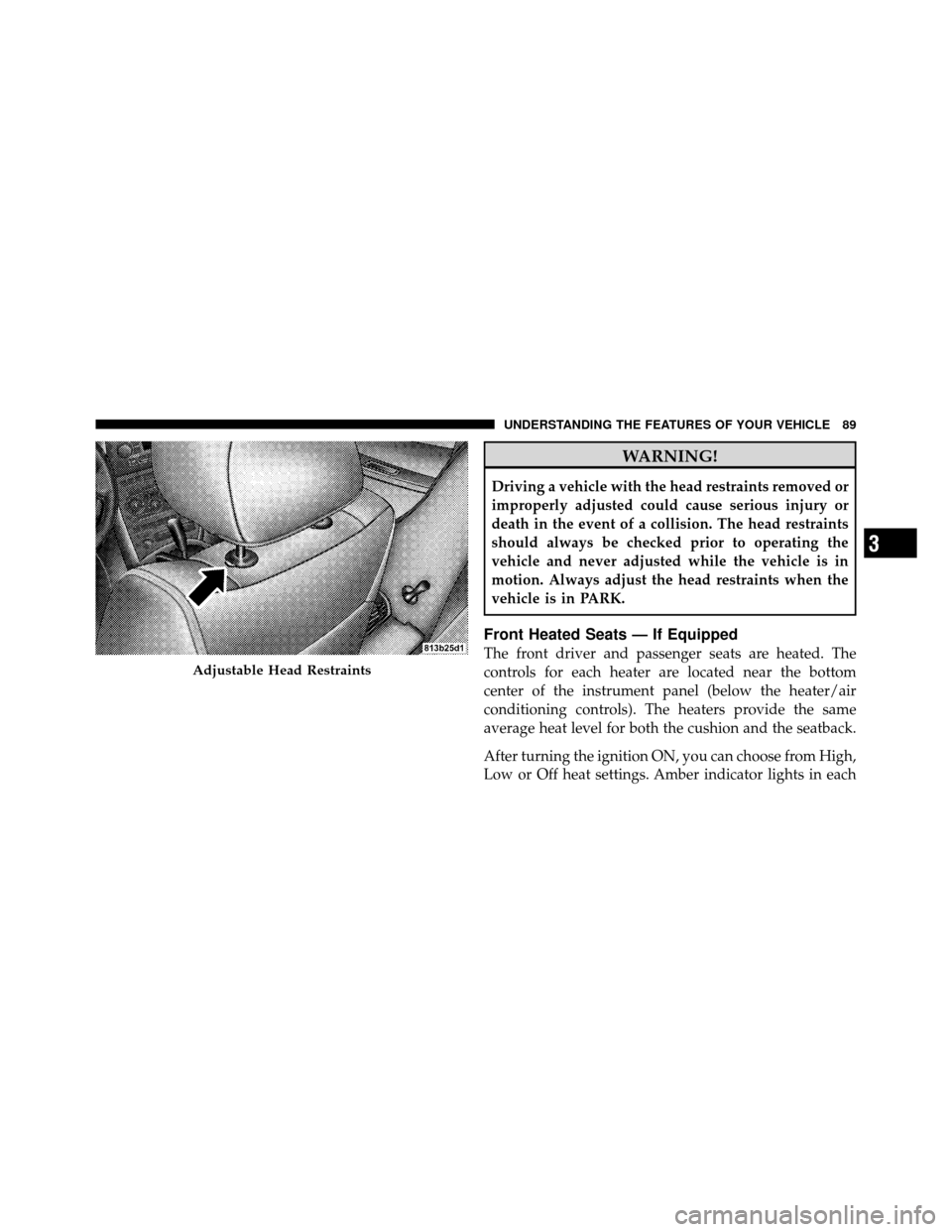
WARNING!
Driving a vehicle with the head restraints removed or
improperly adjusted could cause serious injury or
death in the event of a collision. The head restraints
should always be checked prior to operating the
vehicle and never adjusted while the vehicle is in
motion. Always adjust the head restraints when the
vehicle is in PARK.
Front Heated Seats — If Equipped
The front driver and passenger seats are heated. The
controls for each heater are located near the bottom
center of the instrument panel (below the heater/air
conditioning controls). The heaters provide the same
average heat level for both the cushion and the seatback.
After turning the ignition ON, you can choose from High,
Low or Off heat settings. Amber indicator lights in each
Adjustable Head Restraints
3
UNDERSTANDING THE FEATURES OF YOUR VEHICLE 89
Page 396 of 466

•If your vehicle is damaged due to an accident or
similar cause which destroys the paint and protective
coating, have your vehicle repaired as soon as pos-
sible. The cost of such repairs is considered the respon-
sibility of the owner.
•If you carry special cargo such as chemicals, fertilizers,
de-icer salt, etc., assure that such materials are well
packaged and sealed.
•If a lot of driving is done on gravel roads, consider
mud or stone shields behind each wheel.
•Use MOPAR�Touch Up Paint or equivalent on
scratches or chips as soon as possible. Your authorized
dealer has touch up paint to match the color of your
vehicle.
Wheel and Wheel Trim Care
All wheels and wheel trim, especially aluminum and
chrome-plated wheels should be cleaned regularly with a
mild soap and water to prevent corrosion. To remove
heavy soil, use MOPAR� Wheel Cleaner or select a
nonabrasive, non-acidic cleaner. Do not use scouring
pads, steel wool, a bristle brush or metal polishes. Only
MOPAR� cleaners or equivalent are recommended. Do
not use oven cleaner. Avoid automatic car washes that
use acidic solutions or harsh brushes that may damage
the wheels’ protective finish.
Stain Repel Fabric Cleaning Procedure — If
Equipped
Stain Repel seats may be cleaned in the following man-
ner:
•Remove as much of the stain as possible by blotting
with a clean, dry towel.
7
MAINTAINING YOUR VEHICLE 395