2010 INFINITI M warning
[x] Cancel search: warningPage 346 of 445

cReplacing tires with those not originally
specified by INFINITI could affect the proper
operation of the TPMS.
c Do not inject any tire liquid or aerosol tire
sealant into the tires, as this may cause a
malfunction of the tire pressure sensors.
CHANGING A FLAT TIRE
If you have a flat tire, follow the instructions
below.
Stopping the vehicle
1. Safely move the vehicle off the road and
away from traffic.
2. Turn on the hazard warning flashers.
3. Park on a level surface and apply the parking brake. Move the selector lever to
the P (Park) position.
4. Turn off the engine.
5. Raise the hood to warn other traffic, and to signal professional road assistance
personnel that you need assistance.
6. Have all passengers get out of the vehicle and stand in a safe place, away from
traffic and clear of the vehicle.
WARNING
cMake sure the parking brake is securely ap-
plied and the transmission is shifted into the
P (Park) position.
c Never change tires when the vehicle is on a
slope, ice or slippery areas. This is
hazardous.
c Never change tires if oncoming traffic is
close to your vehicle. Wait for professional
road assistance.
Blocking wheels
Place suitable blockss1at both the front and
back of the wheel diagonally opposite the flat
tire to prevent the vehicle from moving when it
is jacked up.
WARNING
Be sure to block the wheel as the vehicle may
move and result in personal injury.
MCE0001A
In case of emergency6-3
wÐ
Ð
05/15/09Ðpattie
X
Page 347 of 445

Getting the spare tire and tools
Remove jacking tools and spare tire from the
storage area located inside the trunk as illus-
trated.
Raise the trunk floor cover
s1using the handle
sA, then hang it on the edge of the trunk
opening
s2. Remove the clamps3holding the
spare tire.
Jacking up the vehicle and removing
the damaged tire
WARNING
c Never get under the vehicle while it is sup-
ported only by the jack. If it is necessary to
work under the vehicle, support it with
safety stands.
c Use only the jack provided with your vehicle
to lift the vehicle. Do not use the jack pro-
vided with your vehicle on other vehicles.
The jack is designed for lifting only your ve-
hicle during a tire change.
c Use the correct jack-up points. Never use any
other part of the vehicle for jack support.
c Never jack up the vehicle more than
necessary.
c Never use blocks on or under the jack.
c Do not start or run the engine while vehicle is
on the jack, as it may cause the vehicle to
move. This is especially true for vehicles
with limited slip differentials.
c Do not allow passengers to stay in the ve-
hicle while it is on the jack.
Carefully read the caution label attached to the
jack body and the following instructions.
Jacking tools Ð T-type spare tire model
SCE0580
Jacking tools Ð Conventional spare tire model
SCE0581
Spare tire
SCE0638
6-4In case of emergency
wÐ
Ð
05/15/09Ðpattie
X
Page 349 of 445

Installing the spare tire
The spare tire is designed for emergency use.
(See specific instructions under the heading
ªWHEELS AND TIRESº in the ª8. Maintenance
and do-it-yourselfº section.)
1. Clean any mud or dirt from the surfacebetween the wheel and hub.
2. Carefully put the spare tire on and tighten the wheel nuts finger tight. Check that all
the wheel nuts contact the wheel surface
horizontally.
3. With the wheel nut wrench, tighten wheel nuts alternately and evenly in the se-
quence as illustrated (
s1,s2,s3,s4,s5),
more than 2 times, until they are tight. 4. Lower the vehicle slowly until the tire
touches the ground. Then, with the wheel
nut wrench, tighten the wheel nuts se-
curely in the sequence as illustrated.
Lower the vehicle completely.
WARNING
cIncorrect wheel nuts or improperly tightened
wheel nuts can cause the wheel to become
loose or come off. This could cause an
accident.
c Do not use oil or grease on the wheel studs or
nuts. This could cause the nuts to become
loose.
c Retighten the wheel nuts when the vehicle
has been driven for 600 miles (1,000 km)
(also in cases of a flat tire, etc.). c
As soon as possible, tighten the wheel nuts
to the specified torque with a torque wrench.
Wheel nut tightening torque: 80 ft-lb (108 N´m)
The wheel nuts must be kept tightened to speci-
fication at all times. It is recommended that
wheel nuts be tightened to specifications at
each lubrication interval.
c Adjust tire pressure to the COLD pressure.
COLD pressure:
After the vehicle has been parked for three
hours or more or driven less than 1 mile
(1.6 km).
COLD tire pressures are shown on the Tire
and Loading Information label affixed to the
driver side center pillar.
After adjusting tire pressure to the COLD tire
pressure, the display of the tire pressure infor-
mation may show higher pressure than the
COLD tire pressure after the vehicle has been
driven more than 1 mile (1.6 km). This is be-
cause the tire pressurizes as the tire tempera-
ture rises. This does not indicate a system
malfunction.
SCE0039
6-6In case of emergency
wÐ
Ð
05/15/09Ðpattie
X
Page 350 of 445

5. Securely store the flat tire and jackingequipment in the vehicle.
6. Place the spare tire cover and the trunk floor carpeting over the damaged tire.
7. Close the trunk.
WARNING
c Always make sure that the spare tire and
jacking equipment are properly secured af-
ter use. Such items can become dangerous
projectiles in an accident or sudden stop. c
The T-type spare tire and small size spare
tire are designed for emergency use. See
specific instructions under the heading
ªWHEELS AND TIRESº in the ª8. Maintenance
and do-it-yourselfº section.
If needed, Roadside Assistance is available.
Please see your Warranty Information Booklet
or Roadside Assistance I.D. Card for the toll-free
number to call (U.S.) or Warranty Information
Booklet (Canada). To start your engine with a booster battery, the
instructions and precautions below must be
followed.
WARNING
c
If done incorrectly, jump starting can lead to
a battery explosion, resulting in severe in-
jury or death. It could also damage your
vehicle.
c Explosive hydrogen gas is always present in
the vicinity of the battery. Keep all sparks
and flames away from the battery.
c Do not allow battery fluid to come into con-
tact with eyes, skin, clothing or painted sur-
faces. Battery fluid is a corrosive sulfuric
acid solution which can cause severe burns.
If the fluid should come into contact with
anything, immediately flush the contacted
area with water.
c Keep the battery out of the reach of children.
c The booster battery must be rated at 12
volts. Use of an improperly rated battery can
damage your vehicle.
SCE0505
JUMP STARTING
In case of emergency6-7
wÐ
Ð
05/15/09Ðpattie
X
Page 352 of 445

WARNING
Always follow the instructions below. Failure to
do so could result in damage to the charging
system and cause personal injury.
2. If the booster battery is in another vehicle
sA, position the two vehicles (sAandsB)
to bring their batteries into close proxim-
ity to each other.
Do not allow the two vehicles to touch.
3. Apply the parking brake. Move the selec- tor lever to the P (Park) position. Switch
off all unnecessary electrical systems
(light, heater, air conditioner, etc.).
4. Remove vent caps on the battery (if so equipped). Cover the battery with a firmly
wrung out moist cloth
sCto reduce explo-
sion hazard. 5. Connect jumper cables in the sequence as
illustrated (
s1!s2!s3!s4).
If the battery is discharged, the ignition
switch cannot be moved from the LOCK posi-
tion and, if the steering lock is engaged, the
steering wheel cannot be moved. Connect
the jumper cables to the booster vehicle
sB
before pushing the ignition switch and disen-
gaging the steering lock.
CAUTION
cAlways connect positive (+) to positive (+)
and negative ( 2) to body ground (as illus-
trated) Ð not to the battery.
c Make sure the jumper cables do not touch
moving parts in the engine compartment and
that the cable clamps do not contact any
other metal.
6. Start the engine of the booster vehiclesA
and let it run for a few minutes.
7. Keep the engine speed of the booster vehicle
sAat about 2,000 rpm, and start
the engine of the vehicle being jump
started
sB.
SCE0780
In case of emergency6-9
wÐ
Ð
05/15/09Ðpattie
X
Page 354 of 445

3. If engine overheating is caused by climb-ing a long hill on a hot day, run the engine
at a fast idle (approximately 1,500 rpm)
until the temperature gauge indication
returns to normal.
4. Get out of the vehicle. Look and listen for steam or coolant escaping from the radia-
tor before opening the hood. (If steam or
coolant is escaping, turn off the engine.)
Do not open the hood further until no
steam or coolant can be seen.
5. Open the engine hood.
WARNING
If steam or water is coming from the engine,
stand clear to prevent getting burned.
6. Visually check drive belts for damage or looseness. Also check if the cooling fan is
running. The radiator hoses and radiator
should not leak water. If coolant is leak-
ing, the drive belts are missing or loose,
or the cooling fan does not run, stop the
engine.
WARNING
Be careful not to allow your hands, hair, jewelry
or clothing to come into contact with, or get
caught in, engine belts or the engine cooling
fan. The engine cooling fan can start at any
time.
7. After the engine cools down, check thecoolant level in the reservoir tank with the
engine running. Add coolant to the reser-
voir tank if necessary. Have your vehicle
repaired at the nearest INFINITI retailer.
If needed, Roadside Assistance is available.
Please see your Warranty Information Booklet
or Roadside Assistance I.D. Card for the toll-free
number to call (U.S.) or Warranty & Roadside
Assistance Information Booklet (Canada). When towing your vehicle, all State (Provincial
in Canada) and local regulations for towing
must be followed. Incorrect towing equipment
could damage your vehicle. Towing instructions
are available from an INFINITI retailer. Local
service operators are familiar with the appli-
cable laws and procedures for towing. To assure
proper towing and to prevent accidental dam-
age to your vehicle, INFINITI recommends that
you have a service operator tow your vehicle. It
is advisable to have the service operator care-
fully read the following precautions.WARNING
c
Never ride in a vehicle that is being towed.
c Never get under your vehicle after it has been
lifted by a tow truck.
CAUTION
cWhen towing, make sure that the transmis-
sion, axles, steering system and powertrain
are in working condition. If any unit is dam-
aged, dollies must be used.
c Always attach safety chains before towing.
TOWING YOUR VEHICLE
In case of emergency6-11
wÐ
Ð
05/15/09Ðpattie
X
Page 357 of 445
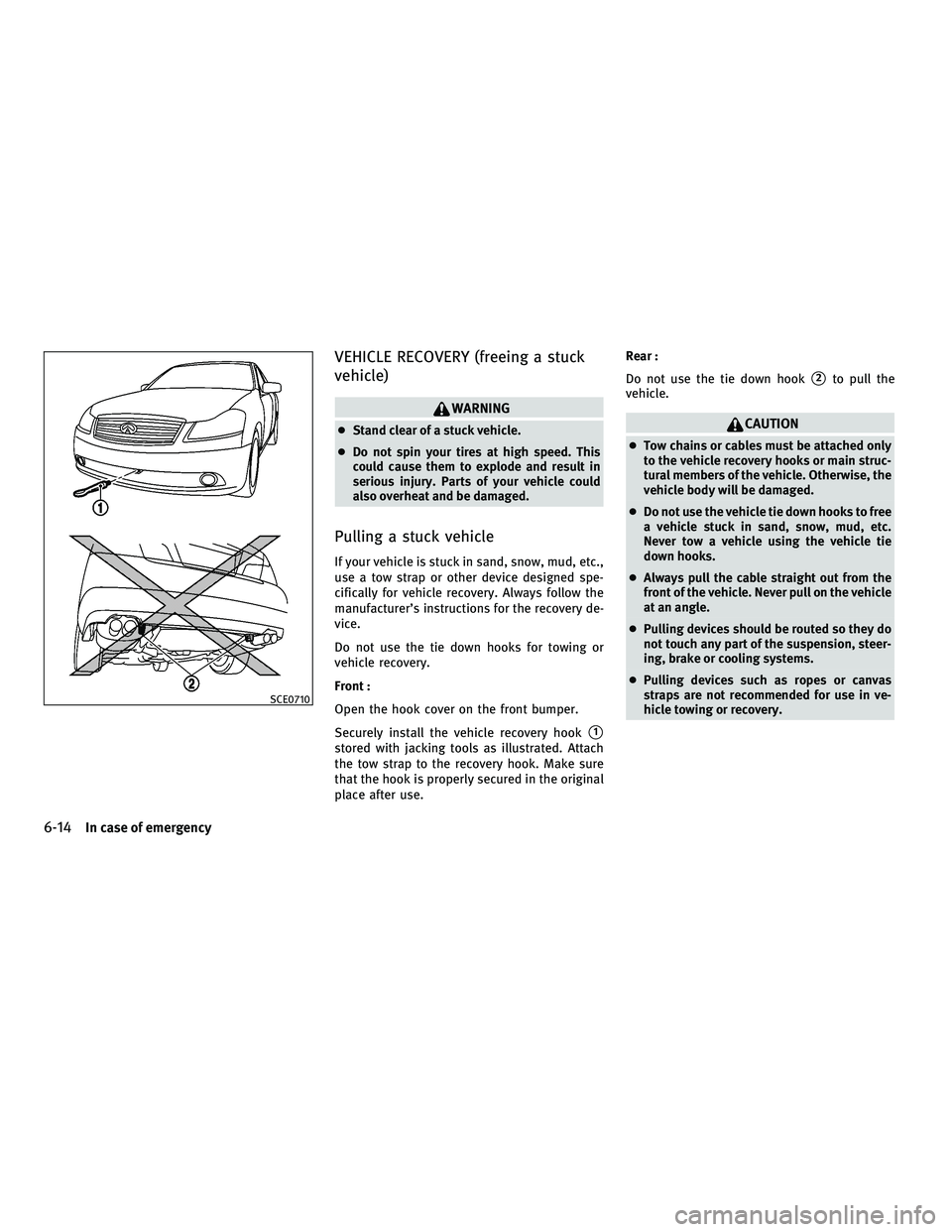
VEHICLE RECOVERY (freeing a stuck
vehicle)
WARNING
cStand clear of a stuck vehicle.
c Do not spin your tires at high speed. This
could cause them to explode and result in
serious injury. Parts of your vehicle could
also overheat and be damaged.
Pulling a stuck vehicle
If your vehicle is stuck in sand, snow, mud, etc.,
use a tow strap or other device designed spe-
cifically for vehicle recovery. Always follow the
manufacturer's instructions for the recovery de-
vice.
Do not use the tie down hooks for towing or
vehicle recovery.
Front :
Open the hook cover on the front bumper.
Securely install the vehicle recovery hook
s1
stored with jacking tools as illustrated. Attach
the tow strap to the recovery hook. Make sure
that the hook is properly secured in the original
place after use. Rear :
Do not use the tie down hook
s2to pull the
vehicle.
CAUTION
c Tow chains or cables must be attached only
to the vehicle recovery hooks or main struc-
tural members of the vehicle. Otherwise, the
vehicle body will be damaged.
c Do not use the vehicle tie down hooks to free
a vehicle stuck in sand, snow, mud, etc.
Never tow a vehicle using the vehicle tie
down hooks.
c Always pull the cable straight out from the
front of the vehicle. Never pull on the vehicle
at an angle.
c Pulling devices should be routed so they do
not touch any part of the suspension, steer-
ing, brake or cooling systems.
c Pulling devices such as ropes or canvas
straps are not recommended for use in ve-
hicle towing or recovery.
SCE0710
6-14In case of emergency
wÐ
Ð
05/15/09Ðpattie
X
Page 363 of 445

Occasionally remove loose dust from the inte-
rior trim, plastic parts and seats using a vacuum
cleaner or soft bristled brush. Wipe the vinyl
and leather surfaces with a clean, soft cloth
dampened in mild soap solution, then wipe
clean with a dry soft cloth.
Regular care and cleaning is required in order to
maintain the appearance of the leather.
Before using any fabric protector, read the
manufacturer's recommendations. Some fabric
protectors contain chemicals that may stain or
bleach the seat material.
Use a cloth dampened only with water, to clean
the meter and gauge lens.
WARNING
Do not use water or acidic cleaners (hot steam
cleaners) on the seat. This can damage the seat
or occupant classification sensor. This can also
affect the operation of the air bag system and
result in serious personal injury.
CAUTION
cNever use benzine, thinner, or any similar
material. c
Small dirt particles can be abrasive and dam-
aging to the leather surfaces and should be
removed promptly. Do not use saddle soap,
car waxes, polishes, oils, cleaning fluids,
solvents, detergents or ammonia-based
cleaners as they may damage the leather's
natural finish.
c Never use fabric protectors unless recom-
mended by the manufacturer.
c Do not use glass or plastic cleaner on meter
or gauge lens covers. It may damage the lens
cover.
AIR FRESHENERS
Most air fresheners use a solvent that could
affect the vehicle interior. If you use an air
freshener, take the following precautions:
c Hanging-type air fresheners can cause per-
manent discoloration when they contact ve-
hicle interior surfaces. Place the air fresh-
ener in a location that allows it to hang free
and not contact an interior surface.
c Liquid-type air fresheners typically clip on
the vents. These products can cause imme-
diate damage and discoloration when
spilled on interior surfaces. Carefully read and follow the manufacturer's
instructions before using air fresheners.
FLOOR MATS
The use of INFINITI floor mats can extend the life
of your vehicle carpet and make it easier to
clean the interior.
No matter what mats are
used, be sure they are fitted for your vehicle and
are properly positioned in the footwell to pre-
vent interference with pedal operation. Mats
should be maintained with regular cleaning and
replaced if they become excessively worn.
CLEANING INTERIOR
7-4Appearance and care
wÐ
Ð
05/15/09Ðpattie
X