2010 Hyundai H-100 Truck fuel
[x] Cancel search: fuelPage 29 of 207
1FEATURES OF YOUR HYUNDAI
28
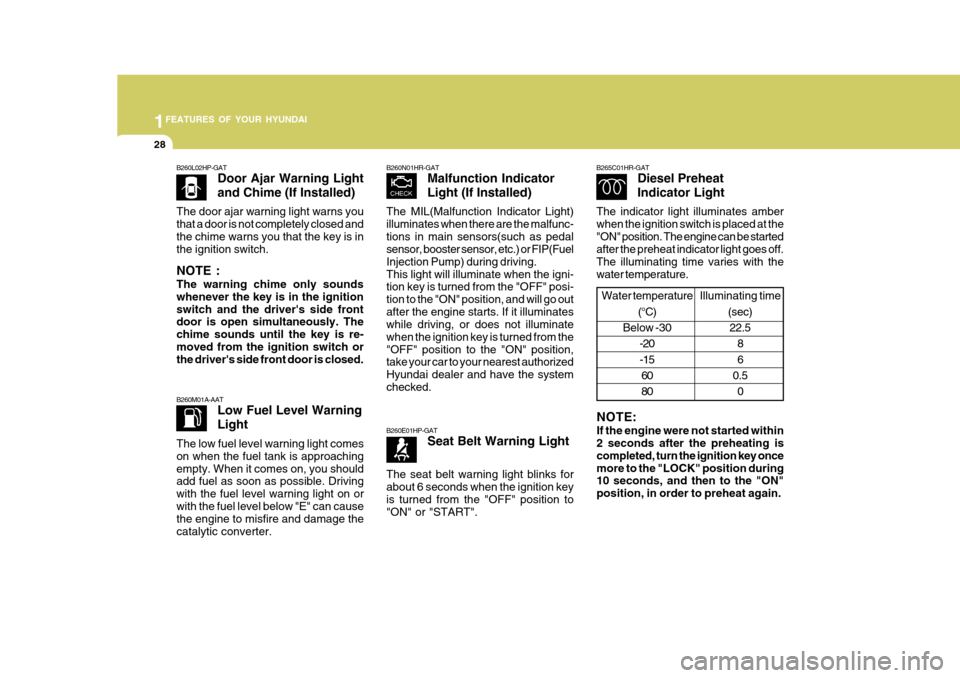
B260L02HP-GAT Door Ajar Warning Light and Chime (If Installed)
The door ajar warning light warns you that a door is not completely closed andthe chime warns you that the key is in the ignition switch. NOTE : The warning chime only sounds whenever the key is in the ignitionswitch and the driver's side front door is open simultaneously. The chime sounds until the key is re-moved from the ignition switch or the driver's side front door is closed. B260M01A-AAT Low Fuel Level Warning Light
The low fuel level warning light comes on when the fuel tank is approachingempty. When it comes on, you should add fuel as soon as possible. Driving with the fuel level warning light on orwith the fuel level below "E" can cause the engine to misfire and damage the catalytic converter.
B260N01HR-GAT Malfunction Indicator Light (If Installed)
The MIL(Malfunction Indicator Light) illuminates when there are the malfunc-tions in main sensors(such as pedal sensor, booster sensor, etc.) or FIP(Fuel Injection Pump) during driving.This light will illuminate when the igni- tion key is turned from the "OFF" posi- tion to the "ON" position, and will go outafter the engine starts. If it illuminates while driving, or does not illuminate when the ignition key is turned from the"OFF" position to the "ON" position, take your car to your nearest authorized Hyundai dealer and have the systemchecked. B260E01HP-GAT Seat Belt Warning Light
The seat belt warning light blinks for about 6 seconds when the ignition keyis turned from the "OFF" position to "ON" or "START".B265C01HR-GAT Diesel Preheat Indicator Light
The indicator light illuminates amber when the ignition switch is placed at the"ON" position. The engine can be started after the preheat indicator light goes off. The illuminating time varies with thewater temperature.
NOTE: If the engine were not started within 2 seconds after the preheating is completed, turn the ignition key oncemore to the "LOCK" position during 10 seconds, and then to the "ON" position, in order to preheat again.
Illuminating time (sec)22.5 8 6
0.5 0
Water temperature
(°C)
Below -30 -20-15
60 80
Page 30 of 207
1
FEATURES OF YOUR HYUNDAI
29INSTRUMENT CLUSTER
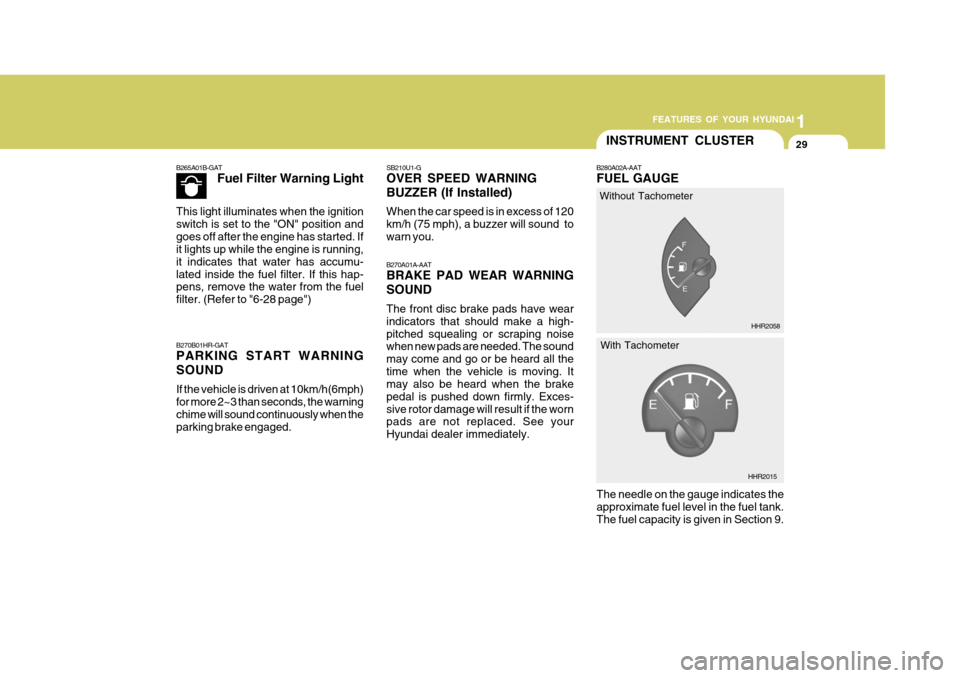
B270A01A-AAT BRAKE PAD WEAR WARNING SOUND The front disc brake pads have wear indicators that should make a high-pitched squealing or scraping noise when new pads are needed. The sound may come and go or be heard all thetime when the vehicle is moving. It may also be heard when the brake pedal is pushed down firmly. Exces-sive rotor damage will result if the worn pads are not replaced. See your Hyundai dealer immediately. The needle on the gauge indicates theapproximate fuel level in the fuel tank. The fuel capacity is given in Section 9.
B280A02A-AAT FUEL GAUGE
HHR2058
B270B01HR-GATPARKING START WARNING SOUND If the vehicle is driven at 10km/h(6mph) for more 2~3 than seconds, the warning chime will sound continuously when theparking brake engaged.
B265A01B-GAT
Fuel Filter Warning Light
This light illuminates when the ignitionswitch is set to the "ON" position andgoes off after the engine has started. If it lights up while the engine is running, it indicates that water has accumu-lated inside the fuel filter. If this hap- pens, remove the water from the fuel
filter. (Refer to "6-28 page")
HHR2015
Without Tachometer
With Tachometer
SB210U1-G OVER SPEED WARNING BUZZER (If Installed) When the car speed is in excess of 120 km/h (75 mph), a buzzer will sound towarn you.
Page 31 of 207
1FEATURES OF YOUR HYUNDAI
30
!
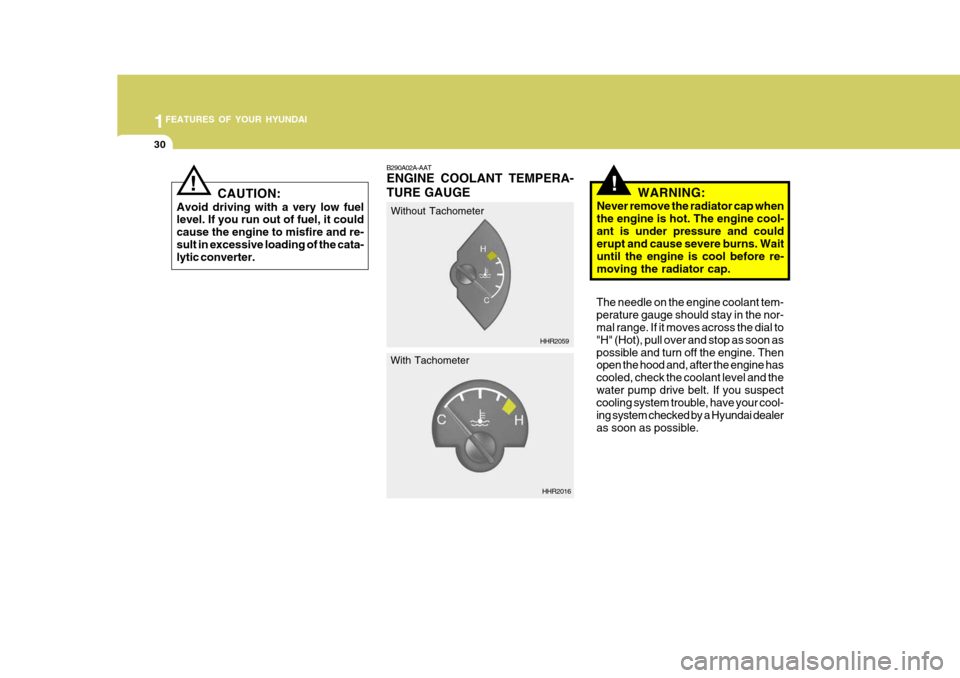
B290A02A-AAT ENGINE COOLANT TEMPERA- TURE GAUGE
WARNING:
Never remove the radiator cap when the engine is hot. The engine cool-ant is under pressure and could erupt and cause severe burns. Wait until the engine is cool before re-moving the radiator cap.
The needle on the engine coolant tem-perature gauge should stay in the nor-mal range. If it moves across the dial to "H" (Hot), pull over and stop as soon as possible and turn off the engine. Then open the hood and, after the engine has cooled, check the coolant level and thewater pump drive belt. If you suspect cooling system trouble, have your cool- ing system checked by a Hyundai dealeras soon as possible.
HHR2059
HHR2016
Without Tachometer
With Tachometer
CAUTION:
Avoid driving with a very low fuel level. If you run out of fuel, it could cause the engine to misfire and re-sult in excessive loading of the cata- lytic converter.
!
Page 49 of 207

1FEATURES OF YOUR HYUNDAI
48
!WARNING:
o Make sure to refuel your vehicle according to the "Fuel require- ments" suggested in section 1.
o Fuel vapors are dangerous. Be-
fore refueling, always stop theengine and never allow sparks or open flames near the tank area. If you need to replace the tank cap,use a genuine Hyundai replace- ment part. If you open the fuel tank cap dur-ing high ambient temperatures, a slight "pressure sound" may be heard. This is normal and not acause for concern. Whenever you open the fuel tank cap, turn it slowly.
o Automotive fuels are flammable/ explosive materials. When refuel-ing, please note the followingguidelines carefully.
- Before touching the fuel nozzle or
fuel tank cap, have one's hands incontact with metal parts away from the tank neck to discharge static electricity.
FUEL TANK CAP
B560A03HR-GAT
The fuel tank cap is located at the left side of the vehicle body. The fuel tank cap can be unlocked by turning the key counterclockwise.To lock the fuel tank cap, turn it clock- wise until it locks into place. NOTE: If the fuel tank cap will not open because ice has formed around it, tap lightly on the cap to break the iceand release the cap. If necessary, spray around the cap with an ap- proved de-icer fluid (do not use ra-diator anti-freeze) or move the ve- hicle to a warm place and allow the ice to melt. HHR2036
- Do not get back in the vehicle
while refueling. Do not operateanything that can produce static electricity. Static electricity dis- charge can ignite fuel vapors re-sulting in an explosion.
- When using a portable fuel con-
tainer, be sure to place the con-tainer on the ground while refuel- ing. Static electricity discharge from the container can ignite fuelvapors causing a fire. While start- ing refueling, contact should be maintained until the filling is com-plete.
- Do not use cellular phones around
a gas station. The electric currentor electronic interference from cel- lular phones can ignite fuel va- pors causing a fire.
- When refueling, always turn the engine off. Sparks by engine com-partment electrical equipment canignite fuel vapors causing a fire. After refueling, check to make sure the fuel tank cap is securely closed,and then start the engine.
- Do not smoke or try to light ciga-
rettes around a gas station. Auto-motive fuels are flammable.
Page 106 of 207

2
DRIVING YOUR HYUNDAI
3
!
TO START THE ENGINEBEFORE STARTING THE EN- GINE
C020A02A-AAT Before you start the engine, you should always:
1. Look around the vehicle to be sure
there are no flat tires, puddles of oil, water or other indications of pos- sible trouble.
2. After entering the car, check to be sure the parking brake is engaged.
3. Check that all windows, and lights are clean.
4. Check that the interior and exterior
mirrors are clean and in position.
5. Check your seat, seatback and headrest to be sure they are in theirproper positions.
6. Lock all the doors.
7. Fasten your seat belt and be sure
that all other occupants have fas- tened theirs.
8. Turn off all lights and accessories
that are not needed.
9. When you turn the ignition switch to "ON", check that all appropriatewarning lights are operating andthat you have sufficient fuel.
10.Check the operation of warning
lights and all bulbs when key is inthe "ON" position. C030A03HR-GAT COMBINATION IGNITION SWITCH
o Place the shift lever in neutral and
depress the clutch pedal fully.
o To start the engine, insert the igni- tion key and turn it to the "START" position. Release it as soon as theengine starts. Do not hold the key in the "START" position for more than 15 seconds.
!WARNING:
To ensure that sufficient vacuum exists within the brake system dur-ing cold weather start-up condi- tions, it is necessary to run the engine at idle for several secondsafter starting the engine.
WARNING:
Always wear appropriate shoes when operating your vehicle. Unsuitable shoes (high heels, ski boots,etc.)may interfere with your ability to use the brake and accelerator pedal, and the clutch (if installed).
!WARNING:
When you intend to park or stop the vehicle with the engine on, be care- ful not to depress the acceleratorpedal for a long period of time. It may overheat the engine or exhaust sys- tem and cause fire.
Page 111 of 207
2 DRIVING YOUR HYUNDAI
8
C070D02O-AAT Good Driving Practices
o Never take the car out of gear andcoast down a hill. This is extremely hazardous. Always leave the car in gear.
o Don't "ride" the brakes. This can cause them to overheat and mal-function. Instead, when you are driv- ing down a long hill, slow down andshift to a lower gear. When you do this, engine braking will help slow the car.
o Slow down before shifting to a lower gear. This will help avoid over-rev-ving the engine, which can causedamage.
o Slow down when you encounter
cross winds. This gives you muchbetter control of your car.
o Be sure the car is completely stopped
before you attempt to shift into re-verse. The transmission can be dam- aged if you do not. To shift into reverse, depress the clutch, movethe shift lever to neutral, wait three seconds, then shift to the reverse position.
o Exercise extreme caution when driv- ing on a slippery surface. Be espe-
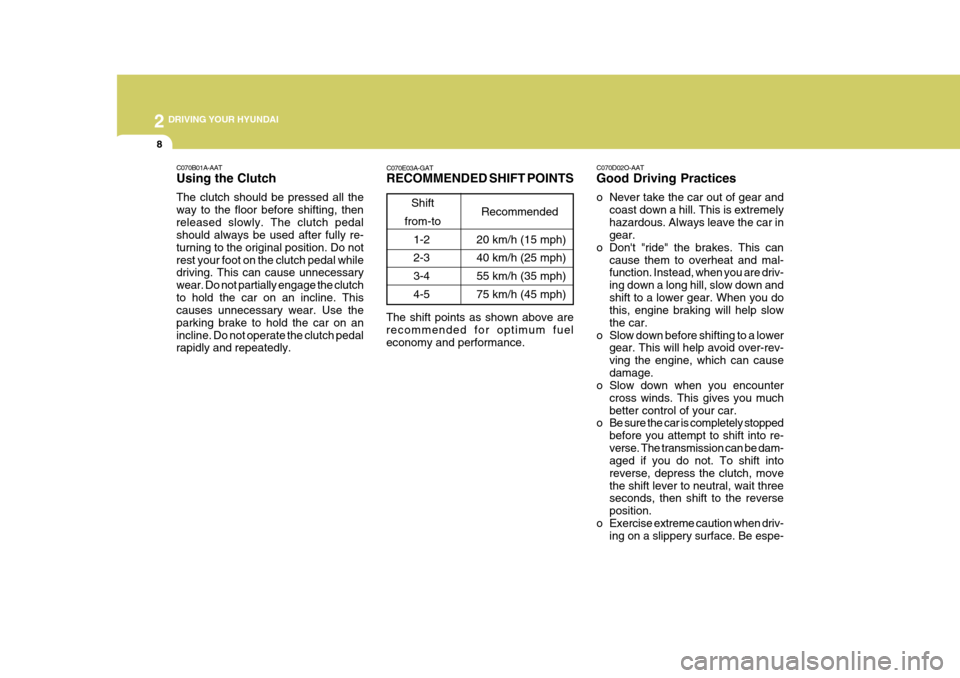
C070E03A-GAT RECOMMENDED SHIFT POINTS
Shift
from-to Recommended
The shift points as shown above are recommended for optimum fuel economy and performance. 20 km/h (15 mph) 40 km/h (25 mph)55 km/h (35 mph) 75 km/h (45 mph)
1-2 2-33-4 4-5
C070B01A-AAT Using the Clutch The clutch should be pressed all the way to the floor before shifting, thenreleased slowly. The clutch pedal should always be used after fully re- turning to the original position. Do notrest your foot on the clutch pedal while driving. This can cause unnecessary wear. Do not partially engage the clutchto hold the car on an incline. This causes unnecessary wear. Use the parking brake to hold the car on anincline. Do not operate the clutch pedal rapidly and repeatedly.
Page 114 of 207
2
DRIVING YOUR HYUNDAI
11
turn the front wheels away from the curb to help keep the car from roll-ing. If there is no curb or if it is required by other conditions to keep the carfrom rolling, block the wheels.
o Under some conditions your park-
ing brake can freeze in the engagedposition. This is most likely to hap- pen when there is an accumulation of snow or ice around or near therear brakes or if the brakes are wet. If there is a risk that the parking brake may freeze, apply it only tem-porarily while you put the gear se- lector lever in first or reverse gear and block the rear wheels so the carcannot roll. Then release the park- ing brake.
o Do not hold the vehicle on the up- grade with the accelerator pedal.This can cause the transmission to overheat. Always use the brakepedal or parking brake. o Don't "ride" the brake or clutch pedal.
This can increase fuel consumptionand also increase wear on these components. In addition, driving with your foot resting on the brake pedalmay cause the brakes to overheat, which reduces their effectiveness and may lead to more serious con-sequences.
o Take care of your tires. Keep them
inflated to the recommended pres-sure. Incorrect inflation, either too much or too little, results in unnec- essary tire wear. Check the tire pres-sures at least once a month.
o Be sure that the wheels are aligned
correctly. Improper alignment canresult from hitting curbs or driving too fast over irregular surfaces. Poor alignment causes faster tire wearand may also result in other prob- lems as well as greater fuel con- sumption.
o Keep your car in good condition. For better fuel economy and reducedmaintenance costs, maintain yourcar in accordance with the mainte- nance schedule in Section 5. If you drive your car in severe conditions,DRIVING FOR ECONOMY
C140A01A-GAT You can save fuel and get more kilo- meters from your car if you follow these suggestions:
o Drive smoothly. Accelerate at a moderate rate. Don't make "jack- rabbit" starts or full-throttle shiftsand maintain a steady cruising speed. Don't race between stop- lights. Try to adjust your speed tothat of the other traffic so you don't have to change speeds unneces- sarily. Avoid heavy traffic wheneverpossible. Always maintain a safe distance from other vehicles so you can avoidunnecessary braking. This also re- duces brake wear.
o Drive at a moderate speed. The faster you drive, the more fuel yourcar uses. Driving at a moderate speed, especially on the highway, isone of the most effective ways to reduce fuel consumption.
Page 115 of 207
2 DRIVING YOUR HYUNDAI
12SMOOTH CORNERING
C150A01A-AAT Avoid braking or gear changing in cor- ners, especially when roads are wet. Ideally, corners should always be taken under gentle acceleration. If you followthese suggestions, tire wear will be held to a minimum.
more frequent maintenance is re- quired (see Section 5 for details).
o Keep your car clean. For maximum service, your Hyundai should bekept clean and free of corrosivematerials. It is especially important that mud, dirt, ice, etc. not be al- lowed to accumulate on the under-side of the car. This extra weight can result in increased fuel con- sumption and also contribute to cor-rosion.
o Travel lightly. Don't carry unneces-
sary weight in your car. Weight re-duces fuel economy.
o Don't let the engine idle longer than
necessary. If you are waiting (andnot in traffic), turn off your engine and restart only when you're ready to go.
o Remember, your Hyundai does not require extended warm-up. As soonas the engine is running smoothly,you can drive away. In very cold weather, however, give your engine a slightly longer warm-up period. o Don't "lug" or "over-rev" the engine.
Lugging is driving too slowly in toohigh a gear resulting in the engine bucking. If this happens, shift to a lower gear. Over-revving is racingthe engine beyond its safe limit. This can be avoided by shifting at the recommended speeds.
o Use your air conditioning sparingly. The air conditioning system is oper-ated by engine power so your fueleconomy is reduced when you use it.