2010 HUMMER H3 tire rotation
[x] Cancel search: tire rotationPage 268 of 410

10-2 Vehicle Care
Wheels and Tires
Tires . . . . . . . . . . . . . . . . . . . . . . . . 10-44
Tire Sidewall Labeling . . . . . . 10-44
Tire Designations . . . . . . . . . . . 10-46
Tire Terminology andDefinitions . . . . . . . . . . . . . . . . 10-48
Tire Pressure . . . . . . . . . . . . . . . 10-51
Tire Pressure Monitor System . . . . . . . . . . . . . . . . . . . 10-52
Tire Pressure Monitor Operation . . . . . . . . . . . . . . . . . 10-53
Tire Inspection . . . . . . . . . . . . . . 10-57
Tire Rotation . . . . . . . . . . . . . . . 10-57
When It Is Time for New Tires . . . . . . . . . . . . . . . . . . . . . . 10-58
Buying New Tires . . . . . . . . . . . 10-59
Different Size Tires and Wheels . . . . . . . . . . . . . . . . . . . 10-60
Uniform Tire Quality Grading . . . . . . . . . . . . . . . . . . . 10-61 Wheel Alignment and Tire
Balance . . . . . . . . . . . . . . . . . . . 10-62
Wheel Replacement . . . . . . . . 10-63
Tire Chains . . . . . . . . . . . . . . . . . 10-64
If a Tire Goes Flat . . . . . . . . . . 10-64
Tire Changing (H3T) . . . . . . . . 10-66
Tire Changing (H3) . . . . . . . . . 10-75
Secondary Latch System . . . 10-84
Full-Size Spare Tire . . . . . . . . 10-85
Jump Starting
Jump Starting . . . . . . . . . . . . . . 10-86
Towing
Towing the Vehicle . . . . . . . . . 10-90
Recreational Vehicle Towing . . . . . . . . . . . . . . . . . . . . 10-90
Appearance Care
Exterior Care . . . . . . . . . . . . . . . 10-92
Interior Care . . . . . . . . . . . . . . . . 10-96
General Information
For service and parts needs, visit
your dealer/retailer. You will receive
genuine parts and trained and
supported service people.
California Proposition 65
Warning
Most motor vehicles, including this
one, contain and/or emit chemicals
known to the State of California to
cause cancer and birth defects or
other reproductive harm. Engine
exhaust, many parts and systems,
many fluids, and some component
wear by-products contain and/or
emit these chemicals.
Page 320 of 410

10-54 Vehicle Care
If the warning light comes on,
stop as soon as possible and
inflate the tires to the recommended
pressure shown on the tire loading
information label. SeeVehicle Load
Limits on page 9‑27.
At the same time, a Driver
Information Center (DIC) message
is displayed on the DIC display
screen. The low tire pressure
warning light and the DIC warning
message come on at each ignition
cycle until the tires are inflated to
the correct inflation pressure. For
additional information and details
about the DIC operation and
displays see Tire Messages
on
page 5‑25.
The low tire pressure warning light
may come on in cool weather when
the vehicle is first started, and then
turn off as you start to drive. This
could be an early indicator that the
air pressure in the tire(s) are getting
low and need to be inflated to the
proper pressure. A Tire and Loading Information
label, attached to the vehicle, shows
the size of the vehicle's original
equipment tires and the correct
inflation pressure for the vehicle's
tires when they are cold. See
Vehicle Load Limits
on page 9‑27,
for an example of the Tire and
Loading Information label and its
location on the vehicle. Also see
Tire Pressure on page 10‑51.
The vehicle's TPMS can warn you
about a low tire pressure condition
but it does not replace normal tire
maintenance. See Tire Inspection
on page 10‑57,Tire Rotationon
page 10‑57and Tires on
page 10‑44.
Notice: Liquid tire sealants could
damage the Tire Pressure Monitor
System (TPMS) sensors. Sensor
damage caused by using a tire
sealant is not covered by your
warranty. Do not use liquid tire
sealants.
TPMS Malfunction Light and
Message
The TPMS will not function properly
if one or more of the TPMS sensors
are missing or inoperable. When the
system detects a malfunction, the
low tire warning light flashes for
about one minute and then stays on
for the remainder of the ignition
cycle. A DIC warning message is
also displayed. The low tire warning
light and DIC warning message
come on at each ignition cycle until
the problem is corrected. Some of
the conditions that can cause the
malfunction light and DIC message
to come on are:
.One of the road tires has been
replaced with the spare tire.
The spare tire does not have
a TPMS sensor. The TPMS
malfunction light and DIC
message should go off once you
re‐install the road tire containing
the TPMS sensor.
Page 323 of 410
Vehicle Care 10-57
10. Set all four tires to therecommended air pressure
level as indicated on the Tire
and Loading Information label.
11. Put the valve caps back on the valve stems.
Tire Inspection
We recommend that you
regularly inspect your vehicle's
tires, including the spare tire,
if the vehicle has one, for
signs of wear or damage. See
When It Is Time for New Tires
on
page 10‑58
for more information.
Tire Rotation
Tires should be rotated every
5,000 to 8,000 miles (8 000 to
13 000 km). See Scheduled
Maintenance
on page 11‑2. The purpose of a regular tire
rotation is to achieve a uniform
wear for all tires on the vehicle.
This will ensure that the vehicle
continues to perform most like it
did when the tires were new.
The first rotation is the most
important. See
Scheduled
Maintenance
on page 11‑2.
Any time you notice unusual
wear, rotate the tires as soon
as possible and check wheel
alignment. Also check for
damaged tires or wheels.
See When It Is Time for New
Tires
on page 10‑58and Wheel
Replacement
on page 10‑63.
Make sure the spare tire is
stored securely. Push, pull and
then try to rotate or turn the tire.
If it moves, use the wheel
wrench/hoist shaft to tighten the
cable. See If a Tire Goes Flat
on
page 10‑64
.
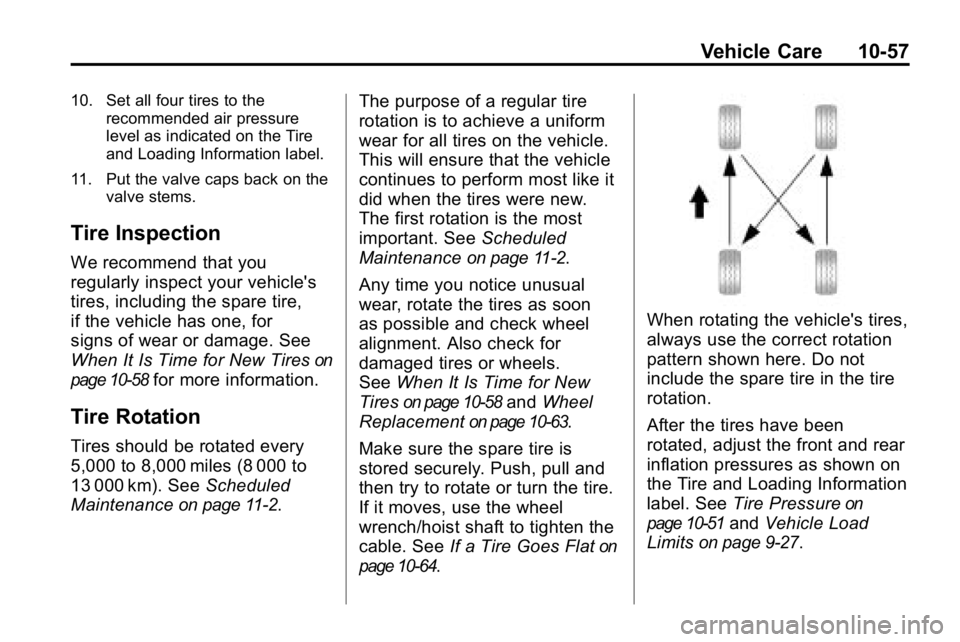
When rotating the vehicle's tires,
always use the correct rotation
pattern shown here. Do not
include the spare tire in the tire
rotation.
After the tires have been
rotated, adjust the front and rear
inflation pressures as shown on
the Tire and Loading Information
label. See Tire Pressure
on
page 10‑51
and Vehicle Load
Limits
on page 9‑27.
Page 326 of 410
10-60 Vehicle Care
SeeTire Inspectionon page 10‑57
andTire Rotationon page 10‑57
for information on proper tire
rotation.
{WARNING
Mixing tires could cause you
to lose control while driving.
If you mix tires of different
sizes, brands, or types
(radial and bias-belted tires)
the vehicle may not handle
properly, and you could have
a crash. Using tires of different
sizes, brands, or types may
also cause damage to your
vehicle. Be sure to use the
correct size, brand, and type
of tires on your vehicle's
wheels.
{WARNING
If you use bias-ply tires on the
vehicle, the wheel rim flanges
could develop cracks after
many miles of driving. A tire
and/or wheel could fail
suddenly, causing a crash.
Use only radial-ply tires with
the wheels on the vehicle.
If you must replace your
vehicle's tires with those that do
not have a TPC Spec number,
make sure they are the same
size, load range, speed rating,
and construction type (radial
and bias‐belted tires) as your
vehicle's original tires.
Vehicles equipped with a tire
pressure monitoring system may
give an inaccurate low‐pressure
warning if non‐TPC spec rated
tires are installed on your
vehicle. Non‐TPC Spec rated tires may give a low‐pressure
warning that is higher or lower
than the proper warning level
you would get with TPC Spec
rated tires. See
Tire Pressure
Monitor System
on page 10‑52.
Your vehicle's original
equipment tires are listed
on the Tire and Loading
Information Label. See Vehicle
Load Limits
on page 9‑27, for
more information about the Tire
and Loading Information Label
and its location on your vehicle.
Different Size Tires and
Wheels
If you add wheels or tires that are
a different size than your original
equipment wheels and tires, this
could affect the way your vehicle
performs, including its braking,
ride and handling characteristics,
stability, and resistance to rollover.
Page 366 of 410

11-2 Service and Maintenance
.Are driven off-road in the
recommended manner. See
Off-Road Driving on page 9‑7.
.Use the recommended fuel.
SeeRecommended Fuelon
page 9‑64.
{WARNING
Performing maintenance work can
be dangerous. Some jobs can
cause serious injury. Perform
maintenance work only if you
have the required know-how and
the proper tools and equipment.
If in doubt, see your dealer to
have a qualified technician do
the work. See Doing Your Own
Service Work on page 10‑4.
At your dealer/retailer, you can be
certain that you will receive the
highest level of service available. Your dealer/retailer has specially
trained service technicians, uses
genuine replacement parts, as
well as, up to date tools and
equipment to ensure fast and
accurate diagnostics.
The proper replacement parts,
fluids, and lubricants to use
are listed in
Recommended Fluids
and Lubricantson page 11‑8and
Maintenance Replacement Partson
page 11‑10. We recommend the
use of genuine parts from your
dealer/retailer.
Rotation of New Tires
To maintain ride, handling, and
performance of the vehicle, it is
important that the first rotation
service for new tires be performed
when they have 8 000 to 13 000 km
(5,000 to 8,000 miles). See Tire
Rotation on page 10‑57.
Scheduled
Maintenance
When the Change Oil Message
Displays
Change engine oil and filter. See
Engine Oilon page 10‑9. An
Emission Control Service.
When the “Change Oil” message
displays, service is required for
the vehicle as soon as possible,
within the next 1 000 km/600 miles.
If driving under the best conditions,
the engine oil life system might not
indicate the need for vehicle service
for more than a year. The engine
oil and filter must be changed at
least once a year and the oil life
system must be reset. Your dealer
has trained service technicians who
will perform this work and reset the
system. If the engine oil life system
is reset accidentally, service the
vehicle within 5 000 km/3,000 miles
since the last service. Reset the oil
Page 367 of 410

Service and Maintenance 11-3
life system whenever the oil is
changed. SeeEngine Oil Life
System on page 10‑11.
When the “Change Oil” message
displays, certain services, checks,
and inspections are required.
The services described for
Maintenance Ishould be performed
at every engine oil change. The
services described for Maintenance
II should be performed when:
.Maintenance Iwas performed
the last time the engine oil was
changed.
.It has been 10 months or more
since the “Change Oil” message
has displayed or since the last
service.
Maintenance I
.Change engine oil and filter.
SeeEngine Oilon page 10‑9.
An Emission Control Service.
.Engine coolant level check. See
Engine Coolant on page 10‑19.
.Windshield washer fluid level
check. See Washer Fluidon
page 10‑25.
.Tire inflation check. See Tire
Pressure on page 10‑51.
.Tire wear inspection. See Tire
Inspection on page 10‑57.
.Rotate tires. See Tire Rotationon page 10‑57.
.Fluids visual leak check
(or every 12 months, whichever
occurs first). A leak in any
system must be repaired and
the fluid level checked.
.Engine air cleaner filter
inspection (vehicles driven in
dusty conditions only). See
Engine Air Cleaner/Filter
on
page 10‑17.
.Brake system inspection
(or every 12 months, whichever
occurs first).
Maintenance II
.Perform all services described in
MaintenanceI.
.Steering and suspension
inspection. Visual inspection for
damaged, loose, or missing
parts or signs of wear.
.Lubricate the front suspension,
steering linkage, and parking
brake cable guides. Control arm
ball joints require lubrication but
should not be lubricated unless
their temperature is −12°C
(10°F) or higher, or they could
be damaged.
.Engine cooling system
inspection. Visual inspection
of hoses, pipes, fittings, and
clamps and replacement,
if needed.
Page 407 of 410

INDEX i-9
Replacing Airbag System . . . . . . 3-42
Replacing LATCH SystemParts After a Crash . . . . . . . . . . . 3-59
Replacing Safety Belt System Parts After a
Crash . . . . . . . . . . . . . . . . . . . . . . . . 3-27
Reporting Safety Defects
Canadian Government . . . . . . 13-14
General Motors . . . . . . . . . . . . . 13-14
U.S. Government . . . . . . . . . . . 13-13
Retained Accessory
Power (RAP) . . . . . . . . . . . . . . . . . 9-35
Ride Control Systems Messages . . . . . . . . . . . . . . . . . . . . 5-24
Roadside Service . . . . . . . . . . . . . . 13-5
Roof Sunroof . . . . . . . . . . . . . . . . . . . . . . . 2-17
Roof Rack System . . . . . . . . . . . . . . 4-4
Rotation, Tires . . . . . . . . . . . . . . . . 10-57
Routing, Engine Drive Belt . . . . . 12-4
Running the Vehicle While Parked . . . . . . . . . . . . . . . . . . . . . . . 9-41S
Safety Belts . . . . . . . . . . . . . . . . . . . 3-10Care . . . . . . . . . . . . . . . . . . . . . . . . . . 3-26
Extender . . . . . . . . . . . . . . . . . . . . . . 3-26
How to Wear Safety BeltsProperly . . . . . . . . . . . . . . . . . . . . . 3-15
Lap-Shoulder Belt . . . . . . . . . . . . 3-20
Reminders . . . . . . . . . . . . . . . . . . . . . 5-9
Replacing After a Crash . . . . . . 3-27
Use During Pregnancy . . . . . . . . 3-25
Safety Defects Reporting
Canadian Government . . . . . . 13-14
General Motors . . . . . . . . . . . . . 13-14
U.S. Government . . . . . . . . . . . 13-13
Safety Locks . . . . . . . . . . . . . . . . . . . . 2-6
Safety System Check . . . . . . . . . . 3-26
Satellite Radio . . . . . . . . . . . . . . . . . . 7-6
Scheduled Maintenance . . . . . . . 11-2
Scheduling Appointments . . . . . . 13-8
Seats Adjustment, Front . . . . . . . . . . . . . . 3-3
Head Restraints . . . . . . . . . . . . . . . 3-2
Heated Front . . . . . . . . . . . . . . . . . . 3-6
Lumbar Adjustment, Front . . . . . 3-4 Seats (cont.)
Power Adjustment, Front . . . . . . 3-3
Rear . . . . . . . . . . . . . . . . . . . . . . 3-7, 3-9
Reclining Seatbacks . . . . . . . . . . . 3-4
Secondary Latch System . . . . . 10-84
Securing Child Restraints . . . . . . . . 3-59, 3-61, 3-62
Security Light . . . . . . . . . . . . . . . . . . . . . . . . . . 5-17
Vehicle . . . . . . . . . . . . . . . . . . . . . . . . 2-9
Service Accessories andModifications . . . . . . . . . . . . . . . . 10-3
Doing Your Own Work . . . . . . . . 10-4
Engine Soon Lamp . . . . . . . . . . . 5-12
Maintenance Records . . . . . . . 11-11
Maintenance, General Information . . . . . . . . . . . . . . . . . . 11-1
Parts Identification Label . . . . . 12-1
Publications Ordering Information . . . . . . . . . . . . . . . . 13-12
Scheduling Appointments . . . . . 13-8
Vehicle Messages . . . . . . . . . . . . 5-25
Page 408 of 410

i-10 INDEX
Servicing theAirbag-Equipped Vehicle . . . . . 3-40
Shifting Into Park . . . . . . . . . . . . . . . . . . . . . . 9-37
Out of Park . . . . . . . . . . . . . . . . . . . 9-38
Signals, Turn and Lane-Change . . . . . . . . . . . . . . . . . 6-5
Specifications and Capacities . . . . . . . . . . . . . . . . . . . . 12-2
Speedometer . . . . . . . . . . . . . . . . . . . 5-8
StabiliTrak System . . . . . . . . . . . . . 9-53
Start Assist, Hills . . . . . . . . . . . . . . 9-52
Starter Switch Check . . . . . . . . . 10-30
Starting the Engine . . . . . . . . . . . . 9-35
Steering . . . . . . . . . . . . . . . . . . . . . . . . 9-4 Fluid, Power . . . . . . . . . . . . . . . . 10-24
Wheel Adjustment . . . . . . . . . . . . . 5-2
Stoplamps and Back-Up Lamps Bulb Replacement . . . 10-35, 10-36
Storage Areas Cargo Cover . . . . . . . . . . . . . . . . . . . 4-2
Cargo Management System . . . 4-2
Center Console . . . . . . . . . . . . . . . . 4-1
Convenience Net . . . . . . . . . . . . . . 4-3
Front . . . . . . . . . . . . . . . . . . . . . . . . . . 4-1 Storage Areas (cont.)
Glove Box . . . . . . . . . . . . . . . . . . . . . 4-1
Rear Compartment/Storage
Panel Cover . . . . . . . . . . . . . . . . . . 4-2
Roof Rack System . . . . . . . . . . . . . 4-4
Stuck Vehicle . . . . . . . . . . . . . . . . . . 9-26
Sun Visors . . . . . . . . . . . . . . . . . . . . . 2-17
Sunroof . . . . . . . . . . . . . . . . . . . . . . . . 2-17
Symbols . . . . . . . . . . . . . . . . . . . . . . . . . . iv
System Roof Rack . . . . . . . . . . . . . . . . . . . . . 4-4
System Check Automatic TransmissionShiftlock Control . . . . . . . . . . 10-30
T
Tachometer . . . . . . . . . . . . . . . . . . . . . 5-8
Tailgate . . . . . . . . . . . . . . . . . . . . . . . . . 2-7
TaillampsBulb Replacement . . . 10-35, 10-36
Text Telephone (TTY) Users . . . 13-4
Theft-Deterrent Systems . . . . . . . . . . . . . . . 2-10, 2-11
Immobilizer . . . . . . . . . . . . . . . . . . . 2-10
Time . . . . . . . . . . . . . . . . . . . . . . . . . . . . 5-4 Tires
Buying New Tires . . . . . . . . . . . 10-59
Chains . . . . . . . . . . . . . . . . . . . . . . 10-64
Changing . . . . . . . . . . . . 10-66, 10-75
Designations . . . . . . . . . . . . . . . 10-46
Different Size . . . . . . . . . . . . . . . 10-60
Full-Size Spare . . . . . . . . . . . . . 10-85
If a Tire Goes Flat . . . . . . . . . . 10-64
Inflation Monitor System . . . . 10-53
Inspection . . . . . . . . . . . . . . . . . . 10-57
Messages . . . . . . . . . . . . . . . . . . . . 5-25
Pressure Light . . . . . . . . . . . . . . . . 5-16
Pressure Monitor System . . . 10-52
Rotation . . . . . . . . . . . . . . . . . . . . 10-57
Secondary Latch System . . . 10-84
Sidewall Labeling . . . . . . . . . . . 10-44
Terminology and
Definitions . . . . . . . . . . . . . . . . . 10-48
Uniform Tire Quality Grading . . . . . . . . . . . . . . . . . . . 10-61
Wheel Alignment and Tire
Balance . . . . . . . . . . . . . . . . . . . 10-62
Wheel Replacement . . . . . . . . 10-63
When It Is Time for New Tires . . . . . . . . . . . . . . . . . . . . . . 10-58