Page 293 of 450

�µ
�µ
�µ
�µ
Fuel economy is not a f ixed number.
It varies based on driving conditions,
driving habits and vehicle condition.
Theref ore, it is not possible f or one
set of estimates to predict f uel
economy precisely f or all drivers in
all environments.
The EPA f uel economy estimates
shownintheexampletotheright
are a usef ul tool f or comparison
when buying a vehicle. EPA
estimates include:
Represents a combination of city and
highway driving. The scale
represents the range of combined
f uel economy f or other vehicles in
the class.
Represents a
mixture of rural and interstate
driving, in a warmed-up vehicle,
typical of longer trips in f ree-f lowing
traf f ic. A range of miles per gallon achieved is also provided.
Represents urban
driving in light traf f ic. A range of
miles per gallon achieved is also
provided.
Provides an estimated annual f uel
cost, based on 15,000 miles in the
U.S. or 20,000 km in Canada per yearmultiplied by the cost per gallon
(based on EPA fuel cost data)
divided by the combined f uel
economy.
For more inf ormation on f uel
economy ratings and factors that
af f ect f uel economy, visit
(Canada: Visit
)
www.
fueleconomy.gov www.
vehicles.gc.ca
Actual Mileage and EPA Fuel
Economy Estimates Comparison.
Combined Fuel Economy
Highway MPG City MPG Estimated Annual Fuel Cost
Fuel Economy
290
Combined Fuel
Economy(Sample U.S. EPA label shown) Estimated Annual
Fuel Cost
City MPG
Highway MPG
�����—�
���—�����y�
�������������y���
�)�"���������y���������y
2010 Insight
Page 302 of 450
Do not spill any liquids over the air
intake or insert any f oreign objects
in it. This may damage the IMA
battery and the power control unit.
The air intake for the IMA battery
and electronics is located on the rear
lef t pillar. Do not block this air intake,
it may cause the IMA battery and the
power control unit to overheat,
causing the IMA to shut down. It will
start working again after it cools. Air Intake
Carrying Cargo
Bef ore Driving
299
AIR INTAKE
�����—�
���—�����y�
�������������y���
�)�"���������y���������y
2010 Insight
Page 306 of 450

Apply the parking brake.
In cold weather, turn of f all
electrical accessories to reduce
the drain on the battery.In cold weather, the conventional
starter is used instead of the IMA
system starter. This is normal.
Make sure the shif t lever is in
Park. Press on the brake pedal.
Without touching the accelerator
pedal, turn the ignition key to the
START (III) position. Do not hold
the key in the START (III)
position f or more than 15 seconds
at a time. If the engine does not
start right away, pause for at least
10 seconds bef ore trying again.
1.
2.
3.
4.
Starting the Engine
Starting in Cold Weather
Driving
303
The engine is harder to start in cold
weather. Also, the thinner air f ound at
altitudes above 8,000 f eet (2,400
meters) adds to this problem.
T he immobilizer system protects your
vehicle f rom thef t. If an improperly
coded key (or other device) is used, the
engine’s f uel system is disabled. For
more inf ormation, see page .
127
�����—�
���—�����y�
�������������y���
�)�"���������y���������y
2010 Insight
Page 313 of 450

�Î
�Î
The f ollowing procedure clears all
leaves and your lif etime points. This
procedure must be f ollowed exactly.
As you progress to a higher level, the
system monitors your driving style
more strictly. As a result, you must
f urther ref ine your driving style to
continue to move up to the next level.
Turn the ignition switch to the ON
(II) position. Conf irm that the ECON
mode is OFF. If it is OFF, proceed to
step 1. Do run the engine.
Thefollowingaresomeof the
conditions that may ef f ect your
score:
Extremely high or low ambient
temperature
Inconsistent acceleration use, such
as pumping the pedal repeatedly
within a short period of time
Frequent use of the climate
control system
Short distance trips If theECONmodeison,pressand
releasetheECONbuttontoturnit
off. You also need to turn the ignition
switch off.
Turn the ignition switch to the ON
(II) position again. Do run the
engine. Press and release the brake pedal
at least two times. The ambient
meter color changes f rom blue to
green .
Complete the following steps within
30 seconds:
The ambient meter color
changes only if the multi-
inf ormation display’s meter
color change setting is on. (See
page .)
Press and release the ECON
button two times (ECON mode
comes on, then goes of f ). The
ambient meter color goes of f , and
the accumulated data is cleared.
Turn the ignition switch to the
LOCK (0) position. :
1.
2.
3. 103
Reset the System
not not
Ecological Drive A ssist System (Eco A ssist )
310
TM
�����—�
���—�����y�
���������
���y���
�)�"���������y�����
���y
2010 Insight
Page 324 of 450

The engine automatically stops
when:
The vehicle comes to a stop with the
shif t lever in the D position and the
brake pedal pressed.The engine will not stop
automatically under the f ollowing
conditions:
Vehicle speed does not go above 7
mph (11 km/h) af ter starting the
engine
The engine coolant temperature is
low
The transmission f luid
temperature is low
The vehicle is stopped with the
shif t position in R, S, or L
When the vehicle is stopped on an
incline
The climate control is in use and
either or is pressed The engine may not stop
automatically under the following
conditions:
When the ECON button is on, the
engine is more likely to stop. See
page f or the ECON button.
The vehicle is stopped by braking
suddenly Theclimatecontrolsystemisin
use to dehumidif y the moist air
inside the vehicle The ECON button is off, and there
is a signif icant dif f erence between
the ambient temperature and the
temperature setting of the climate
control system The IMA battery temperature is
excessively high or low The IMA battery charge is low
The engine may also stop when
vehicle speed drops below 7 mph (11
km/h) with the brake pedal pressed. To help maximize f uel economy,
your vehicle has an Auto Idle Stop
f unction. Depending on
environmental conditions and vehicle
operation, the engine will shut of f
when you come to a stop.
124
Auto Idle Stop
Driving
321
�����—�
���—�����y�
�����������
�y���
�)�"���������y���������y
2010 Insight
Page 325 of 450
The engine automatically restarts
when:
The brake pedal is released
Under the f ollowing conditions, the
engine restarts even if the brake
pedal is pressed:The shif t position is changed to R
or L
The accelerator pedal is pressed
The pressure to the brake pedal is
reduced and the vehicle starts
moving while stopped on an incline
The IMA battery charge becomes
low The engine coolant temperature
becomes low
The pressure on the brake pedal is
repeatedly applied and released
slightly during a stop
The ECON button is off, and the
dif f erence between the ambient
temperature and the temperature
setting of the climate control
system becomes signif icant
Theclimatecontrolsystemstarts
to dehumidif y the interior
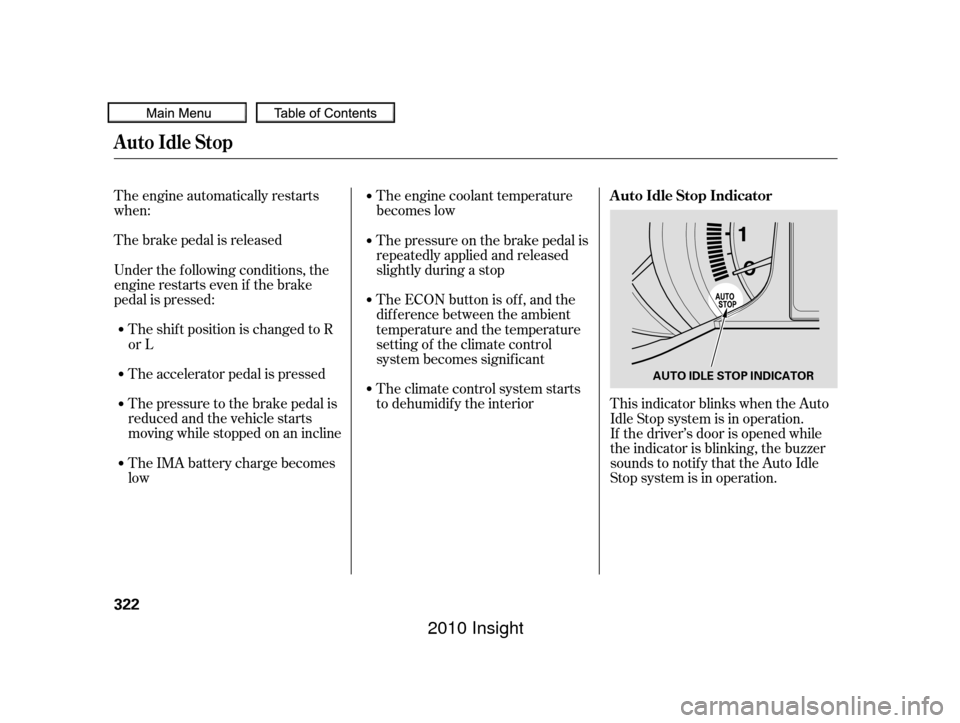
This indicator blinks when the Auto
Idle Stop system is in operation.
If the driver’s door is opened while
the indicator is blinking, the buzzer
sounds to notif y that the Auto Idle
Stop system is in operation.
Auto Idle Stop
A uto Idle Stop Indicator
322
AUTO IDLE STOP INDICATOR
�����—�
���—�����y�
�����������
�y���
�)�"���������y���������y
2010 Insight
Page 332 of 450

For example, if you check and f ill
your tires in a warm area, then drive
in extremely cold weather, the tire
pressure will be lower than
measured and could be underinf lated
and cause the low tire pressure/
TPMS indicator to come on. Or, if
youcheckandadjustyourtire
pressure in cooler conditions, and
drive into extremely hot conditions,
thetiresmaybecomeoverinflated.
However, the low tire pressure/
TPMS indicator will not come on if
thetiresareoverinflated.
Refer to page for tire inflation
guidelines.Although your tire pressure is
monitored, you must manually check
thetirepressuresmonthly.
Each tire, including the spare, should
be checked monthly when the
vehicle is cold, and set to the
recommended inf lation pressure as
specif ied on the vehicle placard and
intheowner’smanual(seepage
).
If there is a problem with the TPMS,
you will see the above message on
the multi-information display.
If you see this message, the system
is of f and is not monitoring the tire
pressures. Have the system checked
by your dealer as soon as possible.
If there is a problem with the TPMS,
this indicator begins to f lash. It stops
flashing after approximately 1
minute, then stays on. You will also
see a ‘‘CHECK TPMS SYSTEM’’
message on the multi-inf ormation
display (see TPMS System Failure). 375
376
CONT INUED
Tire Pressure Monitoring System (TPMS)
TPMS System Failure
Driving
329
�����—�
���—�����y�
�����������
�y���
�)�"���������y���������y
2010 Insight
Page 349 of 450

�Î
�Î
�Ì �Ì
�Ì
�Î
Maintenance Minder
346
:
Adjust the valves during services A, B, 1, 2, or 3 only if they are noisy.
See information on maintenance and emissions warranty on page .
Inspect idle speed every 160,000 miles (256,000 km). Independent of the maintenance messages on the multi-information
display, replace the brake fluid every 3 years.
If the message ‘‘SERVICE DUE NOW’’ does not appear more than 12 months
after the display is reset, change the engine oil every year.
NOTE: :
345
Maintenance Sub Items
Rotate tires
Replace air cleaner element If you drive in dusty conditions, replace
every 15,000 miles (24,000 km).
Replace dust and pollen filter If you drive primarily in urban areas that have high
concentrations of soot in the air from industry and
from diesel-powered vehicles, replace every 15,000
miles (24,000 km).
Inspect drive belt
Replace transmission fluid
Replace spark plugs
Inspect valve clearance
Replace engine coolant
Maintenance Main Items
Replace engine oil
Replace engine oil and oil filter
Inspect front and rear brakes
Check parking brake adjustment
Inspect these items: Tie rod ends, steering gear box, and boots
Suspension components
Driveshaft boots
Brake hoses and lines (including ABS/VSA)
All fluid levels and condition of fluids
Exhaust system
Fuel lines and connections
A
B
Symbol
Symbol
1
2
3
4
5
Maintenance Minder
�����—�
���—�����y�
����
�
������y���
�)�"���������y�������
�y
2010 Insight
