Page 72 of 342
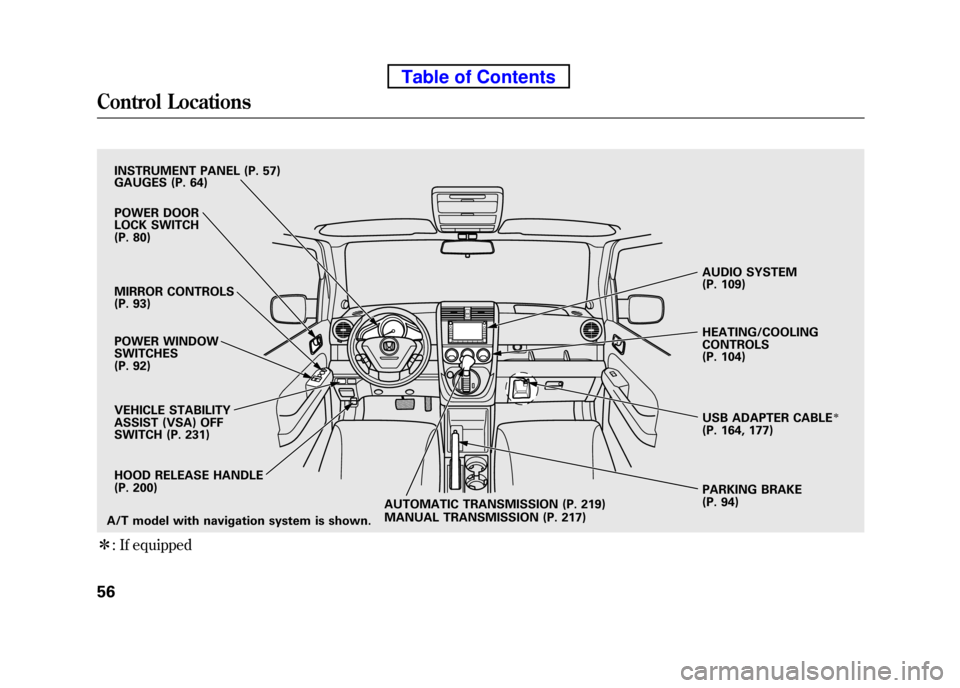
ꭧ: If equipped
VEHICLE STABILITY
ASSIST (VSA) OFF
SWITCH (P. 231)
PARKING BRAKE
(P. 94)
AUDIO SYSTEM
(P. 109)
HEATING/COOLING CONTROLS
(P. 104)
A/T model with navigation system is shown. POWER DOOR
LOCK SWITCH
(P. 80)
MIRROR CONTROLS
(P. 93)
POWER WINDOW
SWITCHES
(P. 92)
INSTRUMENT PANEL (P. 57)
HOOD RELEASE HANDLE
(P. 200)
GAUGES (P. 64)
USB ADAPTER CABLEꭧ
(P. 164, 177)
AUTOMATIC TRANSMISSION (P. 219)
MANUAL TRANSMISSION (P. 217)
Control Locations
56
Table of Contents
Page 85 of 342
ꭧ1: To use the horn, press the center pad of the steering wheel.
ꭧ 2: If equipped
ꭧ 3: Only on vehicles equipped with navigation system. Refer to the navigation system manual.
HAZARD WARNING BUTTON
(P. 73)
CRUISE CONTROL BUTTONS (P. 193)
STEERING WHEEL ADJUSTMENT (P. 74) HORN
ꭧ
1
A/T model with navigation system is shown. VSA OFF SWITCH
(P. 231)
NAVIGATION SYSTEM
VOICE CONTROLBUTTONS
ꭧ
3
REMOTE AUDIOCONTROLSꭧ2
(P. 191)
HEADLIGHTS/TURN SIGNALS
(P. 71)
WINDSHIELD WIPERS/WASHERS
(P. 70)
REAR WINDOW
DEFOGGER BUTTON
(P. 74)
MANUAL TRANSMISSION
(P. 217) AUTOMATIC TRANSMISSION
(P. 219) ACCESSORY
POWER SOCKET
(P. 100)
Controls Near the Steering Wheel
69
Instruments and Controls
Table of Contents
Page 214 of 342

Break-in Period
Help assure your vehicle's future
reliability and performance by paying
extra attention to how you drive
during the first 600 miles (1,000 km).
During this period:● Avoid full-throttle starts and rapidacceleration.
● Do not change the oil until the
scheduled maintenance time.
● Avoid hard braking for the first 200
miles (300 km).
● Do not tow a trailer.
You should also follow these
recommendations with an
overhauled or exchanged engine, or
when the brakes are replaced. Fuel Recommendation
Your vehicle is designed to operate
on unleaded gasoline with a pump
octane number of 87 or higher. Use
of a lower octane gasoline can cause
a persistent, heavy metallic rapping
noise that can lead to enginedamage.
On vehicles with manual transmission
You may hear a knocking noise from
the engine if you drive the vehicle at
low engine speed (below about 1,000
rpm) in a higher gear. To stop this,
raise the engine speed by shifting to
a lower gear.
We recommend using quality
gasoline containing detergent
additives that help prevent fuel
system and engine deposits.In addition, in order to maintain good
performance, fuel economy, and
emissions control, we strongly
recommend, in areas where it is
available, the use of gasoline that
does NOT contain manganese-based
fuel additives such as MMT.
Use of gasoline with these additives
may adversely affect performance,
and cause the malfunction indicator
lamp on your instrument panel to
come on. If this happens, contact
your authorized dealer for service.
Some gasoline today is blended with
oxygenates such as ethanol or
MTBE. Your vehicle is designed to
operate on oxygenated gasoline
containing up to 10% ethanol by
volume and up to 15% MTBE by
volume. Do not use gasoline
containing methanol.
Break-in Period, Fuel Recommendation
198
Table of Contents
Page 219 of 342

Fuel Economy Factors
The following factors can lower your
vehicle's fuel economy:● Aggressive driving (hard
acceleration and braking)
● Excessive idling, accelerating and
braking in stop-and-go traffic
● Cold engine operation (engines are
more efficient when warmed up)
● Driving with a heavy load or the air
conditioner running
● Improperly inflated tires
Improving Fuel Economy
Vehicle MaintenanceA properly maintained vehicle
maximizes fuel economy. Poor
maintenance can significantly reduce
fuel economy. Always maintain your
vehicle according to the maintenance
messages displayed on the
information display (see Owner's
Maintenance Checks on page 248).
For example: ●
Use the recommended viscosity
motor oil, displaying the API
Certification Seal (see page 251).
● Maintain proper tire inflation -
An underinflated tire increases ‘‘ rolling resistance, ’’which reduces
fuel economy.
● Avoid carrying excess weight in
your vehicle -It puts a heavier
load on the engine, increasing fuel consumption.
● Keep your vehicle clean -In
particular, a build-up of snow or
mud on your vehicle's underside
adds weight and rolling resistance.
Frequent cleaning helps your fuel economy.
Drive Efficiently● Drive moderately -Rapid
acceleration, abrupt cornering, and
hard braking increase fuelconsumption.
● Observe the speed limit -
Aerodynamic drag has a big effect
on fuel economy at speeds above
45 mph (75 km/h). Reduce your
speed and you reduce the drag.
Trailers, car top carriers, roof
racks and bike racks are also big
contributors to increased drag.
● Always drive in the highest gearpossible -If your vehicle has a
manual transmission, you can
boost your fuel economy by up
shifting as early as possible.
● Avoid excessive idling -Idling
results in 0 miles per gallon (0 kms
per liter).
CONTINUED
Fuel Economy
203
Before Driving
Table of Contents
Page 229 of 342

This section gives you tips on
starting the engine under various
conditions, and how to operate the
manual and automatic transmissions.
It also includes important information
on parking your vehicle, the braking
system, the vehicle stability assist(VSA
®) system, the tire pressure
monitoring system (TPMS), and
facts you need if you are planning to
tow a trailer or drive off-highway.
Driving Guidelines ......................
214
Preparing to Drive ......................
215
Starting the Engine .....................216
Manual Transmission .................
217
Automatic Transmission .............219
Parking .......................................
223
Braking System .......................... 224
Anti-lock Brakes (ABS) ...............225
Tire Pressure Monitoring System
(TPMS) ................................... 227
Vehicle Stability Assist (VSA
®),
aka Electronic Stability Control (ESC), System .....................230
Towing a Trailer .......................... 232
Off-Highway Driving
Guidelines ............................... 238
Driving
213
Driving
Page 232 of 342

1. Apply the parking brake.
2. In cold weather, turn off allelectrical accessories to reduce the
drain on the battery.
3.
Manual transmission:
Press the clutch pedal down all the
way. The START (III) position
does not function unless the clutch
pedal is pressed.
Automatic transmission:
Make sure the shift lever is in
Park. Press on the brake pedal. 4. Without touching the accelerator
pedal, turn the ignition key to the
START (III) position. Do not hold
the key in the START (III) position
for more than 15 seconds at a time.
If the engine does not start right
away, pause for at least 10 seconds
before trying again.
The immobilizer system protects your
vehicle from theft. If an improperly
coded key (or other device) is used, the
engine's fuel system is disabled. For
more information, see page 76.
The engine is harder to start in cold
weather. Also, the thinner air found at
altitudes above 8,000 feet (2,400
meters) adds to this problem.
Starting the Engine
216
Table of Contents
Page 233 of 342

U.S. models Only
The manual transmission is
synchronized in all forward gears for
smooth operation. It has a lockout so
you cannot shift directly from fifth to
reverse. When shifting up or down,
make sure you push the clutch pedal
down all the way, shift to the next
gear, and let the pedal up gradually.
When you are not shifting, do not
rest your foot on the clutch pedal.
This can cause the clutch to wear out faster.Come to a full stop before you shift
into reverse. You can damage the
transmission by trying to shift into
reverse with the vehicle moving.
Push down the clutch pedal, and
pause for a few seconds before
shifting into reverse, or shift into one
of the forward gears for a moment.
This stops the gears so they won't‘‘
grind. ’’
When slowing down, you can get
extra braking from the engine by
shifting to a lower gear. This extra
braking can help you maintain a safe
speed and prevent your brakes from
overheating while going down a
steep hill. Before downshifting, make
sure the engine speed will not go
into the tachometer's red zone in the
lower gear.
Rapid slowing or speeding up
can cause loss of control on
slippery surfaces. If you crash,
you can be injured.
Use extra care when driving on
slippery surfaces.
CONTINUED
Manual Transmission
217
Driving
Table of Contents
Page 234 of 342
Recommended Shift Points
Drive in the highest gear that lets the
engine run and accelerate smoothly.
This will give you good fuel economy
and effective emissions control. The
following shift points arerecommended:Shift up Normal acceleration
1st to 2nd
2nd to 3rd
3rd to 4th4th to 5th 15 mph (24 km/h)
25 mph (40 km/h)
40 mph (64 km/h)
48 mph (77 km/h) Engine Speed Limiter
If you exceed the maximum speed
for the gear you are in, the engine
speed will enter into the
tachometer's red zone. If this occurs,
you may feel the engine cut in and
out. This is caused by a limiter in the
engine's computer controls. The
engine will run normally when you
reduce the rpm below the red zone.
The engine speed limiter only works
when you upshift; engine speed is
not limited during downshifts. Before
downshifting, make sure the engine
will not go into the tachometer's redzone.
Manual Transmission
218
Table of Contents