Page 405 of 441
�´�´
Although this seems like a simple
procedure, you should take several
precautions.
Open the hood, and check the
physical condition of the battery.
In very cold weather, check the
condition of the electrolyte. If it
seems slushy or f rozen, do not try
jump starting until it thaws.
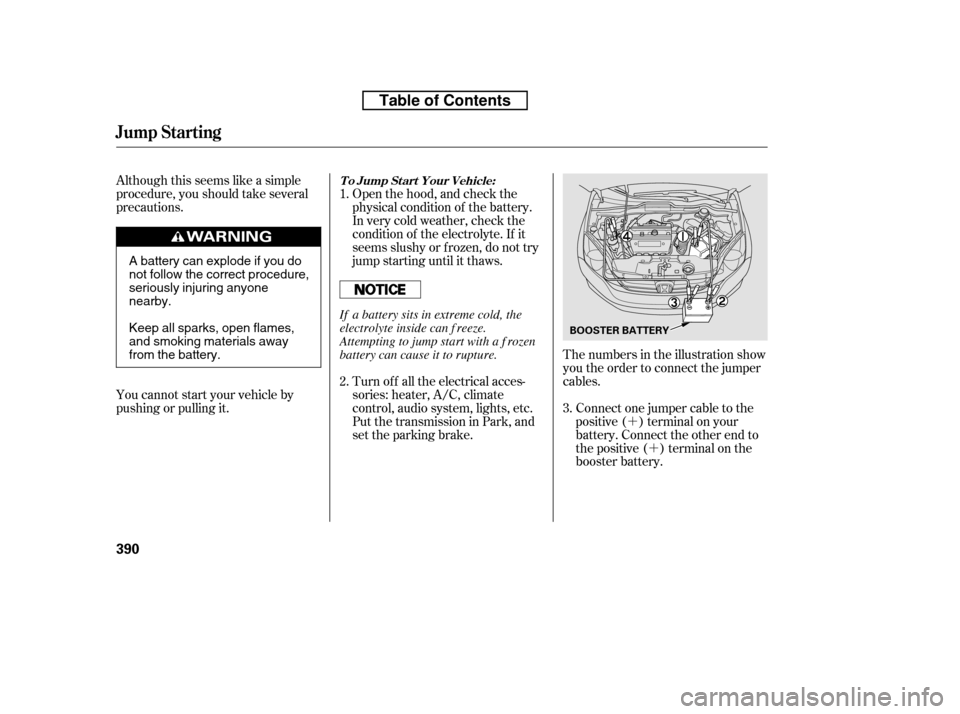
Connect one jumper cable to the
positive ( ) terminal on your
battery. Connect the other end to
the positive ( ) terminal on the
booster battery.
The numbers in the illustration show
you the order to connect the jumper
cables.
You cannot start your vehicle by
pushing or pulling it. Put the transmission in Park, and
set the parking brake.
Turn of f all the electrical acces-
sories: heater, A/C, climate
control, audio system, lights, etc.
1. 2.
3.
To Jump Start Your Vehicle:
Jump Starting
390
BOOSTER BATTERY
A battery can explode if you do
not follow the correct procedure,
seriously injuring anyonenearby.
Keep all sparks, open flames,
and smoking materials away
from the battery.If a battery sits in extreme cold, the
electrolyte inside can f reeze.
Attempting to jump start with a f rozen
battery can cause it to rupture.
Table of Contents
Page 407 of 441
If the vehicle overheats, you should
take immediate action. The only
indication may be the temperature
gauge climbing to or above the red
mark. Or you may see steam or
spray coming f rom under the hood.
The reading of the vehicle’s
temperature gauge should stay in
the midrange. If it climbs to the red
mark, you should determine the
reason (hot day, driving up a steep
hill, etc.).
If you do not see steam or spray,
leave the engine running, and
watch the temperature gauge. If
the high heat is due to overloading,
the engine should start to cool
down almost immediately. If it
does, wait until the temperature
gauge reading comes down to the
midpoint, then continue driving.
If the temperature gauge reading
stays at the red mark, turn of f the
engine.
If you see steam and/or spray
coming f rom under the hood, turn
of f the engine. Wait until you see
no more signs of steam or spray,
then open the hood.
Saf ely pull to the side of the road.
Put the transmission in Park, and
set the parking brake. Turn of f all
the accessories, and turn on the
hazard warning lights.
1. 2. 3. 4.
If theEngineOverheats
392
Steam and spray from an
overheated engine can
seriously scald you.
Do not open the hood if steam
is coming out.
Driving with the temperature gauge
reading at the red mark can cause
serious damage to the engine.
Table of Contents
Page 411 of 441

However, if the brake pedal does not
f eel normal, you should take
immediate action. A problem in one
part of the system’s dual circuit
design will still give you braking at
two wheels. You will f eel the brake
pedal go down much f arther bef ore
the vehicle begins to slow down, and
you will have to press harder on the
pedal.
If you must drive the vehicle a short
distance in this condition, drive
slowly and caref ully.
Slow down by shif ting to a lower
gear, and pull to the side of the road
when it is saf e. Because of the long
distance needed to stop, it is
hazardous to drive the vehicle. You
should have it towed and repaired as
soon as possible (see
on page ). If the ABS indicator and the VSA
system indicator come on with the
brake system indicator, have your
vehicle inspected by your dealer
immediately.
The brake system indicator normally
comes on when you turn the ignition
switch to the ON (II) position, and as
a reminder to check the parking
brake. It will stay on if you do not
f ully release the parking brake.
If the brake system indicator comes
on while driving, the brake f luid level
is probably low. Press lightly on the
brake pedal to see if it f eels normal.
If it does, check the brake f luid level
thenexttimeyoustopataservice
station (see page ).
If the f luid level is low, take your
vehicle to a dealer, and have the
brake system inspected f or leaks or
worn brake pads. 357
403Emergency
Towing
Brake System Indicator
396
Canada
U.S.
Table of Contents
Page 425 of 441

�µ�µ�µ
�µ �µ�µ�µ
�Î
�Î
Specif ications
T echnical Inf ormation
409
Air Conditioning
Seating Capacities
Fuses
Alignment
Tires
Battery
Lights
Refrigerant type
Charge quantity
Lubricant type SP-10
15.5 17.3 oz (440 490 g)HFC-134a (R-134a) 523
Total
FrontRear
Interior
Under-hood
Toe-in
Camber
Caster2°44’1°00’0°
0.08 in (2.0 mm) 0.0in(0mm)
Size
Pressure 60 psi (420 kPa , 4.2 kgf/cm
)
30 psi (210 kPa , 2.1 kgf/cm)
30 psi (210 kPa , 2.1 kgf/cm)
T155/90R17 101M
T155/90D17 101M 225/65R17 102T
Capacity 12 V
12 V
12 V
12 V36 AH/5 HR
38 AH/5 HR
45 AH/20 HR
47 AH/20 HR
Headlights
Front turn signal lights
Parking lights/side marker
lights
Rear turn signal lights
Stop/Taillights
Back-up lights
Taillight/Rear side marker
lights
High-mount brake light
License plate light
Ceiling light
Spotlights
Cargo area light
Vanity mirror Lights 60/55 W
21 W
3CP
21 W
21/5 W
21 W5W
21 W 5W8W8W8W2W See page 401 or the fuse label
attached under the steering
column.
See page 402 or the fuse box
cover.
FrontRear
FrontRear
Front
High/Low (HB2)
(Amber)
(Amber)
Front/Rear
Spare
Front Rear
Spare
:EX,EX-L
Table of Contents
Page 436 of 441
Then drive in city/suburban
traffic for at least 10 minutes.
When traf f ic conditions allow, let
the vehicle coast f or several
seconds without using the
accelerator pedal or the brake
pedal.
If the testing f acility determines the
readiness codes are still not set, see
your dealer.
Select a nearby lightly traveled
major highway where you can
maintain a speed of 50 to 60 mph
(80to97km/h)foratleast20
minutes. Drive on the highway in
D. Do not use the cruise control.
When traffic allows, drive for 90
seconds without moving the
accelerator pedal. (Vehicle speed
may vary slightly; this is okay.) If
you cannot do this f or a
continuous 90 seconds because of
traf f ic conditions, drive f or at least
30 seconds, then repeat it two
more times (for a total of 90
seconds).
Make sure the vehicle has been
parked with the engine of f f or 30
minutes.
7.
8. 9.
Emissions T est ing
420
Table of Contents