This section covers the more
common problems that motorists
experience with their vehicles. It
gives you inf ormation about how to
safely evaluate the problem and what
to do to correct it. If the problem has
stranded you on the side of the road,
you may be able to get going again.
If not, you will also f ind instructions
on getting your vehicle towed.......................Compact Spare Tire . 326
....................
Changing a Flat Tire . 327
.............
If the Engine Won’t Start . 332
................................
Jump Starting . 334
..............
If the Engine Overheats . 337
.........
Low Oil Pressure Indicator . 339
..........
Charging System Indicator . 339
.......
Malf unction Indicator Lamp . 340
...............
Brake System Indicator . 341
..............................................
Fuses . 342
..............................
Fuse Locations . 346
......................
Emergency Towing . 348
Taking Care of the Unexpected
T aking Care of t he Unexpect ed
325
CONT INUED
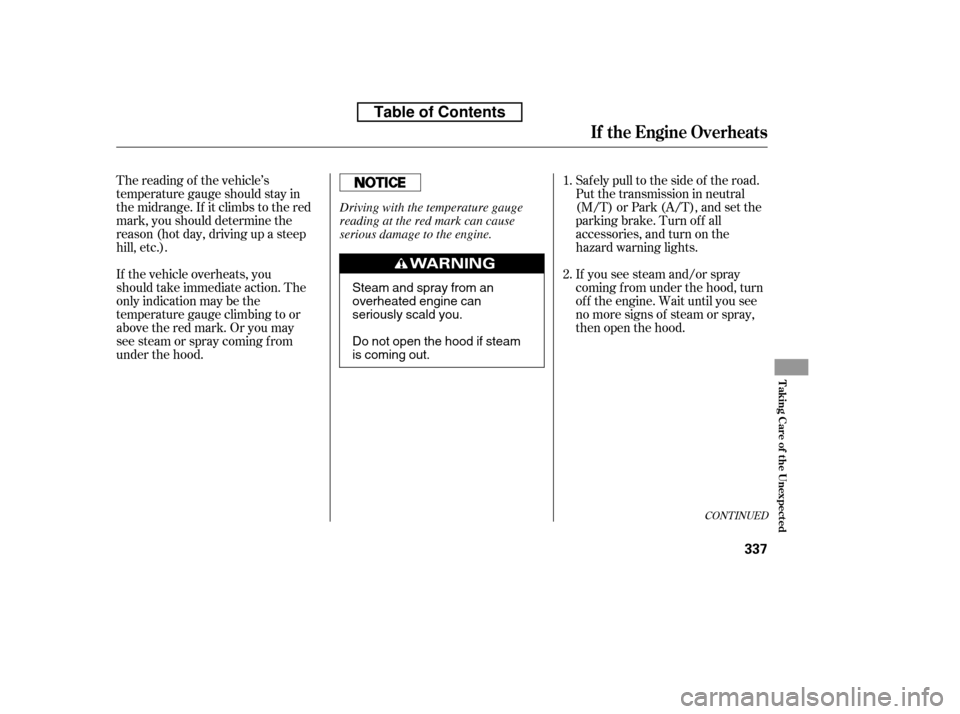
The reading of the vehicle’s
temperature gauge should stay in
the midrange. If it climbs to the red
mark, you should determine the
reason (hot day, driving up a steep
hill, etc.).
If the vehicle overheats, you
should take immediate action. The
only indication may be the
temperature gauge climbing to or
above the red mark. Or you may
see steam or spray coming f rom
under the hood.If you see steam and/or spray
coming f rom under the hood, turn
of f the engine. Wait until you see
no more signs of steam or spray,
then open the hood.
Saf ely pull to the side of the road.
Put the transmission in neutral
(M/T) or Park (A/T), and set the
parking brake. Turn of f all
accessories, and turn on the
hazard warning lights.
1. 2.
If theEngineOverheats
T aking Care of t he Unexpect ed
337
Steam and spray from an
overheated engine can
seriously scald you.
Do not open the hood if steam
is coming out.
Driving with the temperature gauge
reading at the red mark can cause
serious damage to the engine.
Table of Contents
Put the radiator cap back on
tightly. Run the engine, and check
the temperature gauge. If it goes
back to the red mark, the engine
needs repair (seeon page ).
If you do not see steam or spray,
leave the engine running and
watch the temperature gauge. If
the high heat is due to overloading,
the engine should start to cool
down almost immediately. If it
does, wait until the temperature
gauge comes down to the midpoint,
then continue driving.
If the temperature gauge stays at
the red mark, turn of f the engine.
Look f or any obvious coolant leaks,
such as a split radiator hose.
Everything is still extremely hot,
so use caution. If you f ind a leak, it
must be repaired bef ore you
continue driving (see
on page ).
If you don’t f ind an obvious leak,
check the coolant level in the
radiator reserve tank (see page ). Add coolant if the level is
below the MIN mark. Start the engine, and set the
temperature control dial to
maximum heat. Add coolant to the
radiator up to the base of the f iller
neck. If you do not have the
proper coolant mixture available,
you can add plain water.
Remember to have the cooling
system drained and ref illed with
the proper mixture as soon as you
can.
If the temperature stays normal,
check the coolant level in the
radiator reserve tank. If it has
gone down, add coolant to the
MAX mark. Put the cap back on
tightly.
Using gloves or a large heavy
cloth, turn the radiator cap
counterclockwise, without pushing
down, to the f irst stop. Af ter the
pressure releases, push down on
the cap, and turn it until it comes
off.
If there was no coolant in the
reserve tank, you may need to add
coolant to the radiator. Let the
engine cool down until the reading
reaches the middle of the
temperature gauge or lower
bef ore checking the radiator.
7. 8. 9.
3. 4. 5. 6. 10. 11.
348
243 348
Emergency
Towing
Emergency
Towing
If theEngineOverheats
338
Removing the radiator cap
while the engine is hot can
cause the coolant to spray out,
seriously scalding you.
Always let the engine and
radiator cool down before
removing the radiator cap.
Table of Contents