Page 293 of 387
This section explains why it is
important to keep your vehicle well
maintained and how to f ollow basic
maintenance saf ety precautions.
If you have the skills and tools to
perf orm more complex maintenance
tasks on your vehicle, you may want
to purchase the service manual. See
page f or inf ormation on how to
obtain a copy, or see your dealer.
This section also includes
instructions on how to read the
maintenance minder messages on
the information display, and
instructions f or simple maintenance
tasks you may want to take care of
yourself .
......................Maintenance Saf ety . 280
....................
Maintenance Minder . 281
..............................
Fluid Locations . 288
........................
Adding Engine Oil . 290
Changing the Engine Oil
....................................
and Filter . 292
..............................
Engine Coolant . 294
....................
Windshield Washers . 297
.......................
Transmission Fluid . 298
..........
Automatic Transmission . 298
..............
Manual Transmission . 299
................
Brake and Clutch Fluid . 300
....................
Power Steering Fluid . 301
.............................................
Lights . 302
................
Cleaning the Seat Belts . 309
.....................................
Floor Mats . 310
..................
Dust and Pollen Filter . 310
.................................
Wiper Blades . 311
...........................................
Wheels . 313
...............................................
Tires . 314
...................
Checking the Battery . 322
.............................
Vehicle Storage . 324
373
Maintenance
Maint enance
279
Page 302 of 387
�Î�Î
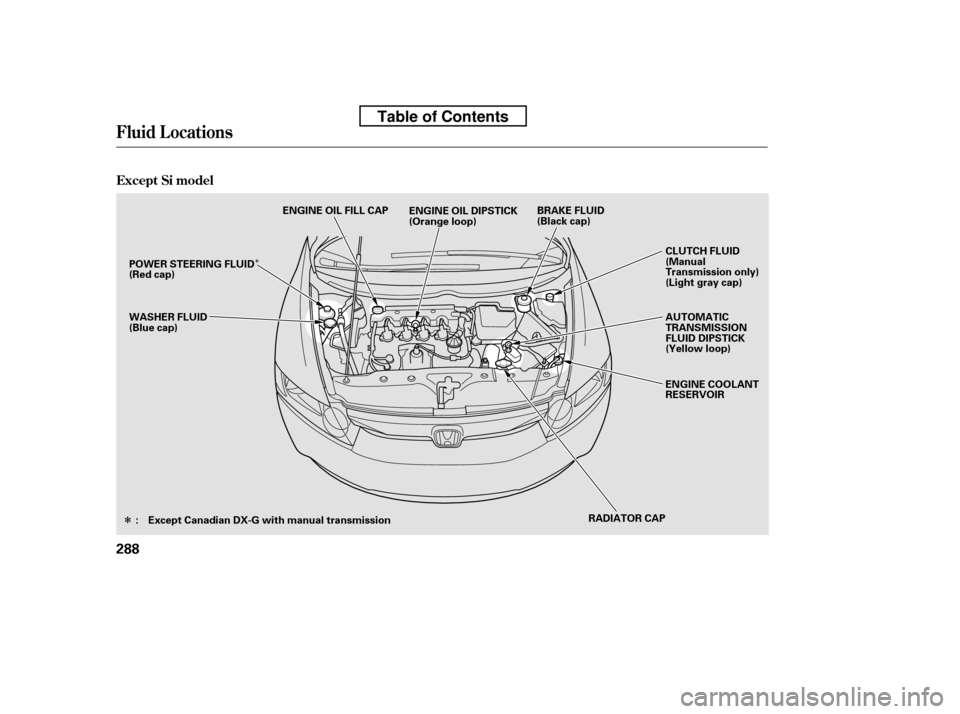
Fluid Locations
Except Si model
288
RADIATOR CAP
AUTOMATIC
TRANSMISSION
FLUID DIPSTICK
(Yellow loop)
ENGINE COOLANT
RESERVOIR
CLUTCH FLUID
(Manual
Transmission only)
(Light gray cap)
WASHER FLUID
(Blue cap) BRAKE FLUID
(Black cap)
ENGINE OIL DIPSTICK
(Orange loop)
ENGINE OIL FILL CAP
: Except Canadian DX-G with manual transmission
POWER STEERING FLUID
(Red cap)
Table of Contents
Page 303 of 387
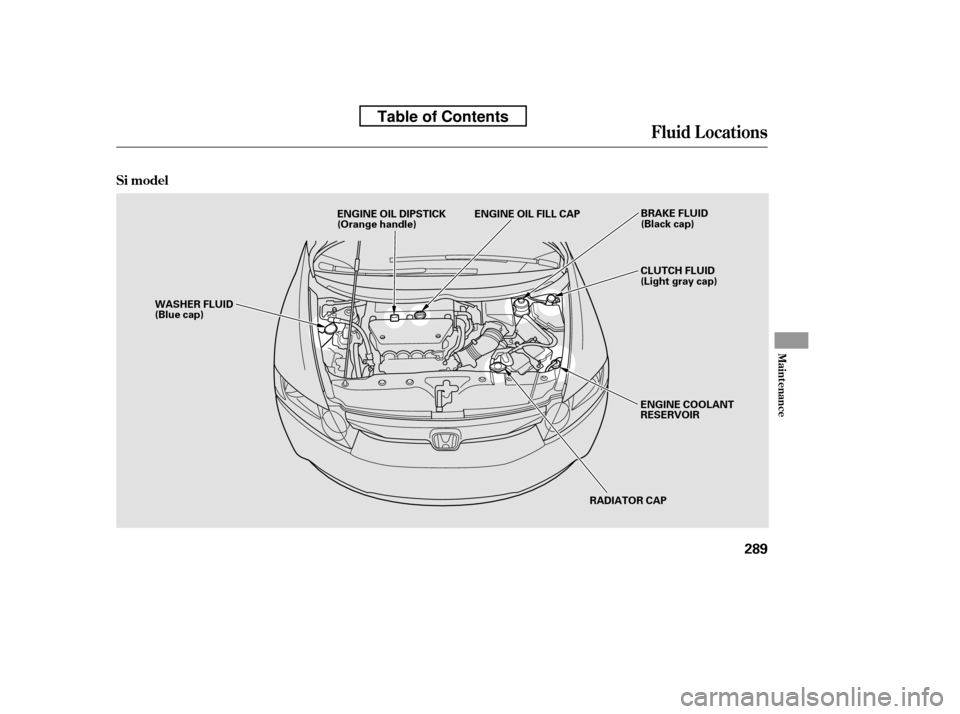
Fluid Locations
Maint enance
Si model
289
RADIATOR CAP
WASHER FLUID
(Blue cap)
ENGINE COOLANT
RESERVOIR
CLUTCH FLUID
(Light gray cap)
ENGINE OIL DIPSTICK
(Orange handle)
BRAKE FLUID
(Black cap)
ENGINE OIL FILL CAP
Table of Contents
Page 314 of 387
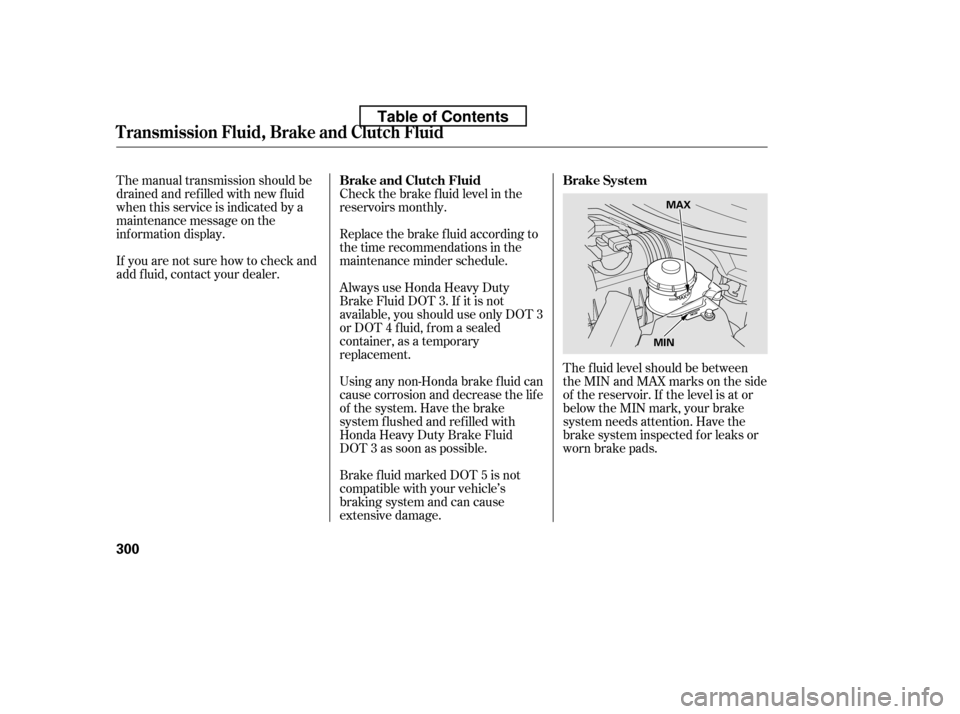
The f luid level should be between
theMINandMAXmarksontheside
of the reservoir. If the level is at or
below the MIN mark, your brake
system needs attention. Have the
brake system inspected f or leaks or
worn brake pads.
The manual transmission should be
drained and ref illed with new f luid
when this service is indicated by a
maintenance message on the
inf ormation display.
If you are not sure how to check and
add f luid, contact your dealer.
Brake f luid marked DOT 5 is not
compatible with your vehicle’s
braking system and can cause
extensive damage.
Using any non-Honda brake f luid can
cause corrosion and decrease the lif e
of the system. Have the brake
system f lushed and ref illed with
Honda Heavy Duty Brake Fluid
DOT 3 as soon as possible.
Always use Honda Heavy Duty
Brake Fluid DOT 3. If it is not
available, you should use only DOT 3
or DOT 4 f luid, f rom a sealed
container, as a temporary
replacement.
Replace the brake f luid according to
thetimerecommendationsinthe
maintenance minder schedule.
Check the brake f luid level in the
reservoirs monthly.
Brake System
Brake and Clutch Fluid
Transmission Fluid, Brake and Clutch Fluid
300
MAX
MIN
Table of Contents
Page 315 of 387
Manual Transmission only All models except Si and Canadian DX-Gwith manual transmission
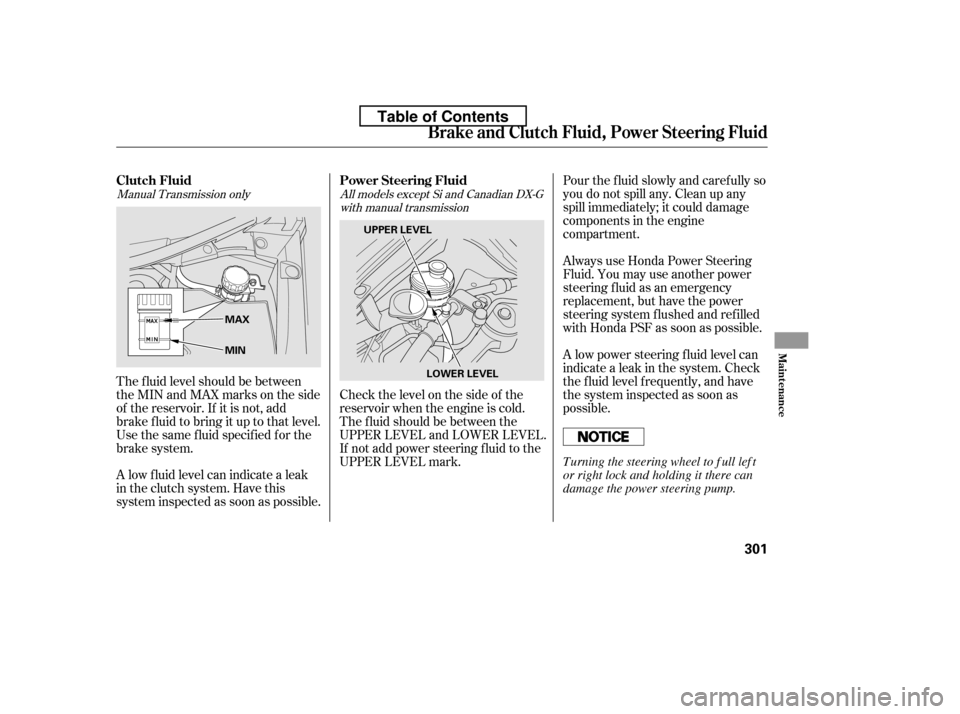
The f luid level should be between
theMINandMAXmarksontheside
of the reservoir. If it is not, add
brake f luid to bring it up to that level.
Use the same fluid specified for the
brake system.
A low f luid level can indicate a leak
in the clutch system. Have this
system inspected as soon as possible. Pour the f luid slowly and caref ully so
you do not spill any. Clean up any
spill immediately; it could damage
components in the engine
compartment.
Always use Honda Power Steering
Fluid. You may use another power
steering f luid as an emergency
replacement, but have the power
steering system f lushed and ref illed
with Honda PSF as soon as possible.
A low power steering f luid level can
indicate a leak in the system. Check
the f luid level f requently, and have
the system inspected as soon as
possible.
Check the level on the side of the
reservoir when the engine is cold.
The f luid should be between the
UPPER LEVEL and LOWER LEVEL.
If not add power steering f luid to the
UPPER LEVEL mark.
Brake and Clutch Fluid, Power Steering Fluid
Power Steering Fluid
Clutch Fluid
Maint enance
301
LOWER LEVEL
UPPER LEVEL
MAX
MIN
T urning the steering wheel to f ull lef t
or right lock and holding it there can
damage the power steering pump.
Table of Contents
Page 346 of 387
Diagnosing why the engine won’t
start f alls into two areas, depending
on what you hear when you turn the
ignition switch to the START (III)
position:You hear nothing, or almost
nothing. The engine’s starter
motor does not operate at all, or
operates very slowly.
You can hear the starter motor
operating normally, or the starter
motor sounds like it is spinning
f aster than normal, but the engine
does not start up and run. When you turn the ignition switch to
the START (III) position, you do not
hear the normal noise of the engine
trying to start. You may hear a
clicking sound, a series of clicks, or
nothing at all.
Check these things:
Check the transmission interlock.
If you have a manual transmission,
the clutch pedal must be pushed
all the way to the f loor or the
starter will not operate. With an
automatic transmission, it must be
in Park or neutral. Turn the ignition switch to the ON
(II) position. Turn on the
headlights, and check their
brightness. If the headlights are
very dim or do not come on at all,
the battery is discharged. See
on page .
Turn the ignition switch to the
START (III) position. If the
headlights do not dim, check the
condition of the f uses. If the f uses
areOK,thereisprobably
something wrong with the
electrical circuit f or the ignition
switch or starter motor. You will
need a qualif ied technician to
determine the problem. See on page .334
348
Nothing Happens or the Starter
Motor Operates Very Slowly
Jump Starting
Emergency T owing
If theEngineWon’tStart
332
Table of Contents
Page 360 of 387
�Î�Î
�Î
�µ �µ �µ �µ
�Î �Î
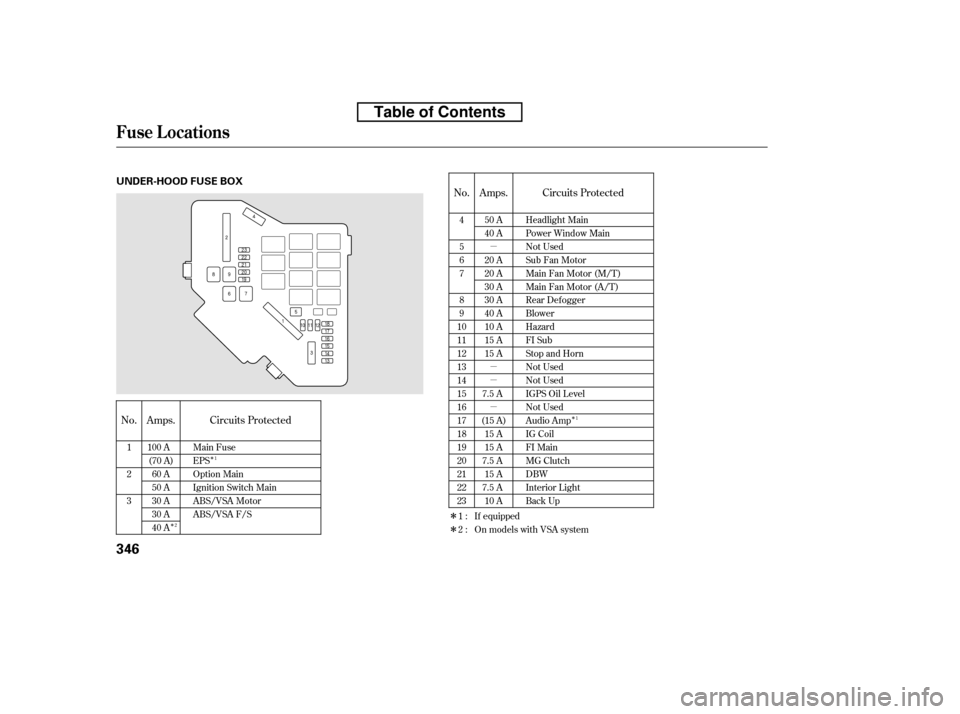
No.
No. Circuits Protected Circuits Protected
Amps. Amps.
4 5 67 8 9
1011121314151617181920212223
1 23 Main Fuse EPS
Option Main
Ignition Switch Main
ABS/VSA Motor
ABS/VSA F/S Headlight Main
Power Window Main
Not Used
Sub Fan Motor
Main Fan Motor (M/T)
Main Fan Motor (A/T)
Rear Defogger
Blower
Hazard
FI Sub
Stop and Horn
Not Used
Not Used
IGPS Oil Level
Not Used
Audio Amp
IG Coil
FI Main
MG Clutch
DBW
Interior Light
Back Up
100 A
(70 A)
60 A
50 A
30 A
30 A
40 A 50 A
40 A
20 A
20 A
30 A
30 A
40 A
10 A
15 A
15 A
7.5 A
(15 A) 15 A
15 A
7.5 A
15 A
7.5 A
10 A
1:2: If equipped
On models with VSA system
1 1
2
Fuse Locations
346
UNDER-HOOD FUSE BOX
Table of Contents