2010 FORD TAURUS change time
[x] Cancel search: change timePage 112 of 378
If your vehicle’s perimeter alarm is in the armed state, the smart unlock
feature will not allow you to lock your IA key inside the trunk. When the
alarm is armed, if the IA key is detected in the trunk, the decklid will
automatically be released when you attempt to close it, and the horn will
chirp, as a reminder that the IA key is inside. If you would like to
intentionally lock your IA key in the trunk of your vehicle, first disarm
the perimeter alarm by unlocking the vehicle, then place the IA key in
the trunk, close the trunk, and rearm your perimeter alarm system by
locking the vehicle using your keyless entry keypad or another IA key.
For more information on arming/disarming of the perimeter alarm
system, refer toPerimeter alarm systemin this chapter.
Central unlocking/Two-stage unlocking for Intelligent Access keys
(if equipped)
When unlocking the driver door with the key, turn it once toward the
rear of the vehicle to unlock that door only, if the two-stage unlocking is
enabled. Turn the key a second time to unlock all doors.
Two-stage unlocking may be disabled and re-enabled (to allow all vehicle
doors to unlock simultaneously) by simultaneously pressing
the
andcontrols on the transmitter for four seconds.
Note:The turn lamps will flash twice to confirm that a change to the
feature has occurred.
Autolock feature
The autolock feature will lock all the doors when:
•all the doors are closed,
•the ignition is in the on position,
•you shift into any gear putting the vehicle in motion, and
•the vehicle attains a speed greater than 12 mph (20 km/h).
The autolock feature repeats when:
•any door is opened then closed while the ignition is in the on position
and the vehicle speed is 9 mph (15 km/h) or lower, and
•the vehicle then attains a speed greater than 12 mph (20 km/h).
Locks and Security
112
2010 Taurus(500)
Owners Guide(own2002), 1st Printing
USA(fus)
Page 214 of 378
3.65:Indicates the aspect ratio which gives the tire’s ratio of height to
width.
4.R:Indicates a “radial” type tire.
5.15:Indicates the wheel or rim diameter in inches. If you change your
wheel size, you will have to purchase new tires to match the new wheel
diameter.
6.95:Indicates the tire’s load index. It is an index that relates to how
much weight a tire can carry. You may find this information in your
Owner’s Guide. If not, contact a local tire dealer.
Note:You may not find this information on all tires because it is not
required by federal law.
7.H:Indicates the tire’s speed rating. The speed rating denotes the
speed at which a tire is designed to be driven for extended periods of
time under a standard condition of load and inflation pressure. The tires
on your vehicle may operate at different conditions for load and inflation
pressure. These speed ratings may need to be adjusted for the difference
in conditions. The ratings range from 81 mph (130 km/h) to 186 mph
(299 km/h). These ratings are listed in the following chart.
Note:You may not find this information on all tires because it is not
required by federal law.
Letter rating Speed rating - mph (km/h)
M 81 mph (130 km/h)
N 87 mph (140 km/h)
Q 99 mph (159 km/h)
R 106 mph (171 km/h)
S 112 mph (180 km/h)
T 118 mph (190 km/h)
U 124 mph (200 km/h)
H 130 mph (210 km/h)
V 149 mph (240 km/h)
W 168 mph (270 km/h)
Y 186 mph (299 km/h)
Note:For tires with a maximum speed capability over 149 mph
(240 km/h), tire manufacturers sometimes use the letters ZR. For
those with a maximum speed capability over 186 mph (299 km/h), tire
manufacturers always use the letters ZR.
Tires, Wheels and Loading
214
2010 Taurus(500)
Owners Guide(own2002), 1st Printing
USA(fus)
Page 314 of 378
THE BETTER BUSINESS BUREAU (BBB) AUTO LINE PROGRAM
(U.S. ONLY)
Your satisfaction is important to Ford Motor Company and to your dealer.
If a warranty concern has not been resolved using the three-step
procedure outlined on the first page of theCustomer Assistancesection,
you may be eligible to participate in the BBB AUTO LINE program.
The BBB AUTO LINE program consists of two parts – mediation and
arbitration. During mediation, a representative of the BBB will contact
both you and Ford Motor Company to explore options for settlement of
the claim. If an agreement is not reached during mediation and your
claim is eligible, you may participate in the arbitration process. An
arbitration hearing will be scheduled so that you can present your case
in an informal setting before an impartial person. The arbitrator will
consider the testimony provided and make a decision after the hearing.
You are not bound by the decision, but should you choose to accept the
BBB AUTO LINE decision, Ford must abide by the accepted decision as
well. Disputes submitted to the BBB AUTO LINE program are usually
decided within forty days after you file your claim with the BBB.
BBB AUTO LINE Application: Using the information provided below,
please call or write to request a program application. You will be asked
for your name and address, general information about your new vehicle,
information about your warranty concerns, and any steps you have
already taken to try to resolve them. A Customer Claim Form will be
mailed that will need to be completed, signed and returned to the BBB
along with proof of ownership. Upon receipt, the BBB will review the
claim for eligibility under the Program Summary Guidelines.
You can get more information by calling BBB AUTO LINE at
1-800-955-5100, or writing to:
BBB AUTO LINE
4200 Wilson Boulevard, Suite 800
Arlington, Virginia 22203–1833
BBB AUTO LINE applications can also be requested by calling the Ford
Motor Company Customer Relationship Center at 1-800-392-3673.
Note:Ford Motor Company reserves the right to change eligibility
limitations, modify procedures, or to discontinue this process at any time
without notice and without obligation.
Customer Assistance
314
2010 Taurus(500)
Owners Guide(own2002), 1st Printing
USA(fus)
Page 350 of 378
Keep a record for at least one month and record the type of driving (city
or highway). This will provide an accurate estimate of the vehicle’s fuel
economy under current driving conditions. Additionally, keeping records
during summer and winter will show how temperature impacts fuel
economy. In general, lower temperatures give lower fuel economy.
Driving style — good driving and fuel economy habits
Give consideration to the lists that follow and you may be able to change
a number of variables and improve your fuel economy.
Habits
•Smooth, moderate operation can yield up to 10% savings in fuel.
•Steady speeds without stopping will usually give the best fuel
economy.
•Idling for long periods of time (greater than one minute) may waste
fuel.
•Anticipate stopping; slowing down may eliminate the need to stop.
•Sudden or hard accelerations may reduce fuel economy.
•Slow down gradually.
•Driving at reasonable speeds (traveling at 55 mph [88 km/h] uses 15%
less fuel than traveling at 65 mph [105 km/h]).
•Revving the engine before turning it off may reduce fuel economy.
•Using the air conditioner or defroster may reduce fuel economy.
•You may want to turn off the speed control in hilly terrain if
unnecessary shifting between the top gears occurs. Unnecessary
shifting of this type could result in reduced fuel economy.
•Warming up a vehicle on cold mornings is not required and may
reduce fuel economy.
•Resting your foot on the brake pedal while driving may reduce fuel
economy.
•Combine errands and minimize stop-and-go driving.
Maintenance
•Keep tires properly inflated and use only recommended size.
•Operating a vehicle with the wheels out of alignment will reduce fuel
economy.
•Use recommended engine oil. Refer toMaintenance product
specifications and capacitiesin this chapter.
Maintenance and Specifications
350
2010 Taurus(500)
Owners Guide(own2002), 1st Printing
USA(fus)
Page 355 of 378
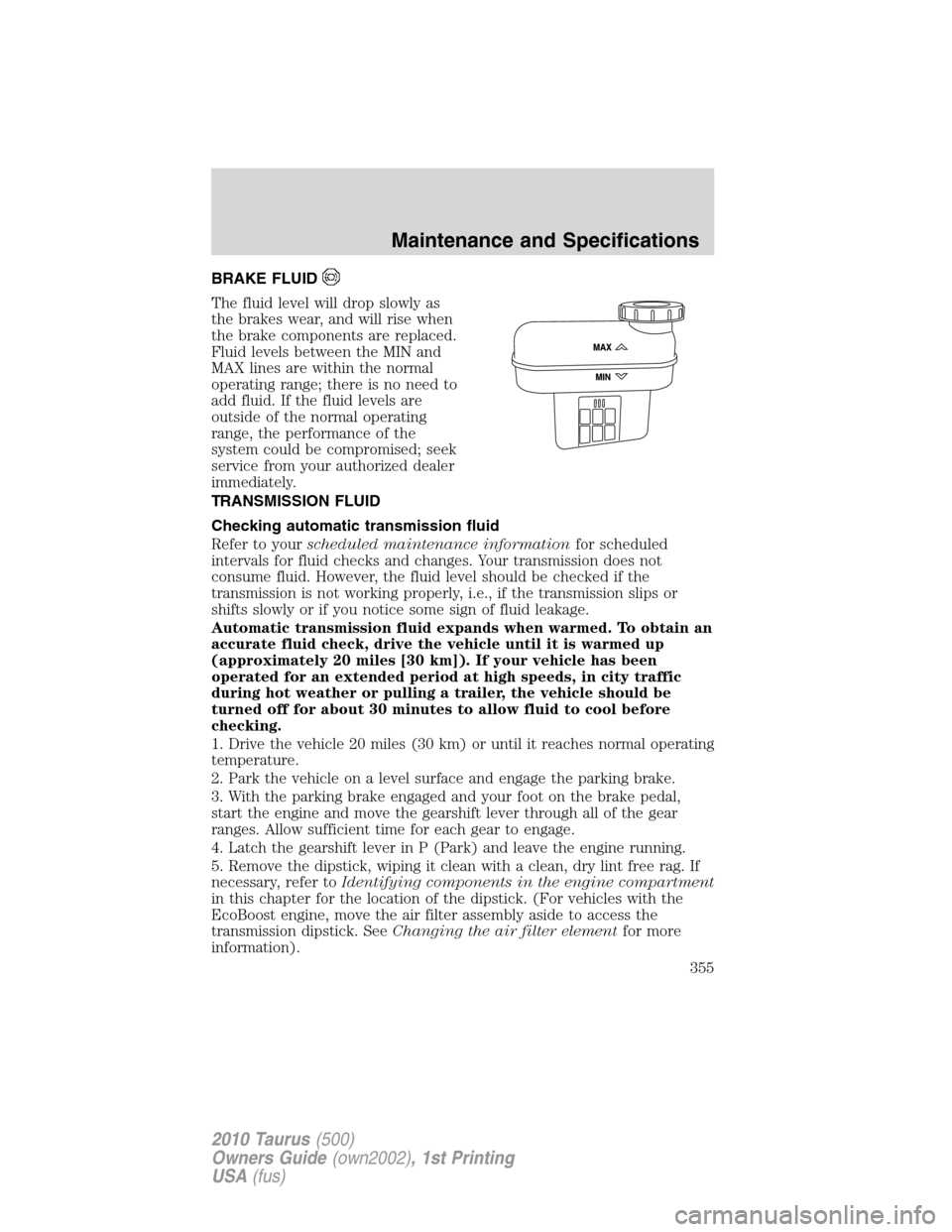
BRAKE FLUID
The fluid level will drop slowly as
the brakes wear, and will rise when
the brake components are replaced.
Fluid levels between the MIN and
MAX lines are within the normal
operating range; there is no need to
add fluid. If the fluid levels are
outside of the normal operating
range, the performance of the
system could be compromised; seek
service from your authorized dealer
immediately.
TRANSMISSION FLUID
Checking automatic transmission fluid
Refer to yourscheduled maintenance informationfor scheduled
intervals for fluid checks and changes. Your transmission does not
consume fluid. However, the fluid level should be checked if the
transmission is not working properly, i.e., if the transmission slips or
shifts slowly or if you notice some sign of fluid leakage.
Automatic transmission fluid expands when warmed. To obtain an
accurate fluid check, drive the vehicle until it is warmed up
(approximately 20 miles [30 km]). If your vehicle has been
operated for an extended period at high speeds, in city traffic
during hot weather or pulling a trailer, the vehicle should be
turned off for about 30 minutes to allow fluid to cool before
checking.
1. Drive the vehicle 20 miles (30 km) or until it reaches normal operating
temperature.
2. Park the vehicle on a level surface and engage the parking brake.
3. With the parking brake engaged and your foot on the brake pedal,
start the engine and move the gearshift lever through all of the gear
ranges. Allow sufficient time for each gear to engage.
4. Latch the gearshift lever in P (Park) and leave the engine running.
5. Remove the dipstick, wiping it clean with a clean, dry lint free rag. If
necessary, refer toIdentifying components in the engine compartment
in this chapter for the location of the dipstick. (For vehicles with the
EcoBoost engine, move the air filter assembly aside to access the
transmission dipstick. SeeChanging the air filter elementfor more
information).
Maintenance and Specifications
355
2010 Taurus(500)
Owners Guide(own2002), 1st Printing
USA(fus)
Page 374 of 378

Emergencies, roadside
jump-starting ..........................304
running out of fuel .........303, 347
Emission control system ..........351
Engine ........................................363
cleaning ...................................320
coolant .....................................336
fail-safe cooling .......................341
idle speed control ...................334
lubrication specifications .......360
refill capacities ........................360
service points ..................328–329
Engine block heater .................240
Engine oil ..................................331
change oil soon warning,
message center .......................331
checking and adding ..............331
dipstick ....................................331
filter, specifications ........333, 359
recommendations ...................333
refill capacities ........................360
specifications ..........................360
Event data recording ....................7
Exhaust fumes ..........................239
F
Fail safe cooling ........................341
Fleet MyKey programming ......134
Fluid capacities .........................360
Four-Wheel Drive vehicles
driving off road .......................270
Fuel ............................................342
calculating fuel
economy ............................21, 348
cap ...........................................344
capacity ...................................360
choosing the right fuel ...........345comparisons with EPA fuel
economy estimates .................351
detergent in fuel .....................346
filler funnel .............................347
filling your vehicle with
fuel ...........................342, 344, 348
filter, specifications ........342, 359
improving fuel economy ........348
octane rating ...................346, 363
quality ......................................346
running out of fuel .........303, 347
safety information relating to
automotive fuels .....................342
Fuses ..........................................279
G
Garage door opener ....................97
Gas cap (see Fuel cap) ............344
Gas mileage
(see Fuel economy) .................348
Gauges .........................................17
H
Hazard flashers .........................278
Headlamps ...................................59
aiming ........................................64
autolamp system .......................59
bulb specifications ....................67
daytime running lights .............63
flash to pass ..............................63
high beam .................................60
replacing bulbs .........................68
turning on and off ....................59
Heating
heating and air conditioning
system ...........................48, 51, 53
Homelink wireless control
system ..........................................98
Index
374
2010 Taurus(500)
Owners Guide(own2002), 1st Printing
USA(fus)